旦
| ||||||||
Translingual
| Stroke order | |||
|---|---|---|---|
 | |||
Han character
旦 (Kangxi radical 72, 日+1, 5 strokes, cangjie input 日一 (AM), four-corner 60100, composition ⿱日一)
Derived characters
References
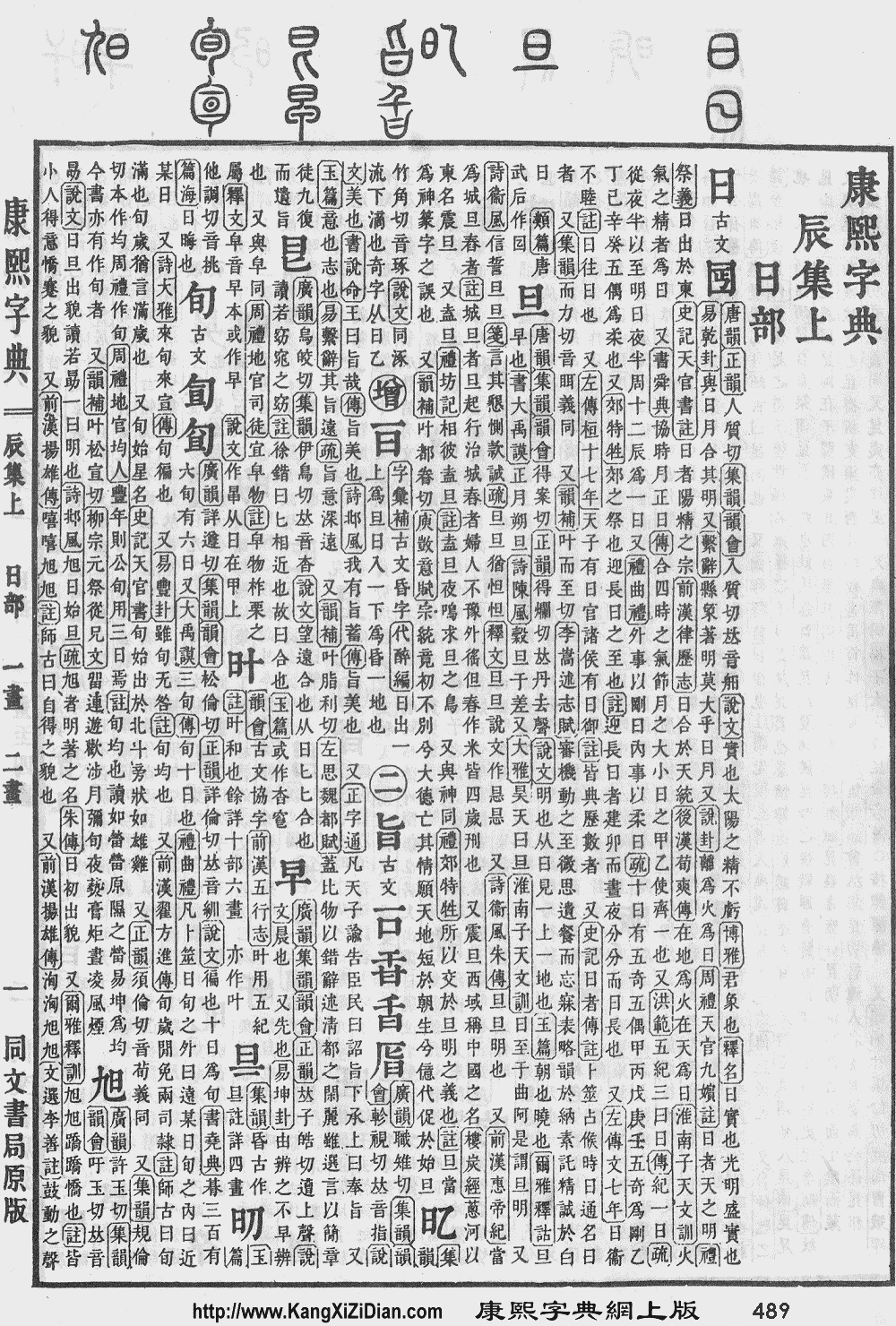
- Kangxi Dictionary: page 489, character 3
- Dai Kanwa Jiten: character 13734
- Dae Jaweon: page 850, character 1
- Hanyu Da Zidian (first edition): volume 2, page 1483, character 1
- Unihan data for U+65E6
Chinese
| simp. and trad. |
旦 | |
|---|---|---|
Glyph origin
| Historical forms of the character 旦 | |||
|---|---|---|---|
| Shang | Western Zhou | Shuowen Jiezi (compiled in Han) | Liushutong (compiled in Ming) |
| Oracle bone script | Bronze inscriptions | Small seal script | Transcribed ancient scripts |
 |
 |
 |
 |
Characters in the same phonetic series (旦) (Zhengzhang, 2003)
| Old Chinese | |
|---|---|
| 皽 | *tjaʀ, *tanʔ, *tjanʔ |
| 担 | *taːnʔ |
| 胆 | *daːn, *daːn |
| 疸 | *taːnʔ, *taːns |
| 觛 | *taːnʔ, *taːns, *daːnʔ |
| 亶 | *taːnʔ |
| 嬗 | *taːnʔ, *tʰaːn, *djans |
| 笪 | *taːnʔ, *taːns, *taːd |
| 狚 | *taːnʔ, *taːns, *taːd |
| 旦 | *taːns |
| 鴠 | *taːns |
| 譠 | *tʰaːn, *rteːn |
| 坦 | *tʰaːnʔ |
| 但 | *daːn, *daːnʔ, *daːns |
| 檀 | *daːn |
| 壇 | *daːn |
| 儃 | *daːn, *djan |
| 驙 | *daːn, *tan |
| 袒 | *daːnʔ, *rdeːns |
| 襢 | *daːnʔ, *tanʔ, *tans |
| 繵 | *daːnʔ |
| 膻 | *daːnʔ |
| 澶 | *daːns, *djan |
| 邅 | *tan, *danʔ, *dans |
| 鱣 | *tan |
| 饘 | *tjan, *tjanʔ |
| 旜 | *tjan |
| 氈 | *tjan |
| 鸇 | *tjan |
| 顫 | *tjans |
| 蟺 | *djanʔ |
| 擅 | *djans |
| 羶 | *hljan |
| 呾 | *taːd, *ʔraːd |
| 怛 | *taːd |
| 妲 | *taːd |
| 靼 | *taːd, *tjad |
| 炟 | *taːd |
Ideogrammic compound (會意/会意) : 日 + 一 – the sun (日) appearing over the horizon (一).
Etymology 1
Cognate with Chepang दारःदो (darʔ.do, “place of sunrise; in east”) (Schuessler, 2007). Unrelated to 丹 (OC *taːn, “cinnabar; red”).
Pronunciation
Definitions
旦
Compounds
- 一旦 (yīdàn)
- 五旦七調/五旦七调
- 信誓旦旦 (xìnshìdàndàn)
- 元旦 (yuándàn)
- 危在旦夕 (wēizàidànxī)
- 只爭旦夕/只争旦夕
- 吉旦 (jídàn)
- 命在旦夕
- 坐以待旦
- 坐而待旦
- 城旦
- 巴旦杏 (bādànxìng)
- 平旦
- 待旦
- 復旦/复旦
- 戒旦
- 撒旦 (Sādàn)
- 文旦 (wéndàn)
- 旦夕 (dànxī)
- 旦夕之危
- 旦夕之費/旦夕之费
- 旦夕禍福/旦夕祸福
- 旦日 (dànrì)
- 旦旦 (dàndàn)
- 旦旦信誓 (dàndànxìnshì)
- 旦旦而伐
- 旦明 (dànmíng)
- 旦晚
- 旦晝/旦昼
- 旦暮
- 旦暮朝夕
- 旦會/旦会
- 旦望
- 旭旦
- 明旦 (míngdàn)
- 昧旦 (mèidàn)
- 昧旦晨興/昧旦晨兴
- 月旦 (yuèdàn)
- 月旦評/月旦评 (yuèdànpíng)
- 枕戈待旦
- 毀於一旦/毁于一旦 (huǐyúyīdàn)
- 汝南月旦
- 申旦
- 申旦達夕/申旦达夕
- 禍在旦夕/祸在旦夕
- 秉燭達旦/秉烛达旦
- 穀旦/谷旦 (gǔdàn)
- 約旦/约旦 (Yuēdàn)
- 約旦河/约旦河 (Yuēdànhé)
- 考旦
- 詰旦/诘旦
- 通宵達旦/通宵达旦 (tōngxiāodádàn)
- 達旦/达旦 (dádàn)
- 震旦 (Zhèndàn)
- 震旦方向
- 鶡旦/鹖旦 (hédàn)
Etymology 2
A post-classical word. (This etymology is missing or incomplete. Please add to it, or discuss it at the Etymology scriptorium.)
Pronunciation
Definitions
旦
- (Chinese opera) female character, particularly a lead role, in a traditional Chinese opera
- (Chinese opera) actor or actress known for playing such characters
Compounds
Etymology 3

| For pronunciation and definitions of 旦 – see 蛋 (“egg; egg-shaped object; etc.”). (This character is the second-round simplified form of 蛋). |
Notes:
|
Usage notes
May still be used as a shorthand.
Japanese
Readings
Korean
Etymology
From Middle Chinese 旦 (MC tanH). Recorded as Middle Korean 단〯 (tǎn) (Yale: tan) in Hunmong Jahoe (訓蒙字會 / 훈몽자회), 1527.
Vietnamese
This article is issued from Wiktionary. The text is licensed under Creative Commons - Attribution - Sharealike. Additional terms may apply for the media files.