柿
| ||||||||
Translingual
Han character
柿 (Kangxi radical 75, 木+5, 9 strokes, cangjie input 木卜中月 (DYLB), four-corner 45927, composition ⿰木市)
References
- Kangxi Dictionary: not present, would follow page 521, character 12
- Dai Kanwa Jiten: character 14681
- Hanyu Da Zidian (first edition): volume 2, page 1188, character 2
- Unihan data for U+67FF
Chinese
| simp. and trad. |
柿 | |
|---|---|---|
| alternative forms | 柹 枾 𣐈 | |

Glyph origin
Originally written as 柹: Phono-semantic compound (形聲/形声, OC *zrɯʔ) : semantic 木 + phonetic 𠂔 ().
The current form is phono-semantic compound (形聲/形声, OC *zrɯʔ) : semantic 木 + phonetic 市 (OC *djɯʔ).
Etymology
(This etymology is missing or incomplete. Please add to it, or discuss it at the Etymology scriptorium.)
Pronunciation
Synonyms
Compounds
- 丁香柿
- 山紅柿/山红柿
- 新紅柿子/新红柿子
- 朱柿
- 松柿
- 柿仔
- 柿仔花
- 柿子 (shìzi)
- 柿子椒 (shìzijiāo)
- 柿子金
- 柿子餅/柿子饼 (shìzibǐng)
- 柿漆
- 柿盤/柿盘
- 柿粿
- 柿糕
- 柿膏兒/柿膏儿
- 柿花
- 柿蒂 (shìdì)
- 柿葉/柿叶
- 柿蔕/柿蒂
- 柿鋪/柿铺 (Shìpù)
- 柿霜
- 柿餅/柿饼 (shìbǐng)
- 椑柿 (bēishì)
- 油柿
- 洋柿
- 流柿
- 洋柿子 (yángshìzi)
- 洋紅柿/洋红柿
- 浸柿
- 火柿子 (huǒshìzi)
- 火盆柿
- 烘柿
- 烏柿/乌柿
- 燈柿/灯柿
- 牛奶柿
- 番仔柿
- 番柿
- 番柿仔
- 紅柿/红柿
- 紅柿仔/红柿仔
- 紅柿囝/红柿囝
- 脆柿
- 腍柿
- 臭柿仔
- 蓋柿/盖柿
- 西番柿 (xīfānshì)
- 西番柿子
- 西紅柿/西红柿 (xīhóngshì)
- 西紅柿子/西红柿子
- 醂柿
- 霜柿
Descendants
- → Proto-Mien: *djəiᴮ
Japanese
Usage notes
- Not to be confused with 杮 (kokera, “wood chips”). Note that this kanji 柿 (kaki) uses the character 市 (shì) as the right-hand portion, which consists of five strokes with two separate strokes for the central vertical. Meanwhile, 杮 (kokera) uses the character 巿 (fú) as the right-hand portion, which consists of four strokes with a single stroke for the central vertical.
Etymology

| Kanji in this term |
|---|
| 柿 |
| かき Grade: S |
| kun’yomi |
From Old Japanese. First cited to a text from 770 CE.[1]
Further derivation uncertain. Possibilities include:
- /kakayaki/ → */kakyaki/ → */kakaki/ → */kakki/ → /kaki/
- /kataki/ → /kaki/
- /akaki/ → /kaki/
While at least one reference considers the akaki derivation more likely,[2] this kind of phonological shift, wherein the first vowel disappears, is not a common pattern in attested Japanese. That said, the kakayaki and kataki derivations are also problematic, considering the lack of any evidence for intermediary forms.
Noun
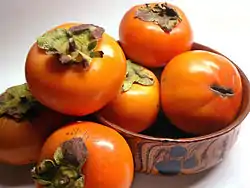
柿 or 柿 • (kaki)
Usage notes
- As with many terms that name organisms, this term is often spelled in katakana, especially in biological contexts (where katakana is customary), as カキ.
Derived terms
- 柿色 (kakīro)
- 柿団扇 (kaki uchiwa)
- 柿衣 (kakigoromo)
- 柿衣, 柿麻 (kakiso)
- 柿染, 柿染め (kakizome)
- 柿糕, 柿餻 (kakizuki)
- 柿膾 (kaki-namasu)
- 柿羊羹 (kaki yōkan)
- 甘柿 (amagaki)
- 淡し柿, 醂し柿 (awashigaki), 淡せ柿, 醂せ柿, 合せ柿, 合わせ柿 (awasegaki)
- 合柿 (Awasegaki), 柿売 (Kakiuri)
- 枝柿 (edagaki)
- 御所柿, 五所柿 (gosho-gaki), 大和柿 (Yamato-gaki)
- 信濃柿 (Shina-no-gaki), 猿柿 (sarugaki), 葡萄柿 (budō-gaki)
- 白柿 (shirogaki)
- 吊るし柿 (tsurushigaki), 釣柿, 釣り柿 (tsurigaki)
- 似柿 (nitarigaki)
- 燻柿, 燻べ柿 (fusubegaki)
- 筆柿 (fudekaki)
- 干し柿, 干柿, 乾し柿 (hoshigaki)
Descendants
See also
- 柿の木 (kaki no ki, “Japanese persimmon tree”)
References
- “柿”, in 日本国語大辞典 (Nihon Kokugo Daijiten, “Nihon Kokugo Daijiten”) (in Japanese), concise edition, Tōkyō: Shogakukan, 2000
- “カキ/柿/かき”, in 語源由来辞典 (Gogen Yurai Jiten, “Etymology Derivation Dictionary”) (in Japanese), 2003–2024.
- “カキ・柿”, in 日本辞典 (Nihon Jiten, “Japan Dictionary”) (in Japanese), 2007–2017.
- Matsumura, Akira, editor (2006), 大辞林 [Daijirin] (in Japanese), Third edition, Tōkyō: Sanseidō, →ISBN
- Kindaichi, Kyōsuke et al., editors (1997), 新明解国語辞典 [Shin Meikai Kokugo Jiten] (in Japanese), Fifth edition, Tōkyō: Sanseidō, →ISBN
- NHK Broadcasting Culture Research Institute, editor (1998), NHK日本語発音アクセント辞典 [NHK Japanese Pronunciation Accent Dictionary] (in Japanese), Tōkyō: NHK Publishing, →ISBN