賒
| ||||||||
Translingual
Han character
賒 (Kangxi radical 154, 貝+7, 14 strokes, cangjie input 月金人一火 (BCOMF), four-corner 68891, composition ⿰貝佘)
References
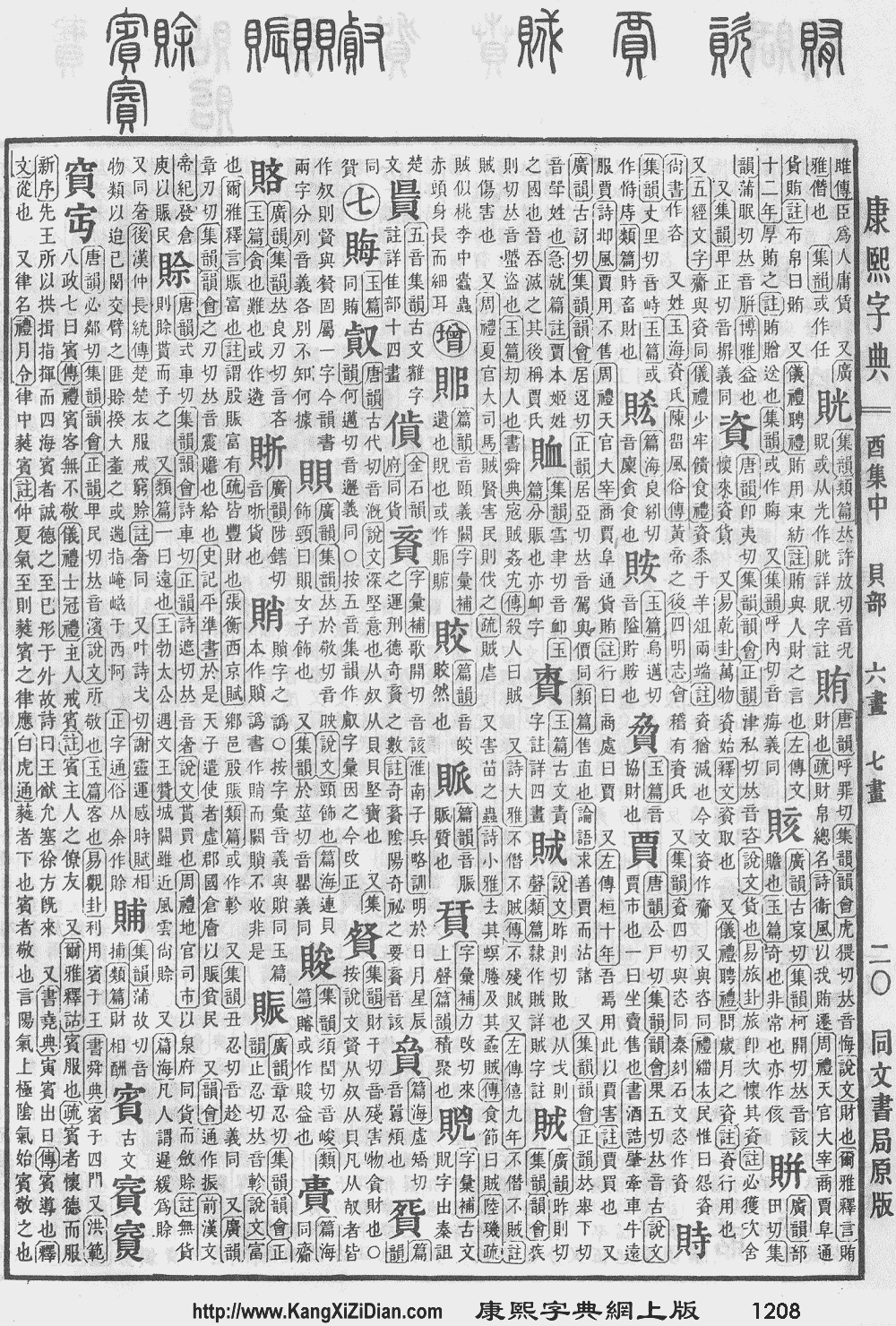
- Kangxi Dictionary: page 1208, character 35
- Dai Kanwa Jiten: character 49736
- Hanyu Da Zidian (first edition): volume 6, page 3642, character 17
- Unihan data for U+8CD2
Chinese
| trad. | 賒 | |
|---|---|---|
| simp. | 赊 | |
| alternative forms | 𧴳 賖 𧶟 | |
Glyph origin
| Old Chinese | |
|---|---|
| 斜 | *lja, *laː |
| 茶 | *rlaː |
| 荼 | *rlaː, *ɦlja, *l'aː |
| 梌 | *rlaː, *l̥ʰaː, *l'aː |
| 搽 | *rlaː |
| 塗 | *rlaː, *l'aː |
| 佘 | *ɦlja |
| 賒 | *hljaː |
| 畬 | *hljaː, *la |
| 舍 | *hljaːʔ, *hljaːs |
| 捨 | *hljaːʔ |
| 騇 | *hljaːʔ, *hljaːs |
| 涻 | *hljaːs |
| 稌 | *l̥ʰaː, *l̥ʰaːʔ |
| 悇 | *l̥ʰaː, *l̥ʰas, *las |
| 庩 | *l̥ʰaː |
| 捈 | *l̥ʰaː, *l'aː |
| 途 | *l'aː |
| 酴 | *l'aː |
| 駼 | *l'aː |
| 鵌 | *l'aː, *la |
| 涂 | *l'aː, *l'a |
| 嵞 | *l'aː |
| 峹 | *l'aː |
| 筡 | *l'aː, *l̥ʰa |
| 蒤 | *l'aː |
| 徐 | *lja |
| 俆 | *lja |
| 敘 | *ljaʔ |
| 漵 | *ljaʔ |
| 除 | *l'a, *l'as |
| 篨 | *rla |
| 滁 | *rla |
| 蒢 | *rla |
| 蜍 | *ɦlja, *la |
| 鵨 | *hljaː |
| 瑹 | *hlja |
| 余 | *la |
| 餘 | *la |
| 艅 | *la |
| 狳 | *la |
| 雓 | *la |
| 悆 | *las |
Originally written as 賖, which is a phono-semantic compound (形聲/形声, OC *hljaː) : semantic 貝 (“shell”) + phonetic 余 (OC *la) – to buy or sell on credit.
In the era of Middle Chinese, a vulgar form 𧶟, also a phono-semantic compound (形聲/形声) with phonetic component 舍 (MC syaeX|syaeH) that was more similar-sounding to the character, once appeared but never became popularized.
The current form 賒 appeared as a vulgar form at the Ming-Qing transition and is a phono-semantic compound (形聲/形声) with phonetic component 佘 that is similar-sounding to the character.
Etymology
According to STEDT, from Proto-Sino-Tibetan *g/m/s-laj ~ r/s-lej ~ b-rej (“to change, exchange, buy”) (whence also 移 (OC *lal, “change, alter”) & 易 (OC *leɡ, “change, exchange”)); if so, Chinese vocalism might have been influenced by superficially similar words like 舍 (OC *hljaːʔ, “to bestow, to give”) (Schuessler, 2007).
商 (OC *hljaŋ) is its derivative with terminative suffix *-ŋ; 貰 (OC), minimally reconstructed as *lhas ~ *m-las, is another with *-s > *-h extrovert suffix (ibid.).
Thai แลก (lɛ̂ɛk)'s possible relation to 賒 (OC *hljaː) (ibid.) is through its cognate 易 (OC *leːɡs, *leɡ), wherefrom arose Thai แลก (lɛ̂ɛk), Lao ແລກ (lǣk), Shan လႅၵ်ႈ (lēk), Tai Nüa ᥘᥦᥐ (laek), & Ahom 𑜎𑜢𑜀𑜫 (lik) (Pittayaporn, 2014)
Lastly, Bodman (1980)) proposes cognacy to Tibetan གྱར་བ (gyar ba, “to borrow, to lend, to hire”).
Pronunciation
Definitions
賒
Descendants
References
- “賒”, in 漢語多功能字庫 (Multi-function Chinese Character Database), 香港中文大學 (the Chinese University of Hong Kong), 2014–
- Dictionary of Chinese Character Variants (教育部異體字字典), A03960
Japanese
Kanji
- This term needs a translation to English. Please help out and add a translation, then remove the text
{{rfdef}}.
Tày
Verb
賒 (xa)