可
See also: 句
| ||||||||
 | ||||||||
Translingual
| Stroke order | |||
|---|---|---|---|
 | |||
| Stroke order | |||
|---|---|---|---|
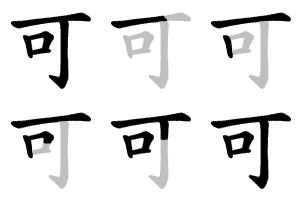 | |||
Han character
可 (Kangxi radical 30, 口+2, 5 strokes, cangjie input 一弓口 (MNR), four-corner 10620, composition ⿹丁口)
Derived characters
References
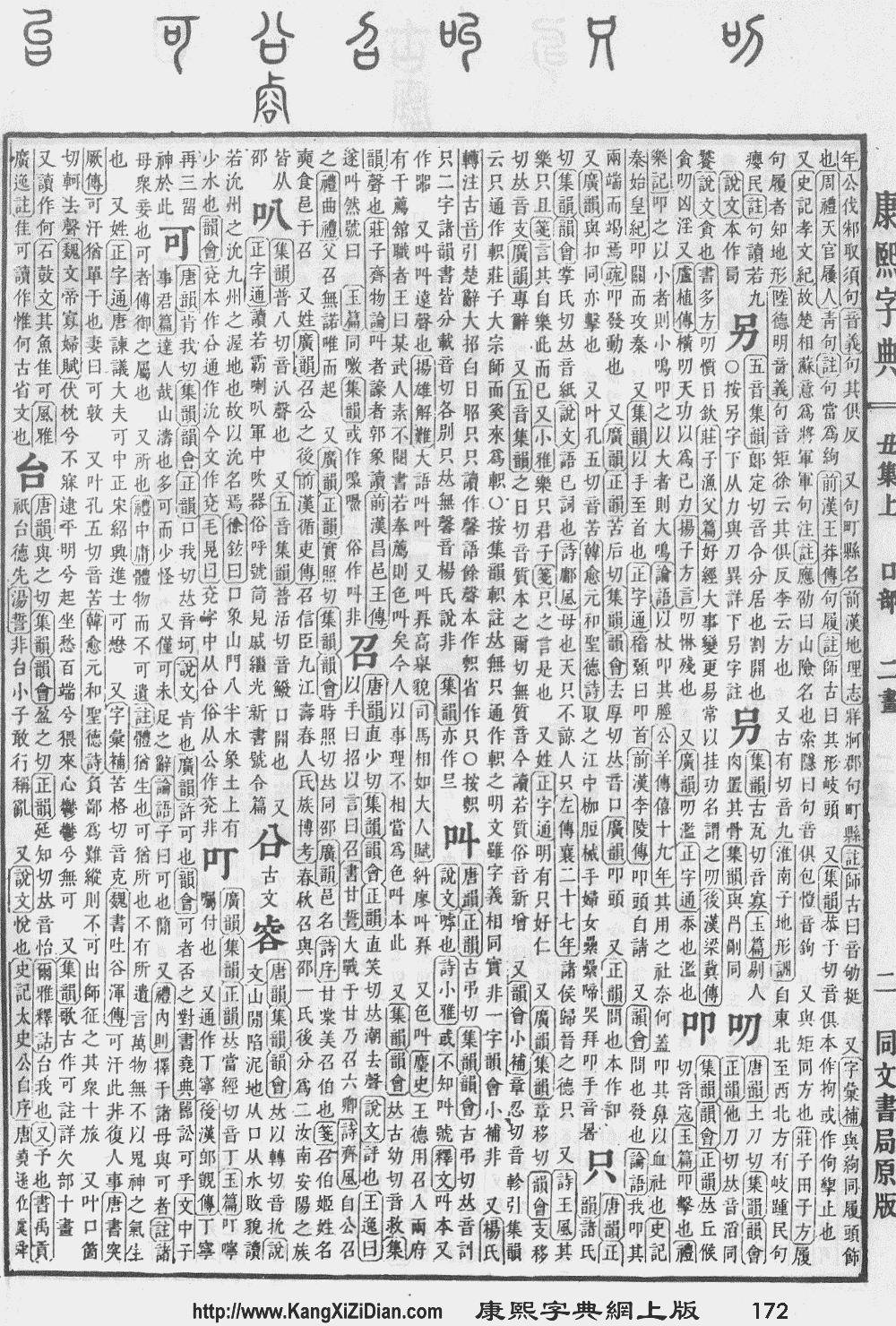
- Kangxi Dictionary: page 172, character 12
- Dai Kanwa Jiten: character 3245
- Dae Jaweon: page 383, character 7
- Hanyu Da Zidian (first edition): volume 1, page 567, character 7
- Unihan data for U+53EF
Chinese
| simp. and trad. |
可 | |
|---|---|---|
Glyph origin
| Historical forms of the character 可 | ||||||
|---|---|---|---|---|---|---|
| Shang | Western Zhou | Spring and Autumn | Warring States | Shuowen Jiezi (compiled in Han) | Liushutong (compiled in Ming) | |
| Oracle bone script | Bronze inscriptions | Bronze inscriptions | Chu slip and silk script | Qin slip script | Small seal script | Transcribed ancient scripts |
 |
 |
 |
 |
 |
 |
 |
Characters in the same phonetic series (可) (Zhengzhang, 2003)
| Old Chinese | |
|---|---|
| 砢 | *ɡ·raːlʔ |
| 柯 | *kaːl |
| 菏 | *kaːl, *ɡaːl |
| 牁 | *kaːl |
| 滒 | *kaːl |
| 哥 | *kaːl |
| 歌 | *kaːl |
| 謌 | *kaːl |
| 鴚 | *kaːl |
| 哿 | *kaːlʔ |
| 舸 | *kaːlʔ |
| 笴 | *kaːlʔ, *kaːnʔ |
| 軻 | *kʰaːl, *kʰaːlʔ, *kʰaːls |
| 珂 | *kʰaːl |
| 可 | *kʰaːlʔ |
| 岢 | *kʰaːlʔ |
| 坷 | *kʰaːlʔ, *kʰaːls |
| 蚵 | *kʰaːls, *ɡaːl |
| 呵 | *qʰaːl, *qʰaːls |
| 訶 | *qʰaːl |
| 抲 | *qʰaːl |
| 荷 | *qʰaːls, *ɡaːl, *ɡaːlʔ |
| 何 | *ɡaːl, *ɡaːlʔ |
| 河 | *ɡaːl |
| 苛 | *ɡaːl |
| 魺 | *ɡaːl |
| 袔 | *ɡaːls |
| 阿 | *qaːl |
| 妸 | *qaːl, *qaːlʔ |
| 疴 | *qaːl, *kʰraːls |
| 鈳 | *qaːl |
| 娿 | *qaːl, *qaːlʔ |
| 痾 | *qaːl |
| 跒 | *kʰraːlʔ |
| 閜 | *qʰraːlʔ |
Phono-semantic compound (形聲/形声, OC *kʰaːlʔ) : semantic 口 + phonetic 丂 (OC *kʰluːʔ).
Etymology 1
From Proto-Sino-Tibetan *m-kal ~ *s-gal (“back (lower); kidney; load; carry”) (STEDT). Cognate with 荷 (OC *qʰaːls, *ɡaːl, *ɡaːlʔ, “to carry”). See there for more.
Pronunciation
Definitions
可
- can; may; be able to
- to approve; to permit
- to fit; suit
- to be worth doing
- but; however
- Synonym: 可是 (kěshì)
- Particle used for emphasis.
- (archaic) Used in questions for emphasis.
- Used in rhetorical questions for emphasis.
- Used in declarative sentences for emphasis.
- Used in exclamatory sentences for emphasis.
- Used in imperative sentences for emphasis.
- (literary) about; around
- (literary) to recover completely (from an illness)
Usage notes
When Mandarin speakers wish to imitate the sound of the dialectal pronunciation of 可 in written form, the character 闊/阔 (kuò) is often used to substitute for 可.
Compounds
- 一無可取/一无可取
- 一蹴可幾/一蹴可几 (yīcùkějī)
- 不卜可知
- 不可 (bùkě)
- 不可一世 (bùkěyīshì)
- 不可不
- 不可以 (bùkěyǐ)
- 不可企及 (bùkě qǐjí)
- 不可偏廢/不可偏废 (bùkě piānfèi)
- 不可勝原/不可胜原
- 不可勝數/不可胜数 (bùkěshèngshǔ)
- 不可勝書/不可胜书
- 不可勝紀/不可胜纪
- 不可勝言/不可胜言 (bùkěshèngyán)
- 不可勝計/不可胜计 (bùkěshèngjì)
- 不可勝記/不可胜记
- 不可及 (bùkějí)
- 不可名字
- 不可名狀/不可名状 (bùkěmíngzhuàng)
- 不可向邇/不可向迩 (bùkěxiàng'ěr)
- 不可多得 (bùkěduōdé)
- 不可得
- 不可思議/不可思议 (bùkěsīyì)
- 不可意
- 不可或缺 (bùkěhuòquē)
- 不可抗力 (bùkěkànglì)
- 不可抗拒 (bùkě kàngjù)
- 不可捉摸 (bùkězhuōmō)
- 不可收拾 (bùkě-shōushí)
- 不可救藥/不可救药 (bùkějiùyào)
- 不可數/不可数 (bùkěshǔ)
- 不可期
- 不可枚舉/不可枚举
- 不可測/不可测
- 不可為/不可为
- 不可狀/不可状
- 不可理喻 (bùkělǐyù)
- 不可理解
- 不可當/不可当 (bùkě dāng)
- 不可知 (bùkězhī)
- 不可知論/不可知论 (bùkězhīlùn)
- 不可磨滅/不可磨灭 (bùkěmómiè)
- 不可終日/不可终日 (bùkě-zhōngrì)
- 不可耐
- 不可能 (bùkěnéng)
- 不可言
- 不可言喻 (bùkěyányù)
- 不可言宣
- 不可諱言/不可讳言
- 不可踰越/不可逾越
- 不可開交/不可开交 (bùkěkāijiāo)
- 不可限量 (bùkě xiànliàng)
- 不可靠
- 不小可
- 不置可否 (bùzhìkěfǒu)
- 乃可
- 乍可
- 乏善可陳/乏善可陈 (fáshànkěchén)
- 乖覺可喜/乖觉可喜 (guāijuékěxǐ)
- 九原可作
- 也可
- 也未可知
- 人盡可夫/人尽可夫 (rénjìnkěfū)
- 人言可畏 (rényánkěwèi)
- 來者可追/来者可追
- 依違兩可/依违两可
- 依阿兩可/依阿两可
- 俗不可耐 (súbùkěnài)
- 便可 (biànkě)
- 倚馬可待/倚马可待 (yǐmǎkědài)
- 僅可/仅可
- 光可鑑人/光可鉴人
- 兩可/两可 (liǎngkě)
- 其情可憫/其情可悯
- 冬日可愛/冬日可爱
- 刻可
- 前車可鑒/前车可鉴
- 功不可沒/功不可没 (gōngbùkěmò)
- 勢不可當/势不可当
- 南山可移
- 印可
- 即可 (jíkě)
- 可不 (kěbù)
- 可不好
- 可不是 (kěbù shì)
- 可不道
- 可乘之機/可乘之机 (kěchéngzhījī)
- 可乘之隙
- 可也
- 可了不得
- 可事 (kěshì)
- 可人 (kěrén)
- 可人意
- 可人憐/可人怜
- 可人憎
- 可什麼/可什么
- 可以
- 可任
- 可作
- 可但
- 可佩
- 可便
- 可信 (kěxìn)
- 可倫坡/可伦坡 (Kělúnpō)
- 可兀的
- 可兒/可儿 (Kě'ér)
- 可冀
- 可則/可则
- 可加 (kějiā)
- 可厭/可厌 (kěyàn)
- 可厭相/可厌相
- 可又來/可又来
- 可取 (kěqǔ)
- 可口 (kěkǒu)
- 只可
- 可可 (kěkě)
- 史可法
- 可可的
- 可可西里 (Kěkěxīlǐ)
- 可否 (kěfǒu)
- 可哀 (kě'āi)
- 可喜 (kěxǐ)
- 可喜可賀/可喜可贺 (kěxǐkěhè)
- 可喜娘
- 可嘉 (kějiā)
- 可嘆/可叹 (kětàn)
- 可圈可點/可圈可点 (kěquānkědiǎn)
- 可堪
- 可塑性 (kěsùxìng)
- 可奈
- 可好 (kěhǎo)
- 可嫌
- 可孕物質/可孕物质
- 可導/可导 (kědǎo)
- 可就
- 可巧 (kěqiǎo)
- 可待 (kědài)
- 可待因 (kědàiyīn)
- 可微 (kěwēi)
- 可心 (kěxīn)
- 可念
- 可怕 (kěpà)
- 可怖 (kěbù)
- 可怪 (kěguài)
- 可恥/可耻 (kěchǐ)
- 可恃 (kěshì)
- 可恨 (kěhèn)
- 可悲 (kěbēi)
- 可惡/可恶 (kěwù)
- 可惜 (kěxī)
- 可惱/可恼 (kěnǎo)
- 可感
- 可意
- 可愛/可爱 (kě'ài)
- 可意人
- 可想而知 (kěxiǎng'érzhī)
- 可慮/可虑
- 可憎 (kězēng)
- 可憐/可怜 (kělián)
- 可憎娘
- 可憎才
- 可憐生/可怜生
- 可憐蟲/可怜虫 (kěliánchóng)
- 可憐見/可怜见 (kěliánjiàn)
- 可操左券
- 可擦擦
- 可教性
- 可敦
- 可敬 (kějìng)
- 可早
- 可是 (kěshì)
- 可是來/可是来
- 可曾 (kěcéng)
- 可有可無/可有可无 (kěyǒukěwú)
- 可望 (kěwàng)
- 可樂/可乐 (kělè)
- 可欲
- 可欽/可钦
- 可歌可泣 (kěgēkěqì)
- 可歎/可叹 (kětàn)
- 可正是
- 可比 (kěbǐ)
- 可氣/可气
- 可溶性 (kěróngxìng)
- 可煞
- 可煞作怪
- 可燃性 (kěránxìng)
- 可燃物 (kěránwù)
- 可甚麼/可甚么
- 可畏 (kěwèi)
- 可疑 (kěyí)
- 可看性
- 可矜
- 可知 (kězhī)
- 可知是好
- 可知道
- 可磕擦
- 可磣/可碜
- 可笑 (kěxiào)
- 可罪
- 可耕地 (kěgēngdì)
- 可能 (kěnéng)
- 可能性 (kěnéngxìng)
- 可著
- 可蘭經/可兰经 (Kělánjīng)
- 可行 (kěxíng)
- 可見/可见 (kějiàn)
- 可見一斑/可见一斑 (kějiànyībān)
- 可見度/可见度 (kějiàndù)
- 可親/可亲 (kěqīn)
- 可覷/可觑
- 可觀/可观 (kěguān)
- 可言 (kěyán)
- 可謂/可谓 (kěwèi)
- 可議/可议
- 可讀性/可读性 (kědúxìng)
- 可變性/可变性
- 可變資本/可变资本
- 可賀/可贺 (kěhè)
- 可貴/可贵 (kěguì)
- 可賀敦/可贺敦
- 可身
- 可逆反應/可逆反应 (kěnì fǎnyìng)
- 可造之材 (kězàozhīcái)
- 可週/可周
- 可鄙 (kěbǐ)
- 可離/可离
- 可靠 (kěkào)
- 可風/可风
- 可飲水/可饮水
- 可駭/可骇
- 可體/可体
- 咄嗟可辦/咄嗟可办
- 和藹可親/和蔼可亲 (hé'ǎikěqīn)
- 唾手可取
- 唾手可得 (tuòshǒukědé)
- 嚴可均/严可均
- 均可 (jūnkě)
- 垂手可得 (chuíshǒukědé)
- 堅不可摧/坚不可摧 (jiānbùkěcuī)
- 堪可
- 夏日可畏
- 多可
- 大可 (dàkě)
- 大可不必 (dàkěbùbì)
- 大有可為/大有可为 (dàyǒukěwéi)
- 大有可觀/大有可观
- 大雅可觀/大雅可观
- 天可憐見/天可怜见
- 天地可表
- 奇貨可居/奇货可居 (qíhuòkějū)
- 妙不可言
- 孝行可嘉
- 孺子可教 (rúzǐkějiào)
- 安可 (ānkě)
- 密不可分 (mìbùkěfēn)
- 富可敵國/富可敌国 (fùkědíguó)
- 寧可/宁可 (nìngkě)
- 寥寥可數/寥寥可数 (liáoliáokěshǔ)
- 小可 (xiǎokě)
- 尚可 (shàngkě)
- 尚可喜
- 尚有可為/尚有可为
- 屈指可數/屈指可数 (qūzhǐkěshǔ)
- 岌岌可危 (jíjíkěwēi)
- 巧不可階/巧不可阶
- 差可 (chākě)
- 張可久/张可久
- 形跡可疑/形迹可疑
- 彰彰可據/彰彰可据
- 後會可期/后会可期
- 後生可畏/后生可畏 (hòushēngkěwèi)
- 志不可奪/志不可夺
- 志不可滿/志不可满
- 忍無可忍/忍无可忍 (rěnwúkěrěn)
- 急不可待 (jíbùkědài)
- 怒不可抑
- 急不可耐
- 怒不可遏 (nùbùkě'è)
- 悲不可抑
- 惟天可表
- 情有可原 (qíngyǒukěyuán)
- 愚不可及 (yúbùkějí)
- 憨狀可掬/憨状可掬
- 指日可待 (zhǐrìkědài)
- 摸棱兩可/摸棱两可 (mōléngliǎngkě)
- 摸稜兩可/摸棱两可 (mōléngliǎngkě)
- 敖不可長/敖不可长
- 斷乎不可/断乎不可
- 易可
- 時不可失/时不可失 (shí bùkě shī)
- 暗室可欺
- 有何不可 (yǒuhébùkě)
- 有例可援
- 有利可圖/有利可图 (yǒulìkětú)
- 有案可查 (yǒu'ànkěchá)
- 有案可稽 (yǒu'ànkějī)
- 有機可乘/有机可乘 (yǒujīkěchéng)
- 有隙可乘 (yǒuxìkěchéng)
- 未可厚非
- 未可限量
- 未嘗不可/未尝不可 (wèichángbùkě)
- 未知可否
- 未置可否
- 核可
- 棄之可惜/弃之可惜
- 楚楚可憐/楚楚可怜 (chǔchǔkělián)
- 樂不可支/乐不可支 (lèbùkězhī)
- 樂不可極/乐不可极
- 樂不可言/乐不可言
- 模棱兩可/模棱两可 (móléngliǎngkě)
- 模稜兩可/模棱两可 (móléngliǎngkě)
- 機不可失/机不可失 (jībùkěshī)
- 欲不可從/欲不可从
- 歷歷可數/历历可数 (lìlìkěshǔ)
- 歷歷可紀/历历可纪
- 歷歷可考/历历可考
- 歷歷可見/历历可见
- 歷歷可辨/历历可辨
- 比屋可封
- 沒可得/没可得
- 泰山可倚
- 洛可可 (luòkěkě)
- 深不可測/深不可测 (shēnbùkěcè)
- 清晰可見/清晰可见
- 渺不可測/渺不可测
- 渾可事/浑可事
- 滿可以/满可以
- 潢潦可薦/潢潦可荐
- 炙手可熱/炙手可热 (zhìshǒukěrè)
- 無利可圖/无利可图
- 無勢可乘/无势可乘
- 無可不可/无可不可
- 無可匹敵/无可匹敌
- 無可厚非/无可厚非 (wúkěhòufēi)
- 無可否認/无可否认 (wúkěfǒurèn)
- 無可奈何/无可奈何 (wúkěnàihé)
- 無可奉告/无可奉告 (wúkěfènggào)
- 無可如何/无可如何
- 無可救藥/无可救药 (wúkějiùyào)
- 無可比擬/无可比拟 (wúkěbǐnǐ)
- 無可比象/无可比象
- 無可置疑/无可置疑 (wúkězhìyí)
- 無可置辯/无可置辩
- 無可諱言/无可讳言 (wúkěhuìyán)
- 無可非議/无可非议 (wúkěfēiyì)
- 無家可奔/无家可奔
- 無家可歸/无家可归 (wú jiā kě guī)
- 無懈可擊/无懈可击 (wúxièkějī)
- 無技可施/无技可施
- 無機可乘/无机可乘
- 無法可施/无法可施
- 然然可可 (ránránkěkě)
- 無瑕可擊/无瑕可击
- 無藥可救/无药可救 (wúyàokějiù)
- 無計可施/无计可施 (wújìkěshī)
- 無計可生/无计可生
- 無話可說/无话可说 (wúhuàkěshuō)
- 無跡可尋/无迹可寻
- 無路可走/无路可走
- 無隙可乘/无隙可乘 (wúxìkěchéng)
- 牢不可拔
- 牢不可破 (láobùkěpò)
- 特利可得
- 猛可
- 猛可裡/猛可里
- 猶可/犹可
- 獻可替否/献可替否
- 獻替可否/献替可否
- 班班可考
- 痊可
- 百事可樂/百事可乐 (bǎishì kělè)
- 盡可/尽可
- 盡可能/尽可能
- 省可
- 省可裡/省可里
- 磣可可/碜可可
- 萬不可失/万不可失
- 萬萬不可/万万不可
- 秀色可餐 (xiùsèkěcān)
- 窅不可測/窅不可测
- 立可白 (lìkěbái)
- 笑容可掬 (xiàoróngkějū)
- 粲然可觀/粲然可观
- 精神可嘉
- 纔可/才可
- 缺一不可 (quēyībùkě)
- 罪不可赦 (zuìbùkěshè)
- 罪無可逭/罪无可逭
- 羅可可式/罗可可式
- 美味可口
- 義行可風/义行可风
- 耐可
- 能可
- 臭不可當/臭不可当
- 臭不可聞/臭不可闻
- 舉手可采
- 良醞可戀/良酝可恋
- 莫可名狀/莫可名状
- 莫可奈何
- 落可便
- 藐不可測/藐不可测
- 藹然可親/蔼然可亲 (ǎiránkěqīn)
- 裁可
- 西洛可風/西洛可风
- 觸手可及/触手可及 (chùshǒukějí)
- 許可/许可 (xǔkě)
- 許可證/许可证 (xǔkězhèng)
- 誠可格天/诚可格天
- 認可/认可 (rènkě)
- 豈可/岂可 (qǐkě)
- 貴不可言/贵不可言 (guì bùkě yán)
- 迪斯可
- 進可替不/进可替不
- 進可替否/进可替否
- 遙不可及/遥不可及
- 遙不可期/遥不可期
- 適可而止/适可而止 (shìkě'érzhǐ)
- 還可以/还可以 (háikěyǐ)
- 銳不可當/锐不可当
- 銳未可當/锐未可当
- 錢可使鬼/钱可使鬼
- 錢可通神/钱可通神
- 門可張羅/门可张罗
- 門可羅雀/门可罗雀 (ménkěluóquè)
- 閒可/闲可
- 難能可貴/难能可贵 (nánnéngkěguì)
- 非同小可 (fēitóngxiǎokě)
- 面目可憎
- 頗可/颇可
- 頗為可觀/颇为可观
- 餘勇可賈/余勇可贾 (yúyǒngkěgǔ)
- 馬可/马可 (Mǎkě)
- 馬可福音/马可福音 (Mǎkě Fúyīn)
- 高不可攀
- 高不可登
- 高可摩天
- 髮光可鑑/发光可鉴
Pronunciation
Japanese
Readings
Compounds
Compounds of 可
- Common
- 可否 (kahi)
- 可決 (kaketsu)
- 可也 (kanari)
- 可能 (kanō)
- 可愛い (kawaii)
- 可哀相 (kawaisō)
- 不可 (fuka)
- 許可 (kyoka)
- 認可 (ninka)
- Uncommon
- 可き (beki)
- 可とする (katosuru)
- 可分 (kabun)
- 可聴 (kachō)
- 可動 (kadō)
- 可読 (kadoku)
- 可逆 (kagyaku)
- 可変 (kahen)
- 可燃 (kanen)
- 可憐 (karen)
- 可算 (kasan)
- 可視 (kashi)
- 可塑 (kaso)
- 可溶 (kayō)
- 加圧性 (kātsusei)
- 可換環 (kakankan)
- 可換群 (kakangun)
- 可処分 (kashobun)
- 印可 (inka)
- 半可 (hanka)
- 裁可 (saika)
- 成る可く (narubeku)
- Archaic / rare
Noun
可 • (ka)
Korean
Vietnamese
This article is issued from Wiktionary. The text is licensed under Creative Commons - Attribution - Sharealike. Additional terms may apply for the media files.