捨
See also: 舍
| ||||||||
| ||||||||
Translingual
| Japanese | 捨 |
|---|---|
| Simplified | 舍 |
| Traditional | 捨 |
Alternative forms
Note that Japanese uses 舎 (土口), while Chinese uses 舍 (干口).
Han character
捨 (Kangxi radical 64, 手+8, 11 strokes, cangjie input 手人一口 (QOMR) or 難手人一口 (XQOMR), four-corner 58061, composition ⿰扌舍(GHKT) or ⿰扌舎(J))
Derived characters
- 𭕹
References
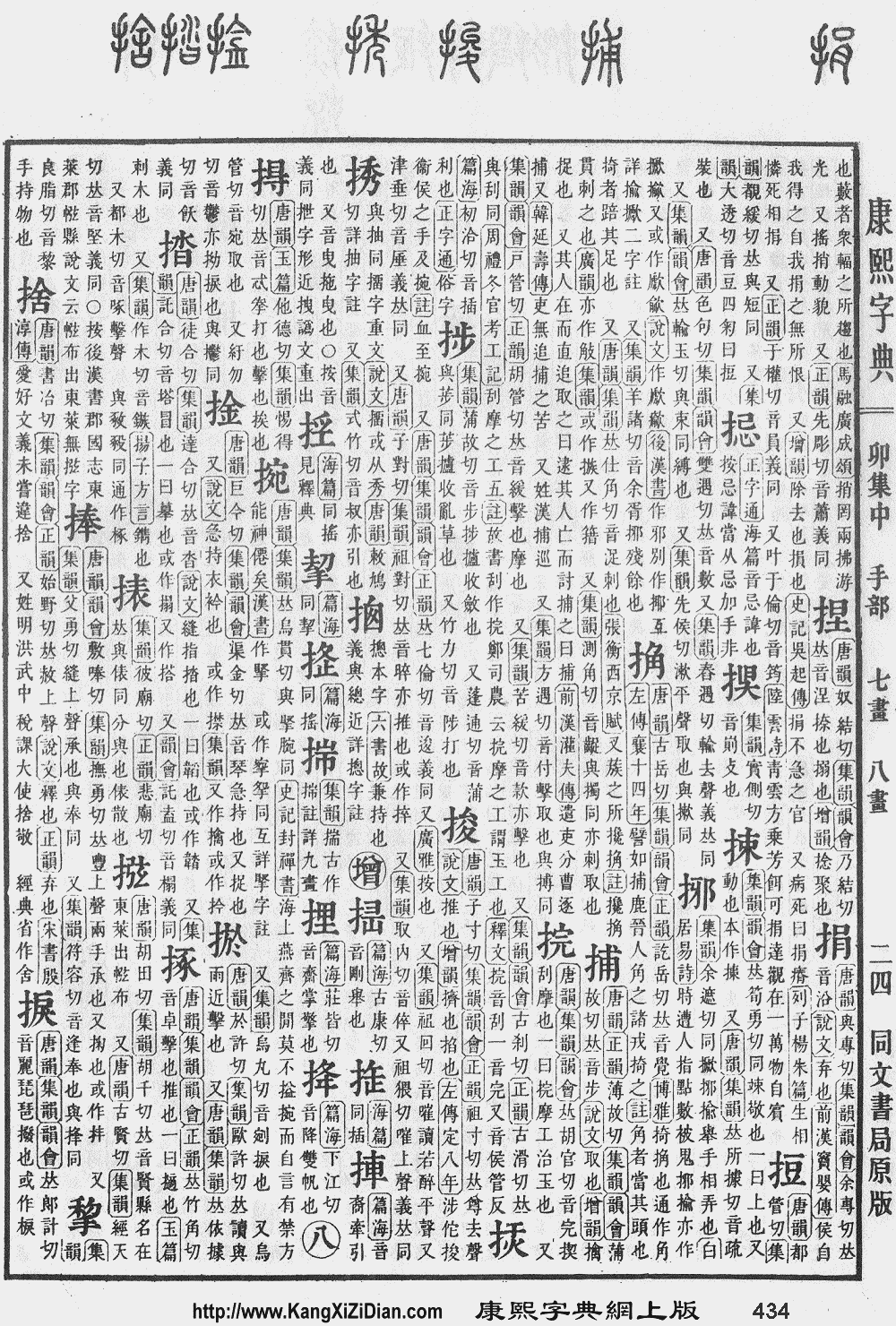
- Kangxi Dictionary: page 434, character 35
- Dai Kanwa Jiten: character 12191
- Dae Jaweon: page 784, character 15
- Hanyu Da Zidian (first edition): volume 3, page 1900, character 4
- Unihan data for U+6368
- Unihan data for U+2F8BB
See also
Chinese
| trad. | 捨/舍* | |
|---|---|---|
| simp. | 舍* | |
| alternative forms | 𦧶 | |
Glyph origin
Characters in the same phonetic series (余) (Zhengzhang, 2003)
| Old Chinese | |
|---|---|
| 斜 | *lja, *laː |
| 茶 | *rlaː |
| 荼 | *rlaː, *ɦlja, *l'aː |
| 梌 | *rlaː, *l̥ʰaː, *l'aː |
| 搽 | *rlaː |
| 塗 | *rlaː, *l'aː |
| 佘 | *ɦlja |
| 賒 | *hljaː |
| 畬 | *hljaː, *la |
| 舍 | *hljaːʔ, *hljaːs |
| 捨 | *hljaːʔ |
| 騇 | *hljaːʔ, *hljaːs |
| 涻 | *hljaːs |
| 稌 | *l̥ʰaː, *l̥ʰaːʔ |
| 悇 | *l̥ʰaː, *l̥ʰas, *las |
| 庩 | *l̥ʰaː |
| 捈 | *l̥ʰaː, *l'aː |
| 途 | *l'aː |
| 酴 | *l'aː |
| 駼 | *l'aː |
| 鵌 | *l'aː, *la |
| 涂 | *l'aː, *l'a |
| 嵞 | *l'aː |
| 峹 | *l'aː |
| 筡 | *l'aː, *l̥ʰa |
| 蒤 | *l'aː |
| 徐 | *lja |
| 俆 | *lja |
| 敘 | *ljaʔ |
| 漵 | *ljaʔ |
| 除 | *l'a, *l'as |
| 篨 | *rla |
| 滁 | *rla |
| 蒢 | *rla |
| 蜍 | *ɦlja, *la |
| 鵨 | *hljaː |
| 瑹 | *hlja |
| 余 | *la |
| 餘 | *la |
| 艅 | *la |
| 狳 | *la |
| 雓 | *la |
| 悆 | *las |
Phono-semantic compound (形聲/形声, OC *hljaːʔ) : semantic 扌 (“hand”) + phonetic 舍 (OC *hljaːʔ, *hljaːs) – to discard with the hand.
Etymology
- to give up
- Areal word possibly of Austroasiatic origin (Schuessler, 2007); compare Mizo thlah (“to release; to acquit; to quit; to give up; to leave; to neglect”), Proto-Monic *blah (“to be released, to go free”) > Old Mon blaḥ (> Mon [script needed] (plɛ̀h, “to escape, to be free from”), [script needed] (həlɛ̀h, “to let go (of), to free (from), to send (for)”), & Nyah Kur [script needed] (phəläh)), Old Khmer lā (> Khmer ក្រឡាស់ (krɑlah, “to turn; to free oneself, break away from; to change one's mind”)), etc. (ibid.), from Proto-Mon-Khmer *lah > *lah-s ~ *las ~ *laas (“to leave”).
- 舍 (OC *hljaːs) is perhaps its exoactive derivative with suffix *-s/*-h (ibid.)
- Schuessler also notes this word-family's parallel to 釋 (OC *hljaɡ) (whose derivative 赦 (OC *hljaɡs) is related by Wang (1982) to 捨 (OC *hljaːʔ) > 舍 (OC *hljaːs)), even though the different phonetics imply different Old Chinese pronuncations; the roots *lhaʔ ~ *lhak ~ *lhaiʔ (> 弛 (OC *l̥ajʔ) (B-S)) are probably variants with parallel morphological and semantic developments.
Pronunciation
Definitions
捨
- to give up; to abandon
- to give alms
- to leave; to part
- 吾與汝俱少年,以為雖暫相別,終當久與相處,故捨汝而旅食京師,以求斗斛之祿。 [Classical Chinese, trad.]
- From: 803, Han Yu, 祭十二郎文
- Wú yǔ rǔ jù shàonián, yǐwéi suī zàn xiàngbié, zhōng dāng jiǔ yǔ xiàngchǔ, gù shě rǔ ér lǚshí jīngshī, yǐ qiú dǒuhú zhī lù. [Pinyin]
- (please add an English translation of this usage example)
吾与汝俱少年,以为虽暂相别,终当久与相处,故舍汝而旅食京师,以求斗斛之禄。 [Classical Chinese, simp.]
Compounds
- 不捨/不舍 (bùshě)
- 不捨得/不舍得 (bùshěde)
- 不捨晝夜/不舍昼夜
- 依依不捨/依依不舍 (yīyībùshě)
- 依依難捨/依依难舍
- 割捨/割舍 (gēshě)
- 取捨/取舍 (qǔshě)
- 善財難捨/善财难舍
- 四捨五入/四舍五入 (sìshěwǔrù)
- 廣捨/广舍
- 忘生捨死/忘生舍死
- 戀戀不捨/恋恋不舍 (liànliànbùshě)
- 戀戀難捨/恋恋难舍
- 拚捨/拚舍
- 捨不得/舍不得
- 捨命/舍命 (shěmìng)
- 捨命救人/舍命救人
- 捨墮/舍堕
- 捨安就危/舍安就危
- 捨實求虛/舍实求虚
- 捨己就人/舍己就人
- 捨己從人/舍己从人
- 捨己成人/舍己成人
- 捨己救人/舍己救人
- 捨己為人/舍己为人 (shějǐwèirén)
- 捨己為公/舍己为公
- 捨得/舍得 (shěde)
- 捨我其誰/舍我其谁 (shěwǒqíshéi)
- 捨本逐末/舍本逐末 (shěběnzhúmò)
- 捨棄/舍弃 (shěqì)
- 捨死忘生/舍死忘生 (shěsǐwàngshēng)
- 捨生取義/舍生取义 (shěshēngqǔyì)
- 捨生忘死/舍生忘死 (shěshēngwàngsǐ)
- 捨短取長/舍短取长
- 捨身/舍身 (shěshēn)
- 捨身圖報/舍身图报
- 捨身報國/舍身报国
- 捨身求法/舍身求法
- 捨近務遠/舍近务远
- 捨近即遠/舍近即远
- 捨近求遠/舍近求远 (shějìnqiúyuǎn)
- 施捨/施舍 (shīshě)
- 棄捨/弃舍
- 留連不捨/留连不舍
- 窮追不捨/穷追不舍 (qióngzhuībùshě)
- 緊追不捨/紧追不舍
- 繾綣難捨/缱绻难舍
- 讀不捨手/读不舍手
- 逐末捨本/逐末舍本
- 鍥而不捨/锲而不舍 (qiè'érbùshě)
- 難分難捨/难分难舍
- 難捨難分/难舍难分
- 齊王捨牛/齐王舍牛
Japanese
| Shinjitai | 捨 | |
| Kyūjitai [1] |
捨󠄁 捨+ 󠄁?(Adobe-Japan1) |
 |
| 捨󠄃 捨+ 󠄃?(Hanyo-Denshi) (Moji_Joho) | ||
| The displayed kanji may be different from the image due to your environment. See here for details. | ||
Readings
Compounds
- 喜捨 (kisha)
- 四捨五入 (shishagonyū)
References
- “捨”, in 漢字ぺディア (Kanjipedia) (in Japanese), 日本漢字能力検定協会, 2015–2024
Korean
Hanja
捨 • (sa) (hangeul 사, revised sa, McCune–Reischauer sa, Yale sa)
- This term needs a translation to English. Please help out and add a translation, then remove the text
{{rfdef}}.
Kunigami
Miyako
Vietnamese
Yaeyama
This article is issued from Wiktionary. The text is licensed under Creative Commons - Attribution - Sharealike. Additional terms may apply for the media files.