醒
| ||||||||
Translingual
| Stroke order | |||
|---|---|---|---|
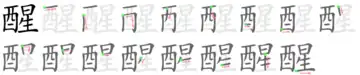 | |||
Han character
醒 (Kangxi radical 164, 酉+9, 16 strokes, cangjie input 一田日竹一 (MWAHM), four-corner 16614, composition ⿰酉星)
Derived characters
- 𫬞
References
- Kangxi Dictionary: page 1285, character 20
- Dai Kanwa Jiten: character 39936
- Dae Jaweon: page 1785, character 22
- Hanyu Da Zidian (first edition): volume 6, page 3590, character 1
- Unihan data for U+9192

Chinese
| trad. | 醒 | |
|---|---|---|
| simp. # | 醒 | |
Glyph origin
Characters in the same phonetic series (生) (Zhengzhang, 2003)
| Old Chinese | |
|---|---|
| 猜 | *sʰlɯː |
| 輤 | *sʰleːns |
| 綪 | *sʰleːns, *ʔsreːŋ |
| 倩 | *sʰleːns, *sʰleŋs |
| 棈 | *sʰleːns |
| 蒨 | *sʰeːns |
| 篟 | *sʰeːns |
| 生 | *sʰleːŋ, *sreŋs |
| 牲 | *sreŋ |
| 笙 | *sreŋ |
| 甥 | *sreŋ |
| 鉎 | *sreŋ, *sleːŋ |
| 珄 | *sreŋ |
| 鼪 | *sreŋ, *sreŋs |
| 猩 | *sreŋ, *seːŋ |
| 狌 | *sreŋ |
| 眚 | *sreŋʔ |
| 貹 | *sreŋs |
| 崝 | *zreːŋ |
| 精 | *ʔsleŋ, *ʔsleŋs |
| 菁 | *ʔsleŋ |
| 鶄 | *ʔsleŋ, *sʰleːŋ |
| 蜻 | *ʔsleŋ, *sʰleːŋ |
| 鼱 | *ʔsleŋ |
| 婧 | *ʔsleŋ, *zleŋs, *zleŋʔ |
| 睛 | *ʔsleŋ, *sʰleŋʔ |
| 箐 | *ʔsleŋ |
| 聙 | *ʔsleŋ |
| 旌 | *ʔsleŋ |
| 清 | *sʰleŋ |
| 圊 | *sʰleŋ |
| 請 | *sʰleŋʔ, *zleŋs, *zleŋ |
| 凊 | *sʰleŋs |
| 䝼 | *zleŋs, *zleŋ |
| 靚 | *zleŋs |
| 情 | *zleŋ |
| 晴 | *zleŋ |
| 夝 | *zleŋ |
| 靜 | *zleŋʔ |
| 靖 | *zleŋʔ |
| 睲 | *seŋʔ, *seːŋs |
| 惺 | *seŋʔ, *seːŋ |
| 性 | *sleŋs |
| 姓 | *sleŋs |
| 靗 | *l̥ʰeŋs |
| 鯖 | *ʔljeŋ, *sʰleːŋ |
| 青 | *sʰleːŋ |
| 靘 | *sʰleːŋ, *sʰleːŋs |
| 掅 | *sʰleːŋs |
| 胜 | *sleːŋ |
| 曐 | *sleːŋ |
| 星 | *sleːŋ |
| 鮏 | *sleːŋ |
| 腥 | *seːŋ, *seːŋs |
| 鯹 | *seːŋ |
| 醒 | *seːŋ, *seːŋʔ, *seːŋs |
| 篂 | *seːŋ |
Phono-semantic compound (形聲/形声, OC *seːŋ, *seːŋʔ, *seːŋs) : semantic 酉 (“alcohol”) + phonetic 星 (OC *sleːŋ).
Etymology
Cognate with 清 (OC *sʰleŋ, “clear”) (Schuessler, 2007). See there for more.
Pronunciation
Definitions
醒
Synonyms
Dialectal synonyms of 聰明 (“clever; intelligent; smart; bright”) [map]
Compounds
- 不醒
- 不醒人事 (bùxǐngrénshì)
- 久夢初醒/久梦初醒
- 半睡半醒
- 叫醒 (jiàoxǐng)
- 叫醒服務/叫醒服务
- 喚醒/唤醒 (huànxǐng)
- 大夢初醒/大梦初醒
- 大覺醒/大觉醒
- 如夢初醒/如梦初醒 (rúmèngchūxǐng)
- 如夢方醒/如梦方醒 (rúmèngfāngxǐng)
- 如醉初醒
- 如醉方醒
- 定醒
- 復醒/复醒
- 提醒 (tíxǐng)
- 昏迷不醒
- 清醒 (qīngxǐng)
- 猛醒
- 獨醒/独醒
- 甦醒/苏醒 (sūxǐng)
- 眾人皆醉我獨醒/众人皆醉我独醒 (zhòngrén jiē zuì wǒ dú xǐng)
- 眾醉獨醒/众醉独醒
- 蘇醒/苏醒 (sūxǐng)
- 覺醒/觉醒 (juéxǐng)
- 警醒 (jǐngxǐng)
- 醒世 (xǐngshì)
- 醒世恆言/醒世恒言 (Xǐngshì Héngyán)
- 醒來/醒来 (xǐnglái)
- 醒悟 (xǐngwù)
- 醒木
- 醒狂
- 醒目 (xǐngmù)
- 醒眼 (xǐngyǎn)
- 醒睡 (xǐngshuì)
- 醒脾
- 醒覺/醒觉
- 醒豁
- 醒酒 (xǐngjiǔ)
- 醒酒石
- 驚醒/惊醒
- 點醒/点醒
Descendants
References
- “醒”, in 漢語多功能字庫 (Multi-function Chinese Character Database), 香港中文大學 (the Chinese University of Hong Kong), 2014–
Japanese
Readings
Korean
Vietnamese
This article is issued from Wiktionary. The text is licensed under Creative Commons - Attribution - Sharealike. Additional terms may apply for the media files.