鑿
See also: 凿
| ||||||||
Translingual
| Stroke order | |||
|---|---|---|---|
 | |||
Han character
鑿 (Kangxi radical 167, 金+19, 27 strokes, cangjie input 廿水金 (TEC), four-corner 37109, composition ⿱𣫞金)
References
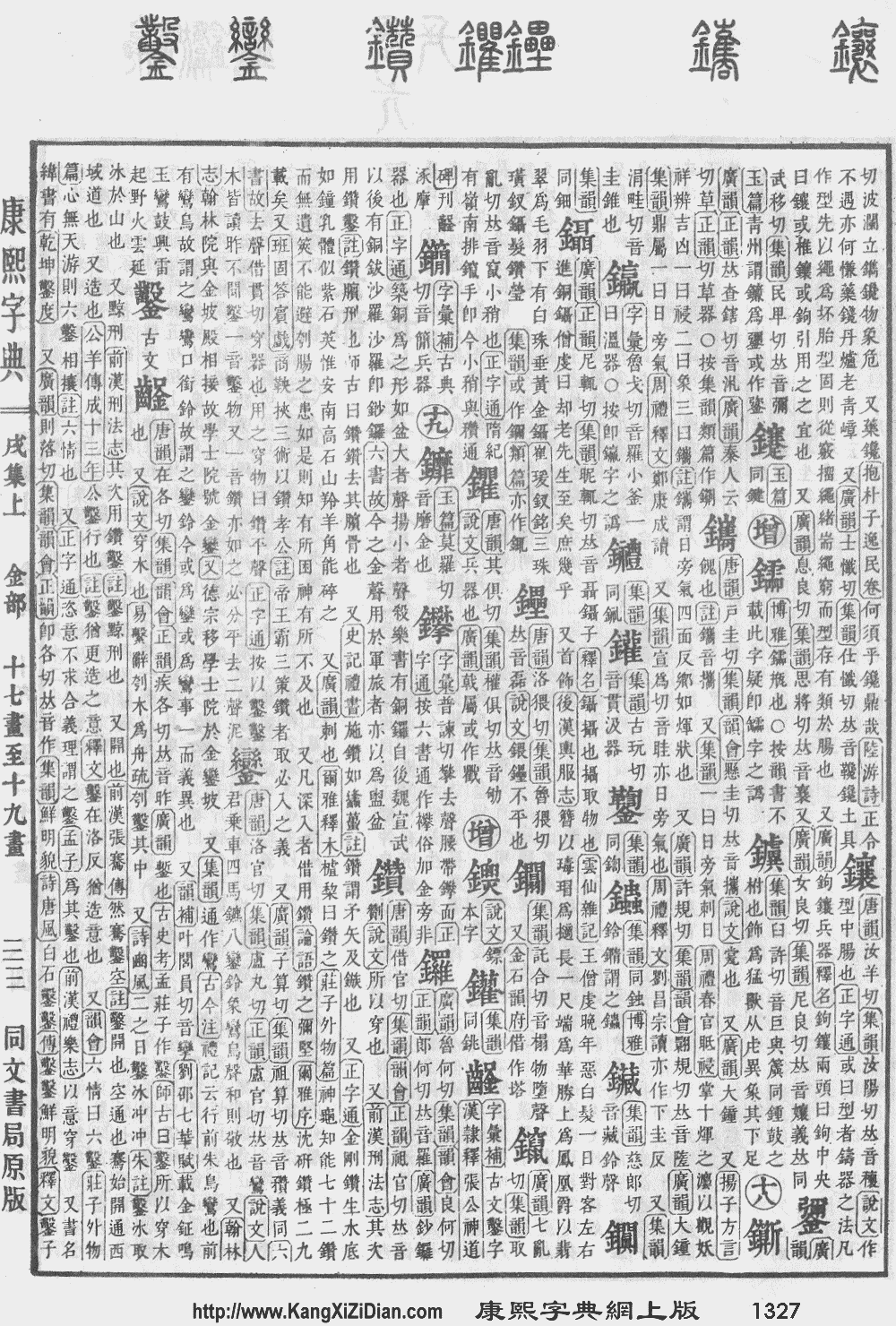
- Kangxi Dictionary: page 1327, character 29
- Dai Kanwa Jiten: character 41088
- Dae Jaweon: page 1829, character 4
- Hanyu Da Zidian (first edition): volume 6, page 4277, character 7
- Unihan data for U+947F
Chinese
| trad. | 鑿 | |
|---|---|---|
| simp. | 凿 | |
| alternative forms | ||
Glyph origin
Characters in the same phonetic series (丵) (Zhengzhang, 2003)
Phono-semantic compound (形聲/形声, OC *ʔsoːwɢ, *zoːwɢ, *zoːwɢ, *zoːwɢ) : semantic 金 (“metal”) + phonetic 𥽿 ().
Pronunciation 1
Definitions
鑿
- chisel
- to bore; to cut a hole; to chisel
- to dig
- (obsolete) tool for tattooing the face as punishment
- (literary) to interpret in a strained manner
- (obsolete) Used in 鑿行/凿行.
- (obsolete) Used in 鑿空/凿空 (záokōng).
- (obsolete) feeling; emotion
- (literary or Beijing Mandarin) to beat forcefully
- (Hokkien) to stab; to pierce
- (Mainland China Hokkien) to criticize with pointed words; to poke holes in people's holes or secrets
- (Taiwanese Hokkien) feeling uncomfortable (when worn, etc.)
Synonyms
- (chisel):
Dialectal synonyms of 鑿子 (“chisel”) [map]
| Variety | Location | Words |
|---|---|---|
| Classical Chinese | 鑿 | |
| Formal (Written Standard Chinese) | 鑿子 | |
| Mandarin | Beijing | 鑿子 |
| Taiwan | 鑿子 | |
| Harbin | 鑿子 | |
| Yantai (Muping) | 鑿子 | |
| Jinan | 鑿子 | |
| Luoyang | 鑿 | |
| Wanrong | 鑿子 | |
| Xi'an | 鑿子 | |
| Yinchuan | 鑿子 | |
| Xining | 鑿子 | |
| Ürümqi | 鑿子 | |
| Wuhan | 鑿子 | |
| Chengdu | 鑿子 | |
| Guiyang | 鑿子 | |
| Liuzhou | 鑿子 | |
| Xuzhou | 鑿子 | |
| Yangzhou | 鑿子 | |
| Nanjing | 鑿子 | |
| Hefei | 鑿子 | |
| Cantonese | Guangzhou | 鑿 |
| Hong Kong | 鑿 | |
| Hong Kong (Kam Tin Weitou) | 鑿 | |
| Hong Kong (Ting Kok) | 鑿仔 | |
| Hong Kong (Tung Ping Chau) | 鑿仔 | |
| Dongguan | 鑿 | |
| Yangjiang | 鑿仔 | |
| Kuala Lumpur (Guangfu) | 鑿 | |
| Gan | Nanchang | 鑿子 |
| Lichuan | 鑿子, 鑿兒, 鑿仔 | |
| Pingxiang | 鑿子 | |
| Hakka | Meixian | 鑿仔 |
| Yudu | 鑿子 | |
| Hong Kong | 鑿仔 | |
| Senai (Huiyang) | 鑿仔 | |
| Huizhou | Jixi | 鑿 |
| Jin | Taiyuan | 鑿子 |
| Xinzhou | 鑿子 | |
| Northern Min | Jian'ou | 鑿仔 |
| Eastern Min | Fuzhou | 鑿鑿, 鑿, 鑿囝 |
| Southern Min | Xiamen | 鑿仔 |
| Quanzhou | 鑿仔 | |
| Zhangzhou | 鑿仔 | |
| Chaozhou | 鑿囝 | |
| Jieyang | 鑿囝 | |
| Bangkok (Teochew) | 鑿 | |
| Haikou | 鑿 | |
| Southern Pinghua | Nanning (Tingzi) | 鑿子, 鑿 |
| Wu | Shanghai | 鑿子, 鑿頭 |
| Shanghai (Chongming) | 鑿子 | |
| Suzhou | 鑿子 | |
| Danyang | 鑿子 | |
| Ningbo | 鑿子 | |
| Wenzhou | 鑿 | |
| Xiang | Changsha | 鑿子 |
| Loudi | 鑿子 | |
| Shuangfeng | 鑿子 | |
- (to bore):
Compounds
Descendants
Pronunciation 2
Compounds
- 圓鑿方枘/圆凿方枘
- 圜鑿方枘/圜凿方枘
- 方枘圜鑿/方枘圜凿
- 方鑿圓枘/方凿圆枘
- 枘圓鑿方/枘圆凿方
- 枘鑿/枘凿
- 鑿圓枘方/凿圆枘方
- 鑿枘/凿枘
- 鑿枘不入/凿枘不入
Pronunciation 3
Definitions
鑿
Pronunciation 4
Japanese
Korean
Compounds
- 굴착기 (掘鑿機, gulchakgi, “excavator”)
- 굴착 (掘鑿, gulchak, “excavation”)
Compounds
- (archaic) 방예원조 (方枘圓鑿, bang'yewonjo)
Vietnamese
This article is issued from Wiktionary. The text is licensed under Creative Commons - Attribution - Sharealike. Additional terms may apply for the media files.