呢
| ||||||||
Translingual
| Stroke order | |||
|---|---|---|---|
 | |||
Han character
呢 (Kangxi radical 30, 口+5, 8 strokes, cangjie input 口尸心 (RSP), four-corner 67011, composition ⿰口尼)
References
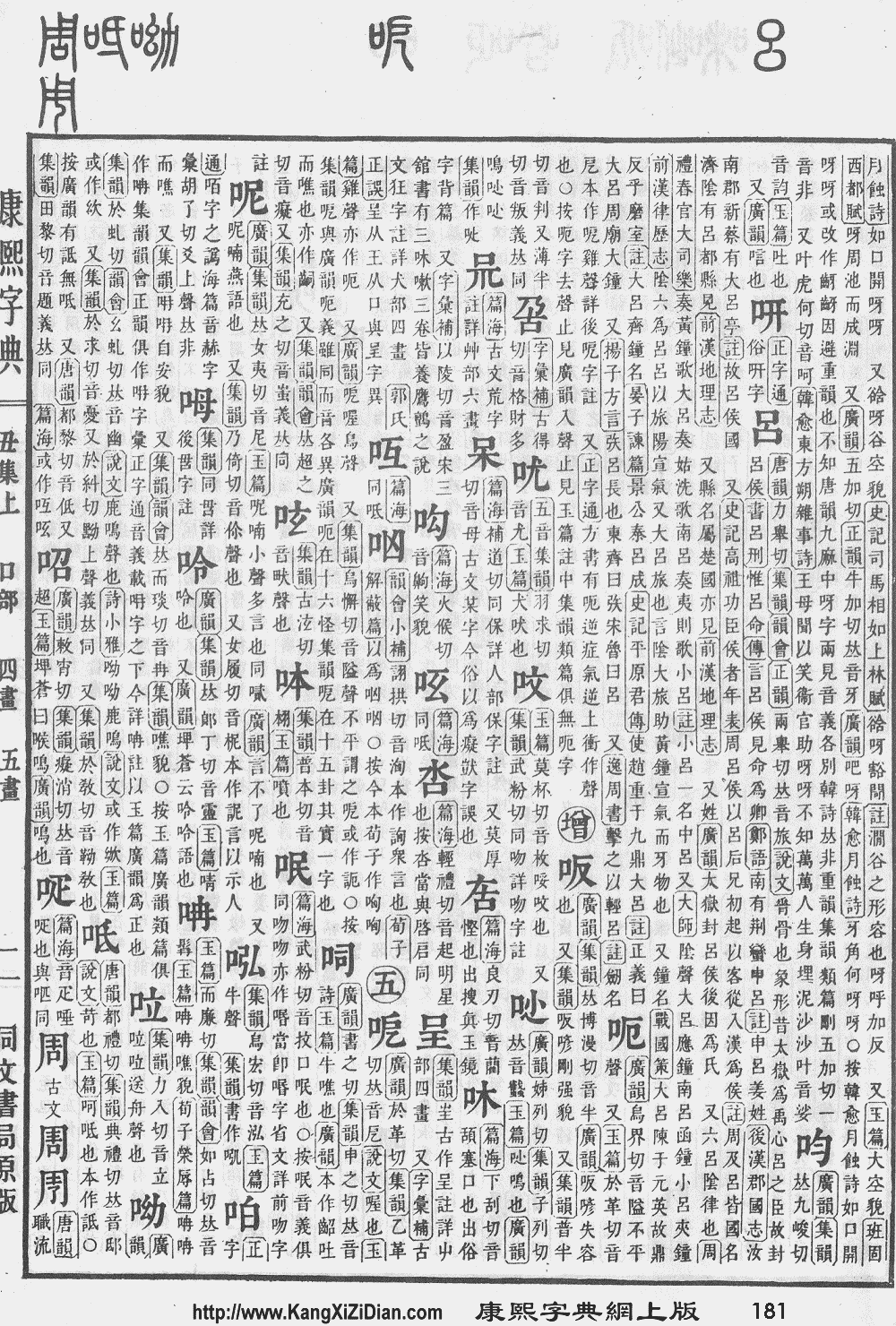
- Kangxi Dictionary: page 181, character 25
- Dai Kanwa Jiten: character 3430
- Dae Jaweon: page 399, character 31
- Hanyu Da Zidian (first edition): volume 1, page 609, character 3
- Unihan data for U+5462
Chinese
Glyph origin
Characters in the same phonetic series (尼) (Zhengzhang, 2003)
Phono-semantic compound (形聲/形声, OC *nil) : semantic 口 (“mouth”) + phonetic 尼 (OC *nil)
Etymology 1
| trad. | 呢 | |
|---|---|---|
| simp. # | 呢 | |
| alternative forms | 吶/呐 膩/腻 Hokkien 逆 Hokkien | |
Ota (1987) suggests that the particle used in questions comes from 聻 (MC nriX) [Five Dynasties], a particle which may come from 爾 (MC nyeX, “that”), and that the particle used to indicate an action in progress comes from earlier 哩 [Yuan dynasty], which may come from 裏 (MC liX, “place”) [Tang dynasty–Five Dynasties].
Pronunciation
Definitions
呢
- Sentence-final particle indicating a reciprocal question; used to apply the previously asked question to a new subject. What about ...?; And ...?
- Sentence-final particle signalling a pause, to emphasize the preceding words.
- Sentence-final particle indicating continuation of an action or state, English present continuous. to be ...-ing
- Sentence-final particle used to make questions more indirect, to give the impression that the speaker is speaking to themselves.
- (Shanghainese) Sentence-final particle expressing anger.
Usage notes
When expressing an action in progress, 呢 can be used with 正在 (zhèngzài) and 著/着 (zhe) in a sentence. This is the full pattern. Each part is optional. The use of 呢 implies a contrastive mood.
Compounds
- 便是呢
- 嗎呢/吗呢
- 按呢 (án-ne)
Pronunciation
Definitions
呢
Etymology 3
| trad. | 呢 | |
|---|---|---|
| simp. # | 呢 | |
| alternative forms | ||
Substrate word. Compare:
- Proto-Tai *najꟲ (“this”): Zhuang neix (“this”), Thai นี้ (níi, “this”), Lao ນີ້ (nī, “this”)
- Proto-Mon-Khmer *niʔ ~ nih (“this”): Khmer នេះ (nih, “this”)
- Proto-Mon-Khmer *naaj (“deictic particle”): Khmer នាយ (niəy, “over there”), Vietnamese này, nầy (“this”), Vietnamese nay (“now”), Vietnamese nấy (“that”)
- Proto-Hmong-Mien *ʔneinˣ (“this”): White Hmong no (“here, this”)
- Proto-Austronesian *nay (“deictic particle: this”), *qani (“proximal deictic: this”), *-ni (“proximal spatio-temporal deixis: this, here; now”): Malay ini (“this”).
Pronunciation
Usage notes
- Unlike Mandarin 這/这 (zhè), 呢 cannot be used alone without a following classifier. See 呢個#Usage notes.
Synonyms
Dialectal synonyms of 這 (“this”) [map]
Pronunciation
Definitions
呢
Pronunciation
Definitions
呢
- (Hong Kong Cantonese, gaming) levels (in a video game)
- (Hong Kong Cantonese, figuratively) levels in a society; social class
Compounds
Pronunciation
Pronunciation
Pronunciation
Japanese
Kanji
呢
- This term needs a translation to English. Please help out and add a translation, then remove the text
{{rfdef}}.
Korean
Hanja
呢 (eum 니 (ni))
- This term needs a translation to English. Please help out and add a translation, then remove the text
{{rfdef}}.
Vietnamese
This article is issued from Wiktionary. The text is licensed under Creative Commons - Attribution - Sharealike. Additional terms may apply for the media files.