龜
| ||||||||
| ||||||||
| ||||||||
| ||||||||
| ||||||||
 | ||||||||
Translingual
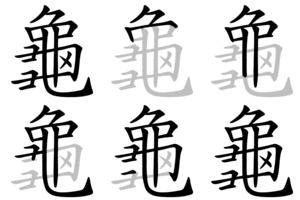
| Stroke order | |||
|---|---|---|---|
 | |||
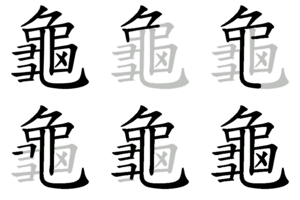
| Stroke order (Hong Kong) | |||
|---|---|---|---|
 | |||
| Stroke order (alternative) | |||
|---|---|---|---|
 | |||
| Traditional | 龜 |
|---|---|
| Shinjitai | 亀 |
| Simplified | 龟 |
Han character
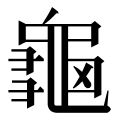
龜 (Kangxi radical 213, 龜+0, 18 strokes in traditional Chinese, Japanese and Korean, 16 strokes in mainland China, cangjie input 竹月尸尸 (HBSS) or 弓難山 (NXU), four-corner 27117, composition ⿱⺈⿹⿷⿻冂⿰一⿺乚⺊⿼コ㐅𢑑(H) or ⿱⺈⿻⿻冂⿰一⿺乚⺊⿻コ⿴⿹𠃌⺕㐅(G) or ⿱丿⿻⿻冂⿰一⿺乚⺊⿻コ⿴⿹𠃌⺕㐅)
- Kangxi radical #213, ⿔.
References
- Kangxi Dictionary: page 1537, character 23
- Dai Kanwa Jiten: character 48847
- Dae Jaweon: page 2078, character 18
- Hanyu Da Zidian (first edition): volume 7, page 4809, character 4
- Unihan data for U+9F9C
- Unihan data for U+F907
- Unihan data for U+F908
- Unihan data for U+FACE

Chinese
| trad. | 龜 | |
|---|---|---|
| simp. | 龟 | |
| alternative forms | ||
Glyph origin
| Historical forms of the character 龜 | |||
|---|---|---|---|
| Shang | Western Zhou | Shuowen Jiezi (compiled in Han) | Liushutong (compiled in Ming) |
| Oracle bone script | Bronze inscriptions | Small seal script | Transcribed ancient scripts |
 |
 |
 |
 |
Characters in the same phonetic series (龜) (Zhengzhang, 2003)
Pictogram (象形) : A drawing of a turtle seen from the side and from above (Bronze inscriptions).
Etymology 1
Austroasiatic. Compare Mon ဂွိ (gwi, “soft-shell turtle”), Nyah Kur ทะวี่ʔ (tha wìiʼ, “soft-shell turtle”) (Schuessler, 2007).
Pronunciation
Definitions
龜
- turtle; tortoise (Classifier: 隻/只 c)
- 何謂四靈?麟鳳龜龍,謂之四靈。 [Classical Chinese, trad.]
- From: The Book of Rites, c. 4th – 2nd century BCE
- Héwèi sìlíng? Lín fèng guī lóng, wèi zhī sìlíng. [Pinyin]
- What are the four numinous animals? The lin, the feng, the tortoise, and the dragon; those are called the four numinous animals.
何谓四灵?麟凤龟龙,谓之四灵。 [Classical Chinese, simp.]
- (figurative) cuckold
- (Cantonese, humorous) signature (Classifier: 隻/只 c)
- (Hong Kong Cantonese, slang) police
Synonyms
- (tortoise):
Dialectal synonyms of 烏龜 (“tortoise; turtle”) [map]
Compounds
- 不待蓍龜/不待蓍龟 (bùdàishīguī)
- 九尾龜/九尾龟
- 兔角龜毛/兔角龟毛
- 六龜/六龟 (Liùguī, “Liouguei”)
- 六龜茶/六龟茶
- 冊府元龜/册府元龟
- 厾龜/厾龟 (tuh-ku) (Min Nan)
- 援鱉失龜/援鳖失龟
- 撥龜/拨龟
- 攝龜/摄龟
- 槓龜/杠龟 (gàngguī)
- 毛寶放龜/毛宝放龟
- 海龜/海龟 (hǎiguī)
- 灼龜/灼龟
- 烏龜/乌龟 (wūguī)
- 烏龜亡八/乌龟亡八
- 爛板烏龜/烂板乌龟
- 瓦影龜魚/瓦影龟鱼
- 白龜年/白龟年
- 紅龜/红龟 (âng-ku) (Min Nan)
- 縮頭烏龜/缩头乌龟 (suōtóu wūguī)
- 蓍龜/蓍龟 (shīguī)
- 蝸步龜移/蜗步龟移 (wōbùguīyí)
- 蟬腹龜腸/蝉腹龟肠
- 蠵龜/蠵龟 (xīguī)
- 解龜/解龟
- 象龜/象龟
- 金龜/金龟 (jīnguī)
- 金龜婿/金龟婿 (jīnguīxù)
- 金龜子/金龟子 (jīnguīzǐ)
- 金龜車/金龟车 (Jīnguīchē)
- 釣金龜/钓金龟
- 鐵雲藏龜/铁云藏龟
- 鴦龜/鸯龟
- 鶴算龜齡/鹤算龟龄
- 麟鳳龜龍/麟凤龟龙
- 龜兆/龟兆 (guīzhào)
- 龜兒子/龟儿子 (guī'érzi)
- 龜兔賽跑/龟兔赛跑
- 龜卜/龟卜 (guībǔ)
- 龜卦/龟卦
- 龜吼/龟吼 (Guīhǒu)
- 龜坼/龟坼
- 龜奴/龟奴
- 龜婆/龟婆 (guīpó)
- 龜子/龟子 (guīzǐ)
- 龜山/龟山 (Guīshān)
- 龜年/龟年
- 龜年鶴壽/龟年鹤寿
- 龜文/龟文
- 龜文鳥跡/龟文鸟迹
- 龜殼花/龟壳花 (guīkéhuā)
- 龜毛/龟毛 (guīmáo)
- 龜毛兔角/龟毛兔角 (guīmáotùjiǎo)
- 龜灼/龟灼
- 龜版/龟版
- 龜玉/龟玉
- 龜甲/龟甲 (guījiǎ)
- 龜策/龟策
- 龜筴/龟策
- 龜筮/龟筮
- 龜紐/龟纽
- 龜紋/龟纹
- 龜綬/龟绶
- 龜縮/龟缩 (guīsuō)
- 龜背芋/龟背芋
- 龜苓膏/龟苓膏 (guīlínggāo)
- 龜蛇二將/龟蛇二将
- 龜行/龟行
- 龜貝/龟贝
- 龜趺/龟趺 (guīfū)
- 龜速/龟速 (guīsù)
- 龜鑑/龟鉴 (guījiàn)
- 龜頭/龟头 (guītóu)
- 龜鱉目/龟鳖目
- 龜鶴/龟鹤
- 龜鶴同春/龟鹤同春
- 龜鼎/龟鼎
- 龜齡/龟龄
- 龜齡鶴算/龟龄鹤算
- 龜龍麟鳳/龟龙麟凤
Descendants
- → Zhuang: gvi
Pronunciation
Pronunciation
Definitions
龜
- (of skin) to crack; to become chapped
- 宋人有善為不龜手之藥者,世世以洴澼絖為事。 [Classical Chinese, trad.]
- From: Zhuangzi, circa 3rd – 2nd centuries BCE
- Sòng rén yǒu shàn wéi bù jūnshǒu zhī yào zhě, shìshì yǐ píngpìkuàng wéi shì. [Pinyin]
- There was a man of Song who was skilful at making a salve for chapped hands; and (his family) for generations had made the bleaching of cocoon-silk their business.
宋人有善为不龟手之药者,世世以洴澼𬘢为事。 [Classical Chinese, simp.]
Korean
Etymology 1
From Middle Chinese 龜 (MC kwij).
| Historical readings |
|---|
|
Pronunciation
- (SK Standard/Seoul) IPA(key): [kɥi] ~ [ky]
- Phonetic hangul: [귀]
Compounds
Compounds
- 귀갑 (龜甲, gwigap)
- 귀각 (龜殼, gwigak)
- 귀모 (龜毛, gwimo)
- 귀배 (龜背, gwibae)
- 귀별 (龜鼈, gwibyeol)
- 귀복 (龜卜, gwibok)
- 귀옥 (龜玉, gwiok)
- 귀점 (龜占, gwijeom)
- 귀패 (龜貝, gwipae)
- 귀판 (龜板, gwipan)
- 맹귀 (盲龜, maenggwi)
- 수귀 (水龜, sugwi)
- 신귀 (神龜, sin'gwi)
- 영귀 (靈龜, yeonggwi)
- 장귀 (長龜, janggwi)
- 진귀 (秦龜, jin'gwi)
- 해귀 (海龜, haegwi)
- 휴귀 (蠵龜, hyugwi)
- 귀두 (龜頭, gwidu)
- 귀감 (龜鑑, gwigam, “warning; self-criticism”)
- 귀선 (龜船, gwiseon, “Turtle ship”)
Etymology 2
From Middle Chinese 龜 (MC kjuw).
| Historical readings |
|---|
|
Pronunciation
- (SK Standard/Seoul) IPA(key): [ku]
- Phonetic hangul: [구]
Compounds
Etymology 3
From Middle Chinese 龜.
| Historical readings |
|---|
|
Pronunciation
- (SK Standard/Seoul) IPA(key): [kjun]
- Phonetic hangul: [균]
Compounds
Old Japanese
Etymology
From Proto-Japonic *kamaCi.[1]
Noun
龜 (kame2) (kana かめ)
- a tortoise, turtle
- 711–712, Kojiki, middle volume (Yamasachihiko and Umisachihiko):
- ...乘二龜甲一爲レ釣乍打羽擧來人遇二于速吸門一...
- (please add an English translation of this quotation)
- a tortoise shell used in 亀卜 (kiboku, “tortoise-shell divination”)
-
- ...千磐破神爾毛莫負卜部座龜毛莫燒曾戀之久爾...
- ...tipayaburu kami2 ni mo na opose urape2 mase kame2 mo na yaki1 so2 ko1pi2siku ni...
- ...mighty gods that carry not the burden, do divination with the unburnt tortoise shell with longing...
-
Descendants
- Japanese: 亀 (kame)
References
- Martin, Samuel E. (1987) The Japanese Language Through Time, New Haven, London: Yale University Press, →ISBN
Vietnamese
This article is issued from Wiktionary. The text is licensed under Creative Commons - Attribution - Sharealike. Additional terms may apply for the media files.