叔
| ||||||||
Translingual
| Stroke order | |||
|---|---|---|---|
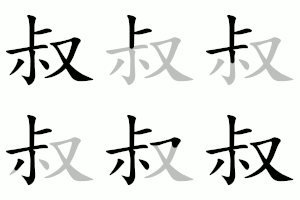 | |||
Han character
叔 (Kangxi radical 29, 又+6, 8 strokes, cangjie input 卜火水 (YFE), four-corner 27940, composition ⿰尗又)
Derived characters
References
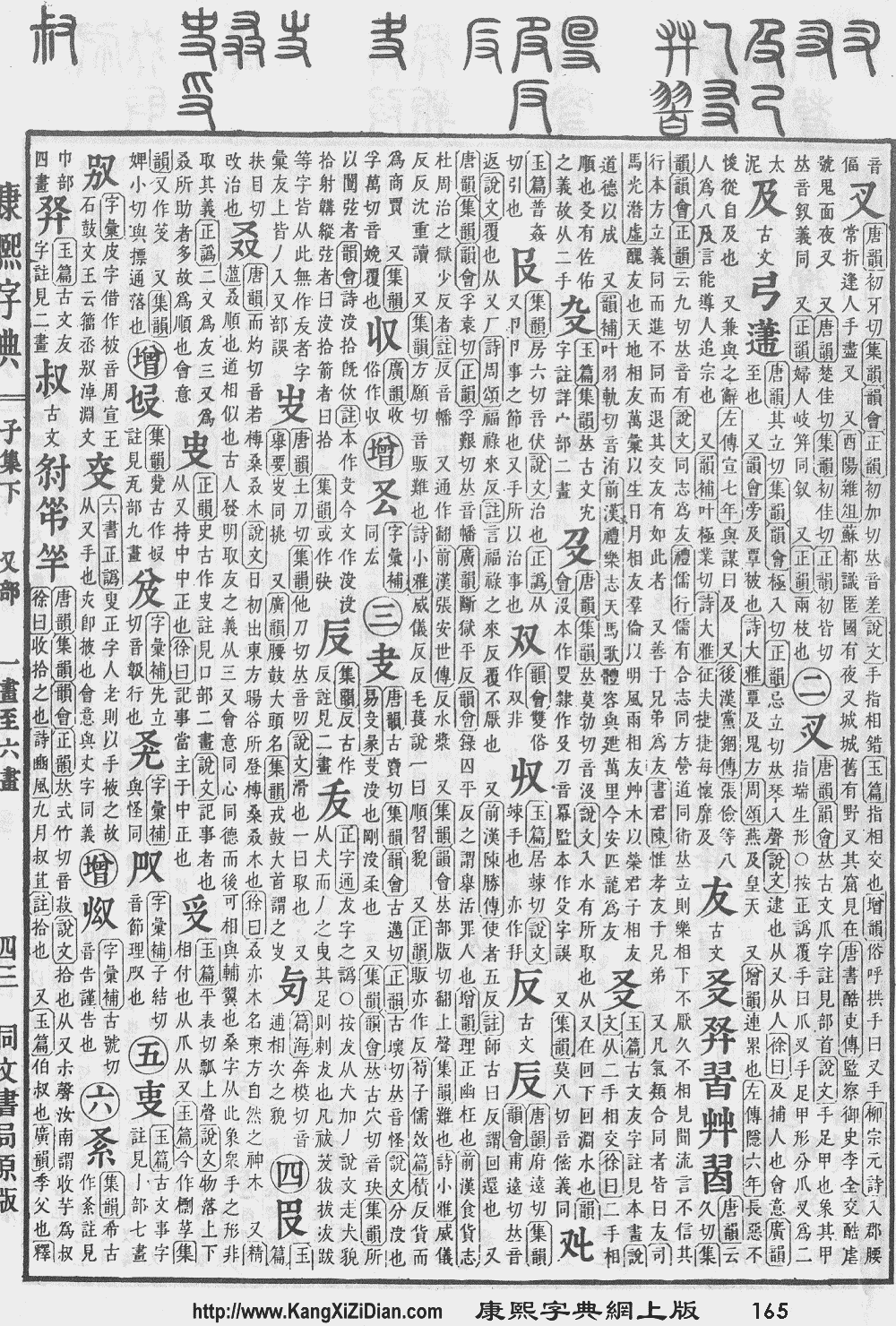
- Kangxi Dictionary: page 165, character 42
- Dai Kanwa Jiten: character 3154
- Dae Jaweon: page 376, character 24
- Hanyu Da Zidian (first edition): volume 1, page 396, character 1
- Unihan data for U+53D4
Chinese
Glyph origin
| Historical forms of the character 叔 | ||
|---|---|---|
| Western Zhou | Warring States | Shuowen Jiezi (compiled in Han) |
| Bronze inscriptions | Chu slip and silk script | Small seal script |
 |
 |
 |
| Old Chinese | |
|---|---|
| 椒 | *ʔsliw |
| 茮 | *ʔsliw |
| 踧 | *l'ɯːwɢ, *ʔslɯwɢ |
| 蔋 | *l'ɯːwɢ |
| 惄 | *nɯːwɢ |
| 戚 | *sʰlɯːwɢ |
| 慼 | *sʰlɯːwɢ |
| 鏚 | *sʰlɯːwɢ |
| 慽 | *sʰlɯːwɢ |
| 磩 | *sʰlɯːwɢ |
| 寂 | *zlɯːwɢ |
| 嘁 | *ʔsluːb |
| 墄 | *sʰlɯːɡ |
| 摵 | *srɯːɡ, *ʔslɯwɢ, *srɯwɢ |
| 督 | *ʔl'uːwɢ |
| 錖 | *ʔl'uːwɢ |
| 裻 | *ʔl'uːwɢ, *sluːwɢ |
| 傶 | *ʔslɯːwɢ |
| 蹙 | *ʔslɯwɢ |
| 槭 | *ʔslɯwɢ |
| 縬 | *ʔslɯwɢ, *ʔsrɯwɢ |
| 顣 | *ʔslɯwɢ |
| 敊 | *l̥ʰɯwɢ |
| 琡 | *ʔljɯwɢ, *l̥ʰjɯwɢ |
| 俶 | *l̥ʰjɯwɢ |
| 埱 | *l̥ʰjɯwɢ |
| 淑 | *ɦljɯwɢ |
| 婌 | *ɦljɯwɢ |
| 尗 | *hljɯwɢ |
| 叔 | *hljɯwɢ |
| 掓 | *hljɯwɢ |
| 菽 | *hljɯwɢ |
| 鮛 | *hljɯwɢ |
Ideogrammic compound (會意/会意) and phono-semantic compound (形聲/形声, OC *hljɯwɢ) : phonetic 尗 (OC *hljɯwɢ, “wooden stake”) + semantic 又 (“hand”) – using a wooden stake to dig the ground. Later borrowed for other uses.
Etymology 1
| simp. and trad. |
叔 | |
|---|---|---|
| alternative forms | ||
Sagart (1999) connects it to 督 (OC *ᵃtuk, “middle”) and reconstructs the Old Chinese as *ᵇs-tuk, the prefix possibly having a nominalizing function.
Alternatively, Starostin proposes a possible derivation from Proto-Sino-Tibetan *t(h)u (~ -iw) (“nephew”) and reconstructs the Old Chinese as *tikʷ (< *tiw-k?) ~ *tu-k.
Pronunciation
Definitions
叔
- † third brother (of four)
- paternal uncle (father's younger brother)
- brother-in-law (husband's younger brother)
- uncle (a term of address for a man around one's father's age or slightly younger)
- (historical) shu, a high rank in the early Zhou aristocracy
- 4th cent. BC, 《竹書紀年》 (Bamboo Annals), s.v. "周宣王" (Xuan King):
- 五年... 秋八月,方叔帥師伐荊蠻
- Year 5 [c. 820 BC]... Autumn, Month 8: Fangshu ("Uncle" Fang) led a force to slaughter the Jingman.
- 三監是管叔鮮、蔡叔度和霍叔處。
- The Three Guards were Guanshu Xian, Caishu Du, and Huoshu Chu.
- 4th cent. BC, 《竹書紀年》 (Bamboo Annals), s.v. "周宣王" (Xuan King):
- (Mainland China Hokkien, euphemistic) dad; father
- a surname
Synonyms
Compounds
- 三叔 (sānshū)
- 世叔
- 中叔
- 么叔
- 二叔 (èrshū)
- 五叔
- 以叔援嫂
- 仲叔
- 伯仲叔季 (bózhòngshūjì)
- 伯叔
- 伯夷叔齊/伯夷叔齐
- 保叔塔
- 叔丈
- 叔丈人
- 叔丈母
- 叔于田
- 叔仲
- 叔伯 (shūbai)
- 叔先
- 叔公 (shūgōng)
- 叔叔
- 叔向
- 叔均
- 叔夏
- 叔夜
- 叔妹
- 叔姑
- 叔姪/叔侄 (shūzhí)
- 叔婆 (shūpó)
- 叔子 (shūzi)
- 叔季 (shūjì)
- 叔孫/叔孙 (shūsūn)
- 叔山
- 叔帶/叔带
- 叔度
- 叔度陂
- 叔度陂湖
- 叔待
- 叔援嫂溺
- 叔敖
- 叔旦
- 叔服
- 叔母 (shūmǔ)
- 叔父 (shūfù)
- 叔牙
- 叔獻/叔献
- 叔相
- 叔祖 (shūzǔ)
- 叔祖母 (shūzǔmǔ)
- 叔翁
- 叔舅
- 叔豹
- 叔達/叔达
- 叔郎
- 叔鮪/叔鲔
- 叔齊/叔齐
- 同叔
- 四叔 (sìshū)
- 大叔 (dàshū)
- 大叔于田
- 太叔 (Tàishū)
- 夷叔
- 女叔
- 嫂溺叔援
- 子叔
- 孟仲叔季
- 季叔
- 孫叔/孙叔
- 家叔
- 小叔 (xiǎoshū)
- 小叔子 (xiǎoshūzi)
- 小爺叔/小爷叔
- 山姆叔叔 (Shānmǔ shūshu)
- 山姆大叔 (Shānmǔ Dàshū)
- 師叔/师叔 (shīshū)
- 庶叔
- 廖叔
- 從叔/从叔
- 從祖叔母/从祖叔母
- 惠叔
- 戎叔
- 方叔
- 族叔
- 步叔
- 班叔
- 申叔
- 痴叔
- 癡叔/痴叔
- 皇叔 (huángshū)
- 磬叔
- 老叔
- 芻叔/刍叔
- 范叔
- 蔡叔
- 血叔
- 表叔 (biǎoshū)
- 衰叔
- 賢叔/贤叔
- 阿叔 (āshū)
- 飂叔/𮨵叔
- 飂叔安/𮨵叔安
- 養叔/养叔
- 鮑叔/鲍叔
Descendants
Etymology 2
| simp. and trad. |
叔 | |
|---|---|---|
| alternative forms | ||
Cognate with 收 (OC *qʰljɯw, “to gather; to harvest”) (Schuessler, 2007).
Pronunciation
Definitions
叔
- (obsolete) to gather; to harvest
- 七月食瓜,八月斷壺,九月叔苴,采荼薪樗。 [Pre-Classical Chinese, trad.]
- From: The Classic of Poetry, c. 11th – 7th centuries BCE, translated based on James Legge's version
- Qīyuè shí guā, bāyuè duàn hú, jiǔyuè shū jū, cǎi tú xīn chū. [Pinyin]
- In the seventh month, they eat the melons;
In the eighth, they cut down the bottle-gourds;
In the ninth, they gather the hemp-seed;
They gather the sowthistle and make firewood of the Fetid tree.
七月食瓜,八月断壶,九月叔苴,采荼薪樗。 [Pre-Classical Chinese, simp.]
Pronunciation
Pronunciation
Pronunciation
Japanese
Korean
Etymology
From Middle Chinese 叔 (MC syuwk). Recorded as Middle Korean 슉〮 (syúk) (Yale: syuk) in Hunmong Jahoe (訓蒙字會 / 훈몽자회), 1527.