屬
See also: 属
| ||||||||
Translingual
Han character
屬 (Kangxi radical 44, 尸+18, 21 strokes, cangjie input 尸水田戈 (SEWI) or 尸卜卜戈 (SYYI), four-corner 77227, composition ⿸尸⿱⿻丨⿱丷八蜀(GHTV) or ⿸尸⿱⿲冫丨⿱丿丶蜀(GHTV) or ⿸尸⿱⿲𠄠丨𠄠蜀(JK))
References
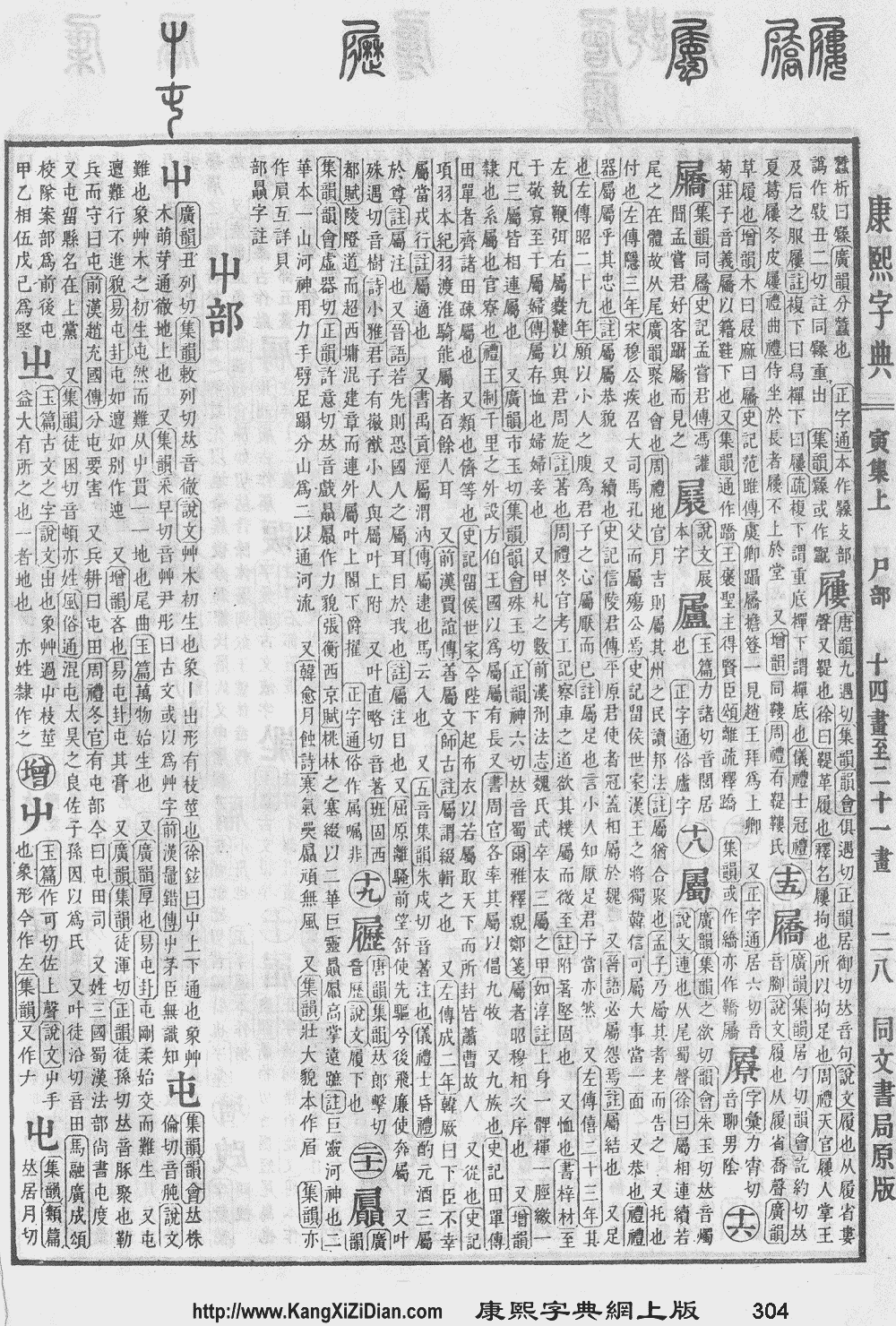
- Kangxi Dictionary: page 304, character 7
- Dai Kanwa Jiten: character 7821
- Dae Jaweon: page 602, character 17
- Hanyu Da Zidian (first edition): volume 2, page 982, character 8
- Unihan data for U+5C6C
Chinese
Glyph origin
Characters in the same phonetic series (蜀) (Zhengzhang, 2003)
| Old Chinese | |
|---|---|
| 襡 | *toːʔ, *toːɡs, *doːʔ, *doːɡ, *djoɡ |
| 噣 | *toːɡs, *tuɡs, *rtoːɡ, *tjoɡ |
| 斣 | *toːɡs |
| 歜 | *sdoːmʔ, *tʰjoɡ |
| 斀 | *rtoːɡ |
| 孎 | *rtoːɡ, *toɡ |
| 濁 | *rdoːɡ |
| 鐲 | *rdoːɡ, *zroːɡ, *djoɡ |
| 鸀 | *rdoːɡ, *tjoɡ |
| 擉 | *sʰroːɡ |
| 獨 | *doːɡ |
| 髑 | *doːɡ |
| 韣 | *doːɡ, *tjoɡ, *djoɡ |
| 斸 | *toɡ |
| 钃 | *toɡ |
| 欘 | *toɡ |
| 躅 | *doɡ |
| 蠋 | *doɡ, *tjoɡ |
| 燭 | *tjoɡ |
| 囑 | *tjoɡ |
| 矚 | *tjoɡ |
| 屬 | *tjoɡ, *djoɡ |
| 属 | *tjoɡ, *djoɡ |
| 蠾 | *tjoɡ, *djoɡ |
| 觸 | *tʰjoɡ |
| 臅 | *tʰjoɡ |
| 觕 | *sʰlaː, *zlaːʔ, *tʰjoɡ |
| 蜀 | *djoɡ |
Phono-semantic compound (形聲/形声, OC *tjoɡ, *djoɡ) : semantic 㞑 (“tail”) + phonetic 蜀 (OC *djoɡ).
Definitions
屬
Synonyms
Dialectal synonyms of 屬 (“to be born in the year of (one of the twelve Chinese zodiac signs)”) [map]
| Variety | Location | Words |
|---|---|---|
| Formal (Written Standard Chinese) | 屬 | |
| Mandarin | Taiwan | 屬 |
| Luoyang | 屬 | |
| Wanrong | 屬 | |
| Yinchuan | 屬 | |
| Guilin | 屬 | |
| Yangzhou | 屬 | |
| Singapore | 屬 | |
| Cantonese | Hong Kong | 屬 |
| Gan | Nanchang | 屬 |
| Hakka | Miaoli (N. Sixian) | 肖 |
| Pingtung (Neipu; S. Sixian) | 肖 | |
| Hsinchu County (Zhudong; Hailu) | 肖 | |
| Taichung (Dongshi; Dabu) | 肖 | |
| Hsinchu County (Qionglin; Raoping) | 肖 | |
| Yunlin (Lunbei; Zhao'an) | 肖 | |
| Huizhou | Jixi | 肖 |
| Eastern Min | Fuzhou | 肖 |
| Southern Min | Xiamen | 相 |
| Quanzhou | 相 | |
| Zhangzhou | 相 | |
| Tainan | 相 | |
| Penang (Hokkien) | 相 | |
| Singapore (Hokkien) | 相 | |
| Jieyang | 相 | |
| Haikou | 席 | |
| Wu | Ningbo | 肖 |
| Wenzhou | 肖 | |
| Jinhua | 肖, 屬 | |
Compounds
- 一家眷屬/一家眷属
- 下屬/下属 (xiàshǔ)
- 不屬/不属
- 僚屬/僚属 (liáoshǔ)
- 卑親屬/卑亲属
- 天屬/天属
- 官屬/官属
- 家屬/家属 (jiāshǔ)
- 專屬海域/专属海域
- 尊親屬/尊亲属
- 屬下/属下 (shǔxià)
- 屬人法/属人法
- 屬員/属员
- 屬國/属国 (shǔguó)
- 屬地/属地 (shǔdì)
- 屬地法/属地法
- 屬實/属实 (shǔshí)
- 屬性/属性 (shǔxìng)
- 屬於/属于 (shǔyú)
- 屬格/属格 (shǔgé)
- 屬相/属相
- 屬車/属车
- 役屬/役属
- 從屬/从属 (cóngshǔ)
- 戚屬/戚属
- 所屬/所属 (suǒshǔ)
- 支屬/支属
- 有情人終成眷屬/有情人终成眷属 (yǒuqíngrén zhōngchéng juànshǔ)
- 歸屬/归属 (guīshǔ)
- 法屬印度支那/法属印度支那 (Fǎshǔ Yìndùzhīnà)
- 法屬圭亞那/法属圭亚那
- 直屬/直属 (zhíshǔ)
- 直系親屬/直系亲属 (zhíxì qīnshǔ)
- 眷屬/眷属 (juànshǔ)
- 神仙眷屬/神仙眷属
- 私屬/私属
- 聯屬/联属
- 肖屬/肖属
- 舊屬/旧属
- 藩屬/藩属 (fānshǔ)
- 要作神仙眷屬,先作柴米夫妻/要作神仙眷属,先作柴米夫妻
- 親屬/亲属 (qīnshǔ)
- 親屬稱謂/亲属称谓
- 親屬語言/亲属语言
- 軍屬/军属 (jūnshǔ)
- 連屬/连属
- 部屬/部属 (bùshǔ)
- 配屬/配属 (pèishǔ)
- 金屬/金属 (jīnshǔ)
- 附屬/附属 (fùshǔ)
- 附屬品/附属品 (fùshǔpǐn)
- 附屬國/附属国 (fùshǔguó)
- 附屬物/附属物 (fùshǔwù)
- 隸屬/隶属 (lìshǔ)
- 領屬/领属 (lǐngshǔ)
- 類屬/类属
- 龍頭屬老成/龙头属老成
See also
Definitions
屬
- † to join; to combine
- † to compose; to write
- † to gather; to congregate
- † Alternative form of 囑/嘱 (zhǔ, “to entrust”)
- † Alternative form of 囑/嘱 (zhǔ, “to exhort; to urge”)
- † excuse; justification
- † Alternative form of 矚/瞩 (zhǔ, “to concentrate one's attention on”)
- † to wear; to bear
- † to be related with
- † to follow
- † Alternative form of 注 (zhù, “to pour”)
Japanese
| 属 | |
| 屬 |
Readings
- Go-on: しょく (shoku)←しよく (syoku, historical); ぞく (zoku)←ぞく (zoku, historical)
- Kan-on: しょく (shoku)←しよく (syoku, historical)
- Kan’yō-on: ぞく (zoku)
- Kun: さかん (sakan, 屬); つく (tsuku, 屬く); つける (tsukeru, 屬ける); つづく (tsuzuku, 屬く); つづける (tsuzukeru, 屬ける); つづる (tsuzuru, 屬る); やから (yakara, 屬)
- Nanori: つら (tsura); まさ (masa); やす (yasu)
Korean
Etymology 1
From Middle Chinese 屬 (MC dzyowk).
| Historical readings |
|---|
|
Pronunciation
- (SK Standard/Seoul) IPA(key): [sʰo̞k̚]
- Phonetic hangul: [속]
Compounds
Etymology 2
From Middle Chinese 屬 (MC tsyowk).
| Historical readings |
|---|
|
Pronunciation
- (SK Standard/Seoul) IPA(key): [t͡ɕʰo̞k̚]
- Phonetic hangul: [촉]
Compounds
Compounds
- 촉의 (屬意, chogui)
- 촉망 (屬望/囑望, chongmang)
- 동동촉촉 (洞洞屬屬, dongdongchokchok)
Vietnamese
Han character
屬: Hán Việt readings: thuộc[1][2][3], chúc[1][2][3], chú[3]
屬: Nôm readings: thuộc[4][5], chuộc[5], chúc[5]
References
- Trần (1999).
- Nguyễn (1974).
- Thiều Chửu (1942).
- Nguyễn (2014).
- Trần (2004).
This article is issued from Wiktionary. The text is licensed under Creative Commons - Attribution - Sharealike. Additional terms may apply for the media files.