牡
| ||||||||
Translingual
Han character
牡 (Kangxi radical 93, 牛+3, 7 strokes, cangjie input 竹手土 (HQG), four-corner 24510, composition ⿰牛土)
Derived characters
- 𪋂, 𧚒
References
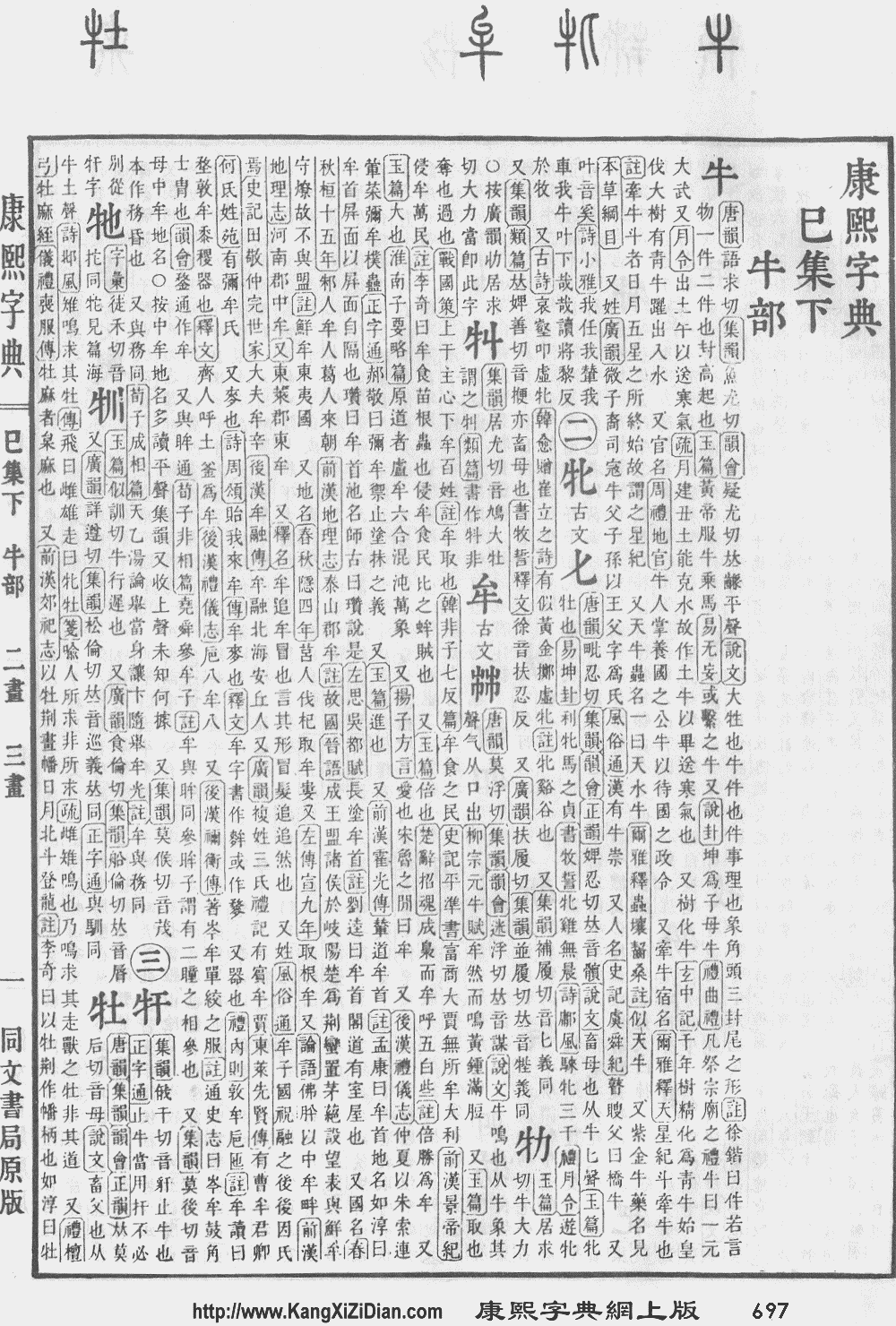
- Kangxi Dictionary: page 697, character 11
- Dai Kanwa Jiten: character 19933
- Dae Jaweon: page 1110, character 1
- Hanyu Da Zidian (first edition): volume 3, page 1801, character 2
- Unihan data for U+7261
Chinese
| simp. and trad. |
牡 | |
|---|---|---|
Glyph origin
| Historical forms of the character 牡 | |||
|---|---|---|---|
| Shang | Western Zhou | Shuowen Jiezi (compiled in Han) | Liushutong (compiled in Ming) |
| Oracle bone script | Bronze inscriptions | Small seal script | Transcribed ancient scripts |
 |
 |
 |
 |
Ideogrammic compound (會意/会意) : 牛 (“cattle”) + 丄. Various explanations exist, some propose 丄 (here unrelated to 上) depicts a penis to represent “male”. Later 丄 came to be written 土. See also the etymology of this character.
Etymology
Austroasiatic (Schuessler, 2007). Compare Proto-Mon-Khmer *ɟm(oo)l (“male”) (whence Khmer ឈ្មោល (chmool, “to be male”)), Old Mon jmūr ~ jmur (“male (elephant)”), Proto-Waic *(k)mɔj (“(wild) ox; buffalo”), Proto-Vietic *mɔːlʔ (“person; human being”) (whence Vietnamese mọi (“savage; barbarian”), Muong mõl (“human being”)).
An oracle bone graph for this word shows a vertical stick on a horizontal ground, possibly because it had been intended for an obsolete homophone cognate with Proto-Vietic *c-mɔːlʔ (“digging stick”), which alongside "male" may derive from a stem represented in Old Khmer cval (“to enter; to penetrate; (of animals) to copulate”), Khmu [script needed] (cmɔɔl, “to plant (rice) with a digging stick”), [script needed] (crmɔɔl, “digging stick”) (ibid.; Ferlus, 1987). Schuessler (2007) further proposes a relationship with 畝 (OC *mɯʔ, “cropland; mu (a Chinese measuring unit for area)”) (ibid.); see there for more.
Pronunciation
Definitions
牡
- (obsolete) male of animals
- 駉駉牡馬,在坰之野。 [Pre-Classical Chinese, trad.]
- From: The Classic of Poetry, c. 11th – 7th centuries BCE, translated based on James Legge's version
- Jiōngjiōng mǔ mǎ, zài jiōng zhī yě. [Pinyin]
- Fat and large are the stallions [/ male horses],
On the plains of the far-distant borders.
𬳶𬳶牡马,在坰之野。 [Pre-Classical Chinese, simp.]
- (obsolete) male genitals
- (obsolete) bolt of door
- (obsolete) hill; hump
- Used in 牡蠣/牡蛎 (mǔlì, “oyster”).
Compounds
References
- “牡”, in 漢語多功能字庫 (Multi-function Chinese Character Database), 香港中文大學 (the Chinese University of Hong Kong), 2014–
Japanese
Readings
Korean
Hanja
牡 • (mo) (hangeul 모, revised mo, McCune–Reischauer mo, Yale mo)
- This term needs a translation to English. Please help out and add a translation, then remove the text
{{rfdef}}.