次
| ||||||||
| ||||||||
Translingual
| Stroke order | |||
|---|---|---|---|
 | |||
Han character
次 (Kangxi radical 76, 欠+2, 6 strokes, cangjie input 戈一弓人 (IMNO) or 一一弓人 (MMNO), four-corner 17182 or 37182, composition ⿰冫欠(GJV) or ⿰二欠(HKT))
References
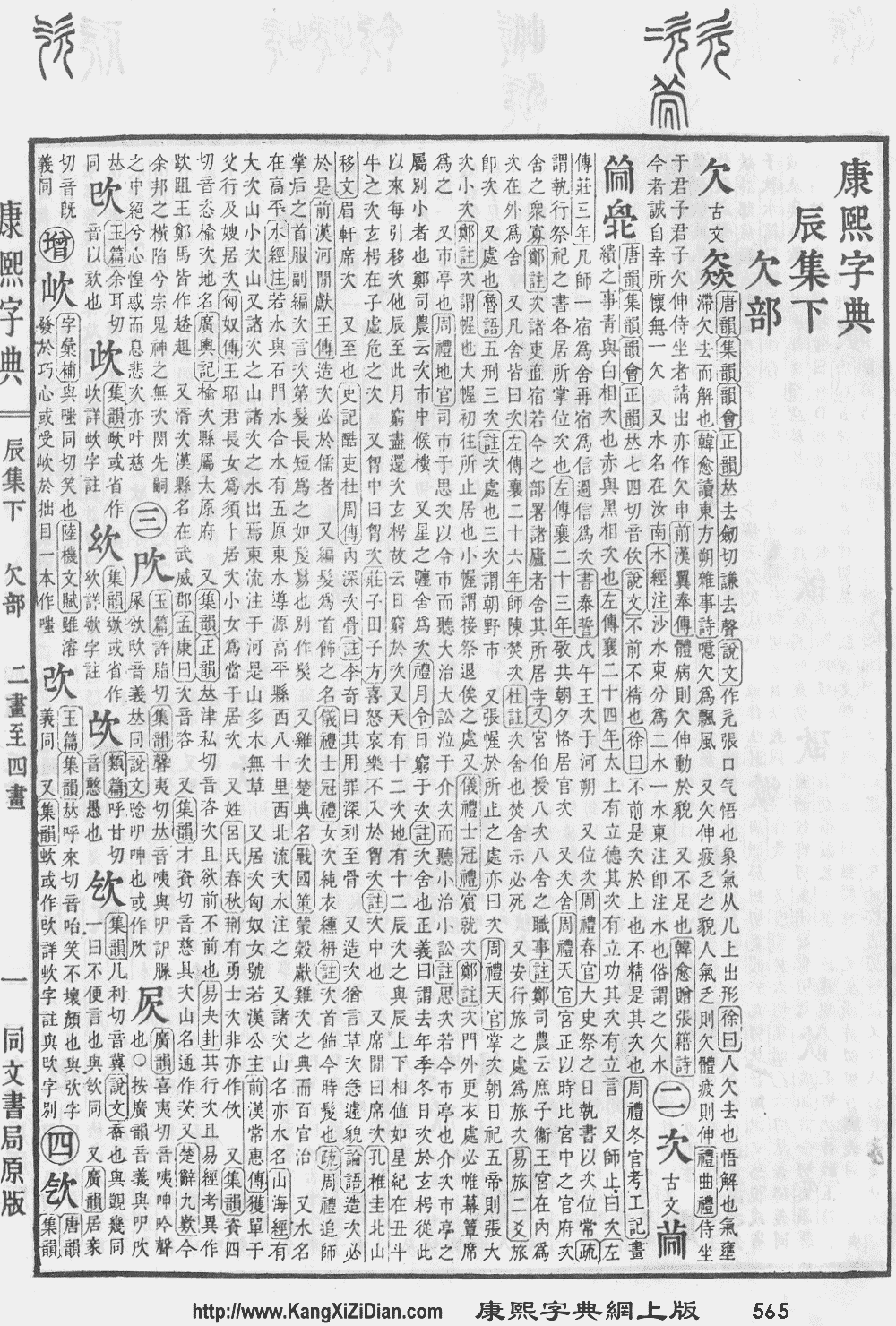
- Kangxi Dictionary: page 565, character 3
- Dai Kanwa Jiten: character 15992
- Dae Jaweon: page 954, character 1
- Hanyu Da Zidian (first edition): volume 3, page 2133, character 2
- Unihan data for U+6B21
- Unihan data for U+2F8EF
Chinese
| trad. | 次 | |
|---|---|---|
| simp. # | 次 | |
| alternative forms | 𠕞 𦮏 𠤣 | |
Glyph origin
| Historical forms of the character 次 | |||
|---|---|---|---|
| Shang | Western Zhou | Shuowen Jiezi (compiled in Han) | Liushutong (compiled in Ming) |
| Oracle bone script | Bronze inscriptions | Small seal script | Transcribed ancient scripts |
 |
 |
 |
 |
Ideogrammic compound (會意/会意) and possibly phono-semantic compound (形聲/形声, OC *sn̥ʰis) : phonetic 二 (OC *njis, “two”) + semantic 欠.
Etymology 1
Probably from *s- + 二 (OC *njis, “two”), from Proto-Sino-Tibetan *g/s-ni-s (Pulleyblank, 1962; Sagart and Baxter, 2012; STEDT).
Pronunciation
Definitions
次
- order; sequence
- 名次 ― míngcì ― position in a name list; place in a competition
- (algebra) order
- next in sequence; second
- 次子 ― cìzǐ ― second son
- (literary) to come next in order
- (literary) to arrange into ordered form; to put into sequence; to impose order; to compile
- inferior; substandard
- Classifier for times, as in frequency. ⇒ all nouns using this classifier
- (archaic, military) to station the troops at some place; to hold position at some place
- 春王正月,師次于郎,以俟陳人、蔡人。 [Classical Chinese, trad.]
- From: Commentary of Zuo, c. 4th century BCE
- Chūn wáng zhēngyuè, shī cì yú Láng, yǐ sì Chénrén, Càirén. [Pinyin]
- Spring, the first month (of Zhou calendar), the armies of Lu were stationed at Lang to await those of Chen and Cai.
春王正月,师次于郎,以俟陈人、蔡人。 [Classical Chinese, simp.]
- (literary) resting place
- 客次 ― kècì ― (please add an English translation of this usage example)
- 六二:旅即次,懷其資,得童僕貞。 [Pre-Classical Chinese, trad.]
- From: I Ching, 11th – 8th century BCE
- Liù èr: lǚ jí cì, huái qí zī, dé tóngpú zhēn. [Pinyin]
- The second SIX, divided, shows the stranger, occupying his lodging-house, carrying with him his means of livelihood, and provided with good and trusty servants.
六二:旅即次,怀其资,得童仆贞。 [Pre-Classical Chinese, simp.]
- (literary) middle
Synonyms
Compounds
- 一次全倒
- 一次方程 (yīcì fāngchéng)
- 一次能源 (yīcì néngyuán)
- 三回五次
- 上次 (shàngcì)
- 三次 (Sāncì)
- 下次 (xiàcì)
- 下次人等
- 下次孩兒/下次孩儿
- 下次小的
- 三次方
- 三番五次 (sānfānwǔcì)
- 三番兩次/三番两次 (sānfānliǎngcì)
- 不次
- 世次 (shìcì)
- 中次
- 主次 (zhǔcì)
- 久次
- 乖次
- 亂次/乱次
- 二十八次
- 二次全倒
- 二次函數/二次函数 (èrcì hánshù)
- 二次大戰/二次大战
- 二次感染
- 二次曲線/二次曲线
- 二次曲面
- 二次汙染/二次污染
- 二次能源 (èrcì néngyuán)
- 二次革命 (Èrcì Gémìng)
- 亞次/亚次
- 人次 (réncì)
- 今次 (jīncì)
- 介次
- 以次
- 位次 (wèicì)
- 依次 (yīcì)
- 俟次
- 信次
- 倫次/伦次 (lúncì)
- 偏次
- 先次
- 入次
- 兩次三番/两次三番 (liǎngcìsānfān)
- 兩次運球/两次运球
- 八次
- 其次 (qícì)
- 出次
- 分次 (fēncì)
- 列次
- 別次/别次
- 初次 (chūcì)
- 刪次/删次
- 前次
- 副次
- 功次
- 十二次 (shí'èrcì)
- 千次
- 印次 (yìncì)
- 卷次
- 取次 (qǔcì)
- 名次 (míngcì)
- 品次
- 員次/员次
- 喪次/丧次
- 坐次 (zuòcì)
- 場次/场次 (chǎngcì)
- 塗次/涂次
- 墓次
- 壓次/压次
- 多次曝光
- 大次
- 失次
- 如次 (rúcì)
- 妝次/妆次
- 季次
- 安次 (Āncì)
- 官次
- 客次
- 家次
- 將次/将次 (jiāngcì)
- 小次
- 尸次
- 居次 (jūcì)
- 屢次/屡次 (lǚcì)
- 屢次三番/屡次三番
- 層次/层次 (céngcì)
- 層次井然/层次井然
- 層次分明/层次分明
- 屯次
- 崖次 (yácì)
- 左次
- 差次
- 市次
- 席次 (xícì)
- 幃次/帏次
- 幄次
- 幕次
- 年次 (niáncì)
- 幾次/几次
- 幾次三番/几次三番
- 序次 (xùcì)
- 座次 (zuòcì)
- 庸次
- 彙次/汇次
- 待次
- 後次/后次
- 徙次
- 循次
- 復次/复次 (fùcì)
- 循次而進/循次而进
- 思次
- 慞惶失次
- 批次處理/批次处理
- 按次
- 括次
- 挨次 (āicì)
- 排次
- 推次
- 捱次
- 揆次
- 撰次
- 操次
- 攝次/摄次
- 改次
- 敘次/叙次
- 整次
- 料次
- 旅次
- 旬次
- 星次
- 更次
- 會次/会次
- 朝次
- 本次
- 架次
- 校次
- 梯次 (tīcì)
- 條次/条次
- 業次/业次
- 榆次之辱
- 槧次/椠次
- 模次
- 檔次/档次 (dàngcì)
- 櫛次鱗比/栉次鳞比
- 櫛比鱗次/栉比鳞次 (zhìbǐlíncì)
- 次丁
- 次世
- 次且 (zījū)
- 次主
- 次乘
- 次事
- 次介
- 次傳/次传
- 次公
- 次列
- 次前
- 次印
- 次卷
- 次卿 (cìqīng)
- 次及
- 次品 (cìpǐn)
- 次大陸/次大陆 (cìdàlù)
- 次妻 (cìqī)
- 次子 (cìzǐ)
- 次室
- 次家
- 次宴
- 次將/次将
- 次對/次对
- 次對官/次对官
- 次巨星 (cìjùxīng)
- 次布
- 次席
- 次序 (cìxù)
- 次後/次后 (cìhòu)
- 次息
- 次成河
- 次房
- 次所
- 次敘/次叙
- 次數/次数 (cìshù)
- 次數線圖/次数线图
- 次文化 (cìwénhuà)
- 次方 (cìfāng)
- 次日 (cìrì)
- 次早 (cìzǎo)
- 次春
- 次次 (cìcì)
- 次止
- 次殖民地
- 次比
- 次浮
- 次生 (cìshēng)
- 次生林 (cìshēnglín)
- 次生礦物/次生矿物
- 次男 (cìnán)
- 次相
- 次矮星 (cì'ǎixīng)
- 次祀
- 次祖
- 次神
- 次程式
- 次第 (cìdì)
- 次等 (cìděng)
- 次篆
- 次級/次级 (cìjí)
- 次級團體/次级团体
- 次級文化/次级文化
- 次級資料/次级资料
- 次經/次经 (cìjīng)
- 次緒/次绪
- 次聖/次圣
- 次舍
- 次著
- 次蟗
- 次行
- 次要 (cìyào)
- 次貨/次货 (cìhuò)
- 次資/次资
- 次賞/次赏
- 次路
- 次躔
- 次車/次车
- 次輅/次辂
- 次輔/次辅
- 次述
- 次重音
- 次長/次长 (cìzhǎng)
- 次長祖/次长祖
- 次雎
- 次非
- 次韻/次韵
- 次題/次题
- 次骨
- 次鱗/次鳞
- 止次
- 正次
- 此次 (cǐcì)
- 歷次/历次 (lìcì)
- 每次 (měicì)
- 比次
- 水次
- 江次
- 洛次
- 海次
- 淹次
- 漸次/渐次 (jiàncì)
- 無次/无次
- 焚次
- 無銓次/无铨次
- 營次/营次
- 爵次
- 版次 (bǎncì)
- 班次 (bāncì)
- 生次
- 甲次
- 番次
- 疊次/叠次
- 目次 (mùcì)
- 相次
- 相次即世
- 祔次
- 祿次/禄次
- 秩次
- 移次
- 積次/积次
- 立克次體/立克次体 (lìkècì-tǐ)
- 笑次
- 第一次 (dì-yī cì)
- 第次
- 筆次/笔次
- 等次
- 節次/节次 (jiécì)
- 篇次
- 粧次/妆次
- 級次/级次
- 紬次/绸次
- 累次
- 累次三番
- 緒次/绪次
- 編次/编次 (biāncì)
- 纂次
- 考次
- 職次/职次
- 胸次
- 舍次
- 舟次
- 航次
- 苫次
- 草次
- 萃次
- 號次/号次
- 行次
- 表次
- 衰次
- 裒次
- 襲次/袭次
- 觴次/觞次
- 言次
- 言無倫次/言无伦次
- 設次/设次
- 詮次/诠次
- 話次/话次
- 語次/语次
- 語無倫次/语无伦次 (yǔwúlúncì)
- 語無詮次/语无诠次
- 論次/论次
- 談次/谈次
- 諸次/诸次
- 譔次/撰次
- 譜次/谱次
- 貫次/贯次
- 貫魚之次/贯鱼之次
- 資次/资次
- 賓次/宾次
- 越次
- 超次
- 越次超倫/越次超伦
- 越次躐等
- 超階越次/超阶越次
- 路次
- 躔次
- 躐次
- 車次/车次 (chēcì)
- 輪次/轮次
- 迭次 (diécì)
- 迴次/回次
- 造次 (zàocì)
- 逡次
- 這次/这次
- 逐次 (zhúcì)
- 連次/连次
- 途次
- 造次顛沛/造次颠沛
- 進次/进次
- 道次
- 過次/过次
- 運次/运次
- 逾次超秩
- 遞次/递次
- 遷次/迁次
- 遲次/迟次
- 避次
- 郊次
- 部次
- 酒次
- 酒次青衣
- 重·次輕/重·次轻 (zhòng-cìqīng)
- 野次
- 釐次
- 銓次/铨次
- 門次/门次
- 防次
- 限次
- 除次
- 陵次
- 陸次/陆次
- 階次/阶次
- 隨次/随次
- 雅庫次克/雅库次克
- 集次
- 雜次/杂次
- 離次/离次
- 雲次鱗集/云次鳞集
- 需次
- 露次
- 非次
- 順次/顺次 (shùncì)
- 須次/须次
- 頓次/顿次
- 頻次/频次
- 類次/类次
- 食次
- 館次/馆次
- 首次 (shǒucì)
- 高次方程
- 鮑魚之次/鲍鱼之次
- 鱗次/鳞次 (líncì)
- 鱗次櫛比/鳞次栉比 (líncìzhìbǐ)
- 鱗次相比/鳞次相比
- 鳥次/鸟次
- 點次/点次
- 齒次/齿次
Pronunciation
Pronunciation
Pronunciation
Definitions
次
- Only used in 具次.
Japanese
| Shinjitai | 次 |  |
| Kyūjitai [1] |
次󠄁 次+ 󠄁?(Adobe-Japan1) |
 |
| 次󠄄 次+ 󠄄?(Hanyo-Denshi) (Moji_Joho) | ||
| The displayed kanji may be different from the image due to your environment. See here for details. | ||
Readings
- Go-on: し (shi, Jōyō)
- Kan-on: し (shi, Jōyō)
- Kan’yō-on: じ (ji, Jōyō)
- Kun: つぎ (tsugi, 次, Jōyō); つぐ (tsugu, 次ぐ, Jōyō); すがい (sugai, 次い)←すがひ (sugafi, 次ひ, historical); すがう (sugau, 次う)←すがふ (sugafu, 次ふ, historical); すき (suki, 次き); すく (suku, 次く); ついで (tsuide, 次いで); とまる (tomaru, 次まる); やどる (yadoru, 次る)
- Nanori: き (ki); すき (suki); ちか (chika); つぎ (tsugi); つぐ (tsugu); ひで (hide); やどる (yadoru); よし (yoshi)
Etymology 1
| Kanji in this term |
|---|
| 次 |
| し Grade: 3 |
| on’yomi |
From Middle Chinese 次 (MC tshijH, “in order; second”).
Less common reading in modern Japanese. Superseded in most cases by ji; see below.
Pronunciation
- IPA(key): [ɕi]
Usage notes
Only found in compounds.
Derived terms
Etymology 2
| Kanji in this term |
|---|
| 次 |
| じ Grade: 3 |
| kan’yōon |
/si/ → /ʑi/ → /d͡ʑi/
Sound shift from shi above.[2]
Pronunciation
- IPA(key): [d͡ʑi]
Counter
次 • (-ji)
- number of times: an ordinal marker
- 第四次計画
- daiyonji keikaku
- the fourth plan
- 第四次計画
- number in a sequence, number of aspects or dimensions
- 二次方程式、三次式
- niji hōteishiki, sanji shiki
- a quadratic equation, a third order expression
- 二次方程式、三次式
Usage notes
Seldom found in isolation.
Prefix
次 • (ji-)
Etymology 3
| Kanji in this term |
|---|
| 次 |
| つぎ Grade: 3 |
| kun’yomi |
Nominalization of the 連用形 (ren'yōkei, “continuative or stem form”) of Old Japanese-derived verb 次ぐ (tsugu, “to be in a sequence; to follow, to continue from something, to be next; to connect, to join”).[2]
Noun
次 • (tsugi)
- next, order, sequence, below
- 子供たちは次のように述べています。
- Kodomotachi wa tsugi no yō ni nobeteimasu.
- The children said as follows.
- From the Emacs tutorial (English)
- では C-v (次の画面を見る)をタイプして次の画面に進んで下さい。(さあ、やってみましょう。コントロールキーを押しながら v です)
- De wa C-v (tsugi no gamen o miru) o taipu shite tsugi no gamen ni susunde kudasai.(Sā, yattemimashō. Kontorōrukī o oshinagara v desu)
- Now type C-v (View next screen) to move to the next screen. (go ahead, do it by depressing the control key and v together)
- では C-v (次の画面を見る)をタイプして次の画面に進んで下さい。(さあ、やってみましょう。コントロールキーを押しながら v です)
- 子供たちは次のように述べています。
Etymology 4
| Kanji in this term |
|---|
| 次 |
| すき Grade: 3 |
| kun’yomi |
| Alternative spelling |
|---|
| 主基 |
Nominalization of the 連用形 (ren'yōkei, “continuative or stem form”) of Old Japanese-derived verb 次く (suku, “to follow, to continue from something, to be next;”).[2]
The verb form was obsolete even in olden times. Existence of the verb, possibly related to tsugu mentioned above, is inferred from placenames found in the Man'yōshū and other ancient poetry.[2]
Pronunciation
- IPA(key): [sɨᵝkʲi]
Noun
次 • (suki)
Etymology 5
| Kanji in this term |
|---|
| 次 |
| ついで Grade: 3 |
| kun’yomi |
| Alternative spellings |
|---|
| 序 序で 第 次いで 尋いで 次第 嗣 |
/tuɡite/ → /tuide/
Sound shift from 次第 (tsugite, “order, sequence”), itself originally the 連用形 (ren'yōkei, “continuative or stem form”) of now-obsolete Old Japanese-derived verb 継ぎつ (tsugitsu, “to do things in sequence, to establish an order”).[2]
Noun
次 • (tsuide)
- order, sequence
- follower, successor; the next thing in a sequence
- a good opportunity to do something; doing something incidental to something else
Usage notes
The good opportunity sense is more often encountered as 序でに (tsuide ni).
References
- Haga, Gōtarō (1914) 漢和大辞書 [The Great Kanji-Japanese Dictionary] (in Japanese), Fourth edition, Tōkyō: Kōbunsha, , page 1185 (paper), page 643 (digital)
- Shōgaku Tosho (1988) 国語大辞典(新装版) [Unabridged Dictionary of Japanese (Revised Edition)] (in Japanese), Tōkyō: Shogakukan, →ISBN
- Matsumura, Akira, editor (2006), 大辞林 [Daijirin] (in Japanese), Third edition, Tōkyō: Sanseidō, →ISBN
Vietnamese
Han character
次: Hán Việt readings: thứ (
次: Nôm readings: thớ[1][3][6][4][5][7], thứ[1][2][4][7], thứa[2][4][5][7], khứa[1]
- chữ Hán form of thứ (“inferior in quality; order, rank, sequence”).
- Nôm form of thớ (“This term needs a translation to English. Please help out and add a translation, then remove the text
{{rfdef}}.”). - Nôm form of thứa (“This term needs a translation to English. Please help out and add a translation, then remove the text
{{rfdef}}.”).
Compounds
- 次元 (thứ nguyên)
References
- Nguyễn (2014).
- Nguyễn et al. (2009).
- Trần (2004).
- Bonet (1899).
- Génibrel (1898).
- Hồ (1976).
- Taberd & Pigneau de Béhaine (1838).