波
See also: 疲
| ||||||||
Translingual
Han character
波 (Kangxi radical 85, 水+5, 8 strokes, cangjie input 水木竹水 (EDHE), four-corner 34147, composition ⿰氵皮)
Descendants
- Japanese: は (ha)
References
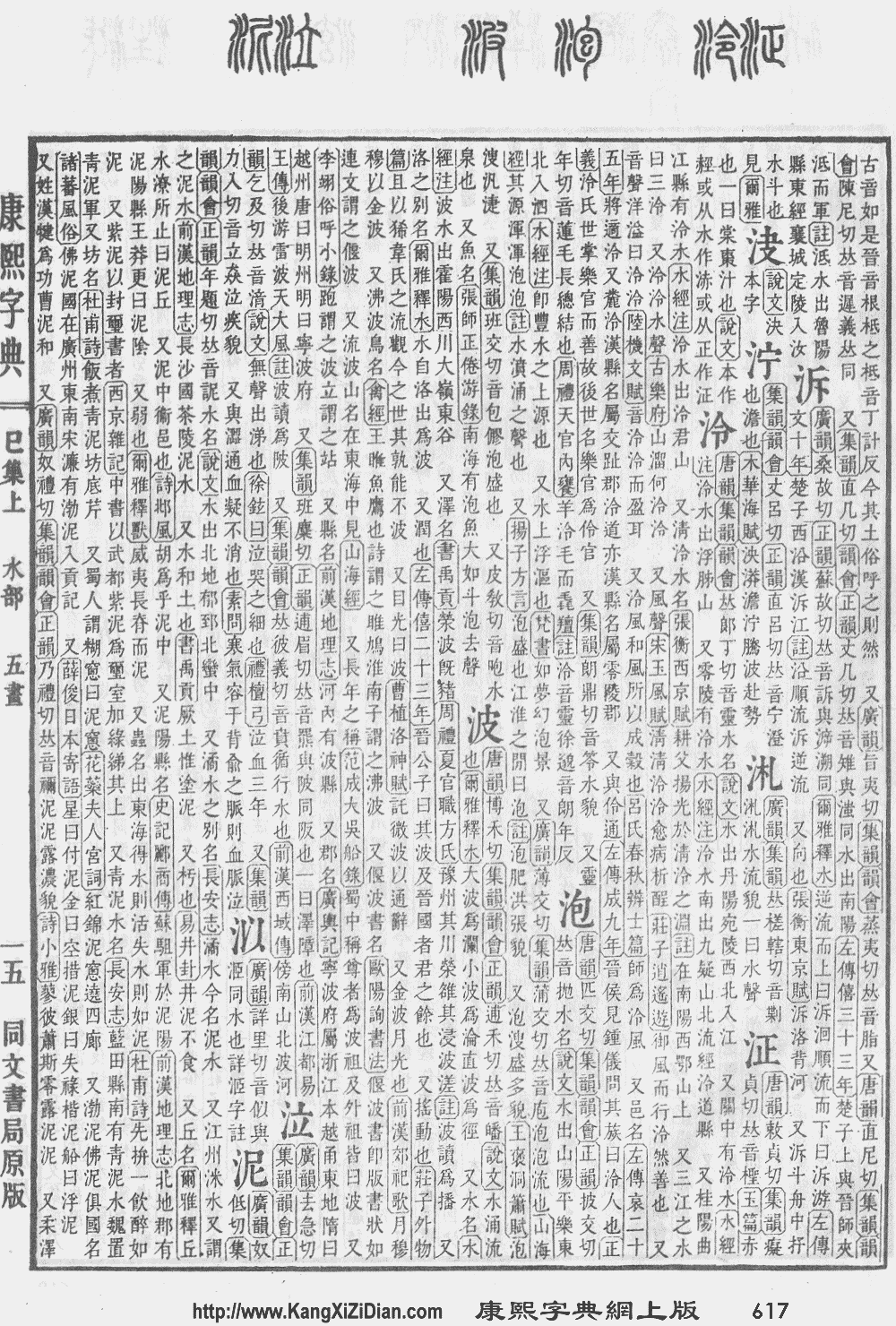
- Kangxi Dictionary: page 617, character 8
- Dai Kanwa Jiten: character 17308
- Dae Jaweon: page 1012, character 6
- Hanyu Da Zidian (first edition): volume 3, page 1597, character 7
- Unihan data for U+6CE2
Chinese

水面波
Glyph origin
Characters in the same phonetic series (皮) (Zhengzhang, 2003)
| Old Chinese | |
|---|---|
| 陂 | *pral, *prals |
| 詖 | *pral, *prals |
| 彼 | *pralʔ |
| 柀 | *pralʔ |
| 佊 | *pralʔ, *prals |
| 貱 | *prals |
| 跛 | *prals, *paːlʔ |
| 披 | *pʰral, *pʰralʔ |
| 鈹 | *pʰral |
| 帔 | *pʰral, *pʰrals |
| 鮍 | *pʰral |
| 耚 | *pʰral |
| 狓 | *pʰral |
| 翍 | *pʰral |
| 旇 | *pʰral, *brals |
| 秛 | *pʰral, *pʰrals |
| 紴 | *pʰralʔ, *paːl |
| 皮 | *bral |
| 疲 | *bral |
| 被 | *bralʔ, *brals |
| 髲 | *brals |
| 鞁 | *brals |
| 骳 | *mbralʔ |
| 波 | *paːl |
| 碆 | *paːl, *baːl |
| 菠 | *paːl |
| 簸 | *paːlʔ, *paːls |
| 駊 | *paːlʔ, *pʰaːlʔ |
| 頗 | *pʰaːl, *pʰaːlʔ, *pʰaːls |
| 坡 | *pʰaːl |
| 玻 | *pʰaːl |
| 破 | *pʰaːls |
| 婆 | *baːl |
| 蔢 | *baːl |
Phono-semantic compound (形聲/形声, OC *paːl) : semantic 氵 (“water”) + phonetic 皮 (OC *bral).
Etymology 1
| simp. and trad. |
波 | |
|---|---|---|
- “wave; undulation”
- Debated.
- STEDT and Starostin derive it from Proto-Sino-Tibetan *r/m-ba (“wave; ripple”). Cognate with Tibetan རྦ (rba), དབའ (dba', “wave”).
- Schuessler (2007) notes a mismatch of the vowels in the above comparanda, and instead posits a root *paj (“slanted; not level”), also subsuming 陂 (OC *pral, “slope; slanting”).
- Wang (1982) relates it to 播 (OC *paːls, “to winnow”), 簸 (OC *paːlʔ, *paːls, “to winnow”).
Pronunciation
Definitions
波
Compounds
- 一寸秋波
- 一波
- 一波三折 (yībōsānzhé)
- 三角波 (sānjiǎobō)
- 中波波段
- 中短波
- 也波
- 仁波切 (rénbōqiè)
- 伏波
- 偃波書/偃波书
- 光波 (guāngbō)
- 六波羅蜜/六波罗蜜
- 凌波 (língbō)
- 凌波仙子
- 凌波微步
- 凌波殿
- 凌波舞
- 凌波襪
- 則波/则波
- 加利波里
- 加里波的
- 古井不波
- 古井無波/古井无波
- 古井重波
- 周波 (zhōubō)
- 回波
- 太陽電波/太阳电波
- 奔波 (bēnbō)
- 奔波勞碌/奔波劳碌
- 嬌波/娇波
- 孤子波 (gūzǐ bō)
- 孤波 (gūbō)
- 孤立子波 (gūlìzǐ bō)
- 孤立波 (gūlìbō)
- 寧波市/宁波市
- 尺水丈波
- 尺波
- 尺波電謝/尺波电谢
- 巴波亞/巴波亚 (bābōyà)
- 平地波瀾/平地波澜
- 平地風波/平地风波
- 強波器/强波器
- 微波 (wēibō)
- 微波爐/微波炉 (wēibōlú)
- 微波食品
- 心波
- 急波波
- 恩波
- 情海生波
- 拔爾波亞/拔尔波亚
- 推波助瀾/推波助澜 (tuībōzhùlán)
- 捲浪翻波/卷浪翻波
- 揚波/扬波
- 擁霧翻波/拥雾翻波
- 擺動波/摆动波
- 政治波普
- 方波 (fāngbō)
- 暗送秋波 (ànsòngqiūbō)
- 曼波 (mànbō)
- 橫波/横波 (héngbō)
- 檢波/检波 (jiǎnbō)
- 歷經波折/历经波折
- 毫米波
- 波以耳
- 波俏
- 波光
- 波光瀲灩/波光潋滟
- 波光粼粼 (bōguānglínlín)
- 波光蕩漾/波光荡漾
- 波光閃閃/波光闪闪
- 波函數/波函数 (bōhánshù)
- 波動/波动 (bōdòng)
- 波及 (bōjí)
- 波及無辜/波及无辜
- 波哥大 (Bōgēdà)
- 波喳
- 波士尼亞/波士尼亚 (Bōshìníyà)
- 波士頓/波士顿 (Bōshìdùn)
- 波多黎各 (Bōduōlígè)
- 波娘
- 波子曼
- 波導/波导 (bōdǎo)
- 波導管/波导管 (bōdǎoguǎn)
- 波峰 (bōfēng)
- 波峭
- 波布政權/波布政权
- 波布那
- 波希
- 波希戰爭/波希战争
- 波希米亞/波希米亚 (Bōxīmǐyà)
- 波幅 (bōfú)
- 波平浪靜/波平浪静
- 波形 (bōxíng)
- 波形板
- 波微
- 波恩病
- 波扇
- 波折 (bōzhé)
- 波提且利
- 波斯 (Bōsī)
- 波斯喀木 (Bōsīkāmù)
- 波斯國/波斯国 (Bōsī Guó)
- 波斯地毯
- 波斯尼亞和黑塞哥維那/波斯尼亚和黑塞哥维那 (Bōsīníyà hé Hēisàigēwéinà)
- 波斯帝國/波斯帝国
- 波斯教
- 波斯灣/波斯湾 (Bōsī Wān)
- 波斯皁莢/波斯皁荚
- 波斯菊
- 波旁王朝
- 波昂
- 波札那 (Bōzhánà)
- 波束 (bōshù)
- 波查
- 波段 (bōduàn)
- 波河
- 波波 (bōbō)
- 波波劫劫
- 波波吒吒
- 波河平原
- 波波悄悄
- 波波淥淥/波波渌渌
- 波波漉漉
- 波波碌碌
- 沿波討源/沿波讨源
- 波津
- 波流
- 波洛克
- 波浪 (bōlàng)
- 波浪熱/波浪热
- 波浪週期/波浪周期
- 波浪銳度/波浪锐度
- 波浪阻力
- 波涌雲亂/波涌云乱 (bōyǒngyúnluàn)
- 波浪鼓 (bōlànggǔ)
- 波源 (bōyuán)
- 波漾
- 波濤/波涛 (bōtāo)
- 波濤洶湧/波涛汹涌 (bōtāoxiōngyǒng)
- 波瀾/波澜 (bōlán)
- 波瀾壯闊/波澜壮阔 (bōlánzhuàngkuò)
- 波瀾老成/波澜老成
- 波爾/波尔
- 波爾卡/波尔卡 (bō'ěrkǎ)
- 波爾卡舞/波尔卡舞
- 波爾多/波尔多 (Bō'ěrduō)
- 波特 (Bōtè)
- 波特萊爾/波特莱尔
- 波特酒
- 波狀熱/波状热 (bōzhuàngrè)
- 波痕
- 波盪/波荡 (bōdàng)
- 波磔 (bōzhé)
- 波磔點畫/波磔点画
- 波稜菜/波棱菜
- 波節/波节 (bōjié)
- 波紋/波纹 (bōwén)
- 波紋如縠/波纹如縠
- 波納爾/波纳尔
- 波紋管/波纹管
- 波累 (bōlěi)
- 波羅/波罗 (bōluó)
- 波羅夷/波罗夷 (bōluóyí)
- 波羅的海/波罗的海 (Bōluódì Hǎi)
- 波羅蓋/波罗盖 (bōluógài)
- 波羅蜜/波罗蜜 (bōluómì)
- 波羅門教/波罗门教
- 波群
- 波耳
- 波能
- 波腹 (bōfù)
- 波臣
- 波臣派
- 波若 (bōrě)
- 波茨坦 (Bōcítǎn)
- 波蕩/波荡 (bōdàng)
- 波蘭/波兰 (Bōlán)
- 波蘭舞曲/波兰舞曲
- 波蘭走廊/波兰走廊
- 波詭雲譎/波诡云谲 (bōguǐyúnjué)
- 波譜/波谱 (bōpǔ)
- 波譎雲詭/波谲云诡 (bōjuéyúnguǐ)
- 波谷 (bōgǔ)
- 波路壯闊/波路壮阔
- 波蹅
- 波迸
- 波逃
- 波迸流移
- 波速
- 波道
- 波長/波长 (bōcháng)
- 波開浪裂/波开浪裂
- 波隆那
- 波霸 (bōbà)
- 波音 (Bōyīn)
- 波高
- 波髮藻/波发藻
- 波黑 (Bōhēi)
- 洪波 (hóngbō)
- 流波
- 洪波滾雪/洪波滚雪
- 海不揚波/海不扬波 (hǎibùyángbō)
- 海不波溢
- 浪恬波靜/浪恬波静
- 海波 (hǎibō)
- 海波不驚/海波不惊
- 消波塊/消波块 (xiāobōkuài)
- 海沸波翻
- 淚波/泪波
- 淪波舟/沦波舟
- 淺海波/浅海波
- 溢波
- 澴波
- 濾波/滤波 (lǜbō)
- 濾波器/滤波器 (lǜbōqì)
- 無波無浪/无波无浪
- 無線電波/无线电波 (wúxiàndiànbō)
- 煙波/烟波 (yānbō)
- 煙波客/烟波客
- 煙波浩渺/烟波浩渺
- 煙波萬頃/烟波万顷
- 煙波釣叟/烟波钓叟
- 煙波釣徒/烟波钓徒
- 爆炸波
- 的黎波里 (Dīlíbōlǐ)
- 目波
- 眼波 (yǎnbō)
- 短波 (duǎnbō)
- 短波廣播/短波广播
- 碌碌波波
- 碧波 (bìbō)
- 碧波爽清
- 碧波萬頃/碧波万顷
- 示波器 (shìbōqì)
- 秋波 (qiūbō)
- 秋波送情 (qiūbō sòngqíng)
- 第一波
- 簾波/帘波
- 粼粼波光
- 縱波/纵波 (zòngbō)
- 群波
- 老魚跳波/老鱼跳波 (lǎoyútiàobō)
- 者波
- 聲波/声波 (shēngbō)
- 脈波體/脉波体
- 腦波/脑波 (nǎobō)
- 臉波/脸波
- 臨去秋波/临去秋波
- 藍波/蓝波
- 藍波主義/蓝波主义
- 衝擊波/冲击波 (chōngjībō)
- 衝波激浪/冲波激浪
- 衝波逆折/冲波逆折
- 西風波/西风波
- 趁波逐浪
- 趁浪逐波
- 超短波 (chāoduǎnbō)
- 超聲波/超声波 (chāoshēngbō)
- 超音波 (chāoyīnbō)
- 軒然大波/轩然大波 (xuānrándàbō)
- 載波/载波 (zàibō)
- 送秋波 (sòngqiūbō)
- 逐浪隨波/逐浪随波
- 金波
- 金波玉液
- 鋸齒波/锯齿波 (jùchǐbō)
- 長波/长波 (chángbō)
- 防波堤 (fángbōdī)
- 阿波羅/阿波罗 (Ābōluó)
- 隨波漂流/随波漂流
- 隨波逐塵/随波逐尘
- 隨波逐流/随波逐流 (suíbōzhúliú)
- 隨波逐浪/随波逐浪
- 雲譎波詭/云谲波诡 (yúnjuébōguǐ)
- 電波/电波 (diànbō)
- 電磁波/电磁波 (diàncíbō)
- 震波 (zhènbō)
- 震波測勘/震波测勘
- 面波羅/面波罗
- 音波 (yīnbō)
- 頹波/颓波
- 風平波息/风平波息
- 風波/风波
- 風波亭/风波亭
- 風波平地/风波平地
- 餘波/余波 (yúbō)
- 餘波盪漾/余波荡漾
- 香波 (xiāngbō)
- 駐波/驻波 (zhùbō)
- 鯨波/鲸波
- 鱗波/鳞波
- 鷗波/鸥波
- 麼波/么波
Pronunciation
Definitions
波
- (Cantonese, Leizhou Min, Hainanese) ball (Classifier: 個/个 c; 粒 c)
- (Cantonese) ball game, especially football (Classifier: 場/场 c)
- (Cantonese) team in a ball game, especially football (Classifier: 隊/队 c)
- (Cantonese) goal (act of scoring with the ball) in a ball game, especially football (Classifier: 球 c)
- (Cantonese) automotive gear, gearbox; transmission
- (Hong Kong Cantonese) typhoon signal (issued by the Hong Kong Observatory)
- 八號波/八号波 [Hong Kong Cantonese] ― baat3 hou6 bo1 [Jyutping] ― Typhoon Signal No. 8
- (chiefly Hong Kong Cantonese, figurative) boob; breast (Classifier: 對/对 c; 個/个 c)
- 波大冇腦/波大冇脑 [Hong Kong Cantonese] ― bo1 daai6 mou5 nou5 [Jyutping] ― with big boobs but brainless
- (Hong Kong Cantonese) ball; dance party (Classifier: 個/个 c)
- (Hong Kong Cantonese, figuratively, always with the classifier) responsibility (Classifier: 個/个 c)
Synonyms
- (ball):
Dialectal synonyms of 球 (“ball”) [map]
Dialectal synonyms of 乳房 (“breast”) [map]
Compounds
- D波 (Cantonese)
- L波 (Cantonese)
- N波 (Cantonese)
- pink波 (ping1 bo1) (Cantonese)
- P波 (pi1 bo1) (Cantonese)
- R波 (Cantonese)
- S波 (Cantonese)
- 三分波 (saam1 fan1 bo1) (Cantonese)
- 世界波 (sai3 gaai3 bo1) (Cantonese)
- 乒乓波 (bing1 bam1 bo1) (Cantonese)
- 交波 (Cantonese)
- 低波 (dai1 bo1) (Cantonese)
- 傳波/传波 (Cantonese)
- 入波 (jap6 bo1) (Cantonese)
- 八字波 (Cantonese)
- 出波 (Cantonese)
- 吹波仔 (ceoi1 bo1 zai2) (Cantonese)
- 吹波糖 (ceoi1 bo1 tong4-2) (Cantonese)
- 吹波膠/吹波胶 (ceoi1 bo1 gaau1) (Cantonese)
- 和波 (wo4 bo1) (Cantonese)
- 坐波監/坐波监 (Cantonese)
- 大波 (daai6 bo1) (Cantonese)
- 大波妹 (Cantonese)
- 失波 (Cantonese)
- 好波 (hou2 bo1) (Cantonese)
- 射波 (se6 bo1) (Cantonese)
- 屎波 (si2 bo1) (Cantonese)
- 帶波/带波 (Cantonese)
- 後波/后波 (hau6 bo1) (Cantonese)
- 打假波 (daa2 gaa2 bo1) (Cantonese)
- 打波 (daa2 bo1) (Cantonese)
- 扭波 (Cantonese)
- 拋波/抛波 (Cantonese)
- 揸波 (Cantonese)
- 斬波/斩波 (Cantonese)
- 棍波 (gwan3 bo1) (Cantonese)
- 檯波/台波 (toi2 bo1) (Cantonese)
- 殺波/杀波 (Cantonese)
- 沙灘波/沙滩波 (Cantonese)
- 波地 (Cantonese)
- 波場/波场 (bo1 coeng4) (Cantonese)
- 波夾棍/波夹棍 (Cantonese)
- 波子 (bo1 zi2) (Cantonese)
- 波帽 (bo1 mou6-2) (Cantonese)
- 波恤 (Cantonese)
- 波板 (bo1 baan2) (Cantonese)
- 波板糖 (bo1 baan2 tong4-2) (Cantonese)
- 波棍 (bo1 gwan3) (Cantonese)
- 波樓/波楼 (bo1 lau4-2) (Cantonese)
- 波檯/波台 (Cantonese)
- 波波 (bo1 bo1) (Cantonese)
- 波濤洶湧/波涛汹涌 (bo1 tou4 hung1 jung2) (Cantonese)
- 波牛 (Cantonese)
- 波砵 (bo1 but1) (Cantonese)
- 波箱 (bo1 soeng1) (Cantonese)
- 波經/波经 (Cantonese)
- 波纜/波缆 (Cantonese)
- 波罅 (bo1 laa3) (Cantonese)
- 波衫 (bo1 saam1) (Cantonese)
- 波褲/波裤 (Cantonese)
- 波迷 (Cantonese)
- 波霸 (bo1 baa3) (Cantonese)
- 波鞋 (bo1 haai4) (Cantonese)
- 波飛/波飞 (bo1 fei1) (Cantonese)
- 烏龍波/乌龙波 (wu1 lung4-2 bo1) (Cantonese)
- 空波 (hung1 bo1) (Cantonese)
- 篤波/笃波 (duk1 bo1) (Cantonese)
- 羽毛波 (Cantonese)
- 老波骨 (lou5 bo1 gwat1) (Cantonese)
- 肥仔波 (Cantonese)
- 自動波/自动波 (zi6 dung6 bo1) (Cantonese)
- 草波 (cou2 bo1) (Cantonese)
- 落波 (lok6 bo1) (Cantonese)
- 西瓜波 (Cantonese)
- 講波/讲波 (Cantonese)
- 講波佬/讲波佬 (gong2 bo1 lou2) (Cantonese)
- 講波箱/讲波箱 (Cantonese)
- 賭波/赌波 (dou2 bo1) (Cantonese)
- 踢波 (tek3 bo1) (Cantonese)
- 轉波/转波 (zyun3 bo1) (Cantonese)
- 通波仔 (tung1 bo1 zai2) (Cantonese)
- 針波/针波 (Cantonese)
- 開波/开波 (hoi1 bo1) (Cantonese)
- 食波餅/食波饼 (sik6 bo1 beng2) (Cantonese)
- 高波 (Cantonese)
- 鬥波/斗波 (Cantonese)
- 黃波燈/黄波灯 (wong4 bo1 dang1) (Cantonese)
Etymology 3
| For pronunciation and definitions of 波 – see 簸 (“to winnow; to bump; to jerk; to jolt”). (This character is the second-round simplified form of 簸). |
Notes:
|
References
- “波”, in 漢語多功能字庫 (Multi-function Chinese Character Database), 香港中文大學 (the Chinese University of Hong Kong), 2014–
Japanese
Etymology 1
| Kanji in this term |
|---|
| 波 |
| なみ Grade: 3 |
| kun’yomi |
| Alternative spellings |
|---|
| 浪 (uncommon) 濤 (rare) |
⟨nami1⟩ → /namʲi/ → /nami/
From Old Japanese 浪 (nami1), from Proto-Japonic *nami.
Noun
波 • (nami)
- a wave
- そのサーファーは一番大きな波に乗った。
- Sono sāfā wa ichiban ōkina nami ni notta.
- That surfer rode the biggest wave.
- そのサーファーは一番大きな波に乗った。
Etymology 2
| Kanji in this term |
|---|
| 波 |
| は Grade: 3 |
| on’yomi |
/pa/ → /ɸa/ → /ha/
From Middle Chinese 波 (MC pa).
Derived terms
Etymology 3
| Kanji in this term |
|---|
| 波 |
| ぽ Grade: 3 |
| irregular |
References
- Matsumura, Akira, editor (2006), 大辞林 [Daijirin] (in Japanese), Third edition, Tōkyō: Sanseidō, →ISBN
- NHK Broadcasting Culture Research Institute, editor (1998), NHK日本語発音アクセント辞典 [NHK Japanese Pronunciation Accent Dictionary] (in Japanese), Tōkyō: NHK Publishing, →ISBN
Korean
Etymology
From Middle Chinese 波 (MC pa). Recorded as Middle Korean 파 (pha) (Yale: pha) in Hunmong Jahoe (訓蒙字會 / 훈몽자회), 1527.
Compounds
Compounds
- 고주파 (高周波, gojupa)
- 광파 (光波, gwangpa)
- 뇌파 (腦波, noepa)
- 방파제 (防波堤, bangpaje)
- 여파 (餘波, yeopa)
- 음파 (音波, eumpa)
- 인파 (人波, inpa)
- 전자기파 (電磁氣波, jeonjagipa)
- 전파 (電波, jeonpa)
- 주파수 (周波數, jupasu)
- 중력파 (重力波, jungnyeokpa)
- 지진파 (地震波, jijinpa)
- 초음파 (超音波, cho'eumpa)
- 추파 (秋波, chupa, “romantic move”)
- 충격파 (衝擊波, chunggyeokpa)
- 파급 (波及, pageup)
- 파도 (波濤, pado)
- 파동 (波動, padong)
- 파력 (波力, paryeok)
- 파문 (波紋, pamun, “ripple, undulation”)
- 풍파 (風波, pungpa)
- 한파 (寒波, hanpa)
Vietnamese
This article is issued from Wiktionary. The text is licensed under Creative Commons - Attribution - Sharealike. Additional terms may apply for the media files.