窗
| ||||||||
Translingual
| Stroke order | |||
|---|---|---|---|
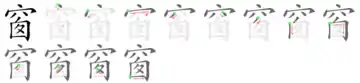 | |||
Han character
窗 (Kangxi radical 116, 穴+7, 12 strokes, cangjie input 十金竹田水 (JCHWE) or 十金竹田大 (JCHWK), four-corner 30608, composition ⿱穴囱(GJKV) or ⿱穴囪(HT))
References
- Kangxi Dictionary: page 865, character 32
- Dai Kanwa Jiten: character 25517
- Dae Jaweon: page 1294, character 2
- Hanyu Da Zidian (first edition): volume 4, page 2731, character 12
- Unihan data for U+7A97

Chinese
| trad. | 窗 | |
|---|---|---|
| simp. # | 窗 | |
| alternative forms | ||
Glyph origin
Characters in the same phonetic series (囱) (Zhengzhang, 2003)
| Old Chinese | |
|---|---|
| 牎 | *sʰroːŋ |
| 窗 | *sʰroːŋ |
| 窓 | *sʰroːŋ |
| 囱 | *sʰroːŋ, *sʰloːŋ |
| 總 | *ʔsloːŋʔ |
| 熜 | *ʔsloːŋʔ |
| 傯 | *ʔsloːŋʔ |
| 緫 | *ʔsloːŋʔ |
| 揔 | *ʔsloːŋʔ |
| 偬 | *ʔsloːŋʔ, *ʔsloːŋs |
| 囪 | *sʰloːŋ |
| 璁 | *sʰloːŋ |
| 驄 | *sʰloːŋ |
| 蔥 | *sʰloːŋ |
| 匆 | *sʰloːŋ |
| 怱 | *sʰloːŋ |
| 葱 | *sʰloːŋ |
| 楤 | *sʰloːŋ |
| 聦 | *sʰloːŋ |
| 繱 | *sʰloːŋ |
| 騘 | *sʰloːŋ |
| 鍯 | *sʰloːŋ |
| 聰 | *sʰloːŋ |
| 愡 | *sʰloːŋs |
| 檧 | *sloːŋ, *sloːŋʔ |
| 憽 | *sloːŋ |
| 幒 | *sʰloŋʔ, *kjoŋ |
Etymology
From circumstantial noun prefix *s- + 通 (OC l̥ˤoŋ, “to penetrate”), literally "where light penetrates" (Baxter and Sagart, 2014).
Pronunciation
Definitions
窗
Synonyms
Dialectal synonyms of 窗戶 (“window”) [map]
Compounds
- 剪燭西窗/剪烛西窗
- 剪窗花
- 北窗高臥/北窗高卧
- 十年寒窗
- 十年窗下
- 十載寒窗/十载寒窗
- 南風窗/南风窗
- 同窗 (tóngchuāng)
- 吊窗 (diàochuāng)
- 同窗夜語/同窗夜语
- 同窗契友
- 天窗 (tiānchuāng)
- 寒窗 (hánchuāng)
- 推窗
- 明窗彩戶/明窗彩户
- 明窗淨几
- 時事櫥窗/时事橱窗
- 東窗事發/东窗事发 (dōngchuāngshìfā)
- 樓窗/楼窗 (lóuchuāng)
- 櫥窗/橱窗 (chúchuāng)
- 櫥窗設計/橱窗设计
- 民主櫥窗/民主橱窗
- 氣窗/气窗 (qìchuāng)
- 泥窗
- 液晶窗
- 漏窗
- 玻璃窗
- 瑣窗/琐窗
- 百葉窗/百叶窗 (bǎiyèchuāng)
- 百葉窗簾/百叶窗帘
- 視窗/视窗 (shìchuāng)
- 視窗九五/视窗九五
- 空窗期 (kōngchuāngqī)
- 窗下
- 窗友
- 窗口 (chuāngkǒu)
- 窗外 (chuāngwài)
- 窗子 (chuāngzi)
- 窗屜/窗屉
- 窗帘 (chuānglián)
- 窗戶/窗户
- 窗戶眼兒/窗户眼儿
- 窗戶紙/窗户纸
- 窗明几淨 (chuāngmíngjījìng)
- 窗格 (chuānggé)
- 窗槅
- 窗檻/窗槛
- 窗櫺/窗棂 (chuānglíng)
- 窗沿
- 窗洞 (chuāngdòng)
- 窗牖
- 窗眼
- 窗簾/窗帘 (chuānglián)
- 窗紙/窗纸
- 窗紗/窗纱
- 窗緣/窗缘
- 窗臺/窗台 (chuāngtái)
- 窗花 (chuānghuā)
- 窗課/窗课
- 窗間過馬/窗间过马
- 窗飾/窗饰
- 篷窗
- 紙窗/纸窗
- 紗窗/纱窗 (shāchuāng)
- 綺窗/绮窗
- 綠窗/绿窗
- 聽窗/听窗
- 肉吊窗
- 自在窗
- 舷窗 (xiánchuāng)
- 芸窗
- 落地窗 (luòdìchuāng)
- 蓬窗
- 螢窗/萤窗
- 螢窗雪案/萤窗雪案
- 西窗翦燭/西窗翦烛
- 話冷雞窗/话冷鸡窗
- 貼現窗口/贴现窗口
- 鋁窗/铝窗
- 鋁門窗/铝门窗
- 鐵窗/铁窗 (tiěchuāng)
- 門窗/门窗 (ménchuāng)
- 開天窗/开天窗 (kāitiānchuāng)
- 隔窗有耳
- 雞窗/鸡窗
- 雪案螢窗/雪案萤窗
- 雪窗螢几
- 雪窗螢火/雪窗萤火
- 靈魂之窗/灵魂之窗
References
- “窗”, in 漢語多功能字庫 (Multi-function Chinese Character Database), 香港中文大學 (the Chinese University of Hong Kong), 2014–
Japanese
Readings
| Kanji in this term |
|---|
| 窗 |
| まど Hyōgaiji |
| kun’yomi |
Definitions
| For pronunciation and definitions of 窗 – see the following entry. | ||
| ||
| (This term, 窗, is an alternative spelling of the above term.) |
Korean
Hanja
窗 • (chang) (hangeul 창)
- This term needs a translation to English. Please help out and add a translation, then remove the text
{{rfdef}}.
Vietnamese
This article is issued from Wiktionary. The text is licensed under Creative Commons - Attribution - Sharealike. Additional terms may apply for the media files.