鏡
| ||||||||
Translingual
Han character
鏡 (Kangxi radical 167, 金+11, 19 strokes, cangjie input 金卜廿山 (CYTU), four-corner 80116, composition ⿰釒竟)
References
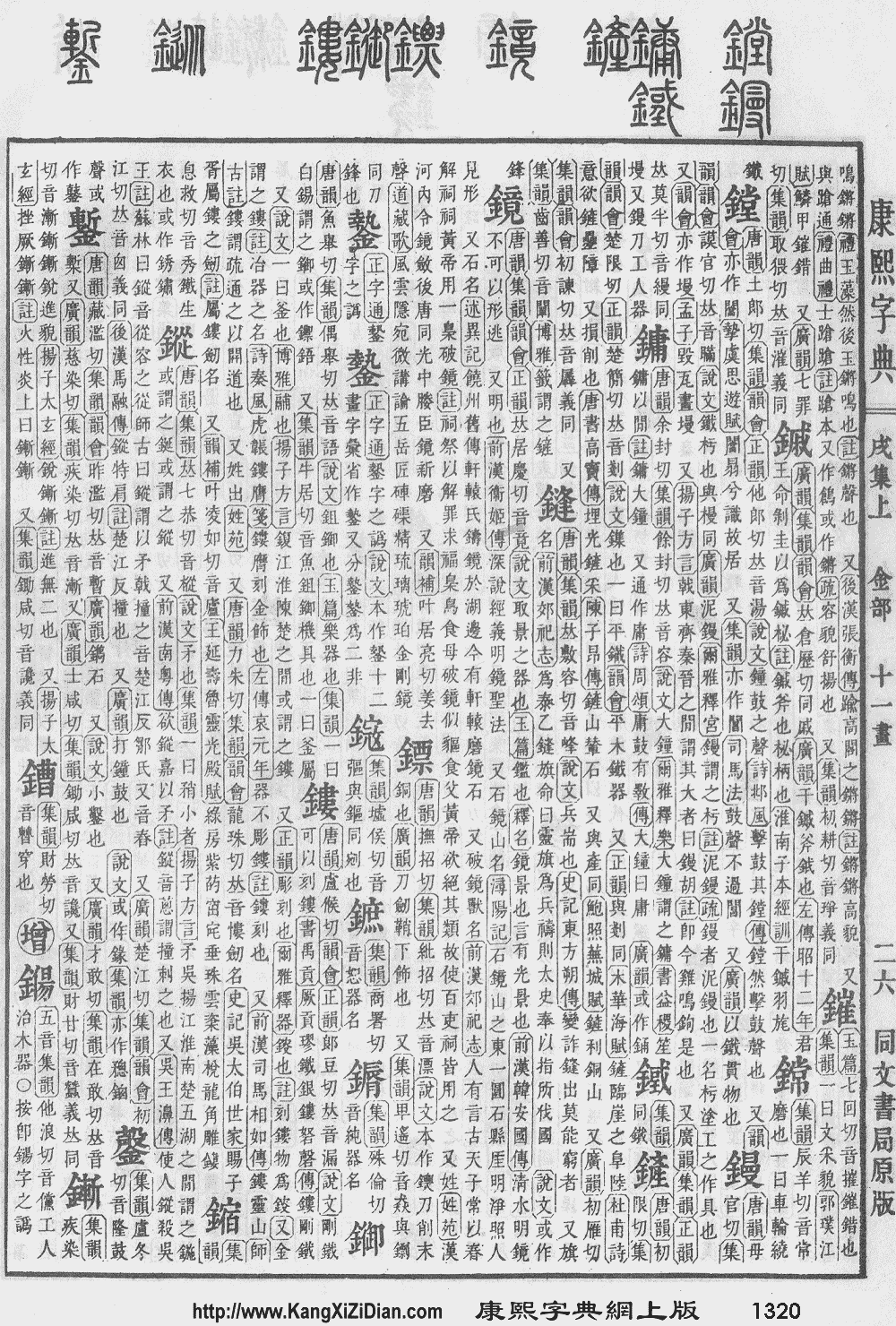
- Kangxi Dictionary: page 1320, character 10
- Dai Kanwa Jiten: character 40812
- Dae Jaweon: page 1820, character 5
- Hanyu Da Zidian (first edition): volume 6, page 4250, character 10
- Unihan data for U+93E1
Chinese
| trad. | 鏡 | |
|---|---|---|
| simp. | 镜 | |
| 2nd round simp. | 𰽟 | |
Glyph origin
| Historical forms of the character 鏡 | |
|---|---|
| Shuowen Jiezi (compiled in Han) | Liushutong (compiled in Ming) |
| Small seal script | Transcribed ancient scripts |
 |
 |
Phono-semantic compound (形聲/形声, OC *kraŋs) : semantic 金 (“metal”) + phonetic 竟 (OC *kraŋs).
Etymology
Probably cognate with 景 (OC *kraŋʔ, “bright”), 影 (OC *qraŋʔ, “shadow”) (Wang, 1982; Schuessler, 2007; Baxter and Sagart, 2014). Gong (2019) identifies the unknown preinitial *C in the reconstruction by Baxter and Sagart (2014) with *s based on evidence from Old Vietnamese, and further posits that it is an instrumental noun derived by prefixation of *s- to the verb 映 (OC *qraŋs, “to reflect”), which is itself a denominal derived from 影 (OC *qraŋʔ, “shadow; image”).
Alternatively, it may be derived from 亮 (OC *raŋs, “to shine”) with the nominalising *k- prefix (Schuessler, 2007; apud Baxter, p.c.).
STEDT compares 鏡, 景 and 亮, among others, to Proto-Kuki-Chin *klaaŋ-I, *klaan-II (“to shine; light; bright”).
This word is relatively late and is perhaps re-etymologized from the nearly identical earlier word 監 (OC *kraːms), 鑑 (OC *kraːms, “mirror”) (Schuessler, 2007), which Wang (1982) treats as cognate. Gong (2019) considers 鏡 to be an unrelated neologism replacing 鑑.
Pronunciation
Definitions
鏡
- (now in compounds or dialectal) mirror; reflecting glass (Classifier: 塊/块 c)
- (physics, in compounds) lens; -scope
- (in compounds) spectacles; glasses
- (Cantonese) Short for 鏡頭/镜头 (jìngtóu, “camera lens”). (Classifier: 支 c)
- † to mirror; to reflect
- † to perceive; to observe clearly
- † to use for reference; to draw lessons from
- † clear
- a surname
Synonyms
Compounds
- 三稜鏡/三棱镜 (sānléngjìng)
- 上鏡頭/上镜头 (shàng jìngtóu)
- 人鏡/人镜
- 借鏡/借镜 (jièjìng)
- 偏光鏡/偏光镜
- 偏極光鏡/偏极光镜
- 內視鏡/内视镜 (nèishìjìng)
- 八卦鏡/八卦镜
- 冰鏡/冰镜
- 凹透鏡/凹透镜 (āotòujìng)
- 凸透鏡/凸透镜 (tūtòujìng)
- 出鏡頭/出镜头
- 凸面鏡/凸面镜 (tūmiànjìng)
- 凹面鏡/凹面镜 (āomiànjìng)
- 分光鏡/分光镜
- 分色鏡/分色镜
- 分釵破鏡/分钗破镜
- 分鏡頭/分镜头
- 千里鏡 (qiānlǐjìng)
- 反光鏡/反光镜 (fǎnguāngjìng)
- 反射鏡/反射镜 (fǎnshèjìng)
- 合鏡/合镜
- 哈哈鏡/哈哈镜 (hāhājìng)
- 喉鏡/喉镜 (hóujìng)
- 回光鏡/回光镜
- 太陽眼鏡/太阳眼镜 (tàiyáng yǎnjìng)
- 妖鏡/妖镜
- 山雞舞鏡/山鸡舞镜 (shānjīwǔjìng)
- 平面鏡/平面镜 (píngmiànjìng)
- 廣角鏡/广角镜
- 廣角鏡頭/广角镜头
- 後視鏡/后视镜 (hòushìjìng)
- 心鏡/心镜
- 把兒鏡子/把儿镜子
- 拉鏡頭/拉镜头
- 接物鏡/接物镜
- 接目鏡/接目镜
- 掛鏡兒/挂镜儿
- 搖鏡頭/摇镜头
- 搶鏡頭/抢镜头 (qiǎng jìngtóu)
- 攬鏡/揽镜
- 放大鏡/放大镜 (fàngdàjìng)
- 明鏡/明镜 (míngjìng)
- 明鏡不疲/明镜不疲
- 昏鏡重明/昏镜重明
- 昏鏡重磨/昏镜重磨
- 明鏡高懸/明镜高悬 (míngjìnggāoxuán)
- 會聚透鏡/会聚透镜
- 有色眼鏡/有色眼镜 (yǒusè yǎnjìng)
- 望遠鏡/望远镜 (wàngyuǎnjìng)
- 望遠鏡頭/望远镜头 (wàngyuǎn jìngtóu)
- 柔光鏡/柔光镜
- 業鏡/业镜
- 樂昌破鏡/乐昌破镜
- 標準鏡頭/标准镜头
- 水月鏡像/水月镜像
- 水月鏡花/水月镜花
- 水鏡/水镜
- 海鏡/海镜
- 淬鏡/淬镜
- 潛望鏡/潜望镜 (qiánwàngjìng)
- 濾光鏡/滤光镜
- 濾色鏡/滤色镜
- 火鏡/火镜
- 無形眼鏡/无形眼镜
- 無形鏡/无形镜
- 照妖鏡/照妖镜 (zhàoyāojìng)
- 照後鏡/照后镜
- 照膽鏡/照胆镜
- 照鏡子/照镜子
- 燧火鏡/燧火镜
- 物鏡/物镜 (wùjìng)
- 特寫鏡頭/特写镜头
- 特技鏡頭/特技镜头
- 玉鏡臺/玉镜台
- 瑤臺鏡/瑶台镜
- 瑩鏡/莹镜
- 璣鏡/玑镜 (jījìng)
- 目光如鏡/目光如镜
- 目鏡/目镜 (mùjìng)
- 盲者得鏡/盲者得镜
- 眼鏡/眼镜 (yǎnjìng)
- 眼鏡猴/眼镜猴 (yǎnjìnghóu)
- 眼鏡蛇/眼镜蛇 (yǎnjìngshé)
- 破鏡/破镜 (pòjìng)
- 破鏡之憂/破镜之忧
- 破鏡分釵/破镜分钗
- 破鏡分離/破镜分离
- 破鏡重合/破镜重合
- 破鏡重圓/破镜重圆 (pòjìngchóngyuán)
- 磨磚成鏡/磨砖成镜
- 秦庭朗鏡/秦庭朗镜
- 秦鏡/秦镜
- 秦鏡高懸/秦镜高悬
- 稜鏡/棱镜 (léngjìng)
- 空鏡頭/空镜头
- 穿衣鏡/穿衣镜 (chuānyījìng)
- 網站鏡照/网站镜照
- 纖維鏡/纤维镜
- 老花眼鏡/老花眼镜 (lǎohuā yǎnjìng)
- 考鏡/考镜
- 耳鏡/耳镜
- 聚光鏡/聚光镜
- 胃鏡/胃镜 (wèijìng)
- 胃鏡檢查/胃镜检查
- 膀胱鏡/膀胱镜 (pángguāngjìng)
- 舌面如鏡/舌面如镜
- 花鏡/花镜 (huājìng)
- 茶鏡/茶镜 (chájìng)
- 菱花鏡/菱花镜
- 著衣鏡/著衣镜
- 藻鏡/藻镜
- 虛堂懸鏡/虚堂悬镜
- 蛙鏡/蛙镜
- 西洋鏡/西洋镜 (xīyángjìng)
- 規鏡/规镜
- 觀劇鏡/观剧镜 (guānjùjìng)
- 試鏡/试镜 (shìjìng)
- 護心鏡/护心镜 (hùxīnjìng)
- 變焦鏡頭/变焦镜头
- 變色眼鏡/变色眼镜 (biànsè yǎnjìng)
- 變色鏡/变色镜 (biànsèjìng)
- 跌破眼鏡/跌破眼镜
- 近攝鏡頭/近摄镜头
- 透光鏡/透光镜
- 透鏡/透镜 (tòujìng)
- 金鏡/金镜
- 銅鏡/铜镜 (tóngjìng)
- 鏡中花/镜中花
- 鏡像/镜像 (jìngxiàng)
- 鏡匣/镜匣
- 鏡子/镜子 (jìngzi)
- 鏡戒/镜戒
- 鏡支兒/镜支儿
- 鏡框/镜框 (jìngkuàng)
- 鏡泊湖/镜泊湖 (Jìngpō Hú)
- 鏡湖/镜湖 (Jìnghú)
- 鏡片/镜片 (jìngpiàn)
- 鏡破釵分/镜破钗分
- 鏡筒/镜筒
- 鏡箱/镜箱
- 鏡考/镜考
- 鏡聽/镜听
- 鏡臺/镜台
- 鏡花/镜花
- 鏡花水月/镜花水月 (jìnghuāshuǐyuè)
- 鏡花緣/镜花缘
- 鏡袱/镜袱
- 鏡裡孤鸞/镜里孤鸾
- 鏡貝/镜贝
- 鏡鐵礦/镜铁矿
- 鏡面呢/镜面呢
- 鏡頭/镜头 (jìngtóu)
- 鏡頭視角/镜头视角
- 鏡頭罩/镜头罩
- 鏡魚/镜鱼
- 鏡鯧/镜鲳
- 長鏡頭/长镜头
- 開鏡/开镜
- 隱形眼鏡/隐形眼镜 (yǐnxíng yǎnjìng)
- 靶兒鏡子/靶儿镜子
- 韻鏡/韵镜
- 顯微鏡/显微镜 (xiǎnwēijìng)
- 風鏡/风镜 (fēngjìng)
- 高抬明鏡/高抬明镜
- 魔鏡/魔镜 (mójìng)
- 魚眼鏡頭/鱼眼镜头
- 鸞鏡/鸾镜
- 墨鏡/墨镜 (mòjìng)
Descendants
Others:
References
- “鏡”, in 漢語多功能字庫 (Multi-function Chinese Character Database), 香港中文大學 (the Chinese University of Hong Kong), 2014–
Japanese
| Shinjitai | 鏡 | |
| Kyūjitai [1][2] |
鏡󠄂 鏡+ 󠄂?(Hanyo-Denshi) (Moji_Joho) |
 |
| The displayed kanji may be different from the image due to your environment. See here for details. | ||
Readings
Compounds
Etymology 1
| Kanji in this term |
|---|
| 鏡 |
| かがみ Grade: 4 |
| kun’yomi |
From Old Japanese.
Originally a compound of 影 (kaga, ancient combining form of 影 (kage), “shadow; outline; figure; image”) + 見 (mi, “seeing”, the 連用形 (ren'yōkei, “stem or continuative form”) of verb 見る (miru), “to see, to look at”).[3][4]
Noun
鏡 • (kagami)
- a mirror (smooth reflecting surface)
- 1999 March 6, “ミラージュ [Mirage]”, in Starter Box, Konami:
- 手にする鏡から仲間を呼び出すことのできる鳥のけもの。
- Te ni suru kagami kara nakama o yobidasu koto no dekiru tori no kemono.
- An avian beast that can call upon its companions from inside the mirror in its hands.
- 手にする鏡から仲間を呼び出すことのできる鳥のけもの。
- 1999 July 22, “アブソリューター [Absolutor]”, in Vol.4, Konami:
- 相手を鏡の中の世界に吸い込むことができる。
- Aite o kagami no naka no sekai ni suikomu koto ga dekiru.
- It can suck opponents into the world inside the mirror.
- 相手を鏡の中の世界に吸い込むことができる。
- Short for 鏡餅 (kagami mochi): a set of mochi rice cakes used in New Year celebrations
- Short for 鏡物 (kagamimono): This term needs a translation to English. Please help out and add a translation, then remove the text
{{rfdef}}. - (theater) Short for 鏡板 (kagami ita): the panel at the back of a noh stage that is painted with an image of an old pine tree
- the barrelhead or lid of a sake barrel
- 昨日、鏡を抜いた。
- Kinō, kagami o nuita.
- They removed the barrelhead yesterday. → They opened the saké barrel yesterday.
- 昨日、鏡を抜いた。
- This term needs a translation to English. Please help out and add a translation, then remove the text
{{rfdef}}.
Derived terms
- 鑑 (kagami, “pattern, example”)
- 鏡いご (kagami igo, type of gelatin made from cooked-down seaweed used as a side dish during Obon in certain regions)
- 鏡ヶ池 (Kagamigaike)
- 鏡鞍 (kagamigura, a type of saddle)
- 鏡台 (kagamidai)
- 鏡立て (kagamitate)
- 鏡の家 (kagami no ie, “box or case for a mirror”)
- 鏡の奩 (kagami no su, “box or case for a mirror”)
- 鏡の間 (kagami no ma): in noh, a room or alcove behind the curtain and affixed with a mirror for players to check their appearance; a similar space in other theaters; a room with mirrors on all four walls, such as at Versailles
- 鏡板 (kagami ita): panel that forms the back wall of a noh stage and is traditionally painted with a picture of an old pine tree
- 鏡の松 (kagami no matsu): a painting of an old pine tree on the kagami ita that forms the back wall of a noh stage
- 鏡の御影 (kagami no miei): a depiction of a round window through which can be seen gods, spirits, or Buddhas
- 鏡開き (kagami-biraki)
- 鏡餅 (kagami mochi)
- 鏡物 (kagamimono)
- 合わせ鏡 (awase kagami)
- 今鏡 (Imakagami)
- 岩鏡 (iwakagami)
- 自惚れ鏡 (unubore kagami)
- 衣紋鏡 (emon kagami)
- お鏡, 御鏡 (o-kagami)
- 大鏡 (Ōkagami)
- 懐中鏡 (kaichū kagami)
- 浄玻璃の鏡 (jōhari no kagami)
- 空の鏡 (sora no kagami)
- 知恵の鏡 (chie no kagami)
- 手鏡 (tekagami)
- 共鏡, 友鏡 (tomokagami)
- 野守の鏡 (nomori no kagami)
- 初鏡 (hatsukagami)
- 鬢鏡 (binkagami)
- ビードロ鏡 (bīdoro kagami)
- 懐鏡 (futokoro kagami)
- 増鏡 (Masukagami)
- 真澄の鏡 (ma-sumi no kagami, “clear mirror”)
- ます鏡 (masukagami)
- まそ鏡 (masokagami)
- 丸鏡, 円鏡 (marukagami)
- 水鏡 (mizukagami)
- 餠鏡 (mochii kagami)
- 八咫の鏡 (Yata no Kagami)
Idioms
- 鏡は女の魂 (kagami wa onna no tamashii, “a mirror is a woman's soul”)
- 鏡が曇ると魂が曇る (kagami ga kumoru to tamashii ga kumoru, “if the looking glass is cloudy, so too is one's soul → (particularly regarding women) one's appearance is a reflection of one's psyche, and a disordered appearance indicates a disordered mind”)
- 鏡は重磨によって輝く (kagami wa jūma ni yotte kagayaku): "a mirror shines from heavy polishing" → practice makes perfect
- 鏡は容貌を見せ酒は心を現す (kagami wa katachi o mise, sake wa kokoro o arawasu, “a mirror shows one's appearance; alcohol brings out one's true thoughts → a metaphor for how drinking can lead to freer expression of what one really thinks”)
- 鏡に掛く (kagami ni kaku, “show in a mirror → extremely clear, extremely certain: as clear as day”)
- 鏡を掛く (kagami o kaku, “hang a mirror → to know something in detail as if looking at it in a mirror: to know something like the back of one's hand, to know something inside and out”)
- 月の鏡 (tsuki no kagami)
Etymology 2
| Kanji in this term |
|---|
| 鏡 |
| きょう Grade: 4 |
| goon |
/kjau/ → /kjɔː/ → /kjoː/
From Middle Chinese 鏡 (MC kjaengH).
Pronunciation
- IPA(key): [kʲo̞ː]
Derived terms
References
- Haga, Gōtarō (1914) 漢和大辞書 [The Great Kanji-Japanese Dictionary] (in Japanese), Fourth edition, Tōkyō: Kōbunsha, , page 2198 (paper), page 1151 (digital)
- Shōundō Henshūjo, editor (1927), 新漢和辞典 [The New Kanji-Japanese Dictionary] (in Japanese), Ōsaka: Shōundō, , page 1274 (paper), page 650 (digital)
- Shōgaku Tosho (1988) 国語大辞典(新装版) [Unabridged Dictionary of Japanese (Revised Edition)] (in Japanese), Tōkyō: Shogakukan, →ISBN
- Matsumura, Akira, editor (2006), 大辞林 [Daijirin] (in Japanese), Third edition, Tōkyō: Sanseidō, →ISBN
Korean
Oki-No-Erabu
Okinawan
Readings
- On (unclassified): ちょー (chō)
- Kun: かがん (kagan)
Compounds
- 眼鏡 (ganchō)
Etymology
| Kanji in this term |
|---|
| 鏡 |
| かがん Grade: 4 |
| kun’yomi |
Cognate with mainland Japanese 鏡 (kagami) and Kagoshima dialect 鏡 (kagan).
Derived terms
- 鏡囃さー (kagan fēsā)
- 合し鏡 (āshikagan)
- 眼鏡 (mīkagan)
Old Japanese
Etymology
Originally a compound of 影 (kaga, combining form of 影 (kage2), “shadow; outline; figure; image”) + 見 (mi1, “seeing”, the 連用形 (ren'yōkei, “stem or continuative form”) of verb 見る (mi1ru), “to see, to look at”).[1][2]
Noun
鏡 (kagami1) (kana かがみ)
- a mirror
- 711–712, Kojiki, poem 90; also Man'yōshū, book 13, poem 3263:
- ...伊久比爾波加賀美袁加氣麻久比爾波麻多麻袁加氣...
- ...ikupi1 ni pa kagami1 wo kake2 ma-kupi1 ni pa ma-tama wo kake2...
- On the sacred stake a mirror is suspended; on the splendid stake splendid jewels are suspended.[3]
- ,[4] text here
- 夜麻杼里乃乎呂能波都乎爾可賀美可家刀奈布倍美許曾奈爾与曾利鷄米
- yamado2ri no2 woro2 no2 patuwo ni kagami1 kake1 to1nau be2mi1 ko2so2 na ni yo2serike1me2
- (please add an English translation of this usage example)
Derived terms
- 鑑 (kagami1, “pattern, example”)
- 鏡なす (kagami1 nasu, pillow word)
- 大鏡 (opokagami1)
- 眞澄の鏡 (ma-sumi1 no2 kagami1)
- まそ鏡 (maso1kagami1)
- 眞經津の鏡 (Ma-putu no2 Kagami1)
- 八咫の鏡 (Yata no2 Kagami1)
Descendants
- Japanese: 鏡 (kagami)
References
- Shōgaku Tosho (1988) 国語大辞典(新装版) [Unabridged Dictionary of Japanese (Revised Edition)] (in Japanese), Tōkyō: Shogakukan, →ISBN
- Matsumura, Akira, editor (2006), 大辞林 [Daijirin] (in Japanese), Third edition, Tōkyō: Sanseidō, →ISBN
- Helen Craig McCullough (1985) Brocade by Night: Kokin Wakashū and the Court Style in Japanese Classical Poetry, Stanford University Press, →ISBN, page 80
- Satake, Akihiro with Hideo Yamada, Rikio Kudō, Masao Ōtani, and Yoshiyuki Yamazaki (c. 759) Shin Nihon Koten Bungaku Taikei 3: Man’yōshū 3 (in Japanese), Tōkyō: Iwanami Shoten, published 2002, →ISBN.
Vietnamese
Yonaguni
Pronunciation
- IPA(key): /kaŋaŋ̍/