需
| ||||||||
Translingual
| Stroke order | |||
|---|---|---|---|
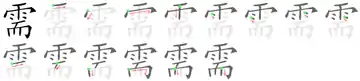 | |||
Han character
需 (Kangxi radical 173, 雨+6, 14 strokes, cangjie input 一月一月中 (MBMBL), four-corner 10227, composition ⿱⻗而)
Derived characters
References
- Kangxi Dictionary: page 1373, character 24
- Dai Kanwa Jiten: character 42275
- Dae Jaweon: page 1883, character 2
- Hanyu Da Zidian (first edition): volume 6, page 4062, character 2
- Unihan data for U+9700

Chinese
| trad. | 需 | |
|---|---|---|
| simp. # | 需 | |
| alternative forms | 耎 𦓔 𩂉 | |
Glyph origin
| Historical forms of the character 需 | ||
|---|---|---|
| Western Zhou | Shuowen Jiezi (compiled in Han) | Liushutong (compiled in Ming) |
| Bronze inscriptions | Small seal script | Transcribed ancient scripts |
 |
 |
 |
Characters in the same phonetic series (需) (Zhengzhang, 2003)
In bronze inscriptions, ideogrammic compound (會意/会意) : a person (天) under the rain (雨) – "to wait until the rain is over; to get wet", original character of 濡. The component 天 corrupted into 而 during the Han dynasty.
Pronunciation
Definitions
需
Usage notes
For the sense of "need", this word is frequently mistaken with 須/须 (xū). 需 is usually followed by a noun while 須/须 is usually followed by a verb or an adverb.
Compounds
References
- “需”, in 漢語多功能字庫 (Multi-function Chinese Character Database), 香港中文大學 (the Chinese University of Hong Kong), 2014–
- Dictionary of Chinese Character Variants (教育部異體字字典), A04476
Japanese
Korean
Hanja
需 • (su) (hangeul 수, revised su, McCune–Reischauer su, Yale swu)
- This term needs a translation to English. Please help out and add a translation, then remove the text
{{rfdef}}.
Vietnamese
Compounds
- 需求 (nhu cầu)
- 需要 (nhu yếu)
- 需要品 (nhu yếu phẩm)
- 需費 (nhu phí)
References
- Thiều Chửu (1942).
- Nguyễn (1974).
- Trần (1999).
This article is issued from Wiktionary. The text is licensed under Creative Commons - Attribution - Sharealike. Additional terms may apply for the media files.