儒
| ||||||||
Translingual
Han character
儒 (Kangxi radical 9, 人+14, 16 strokes, cangjie input 人一月月 (OMBB), four-corner 21227, composition ⿰亻需)
Derived characters
- 𡃽, 𮒯
References
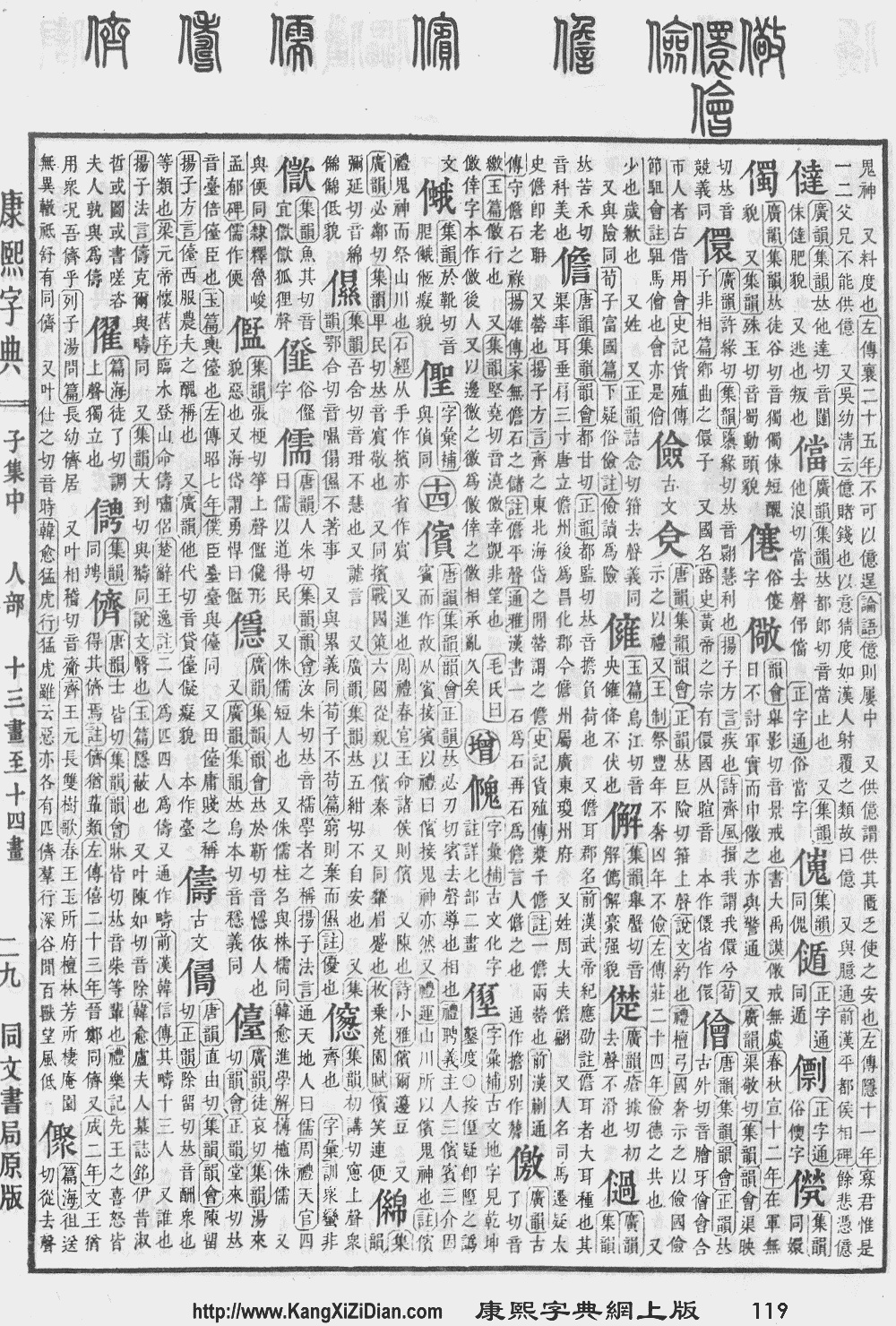
- Kangxi Dictionary: page 119, character 30
- Dai Kanwa Jiten: character 1220
- Dae Jaweon: page 253, character 8
- Hanyu Da Zidian (first edition): volume 1, page 230, character 9
- Unihan data for U+5112
Chinese
| trad. | 儒 | |
|---|---|---|
| simp. # | 儒 | |
| 2nd round simp. | 𰁡 | |
| alternative forms | 㐵 偄 𠍶 𪝥 | |
Glyph origin
| Historical forms of the character 儒 | ||||||||||||||||
|---|---|---|---|---|---|---|---|---|---|---|---|---|---|---|---|---|
| Shuowen Jiezi (compiled in Han) | Liushutong (compiled in Ming) | |||||||||||||||
| Small seal script | Transcribed ancient scripts | |||||||||||||||
 |
 | |||||||||||||||
|
|
References: Mostly from Richard Sears' Chinese Etymology site (authorisation),
| ||||||||||||||||


Phono-semantic compound (形聲/形声, OC *njo) : semantic 亻 (“human”) + phonetic 需 (OC *sno).
Etymology
Origin obscure. Chen (2013)[1] – following Xu Shen's Shuowen Jiezi, etc. – links 儒 (OC *njo, “sorcerers, intellectuals, government officials, Confucians”) to 柔 (OC *mlju, “soft”) and 懦 (OC *noːls, *njo, “weak, timid”) "probably derived from the nature of the profession, registered by softness, suppleness, and flexibility".
Pronunciation
Definitions
儒
- scholar; learned person
- 儒林外史 ― Rúlín wàishǐ ― Unofficial History of the Scholars (a satirical novel by 吳敬梓 Wu Jingzi)
- 子謂子夏曰:「女為君子儒,無為小人儒。」 [Classical Chinese, trad.]
- From: The Analects of Confucius, c. 475 – 221 BCE
- Zǐ wèi Zǐxià yuē: “Rǔ wèi jūnzǐ rú, wú wèi xiǎorén rú.” [Pinyin]
- The Master said to Zi Xia, "Do you be a scholar after the style of the superior man, and not after that of the mean man."
子谓子夏曰:「女为君子儒,无为小人儒。」 [Classical Chinese, simp.]- 以九兩系邦國之民:……四曰儒,以道得民。……。 [Classical Chinese, trad.]
- From: Rites of Zhou, circa 3rd century BCE
- Yǐ jiǔ liǎng xì bāngguó zhī mín:...... Sì yuē rú, yǐ dào dé mín........ [Pinyin]
- Use nine working-duos to involve the people of the polities and states: [...] the fourth are called the scholars, who use moral principles to procure people. [...].
以九两系邦国之民:……四曰儒,以道得民。……。 [Classical Chinese, simp.]
- Confucian; Ruist
- 通天、地、人曰儒,通天、地而不通人曰伎。 [Classical Chinese, trad. and simp.]
- From: Yang Xiong, Fa Yan (Exemplary Sayings), 9 CE
- Tōng tiān, dì, rén yuē rú, tōng tiān, dì ér bùtōng rén yuē jì. [Pinyin]
- Having a penetrating understanding of Heaven, Earth, and Man is called ru (Confucian). Having a penetrating understanding of Heaven and Earth, but not understanding Man, is called "clever."
- Confucianism; Ruism
- 孟子曰:「逃墨必歸於楊,逃楊必歸於儒。歸,斯受之而已矣。今之與楊墨辯者,如追放豚,既入其苙,又從而招之。」 [Classical Chinese, trad.]
- From: Mencius, c. 4th century BCE
- Mèngzǐ yuē: “Táo Mò bì guī yú Yáng, táo Yáng bì guī yú Rú. Guī, sī shòu zhī ér yǐ yǐ. Jīn zhī yǔ Yángmò biàn zhě, rú zhuī fàng tún, jì rù qí lì, yòu cóng ér zhāo zhī.” [Pinyin]
- Mencius said, 'Those who are fleeing from the errors of Mohism naturally turn to Yangism, and those who are fleeing from the errors of Yang naturally turn to Ruism. When they so turn, they should at once and simply be received. Those who nowadays dispute with the followers of Yangism and Mohism do so as if they were pursuing a stray pig, the leg of which, after they have got it to enter the pen, they proceed to tie.'
孟子曰:「逃墨必归于杨,逃杨必归于儒。归,斯受之而已矣。今之与杨墨辩者,如追放豚,既入其苙,又从而招之。」 [Classical Chinese, simp.]
- weak; cowardly
- a surname
Compounds
- 世儒
- 侏儒 (zhūrú)
- 侏儒症 (zhūrúzhèng)
- 侏儒觀戰/侏儒观战
- 俗儒
- 俚儒
- 僻儒
- 儒冠
- 儒士 (rúshì)
- 儒學/儒学 (rúxué)
- 儒宗
- 儒家 (rújiā)
- 儒將/儒将
- 儒巾
- 儒教 (rújiào)
- 儒林 (rúlín)
- 儒林外史 (Rúlín Wàishǐ)
- 儒業/儒业
- 儒生 (rúshēng)
- 儒略曆/儒略历 (rúlüèlì)
- 儒經/儒经 (rújīng)
- 儒者 (rúzhě)
- 儒艮 (rúgèn)
- 儒藏 (rúzàng)
- 儒術/儒术 (rúshù)
- 儒醫/儒医 (rúyī)
- 儒雅 (rúyǎ)
- 儒風/儒风
- 先儒
- 八儒
- 博學鴻儒/博学鸿儒
- 名儒 (míngrú)
- 回儒 (huírú)
- 坑儒
- 夙儒
- 大儒 (dàrú)
- 宋儒 (sòngrú)
- 宏儒碩學/宏儒硕学
- 宿儒 (sùrú)
- 宿學舊儒/宿学旧儒
- 崇儒
- 拘儒
- 拘拘儒儒
- 散儒
- 新儒學/新儒学
- 溫文儒雅/温文儒雅
- 焚書坑儒/焚书坑儒 (fénshūkēngrú)
- 燔書坑儒/燔书坑儒
- 犬儒學派/犬儒学派
- 瑰儒
- 當世儒宗/当世儒宗
- 盜儒/盗儒
- 瞀儒
- 碩儒/硕儒
- 碩學通儒/硕学通儒
- 碩彥名儒/硕彦名儒
- 穴見小儒/穴见小儒
- 老儒
- 老師宿儒/老师宿儒
- 耆儒
- 耆儒碩德/耆儒硕德
- 耆儒碩望/耆儒硕望
- 耆儒碩老/耆儒硕老
- 腐儒 (fǔrú)
- 英儒
- 豎儒/竖儒 (shùrú)
- 賈儒商秀/贾儒商秀
- 迂儒
- 通儒 (tōngrú)
- 醇儒
- 陋儒 (lòurú)
- 陽儒陰釋/阳儒阴释
- 章句儒
- 風流儒雅/风流儒雅
- 鴻儒/鸿儒 (hóngrú)
References
- Chen, Yong (2013) Confucianism as Religion: Controversies and Consequences. Series: Religion in Chinese Societies, Volume 5. Leiden: Brill. pp. 26-29
- “儒”, in 漢語多功能字庫 (Multi-function Chinese Character Database), 香港中文大學 (the Chinese University of Hong Kong), 2014–
- Dictionary of Chinese Character Variants (教育部異體字字典), A00253
Japanese
Readings
Korean
Etymology
From Middle Chinese 儒 (MC nyu).
| Historical Readings | ||
|---|---|---|
| Dongguk Jeongun Reading | ||
| Dongguk Jeongun, 1448 | ᅀᅲᆼ (Yale: zyù) | |
| Middle Korean | ||
| Text | Eumhun | |
| Gloss (hun) | Reading | |
| Hunmong Jahoe, 1527 | 션븨 (Yale: syènpùy) | ᅀᅲ (Yale: zyù) |
Pronunciation
- (SK Standard/Seoul) IPA(key): [ju]
- Phonetic hangul: [유]
Compounds
Vietnamese
References
- Génibrel (1898).
- Bonet (1899).
- Thiều Chửu (1942).
- Trần (1999).
- Nguyễn (2004).
- Nguyễn et al. (2009).
- Hồ (1976).
- Trần (2004).