夕
| ||||||||
| ||||||||
Translingual
| Stroke order | |||
|---|---|---|---|
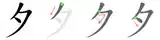 | |||
| Stroke order | |||
|---|---|---|---|
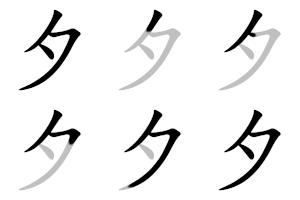 | |||
Han character
夕 (Kangxi radical 36, 夕+0, 3 strokes, cangjie input 弓戈 (NI), four-corner 27200, composition ⿴𠂊丶)
- Kangxi radical #36, ⼣.
Derived characters
References
- Kangxi Dictionary: page 246, character 1
- Dai Kanwa Jiten: character 5749
- Dae Jaweon: page 487, character 4
- Hanyu Da Zidian (first edition): volume 2, page 859, character 1
- Unihan data for U+5915

Chinese
| trad. | 夕 | |
|---|---|---|
| simp. # | 夕 | |
Glyph origin
| Historical forms of the character 夕 | ||||
|---|---|---|---|---|
| Shang | Western Zhou | Warring States | Shuowen Jiezi (compiled in Han) | Liushutong (compiled in Ming) |
| Oracle bone script | Bronze inscriptions | Chu slip and silk script | Small seal script | Transcribed ancient scripts |
 |
 |
 |
 |
 |
Etymology 1
Related to 汐 (OC *ljaːɡ, “evening tide”).
Schuessler (2007) suggests it is from Proto-Sino-Tibetan *s-r(j)ak (“day; full day; to spend the night”); cognate with Tibetan ཞག (zhag, “day (24 hours)”), Mizo riak (“to pass the night”), Jingpho [script needed] (jaʔ⁵⁵, “day (24 hours)”), Burmese ရက် (rak, “day (24 hours)”), Lahu há (“night; to pass the night”); may also be cognate with 宿 (OC *suɡs, *suɡ, “to spend the night”) and 昔 (OC *sjaːɡ, “former times”). It is noted that in the oracle bone script, the 24 hour day started and ended some time in the evening or night. Since 日 (rì, “sun”) has acquired the meaning of "day (24 hours)", 夕 was then restricted to the time of the day's end.
On the other hand, STEDT suggests 夕 (OC *ljaːɡ, “evening; night”) was derived from Proto-Sino-Tibetan *ja-n (“night”), from which 夜 (OC *laːɡs, “night”) was also derived. However, 夕 was also compared to Proto-Sino-Tibetan *s-r(j)ak (“day; full day; to spend the night”). Schuessler (2007) assigns Chinese 夜 (yè) to *ja (“night”) instead, and notes *ja (“night”) and *ryak (“day (24 hours)”) were kept strictly separate in Tibeto-Burman.
Pronunciation
Definitions
夕
- night; evening; dusk
- 哀我征夫、朝夕不暇。 [Pre-Classical Chinese, trad. and simp.]
- From: The Classic of Poetry, c. 11th – 7th centuries BCE, translated based on James Legge's version
- Āi wǒ zhēngfū, zhāoxī bùxiá. [Pinyin]
- Woe to us soldiers on these expeditions! Morning and evening we have no rest.
- 今夕何夕兮,搴舟中流。今日何日兮,得與王子同舟。 [Classical Chinese, trad.]
- From: Shuoyuan, circa 1st century BCE
- Jīnxī hé xī xī, qiān zhōu zhōngliú. Jīnrì hérì xī, dé yǔ wángzǐ tóng zhōu. [Pinyin]
- What night is tonight, that I take a boat into the stream? What day is today, that I get to share a boat with a prince?
今夕何夕兮,搴舟中流。今日何日兮,得与王子同舟。 [Classical Chinese, simp.]
Synonyms
Compounds
- 一夕 (yīxī)
- 一朝一夕 (yīzhāoyīxī)
- 七夕 (Qīxī)
- 今夕 (jīnxī)
- 今夕何夕
- 前夕 (qiánxī)
- 匪朝伊夕
- 危在旦夕 (wēizàidànxī)
- 只爭旦夕/只争旦夕
- 吉夕
- 命在旦夕
- 夕惕
- 夕惕若厲/夕惕若厉
- 夕拜
- 夕日 (xīrì)
- 夕暉/夕晖
- 夕暮
- 夕曛
- 夕月
- 夕煙/夕烟 (xīyān)
- 夕照 (xīzhào)
- 夕陽/夕阳 (xīyáng)
- 夕陽工業/夕阳工业
- 夕陽簫鼓/夕阳箫鼓
- 夕陽西下/夕阳西下 (xīyángxīxià)
- 夕陽餘暉/夕阳余晖
- 夕食
- 大除夕
- 宿夕
- 寅憂夕惕/寅忧夕惕
- 小除夕
- 巧夕
- 既夕禮/既夕礼
- 日夕
- 旦夕 (dànxī)
- 旦夕之危
- 旦夕之費/旦夕之费
- 旦夕禍福/旦夕祸福
- 旦暮朝夕
- 昕夕
- 晡夕
- 晨夕
- 月夕
- 月夕花朝
- 朝不保夕 (zhāobùbǎoxī)
- 朝不及夕
- 朝不圖夕/朝不图夕
- 朝不慮夕/朝不虑夕 (zhāobùlǜxī)
- 朝不謀夕/朝不谋夕
- 朝乾夕惕/朝干夕惕
- 朝令夕改 (zhāolìngxīgǎi)
- 朝兢夕惕
- 朝出夕改
- 朝夕 (zhāoxī)
- 朝夕不倦
- 朝夕難保/朝夕难保 (zhāoxīnánbǎo)
- 朝思夕想
- 朝思夕計/朝思夕计
- 朝更夕改
- 朝榮夕悴/朝荣夕悴
- 朝榮夕斃/朝荣夕毙
- 朝榮夕滅/朝荣夕灭
- 朝發夕至/朝发夕至 (zhāofāxīzhì)
- 朝聞夕改/朝闻夕改
- 朝聞夕死/朝闻夕死
- 朝行夕改
- 朝過夕改/朝过夕改
- 朝饔夕飧
- 永夕
- 燈夕/灯夕
- 申旦達夕/申旦达夕
- 當夕/当夕
- 禍在旦夕/祸在旦夕
- 終夕/终夕
- 花晨月夕
- 花朝月夕
- 西夕年
- 連朝接夕/连朝接夕
- 除夕 (chúxī)
- 竟夕 (jìngxī)
Etymology 2
| For pronunciation and definitions of 夕 – see 穸 (“a vault or recess in a sepulchre meant to store a coffin”). (This character is a variant form of 穸). |
Etymology 3
| For pronunciation and definitions of 夕 – see 月 (“moon; moon-shaped; round like a moon; etc.”). (This character is an ancient form of 月). |
Japanese
Readings
Pronunciation
References
- Matsumura, Akira, editor (2006), 大辞林 [Daijirin] (in Japanese), Third edition, Tōkyō: Sanseidō, →ISBN
Korean
Etymology 1
From Middle Chinese 夕 (MC zjek).
Recorded as Middle Korean 쎡〮 (Yale: ssyek) in Dongguk Jeongun (東國正韻 / 동국정운), 1448.
Recorded as Middle Korean 셕〮 (syék) (Yale: syek) in Hunmong Jahoe (訓蒙字會 / 훈몽자회), 1527.
Compounds
Hanja
Okinawan
Pronunciation
- IPA(key): /juː/