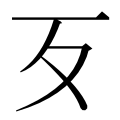
歹
See also: 歺
| ||||||||
| ||||||||
 | ||||||||
Translingual
| Stroke order | |||
|---|---|---|---|
 | |||
Han character
歹 (Kangxi radical 78, 歹+0, 4 strokes, cangjie input 一弓戈 (MNI), four-corner 10207, composition ⿱一夕)
- Kangxi radical #78, ⽍.
Derived characters
References
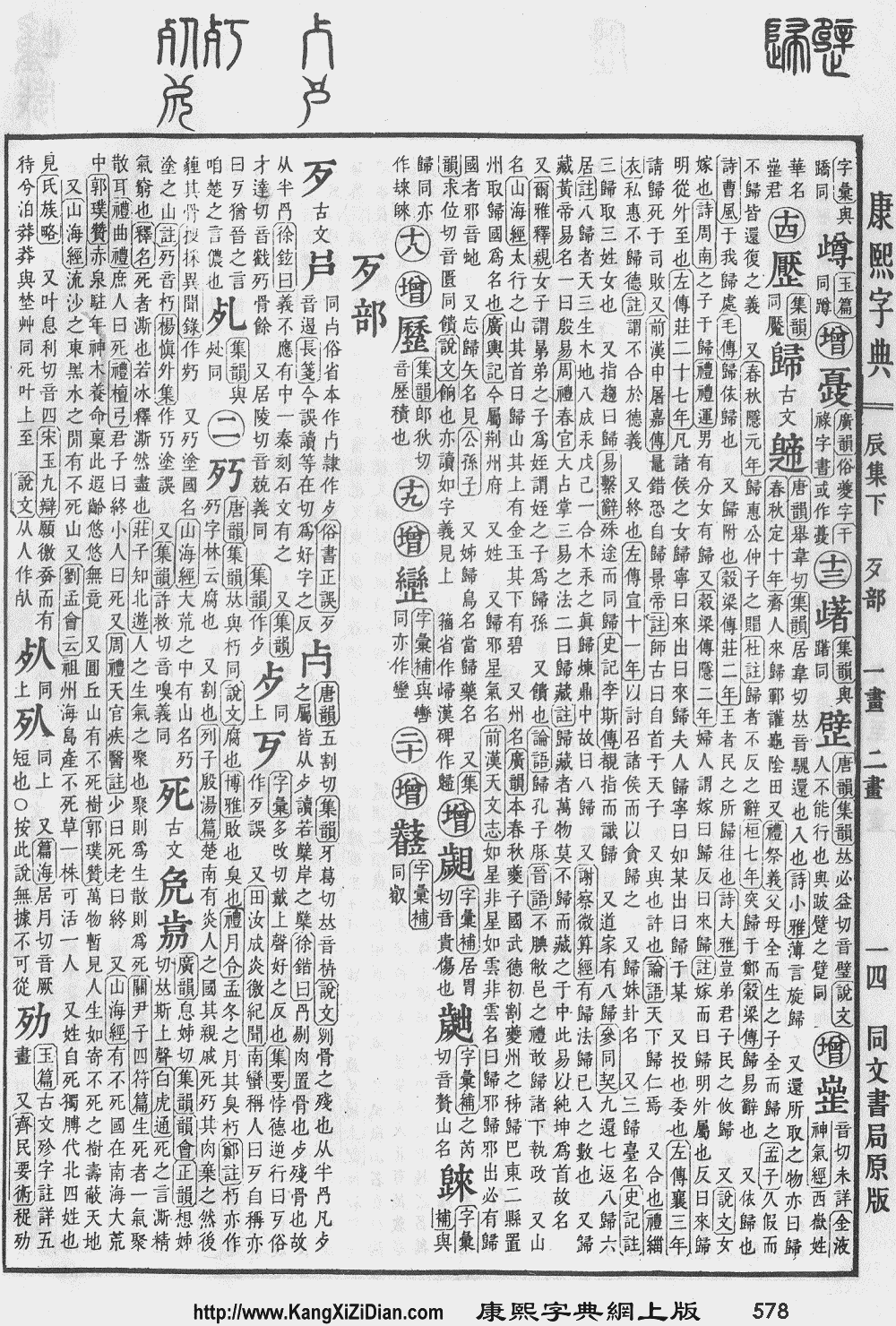
- Kangxi Dictionary: page 578, character 15
- Dai Kanwa Jiten: character 16359
- Dae Jaweon: page 969, character 7
- Hanyu Da Zidian (first edition): volume 2, page 1379, character 14
- Unihan data for U+6B79
- Unihan data for U+FA95
Chinese
Glyph origin 1
| Historical forms of the character 歹 | ||
|---|---|---|
| Shang | Shuowen Jiezi (compiled in Han) | Liushutong (compiled in Ming) |
| Oracle bone script | Small seal script | Transcribed ancient scripts |
 |
 |
 |
Pictogram (象形) - human remains.
Pronunciation
Pronunciation
Glyph origin 2
Disputed:
Pronunciation
Definitions
歹
Compounds
- 三好兩歹/三好两歹
- 不分好歹
- 不知好歹 (bùzhīhǎodǎi)
- 不識好歹/不识好歹 (bùshíhǎodǎi)
- 作好作歹
- 作歹 (zuòdǎi)
- 低歹
- 作歹為非/作歹为非
- 做好做歹
- 口歹
- 好共歹
- 好歹 (hǎodǎi)
- 好說歹說/好说歹说
- 心歹
- 忙古歹
- 惡歹子/恶歹子
- 放歹
- 有個好歹/有个好歹
- 杭好杭歹
- 歹不中
- 歹事 (dǎishì)
- 歹事頭/歹事头
- 歹人 (dǎirén)
- 歹做出
- 歹口
- 歹命
- 歹婆娘
- 歹徒 (dǎitú)
- 歹徒橫行/歹徒横行
- 歹心 (dǎixīn)
- 歹意 (dǎiyì)
- 歹戲拖棚/歹戏拖棚
- 歹毒 (dǎidú)
- 歹生活
- 歹話/歹话
- 歹鬥/歹斗
- 歹鬥毛/歹斗毛
- 沒好沒歹/没好没歹
- 為非作歹/为非作歹 (wéifēizuòdǎi)
- 無道歹/无道歹
- 生非作歹
- 知好歹
- 莽古歹
- 詭歹/诡歹
- 說好嫌歹/说好嫌歹
- 說好說歹/说好说歹
- 賴歹/赖歹
Etymology 4
| trad. | 歹 | |
|---|---|---|
| simp. # | 歹 | |
| alternative forms | 否 壞/坏 痞 | |
Unclear. It has been suggested that it could be related to 否 (pǐ, “evil”) or 痞 (pǐ, “rascal; evil”).
Pronunciation
Definitions
歹
Synonyms
Dialectal synonyms of 壞 (“bad; not good”) [map]
| Variety | Location | Words |
|---|---|---|
| Classical Chinese | 惡 | |
| Formal (Written Standard Chinese) | 壞 | |
| Mandarin | Beijing | 壞, 賴 |
| Taiwan | 壞 | |
| Jinan | 壞, 孬, 賴 | |
| Xi'an | 瞎, 壞 | |
| Wuhan | 壞, 拐 | |
| Chengdu | 壞 | |
| Yangzhou | 壞 | |
| Hefei | 壞 | |
| Malaysia | 壞 | |
| Singapore | 壞 | |
| Cantonese | Guangzhou | 壞, 弊, 衰 |
| Hong Kong | 壞, 衰 | |
| Zhongshan (Shiqi) | 衰 | |
| Yangjiang | 壞 | |
| Kuala Lumpur (Guangfu) | 衰 | |
| Singapore (Guangfu) | 衰 | |
| Gan | Nanchang | 壞 |
| Hakka | Meixian | 壞 |
| Wuhua (Meilin) | 衰 | |
| Jin | Taiyuan | 賴, 壞 |
| Northern Min | Jian'ou | 壞, 獰 |
| Eastern Min | Fuzhou | 呆, 否 |
| Southern Min | Xiamen | 歹, 䆀 |
| Xiamen (Tong'an) | 歹 | |
| Quanzhou | 歹 | |
| Jinjiang | 歹 | |
| Nan'an | 歹 | |
| Shishi | 歹 | |
| Zhangzhou | 䆀 | |
| Zhao'an | 䆀, 孬 | |
| Tainan | 歹 | |
| Penang (Hokkien) | 䆀, 歹 | |
| Singapore (Hokkien) | 歹 | |
| Manila (Hokkien) | 歹 | |
| Datian | 歹 | |
| Chaozhou | 孬 | |
| Shantou | 孬 | |
| Jieyang | 孬, 歹 | |
| Singapore (Teochew) | 歹, 孬 | |
| Leizhou | 㾀 | |
| Wenchang | 㾀 | |
| Haikou | 㾀 | |
| Singapore (Hainanese) | 㾀 | |
| Wu | Shanghai | 壞, 恘 |
| Suzhou | 壞, 恘 | |
| Ningbo | 歪, 推扳, 嘸做 | |
| Wenzhou | 毛 | |
| Xiang | Changsha | 壞, 拐 |
| Shuangfeng | 壞, 拐 | |
Dialectal synonyms of 壞 (“rotten; spoilt”) [map]
| Variety | Location | Words |
|---|---|---|
| Formal (Written Standard Chinese) | 壞 | |
| Mandarin | Taiwan | 壞 |
| Malaysia | 壞 | |
| Singapore | 壞 | |
| Cantonese | Hong Kong | 壞 |
| Singapore (Guangfu) | 壞 | |
| Hakka | Miaoli (N. Sixian) | 壞 |
| Pingtung (Neipu; S. Sixian) | 壞 | |
| Hsinchu County (Zhudong; Hailu) | 壞 | |
| Taichung (Dongshi; Dabu) | 壞 | |
| Hsinchu County (Qionglin; Raoping) | 壞 | |
| Yunlin (Lunbei; Zhao'an) | 壞 | |
| Southern Min | Taipei | 歹 GT |
| Penang (Hokkien) | 歹 | |
| Singapore (Hokkien) | 歹 | |
| Wu | Ningbo | 壞, 嘸做 |
| Note | GT - General Taiwanese (no specific region identified) | |
Dialectal synonyms of 難 (“difficult”) [map]
Compounds
- 做歹
- 好歹 (hó-pháiⁿ) (Min Nan)
- 拍歹
- 𣍐歹/𫧃歹
- 歹人 (pháiⁿ-lâng) (Min Nan)
- 歹代
- 歹價/歹价
- 歹剃頭/歹剃头
- 歹勢/歹势 (pháiⁿ-sè) (Min Nan)
- 歹吉兆
- 歹命
- 歹命人
- 歹喙
- 歹喙斗
- 歹囝
- 歹天
- 歹年冬
- 歹徒 (pháiⁿ-tô͘) (Min Nan)
- 歹心 (dǎixīn)
- 歹性地
- 歹意 (dǎiyì)
- 歹手爪
- 歹扭搦
- 歹日
- 歹款
- 歹死
- 歹𤆬頭/歹𤆬头
- 歹物
- 歹物仔
- 歹症頭/歹症头
- 歹癖
- 歹看
- 歹看相
- 歹看面
- 歹睏/歹困
- 歹積德/歹积德
- 歹空
- 歹竹出好筍/歹竹出好笋 (pháiⁿ tek chhut hó sún) (Min Nan)
- 歹紡/歹纺
- 歹聲嗽/歹声嗽
- 歹聽/歹听
- 歹育飼/歹育饲
- 歹腹肚
- 歹話/歹话
- 歹講/歹讲
- 歹路
- 歹運/歹运
- 歹銅舊錫/歹铜旧锡
- 歹面
- 歹面相看
- 歹食 (pháiⁿ-chia̍h) (Min Nan)
Pronunciation
Pronunciation
Definitions
歹
- (used by Miao people) I, you
References
- “Entry #817”, in 臺灣閩南語常用詞辭典 [Dictionary of Frequently-Used Taiwan Minnan] (overall work in Mandarin and Hokkien), Ministry of Education, R.O.C., 2023.
- The template Template:R:nan:thcwda does not use the parameter(s):
1=297
Please see Module:checkparams for help with this warning.“(#)”, in 臺灣閩南語按呢寫, Ministry of Education, R.O.C., 2013. - Revised Mandarin Chinese Dictionary
- Chinese Linguipedia
Japanese
Kanji
歹
- This term needs a translation to English. Please help out and add a translation, then remove the text
{{rfdef}}.
Korean
Vietnamese
This article is issued from Wiktionary. The text is licensed under Creative Commons - Attribution - Sharealike. Additional terms may apply for the media files.