豆
| ||||||||
| ||||||||
Translingual
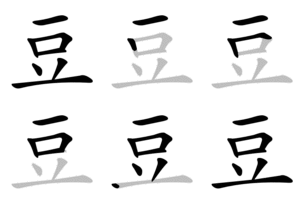
| Stroke order | |||
|---|---|---|---|
 | |||
Han character
豆 (Kangxi radical 151, 豆+0, 7 strokes, cangjie input 一口廿 (MRT), four-corner 10108, composition ⿱𠮛䒑)
- Kangxi radical #151, ⾖.
Derived characters
References
- Kangxi Dictionary: page 1191, character 14
- Dai Kanwa Jiten: character 36245
- Dae Jaweon: page 1654, character 12
- Hanyu Da Zidian (first edition): volume 6, page 3565, character 1
- Unihan data for U+8C46

Chinese
| simp. and trad. |
豆 | |
|---|---|---|
| alternative forms | 荳 “bean” | |
Glyph origin
| Historical forms of the character 豆 | |||
|---|---|---|---|
| Shang | Western Zhou | Shuowen Jiezi (compiled in Han) | Liushutong (compiled in Ming) |
| Oracle bone script | Bronze inscriptions | Small seal script | Transcribed ancient scripts |
 |
 |
 |
 |
Characters in the same phonetic series (豆) (Zhengzhang, 2003)
Pictogram (象形) – some kind of container. Borrowed phonetically for the plant name. Displaced Old Chinese 菽 (shū).
Etymology
Derived from 頭 (OC *doː), ultimately from Proto-Sino-Tibetan *du (“head”) (STEDT).
"Soybean > bean" is possibly the same word as "round vessel" (Unger, 1984)
Pronunciation
Definitions
豆
- pod-bearing plant or its seeds; bean; pea (Classifier: 顆/颗 m; 粒 m)
- bean-shaped object (Classifier: 顆/颗 m; 粒 m)
- 咖啡豆 ― kāfēidòu ― coffee bean
- (historical) stemmed shallow bowl on a round base, often with a lid and sometimes with handles, initially earthenware and used as a food container, later also made of wood or bronze and used to hold minced and pickled meats and vegetables and used in ritual sacrifice
Compounds
- 伊豆半島/伊豆半岛 (Yīdòu Bàndǎo)
- 俎豆
- 兩豆塞耳/两豆塞耳
- 冷灰爆豆
- 凍豆腐/冻豆腐
- 刀切豆腐
- 吃豆腐 (chī dòufu)
- 四季豆 (sìjìdòu)
- 土豆 (tǔdòu)
- 大豆 (dàdòu)
- 大豆油
- 寸馬豆人/寸马豆人
- 小豆兒/小豆儿
- 山扁豆
- 山豆根 (shāndòugēn)
- 巴豆 (bādòu)
- 念豆兒佛/念豆儿佛
- 扁豆 (biǎndòu)
- 撒豆成兵
- 敏豆 (mǐndòu)
- 料豆兒/料豆儿
- 杏仁豆腐
- 梅豆
- 棧豆/栈豆 (zhàndòu)
- 榆瞑豆重
- 楬豆
- 槐豆
- 毛豆 (máodòu)
- 油炸豆兒/油炸豆儿 (yóuzhádòur)
- 澡豆
- 濱豇豆/滨豇豆
- 炒豆兒/炒豆儿
- 烏豆/乌豆
- 煮豆燃萁 (zhǔdòuránqí)
- 燃萁煮豆
- 狗豆子
- 瓜分豆剖 (guāfēndòupōu)
- 瓜剖豆分
- 甘納豆/甘纳豆
- 甜豆 (tiándòu)
- 發牙豆/发牙豆
- 白小豆
- 白豆兒佛/白豆儿佛
- 白豆蔻 (báidòukòu)
- 皇帝豆 (huángdìdòu)
- 目光如豆
- 相思豆
- 磨豆腐
- 稨豆 (biǎndòu)
- 種豆得豆/种豆得豆
- 簞食豆羹/箪食豆羹
- 籩豆/笾豆
- 糟豆腐
- 紅豆/红豆 (hóngdòu)
- 綠豆/绿豆 (lǜdòu)
- 綠豆皮兒/绿豆皮儿
- 綠豆稀飯/绿豆稀饭
- 綠豆糕/绿豆糕 (lǜdòugāo)
- 綠豆蠅/绿豆蝇
- 羅漢豆/罗汉豆 (luóhàndòu)
- 羽扇豆
- 老豆
- 老豆腐 (lǎodòufu)
- 肉豆蔻 (ròudòukòu)
- 胡豆 (húdòu)
- 臭豆
- 臭豆腐 (chòudòufu)
- 芻豆/刍豆
- 芽豆 (yádòu)
- 芝麻綠豆/芝麻绿豆 (zhīma lǜdòu)
- 荷蘭豆/荷兰豆 (hélándòu)
- 萁豆
- 菉豆 (lǜdòu)
- 菜豆 (càidòu)
- 菉豆眼
- 萹豆 (biǎndòu)
- 虎爪豆
- 蛾眉豆
- 蜜豆冰
- 蠶豆/蚕豆 (cándòu)
- 蠶豆症/蚕豆症 (cándòuzhèng)
- 觴豆/觞豆
- 豆乳 (dòurǔ)
- 豆乾/豆干 (dòugān)
- 豆兒大/豆儿大
- 豆剖
- 豆剖瓜分
- 豆嘴兒/豆嘴儿
- 豆大
- 豆姑娘
- 豆娘 (dòuniáng)
- 豆娘子
- 豆子 (dòuzi)
- 豆宣
- 豆干 (dòugān)
- 豆條/豆条
- 豆槐
- 豆汁 (dòuzhī)
- 豆沙 (dòushā)
- 豆油 (dòuyóu)
- 豆渣 (dòuzhā)
- 豆漺
- 豆漿/豆浆 (dòujiāng)
- 豆爽 (dòushuǎng)
- 豆瓣醬/豆瓣酱 (dòubànjiàng)
- 豆皮 (dòupí)
- 豆碹
- 豆秸灰
- 豆算
- 豆簽/豆签
- 豆粥
- 豆絲/豆丝
- 豆綠/豆绿 (dòulǜ)
- 豆羹
- 豆脯
- 豆腐
- 豆腐乳 (dòufurǔ)
- 豆腐乾/豆腐干 (dòufugān)
- 豆腐官
- 豆腐干 (dòufugān)
- 豆腐心
- 豆腐皮 (dòufupí)
- 豆腐腦/豆腐脑 (dòufunǎo)
- 豆腐衣
- 豆腐西施
- 豆腐飯/豆腐饭
- 豆腐鯊/豆腐鲨 (dòufushā)
- 豆花 (dòuhuā)
- 豆芽 (dòuyá)
- 豆芽菜 (dòuyácài)
- 豆苗 (dòumiáo)
- 豆莢/豆荚 (dòujiá)
- 豆萁
- 豆萁之喻
- 豆萁相煎
- 豆萱
- 豆蓉
- 豆蒜
- 豆蔻 (dòukòu)
- 豆蔻年華/豆蔻年华 (dòukòuniánhuá)
- 豆蔻梢頭/豆蔻梢头
- 豆薯 (dòushǔ)
- 豆角 (dòujiǎo)
- 豆豉
- 豆豉油
- 豆象
- 豆醬/豆酱 (dòujiàng)
- 豆重榆瞑
- 豆雁
- 豆青 (dòuqīng)
- 豆餅/豆饼 (dòubǐng)
- 豆饌/豆馔
- 豇豆 (jiāngdòu)
- 豌豆 (wāndòu)
- 赤小豆 (chìxiǎodòu)
- 赤豆 (chìdòu)
- 跳豆
- 迸豆兒/迸豆儿
- 醬豆腐/酱豆腐 (jiàngdòufu)
- 野毛扁豆
- 野豌豆
- 銅豌豆/铜豌豆
- 鐵蠶豆/铁蚕豆
- 長豇豆/长豇豆
- 雲豆/云豆 (yúndòu)
- 青豆 (qīngdòu)
- 馬齒豆/马齿豆 (mǎchǐdòu)
- 麻婆豆腐 (mápó dòufu)
- 麻豆
- 黃豆/黄豆 (huángdòu)
- 黃豆芽/黄豆芽
- 黑豆
Descendants
References
- “豆”, in 漢語多功能字庫 (Multi-function Chinese Character Database), 香港中文大學 (the Chinese University of Hong Kong), 2014–
Japanese
Readings
Compounds
Etymology
| Kanji in this term |
|---|
| 豆 |
| まめ Grade: 3 |
| kun’yomi |
⟨mame2⟩ → /mame/
From Old Japanese, in turn from Proto-Japonic *mamay.
Noun
豆 • (mame)
- the pulses
- a bean
- 1988 July 30 [1984 July 25], Fujiko F. Fujio, “世界名作童話第5巻 ジャックと豆の木 (世界名作童話第5巻 ジャックと豆の木) [World’s Renowned Fairy Tales Book 5: Jack and the Beanstalk]”, in ポストの中の明日 [Post-Mid-Tomorrow] (藤子不二雄少年SF短編集; 2), 10th edition, volume 2 (fiction), Tokyo: Shogakukan, →ISBN, page 120:
- ジャックは豆の木をつたって、雲の上にのぼりました。
- Jakku wa mame no ki o tsutatte, kumo no ue ni noborimashita.
- Jack scrambled along the beanstalk, climbed up above the clouds.
- a pea
- a soybean
Idioms
- 豆を植えて稗を得る (mame o uete hie o eru, “to do something expecting good results, instead getting bad results”)
References
- Matsumura, Akira, editor (2006), 大辞林 [Daijirin] (in Japanese), Third edition, Tōkyō: Sanseidō, →ISBN
- Kindaichi, Kyōsuke et al., editors (1997), 新明解国語辞典 [Shin Meikai Kokugo Jiten] (in Japanese), Fifth edition, Tōkyō: Sanseidō, →ISBN
- NHK Broadcasting Culture Research Institute, editor (1998), NHK日本語発音アクセント辞典 [NHK Japanese Pronunciation Accent Dictionary] (in Japanese), Tōkyō: NHK Publishing, →ISBN
Korean
Etymology
From Middle Chinese 豆 (MC duwH).
| Historical readings |
|---|
|
Pronunciation
- (SK Standard/Seoul) IPA(key): [tu]
- Phonetic hangul: [두]
Compounds
Vietnamese
References
- Trần (1999).
- Trần (2004).
Zhuang
This article is issued from Wiktionary. The text is licensed under Creative Commons - Attribution - Sharealike. Additional terms may apply for the media files.