咱
See also: 偺
| ||||||||
Translingual
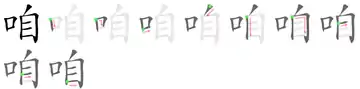
| Stroke order | |||
|---|---|---|---|
 | |||
Han character
咱 (Kangxi radical 30, 口+6, 9 strokes, cangjie input 口竹月山 (RHBU), four-corner 66000, composition ⿰口自)
Derived characters
- 𥻢
References
- Kangxi Dictionary: page 187, character 7
- Dai Kanwa Jiten: character 3552
- Dae Jaweon: page 406, character 9
- Hanyu Da Zidian (first edition): volume 1, page 618, character 6
- Unihan data for U+54B1

Chinese
Etymology 1
| trad. | 咱/喒/偺 | |
|---|---|---|
| simp. | 咱 | |
| alternative forms | 𠴰 倃/咱 | |
Fusion of 自家 (MC dzijH kae, “self”) [Song] > Modern Mandarin zá (Lü, 1984). Fusion with 們/们 (men) produces the form with a nasal coda [Yuan], e.g. Modern Mandarin zán (Norman, 1988).
Pronunciation
Definitions
咱
Synonyms
Dialectal synonyms of 我 (“I”) [map]
Dialectal synonyms of 咱們 (“we; us (inclusive)”) [map]
Descendants
- → Vietnamese: ta
See also
| Standard Mandarin Chinese personal pronouns | |||
|---|---|---|---|
| Person | Singular | Plural | |
| 1st | — | 我 (wǒ) | 我們/我们 (wǒmen) |
| inclusive | 咱們/咱们 (zánmen) | ||
| 2nd | male/indefinite | 你 (nǐ) | 你們/你们 (nǐmen) |
| female | 妳/你 (nǐ) | 妳們/你们 (nǐmen) | |
| deity | 祢 (nǐ) | 祢們/祢们 (nǐmen) | |
| polite | 您 (nín) | 你們/你们 (nǐmen) 您們/您们 (nínmen) | |
| 3rd | male/indefinite | 他 (tā) | 他們/他们 (tāmen) |
| female | 她 (tā) | 她們/她们 (tāmen) | |
| deity | 祂 (tā) | 祂們/祂们 (tāmen) | |
| animal | 牠/它 (tā) | 牠們/它们 (tāmen) | |
| inanimate | 它 (tā) | 它們/它们 (tāmen) | |
Etymology 2
Fusion of 早晚 (zǎowǎn).
Pronunciation
Etymology 3
| simp. and trad. |
咱 | |
|---|---|---|
| alternative forms | 俺 㑑 玌 | |
From 儂/侬 (lâng, “person; I, me”) + elision of 儂/侬. Compare 阮 (gún, goán, “we, us (exclusive)”), 恁 (lín, “you (plural)”), 𪜶 (in, “they, them”).
Pronunciation
Synonyms
Dialectal synonyms of 咱們 (“we; us (inclusive)”) [map]
Pronunciation
Definitions
咱
- † Sentence-final modal particle for the imperative mood, similar to 吧 (ba).
- † Sentence-final modal particle for the declarative mood.
Pronunciation
References
- “Entry #4792”, in 臺灣閩南語常用詞辭典 [Dictionary of Frequently-Used Taiwan Minnan] (overall work in Mandarin and Hokkien), Ministry of Education, R.O.C., 2023.
- The template Template:R:nan:thcwda does not use the parameter(s):
1=325
Please see Module:checkparams for help with this warning.“(#)”, in 臺灣閩南語按呢寫, Ministry of Education, R.O.C., 2013.
Japanese
Kanji
咱
- This term needs a translation to English. Please help out and add a translation, then remove the text
{{rfdef}}.
Korean
Vietnamese
This article is issued from Wiktionary. The text is licensed under Creative Commons - Attribution - Sharealike. Additional terms may apply for the media files.