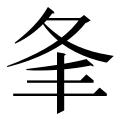
夆
| ||||||||
 | ||||||||
Translingual
Han character
夆 (Kangxi radical 34, 夂+4, 7 strokes, cangjie input 竹水手十 (HEQJ), four-corner 27504, composition ⿱夂丰)
Derived characters
References
- Kangxi Dictionary: page 244, character 22
- Dai Kanwa Jiten: character 5698
- Dae Jaweon: page 485, character 9
- Hanyu Da Zidian (first edition): volume 2, page 868, character 7
- Unihan data for U+5906
- Unihan data for U+2F85C

Chinese
| simp. and trad. |
夆 | |
|---|---|---|
Glyph origin
Characters in the same phonetic series (丰) (Zhengzhang, 2003)
| Old Chinese | |
|---|---|
| 邦 | *proːŋ |
| 梆 | *proːŋ |
| 垹 | *proːŋ |
| 肨 | *pʰroːŋs, *pʰroːŋs |
| 蚌 | *broːŋʔ, *breːŋʔ |
| 玤 | *broːŋʔ |
| 棒 | *broːŋʔ |
| 蜯 | *broːŋʔ |
| 琫 | *poːŋʔ |
| 菶 | *poːŋʔ, *boːŋʔ |
| 俸 | *poːŋʔ, *boŋs |
| 髼 | *boːŋ |
| 蜂 | *boːŋ, *pʰoŋ |
| 韸 | *boːŋ |
| 蓬 | *boːŋ |
| 篷 | *boːŋ |
| 唪 | *boːŋʔ, *boŋʔ |
| 埲 | *boːŋʔ |
| 丰 | *pʰoŋ |
| 妦 | *pʰoŋ |
| 仹 | *pʰoŋ |
| 峯 | *pʰoŋ |
| 峰 | *pʰoŋ |
| 鋒 | *pʰoŋ |
| 烽 | *pʰoŋ |
| 蠭 | *pʰoŋ |
| 桻 | *pʰoŋ |
| 莑 | *pʰoŋ |
| 夆 | *pʰoŋ, *boŋ, *ɡaːds |
| 捧 | *pʰoŋʔ |
| 逢 | *boŋ |
| 縫 | *boŋ, *boŋs |
| 漨 | *boŋ |
| 捀 | *boŋ, *boŋs |
| 奉 | *boŋʔ |
Phono-semantic compound (形聲/形声, OC *pʰoŋ, *boŋ, *ɡaːds) : semantic 夂 (“foot, walk”) + phonetic 丰 (OC *pʰoŋ, “bush, brush”) – also idiomatic, a foot walking through brush, which resists being moved through.
Pronunciation 1
Pronunciation 2
Pronunciation
Definitions
夆
- Contraction of 予儂/予侬 (hō͘ lâng, literally “by person”)
- precedes a verb to indicate the passive voice
- 雄蜂干焦佮后蜂交尾,煞矣可能就會因為食物無夠hőng趕出巢外。 [Hokkien, trad.]
- From: 2020, 環境資訊中心, "【蠻野講堂】台語棲地復育系列座談─植物ê媒人:蜂、蝴蝶佮蛾仔"
- Hêng-phang kan-ta kah hiō-phang kau-bóe, soah ah khó-lêng tiō ē in-ūi chia̍h-mi̍h bô-kàu hőng kóaⁿ-chhut siū-gōa. [Pe̍h-ōe-jī]
- A male bee only copulate with the queen bee, and he may be banished from the honeycomb because of insufficient food after that.
雄蜂干焦佮后蜂交尾,煞矣可能就会因为食物无够hőng赶出巢外。 [Hokkien, simp.]
- be ... [passive voice of a verb] by a person/people
- 舊年的香港反送中事件,有幾若千人hőng掠去。 [Hokkien, trad.]
- From: 2020, 公視新聞網 PNN, "反送中人士指控 懲教所人員對ﰀ起跤動手"
- Kū-nî ê Hiang-káng hoán-sàng-tiong sū-kiāⁿ, iú kúi-nā chheng lâng hőng lia̍h--khì. [Pe̍h-ōe-jī]
- On the anti-extradition law amendment bill incident last year, there was several thousands of people being arrested by people.
旧年的香港反送中事件,有几若千人hőng掠去。 [Hokkien, simp.]
- precedes a verb to indicate the passive voice
Etymology 3
| For pronunciation and definitions of 夆 – see 豐 (“luxuriant; lush; abundant; bountiful; plenty; etc.”). (This character is a variant form of 豐). |
Etymology 4
| For pronunciation and definitions of 夆 – see 鋒 (“pointed edge; cutting edge; vanguard; pioneer; etc.”). (This character is the second-round simplified and variant form of 鋒). |
Notes:
|
Etymology 5
| For pronunciation and definitions of 夆 – see 蜂 (“Apoidea or Vespa; etc.”). (This character is the second-round simplified form of 蜂). |
Notes:
|
Etymology 6
| For pronunciation and definitions of 夆 – see 峰 (“peak; summit; hump; etc.”). (This character is the second-round simplified form of 峰). |
Notes:
|
Etymology 7
| For pronunciation and definitions of 夆 – see 烽 (“signal fire; the tower where such a signal fire is lit”). (This character is the second-round simplified form of 烽). |
Notes:
|
Japanese
Korean
This article is issued from Wiktionary. The text is licensed under Creative Commons - Attribution - Sharealike. Additional terms may apply for the media files.