孔
| ||||||||
Translingual
| Stroke order | |||
|---|---|---|---|
 | |||
Han character
孔 (Kangxi radical 39, 子+1, 4 strokes, cangjie input 弓木山 (NDU), four-corner 12410, composition ⿰子乚)
References
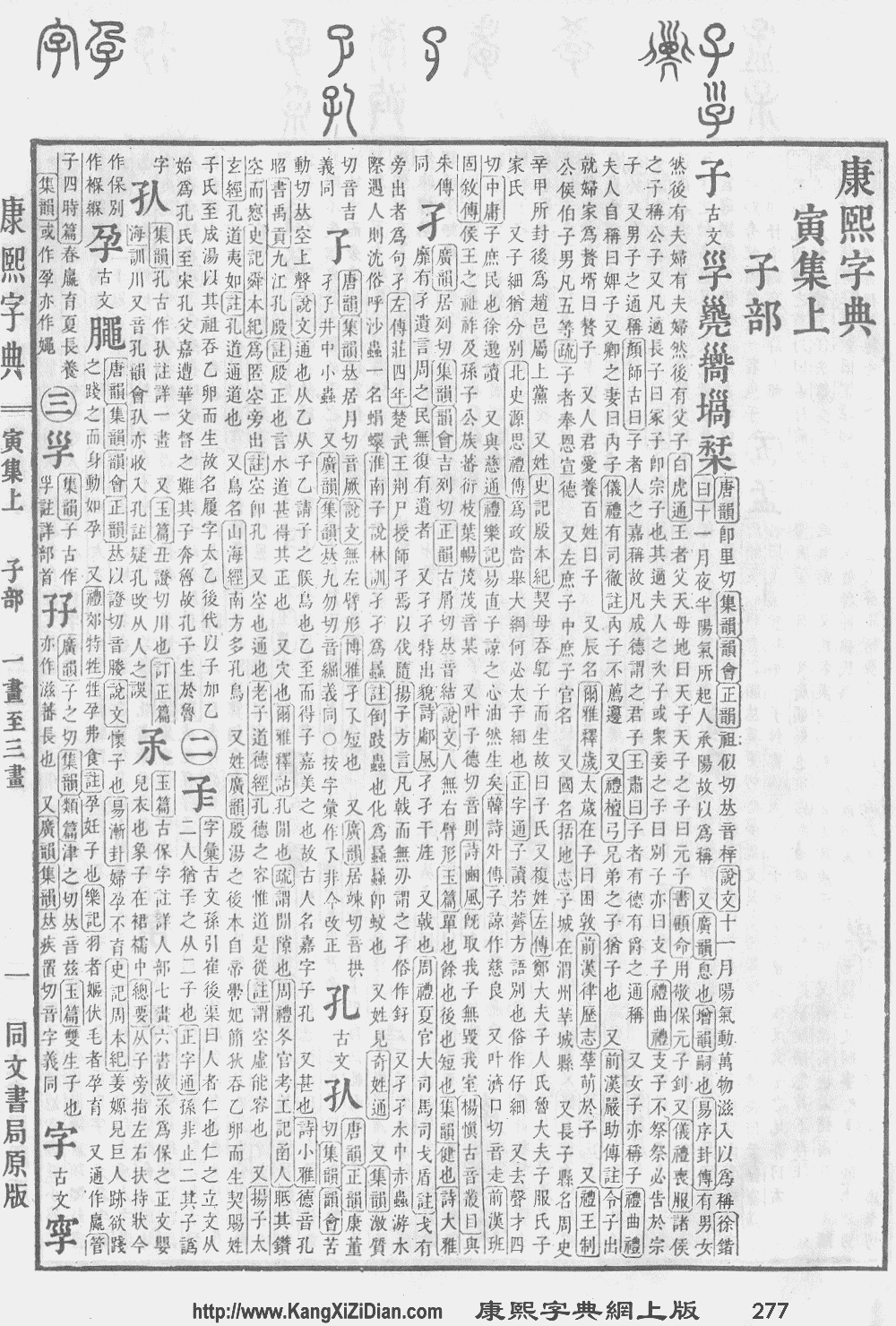
- Kangxi Dictionary: page 277, character 9
- Dai Kanwa Jiten: character 6933
- Dae Jaweon: page 544, character 3
- Hanyu Da Zidian (first edition): volume 2, page 1008, character 4
- Unihan data for U+5B54
Chinese
| simp. and trad. |
孔 | |
|---|---|---|
Glyph origin
| Historical forms of the character 孔 | ||
|---|---|---|
| Western Zhou | Shuowen Jiezi (compiled in Han) | Liushutong (compiled in Ming) |
| Bronze inscriptions | Small seal script | Transcribed ancient scripts |
 |
 |
 |
Characters in the same phonetic series (孔) (Zhengzhang, 2003)
Bronze inscriptions: Ideogrammic compound (會意/会意) : 丿 (“opening”) + 子 (“child”) – opening in the skull of a newborn, i.e. fontanelle.
Etymology
- "hole"
- From Proto-Sino-Tibetan *(g/k)uŋ (“hole; orifice; inner part”). 孔 (OC *kʰloːŋʔ, “hole”) is probably the endoactive derivation of 空 (OC *kʰoːŋ, “hollow; empty”) (Schuessler, 2007). Cognate with Tibetan ཁུང (khung, “hole”), Jingpho ladi hku (lədî hkū, “nostril”), Chepang घाङ् (gʰaŋ, “hole”), Burmese အခေါင်း (a.hkaung:, “hollow place; cavity”), Naxi kho³³ (“cave; hole; pit”) (STEDT).
- "peacock"
- Starostin reconstructs 孔 (OC *khōŋ) and compares it to Proto-Vietic *k-voːŋ. Compare also Semai kuwok, Semnam kwɔːŋ.
Pronunciation
Definitions
孔
- hole; aperture; opening
- 鼻孔 ― bíkǒng ― nostril
- classifier for cave dwellings, oil wells, etc..
- (literary, for irrigation, drainage) ditch; trench; canal; channel
- (literary, or in compounds) profound; far-reaching
- (literary, or in compounds) unimpeded; unblocked
- (literary, or in compounds) large
- (literary, or in compounds) fine
- (literary, or in compounds) very; extremely
- (literary, or in compounds) peacock; peafowl
- a surname
- 孔祥熙 ― Kǒng Xiángxī ― H. H. Kung (Chinese banker and politician)
- (specifically) Short for 孔子 (Kǒngzǐ, “Confucius”).
- 祭孔 ― jì Kǒng ― worship of Confucius
- 批林批孔 ― pī Lín pī Kǒng ― (historical) Criticize Lin Biao and Confucius movement
- (Quanzhou Hokkien) classifier for partitioned grid units in a tool.
Synonyms
- (hole):
Dialectal synonyms of 孔 (“hole”) [map]
| Variety | Location | Words |
|---|---|---|
| Classical Chinese | 孔, 洞, 穴 | |
| Formal (Written Standard Chinese) | 孔, 洞, 孔洞, 空洞, 空穴 | |
| Mandarin | Beijing | 窟窿 |
| Jinan | 窟窿 | |
| Luoyang | 窟窿 | |
| Wanrong | 窟窿 | |
| Xi'an | 窟窿子, 窟窿 | |
| Wuhan | 窟窿, 窟眼, 洞洞, 洞 | |
| Chengdu | 窟窿, 洞洞, 洞 | |
| Liuzhou | 窿 | |
| Yangzhou | 洞, 窟窿 | |
| Nanjing | 窟窿 | |
| Hefei | 窟窿, 洞 | |
| Singapore | 洞 | |
| Cantonese | Guangzhou | 窿, 咕窿 |
| Hong Kong | 窿, 咕窿 | |
| Taishan | 孔 | |
| Yangjiang | 窿 | |
| Kuala Lumpur (Guangfu) | 窿 | |
| Singapore (Guangfu) | 窿 | |
| Gan | Nanchang | 洞 |
| Hakka | Meixian | 窿仔, 窿空仔 |
| Miaoli (N. Sixian) | 空 | |
| Pingtung (Neipu; S. Sixian) | 空 | |
| Hsinchu County (Zhudong; Hailu) | 空 | |
| Taichung (Dongshi; Dabu) | 空 | |
| Hsinchu County (Qionglin; Raoping) | 空 | |
| Yunlin (Lunbei; Zhao'an) | 空 | |
| Jin | Taiyuan | 窟窿, 窟子 |
| Northern Min | Jian'ou | 川 |
| Eastern Min | Fuzhou | 空空 |
| Southern Min | Xiamen | 空, 空口 |
| Quanzhou | 空 | |
| Zhangzhou | 空口 | |
| Zhangzhou (Changtai) | 空 | |
| Taipei | 空 | |
| Penang (Hokkien) | 空 | |
| Singapore (Hokkien) | 空 | |
| Manila (Hokkien) | 空 | |
| Chaozhou | 空 | |
| Jieyang | 空, 洞 | |
| Haifeng | 空 | |
| Singapore (Teochew) | 空 | |
| Singapore (Hainanese) | 空 | |
| Southern Pinghua | Nanning (Tingzi) | 窿 |
| Wu | Suzhou | 洞 |
| Wenzhou | 洞, 窟, 窟窿 | |
| Jinhua | 窟窿 | |
| Xiang | Changsha | 洞, 洞子 |
| Shuangfeng | 眼貢, 洞 | |
- (very):
- (peacock): 孔雀 (kǒngquè)
- (Confucius):
Compounds
- 一孔之見/一孔之见 (yīkǒngzhījiàn)
- 一孔出氣/一孔出气
- 七孔 (qīkǒng)
- 七孔流血
- 七孔生煙/七孔生烟
- 九孔 (jiǔkǒng)
- 人孔 (rénkǒng)
- 六案孔目
- 千孔百瘡/千孔百疮
- 千瘡百孔/千疮百孔 (qiānchuāngbǎikǒng)
- 卵孔
- 呼吸孔
- 周情孔思
- 噴氣孔/喷气孔 (pēnqìkǒng)
- 威儀孔時/威仪孔时
- 孔佛
- 孔叢子/孔丛子 (Kǒngcóngzǐ)
- 孔嘉
- 孔坡
- 孔型
- 孔壁古文
- 孔壠/孔垄/孔垅 (Kǒnglǒng)
- 孔多 (kǒngduō)
- 孔夫子 (Kǒng Fūzǐ)
- 孔子 (Kǒngzǐ)
- 孔子家語/孔子家语
- 孔子廟/孔子庙 (Kǒngzǐmiào)
- 孔子白
- 孔孟 (Kǒng-Mèng)
- 孔孟之道 (Kǒng-Mèng zhī dào)
- 孔孟學會/孔孟学会
- 孔宙碑
- 孔席不暖
- 孔廟/孔庙 (Kǒngmiào)
- 孔徑/孔径
- 孔德
- 孔急 (kǒngjí)
- 孔懷/孔怀
- 孔教 (kǒngjiào)
- 孔方 (kǒngfāng)
- 孔方兄 (kǒngfāngxiōng)
- 孔明 (Kǒngmíng)
- 孔明借箭
- 孔明燈/孔明灯 (kǒngmíngdēng)
- 孔林 (Kǒnglín)
- 孔武有力 (kǒngwǔyǒulì)
- 孔洞 (kǒngdòng)
- 孔灣/孔湾 (Kǒngwān)
- 孔版
- 孔版印刷
- 孔版畫/孔版画
- 孔目
- 孔目房
- 孔眼
- 孔穴 (kǒngxué)
- 孔竅/孔窍
- 孔翠
- 孔融讓梨/孔融让梨
- 孔道 (kǒngdào)
- 孔門/孔门
- 孔隙
- 孔雀 (kǒngquè)
- 孔雀座 (Kǒngquèzuò)
- 孔雀王朝 (Kǒngquè Wángcháo)
- 孔雀石 (kǒngquèshí)
- 孔雀綠/孔雀绿
- 孔雀舞 (kǒngquèwǔ)
- 孔雀開屏/孔雀开屏
- 孔雁
- 孔章望斗
- 孔鯉過庭/孔鲤过庭
- 彰化孔廟/彰化孔庙
- 心孔
- 打孔 (dǎkǒng)
- 打孔機/打孔机 (dǎkǒngjī)
- 打孔紙帶/打孔纸带
- 拉孔
- 晚娘面孔
- 有孔蟲/有孔虫
- 椎孔 (zhuīkǒng)
- 椎間孔/椎间孔 (zhuījiānkǒng)
- 橋孔/桥孔
- 毛孔 (máokǒng)
- 氣孔/气孔 (qìkǒng)
- 泌水孔
- 漏孔
- 漢孔宙碑/汉孔宙碑
- 無孔不入/无孔不入 (wúkǒngbùrù)
- 生面孔
- 白孔六帖
- 百孔千創/百孔千创
- 百孔千瘡/百孔千疮 (bǎikǒngqiānchuāng)
- 皮孔
- 眼孔 (yǎnkǒng)
- 瞳孔 (tóngkǒng)
- 祀孔
- 祭孔 (jìkǒng)
- 程孔傾蓋/程孔倾盖
- 穿孔 (chuānkǒng)
- 羊真孔草
- 老面孔
- 耳孔 (ěrkǒng)
- 胃穿孔 (wèichuānkǒng)
- 腸穿孔/肠穿孔
- 膜孔
- 臉孔/脸孔 (liǎnkǒng)
- 臺南孔廟/台南孔庙
- 蟲孔/虫孔
- 裂孔
- 謀夫孔多/谋夫孔多
- 針孔/针孔 (zhēnkǒng)
- 針孔現象/针孔现象
- 鏜孔/镗孔
- 鑽孔/钻孔 (zuānkǒng)
- 隄潰蟻孔/隄溃蚁孔
- 需才孔亟
- 需款孔急
- 面孔 (miànkǒng)
- 革帶移孔/革带移孔
- 顏苦孔卓/颜苦孔卓
- 鼻孔 (bíkǒng)
References
- “孔”, in 漢語多功能字庫 (Multi-function Chinese Character Database), 香港中文大學 (the Chinese University of Hong Kong), 2014–
Japanese
Compounds
Compounds
- 孔雀 (kujaku)
- 孔雀石 (kujakuseki)
- 孔雀妙王 (kujakumyōō)
- 孔子 (Kōshi)
- 孔版 (kōhan)
- 孔孟 (Kō-Mō)
- 孔門 (kōmon)
- 毛孔 (keana)
- 眼孔 (gankō)
- 気孔 (kikō)
- 空気孔 (kūkikō)
- 細孔 (saikō)
- 鑽孔 (sankō)
- 鑽孔機 (sankōki)
- 鑚孔機 (sankōki)
- 耳孔 (jikō)
- 人孔 (jinkō): manhole
- 穿孔 (senkō)
- 穿孔機 (senkōki)
- 多孔 (takō)
- 多孔性 (takōsei)
- 単孔類 (tankōrui)
- 通気孔 (tsūkikō)
- 通風孔 (tsūfūkō)
- 瞳孔 (dōkō)
- 排水孔 (haisuikō)
- 鼻孔 (bikō)
- 噴気孔 (funkikō)
- 有孔虫 (yūkōchū)
Vietnamese
This article is issued from Wiktionary. The text is licensed under Creative Commons - Attribution - Sharealike. Additional terms may apply for the media files.