尻
| ||||||||
Translingual
Han character
尻 (Kangxi radical 44, 尸+2, 5 strokes, cangjie input 尸大弓 (SKN), four-corner 77217, composition ⿸尸九)
References
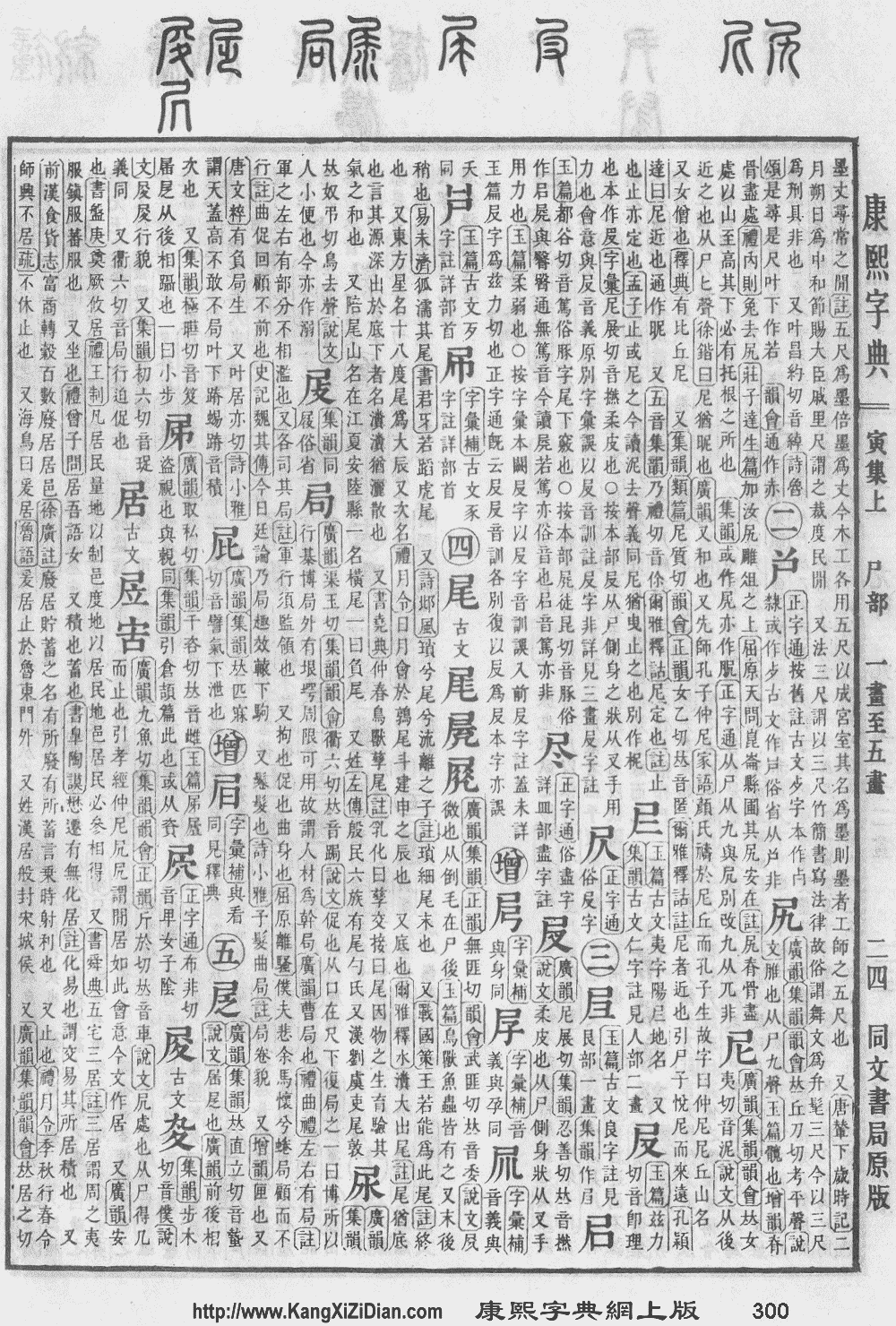
- Kangxi Dictionary: page 300, character 2
- Dai Kanwa Jiten: character 7634
- Dae Jaweon: page 595, character 12
- Hanyu Da Zidian (first edition): volume 2, page 965, character 5
- Unihan data for U+5C3B
Chinese
Glyph origin
| Historical forms of the character 尻 | ||
|---|---|---|
| Shang | Shuowen Jiezi (compiled in Han) | Liushutong (compiled in Ming) |
| Oracle bone script | Small seal script | Transcribed ancient scripts |
 |
 |
 |
Pictogram (象形) in the oracle bone script – a person with the buttocks highlighted.
In the seal script, it developed into a phono-semantic compound (形聲/形声, OC *kʰuː) : semantic 尸 (“body”) + phonetic 九 (OC *kuʔ).
Etymology 1
| simp. and trad. |
尻 | |
|---|---|---|
| alternative forms | 𫝲 㞍 𡰼 𡱧 𡱂 | |
(This etymology is missing or incomplete. Please add to it, or discuss it at the Etymology scriptorium.)
Pronunciation
Definitions
尻
Synonyms
Etymology 2
| simp. and trad. |
尻 | |
|---|---|---|
(This etymology is missing or incomplete. Please add to it, or discuss it at the Etymology scriptorium. Particularly: “From Min Nan 剾?”)
Pronunciation
Synonyms
Descendants
- 尻尻
- 尻手槍/尻手枪
- 尻槍/尻枪
Pronunciation
Japanese
Readings
Etymology 1
| Kanji in this term |
|---|
| 尻 |
| しり Grade: S |
| kun’yomi |
| Alternative spellings |
|---|
| 後 (less common) 臀 (obsolete) 㞍 (rare) |
From Old Japanese, in turn from Proto-Japonic *siri. Ultimate derivation unknown.
The use as a suffixing element in surnames is of unclear derivation. Many of these surnames may derive from place names, in which case the "behind, the end" sense may be the origin. However, other surnames have no clear geographic derivation.
Noun
尻 • (shiri)
- behind; the end
- 尻取り
- shiritori
- word chain
- (literally, “taking the end”)
- 尻取り
- the rear portion of the body: bottom, buttocks
- 2018, 吉田卓矢, 傷害致死容疑:尻に高圧空気、同僚死なす 男を逮捕 in 毎日新聞 (Mainichi Shimbun)
- 茨城県警竜ヶ崎署は 14日、会社の同僚の尻に空気を入れて死亡させたとして、同県つくば市手代木の会社員、吉田佳志容疑者(34)を傷害致死容疑で逮捕した。
- Ibaraki Kenkei Ryūgasaki-sho wa jūyokka, kaisha no dōryō no shiri ni kūki o irete shibō saseta to shite, dōken Tsukuba-shi Teshirogi no kaishain, Yoshida Yoshiyuki yōgisha (sanjūyon) o shōgai-chishi yōgi de taiho shita.
- On the 14th, Ibaraki Prefecture Ryugasaki Police arrested suspect Yoshiyuki YOSHIDA, 34, an office worker from Teshirogi, Tsukuba City, Ibaraki Prefecture, on charges of manslaughter for pumping air into the rectum of a coworker and causing his death.
- 茨城県警竜ヶ崎署は 14日、会社の同僚の尻に空気を入れて死亡させたとして、同県つくば市手代木の会社員、吉田佳志容疑者(34)を傷害致死容疑で逮捕した。
- 2018, 吉田卓矢, 傷害致死容疑:尻に高圧空気、同僚死なす 男を逮捕 in 毎日新聞 (Mainichi Shimbun)
- the bottom or underside of an object
Usage notes
Derived terms
See also
Suffix
尻 • (-shiri)
Usage notes
- When appearing as a suffix, this often takes rendaku (連濁) and voices to -jiri.
Etymology 2
| Kanji in this term |
|---|
| 尻 |
| しり Grade: S (ateji) |
| kun’yomi |
From Ainu シㇼ (sir, “place, island”). The kanji spelling is an example of ateji.
Pronunciation
- IPA(key): [ɕiɾʲi]
Derived terms
- 奥尻島 (Okushiri-tō): Okushiri Island
- 利尻島 (Rishiri-tō)
Pronunciation
- IPA(key): [isa̠ɾa̠i]
Etymology 4
| Kanji in this term |
|---|
| 尻 |
| けつ Grade: S |
| irregular |
| For pronunciation and definitions of 尻 – see the following entry. | ||
| ||
| (This term, 尻, is an alternative spelling (rare) of the above term.) |
References
- Matsumura, Akira, editor (2006), 大辞林 [Daijirin] (in Japanese), Third edition, Tōkyō: Sanseidō, →ISBN
- Kindaichi, Kyōsuke et al., editors (1997), 新明解国語辞典 [Shin Meikai Kokugo Jiten] (in Japanese), Fifth edition, Tōkyō: Sanseidō, →ISBN
Okinawan
Derived terms
- 尻ぬ目 (chibi nu mī, “anus”)
Vietnamese
Han character
尻: Hán Nôm readings: khào
- This term needs a translation to English. Please help out and add a translation, then remove the text
{{rfdef}}.