發
| ||||||||
Translingual
| Stroke order | |||
|---|---|---|---|
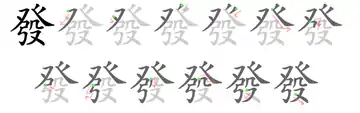 | |||
| Traditional | 發 |
|---|---|
| Shinjitai | 発 |
| Simplified | 发 |
Han character
發 (Kangxi radical 105, 癶+7, 12 strokes, cangjie input 弓人弓竹水 (NONHE), four-corner 12247, composition ⿱癶𭚧)
Derived characters
Related characters
- 発 (Japanese shinjitai)
- 发 (Simplified Chinese)
References
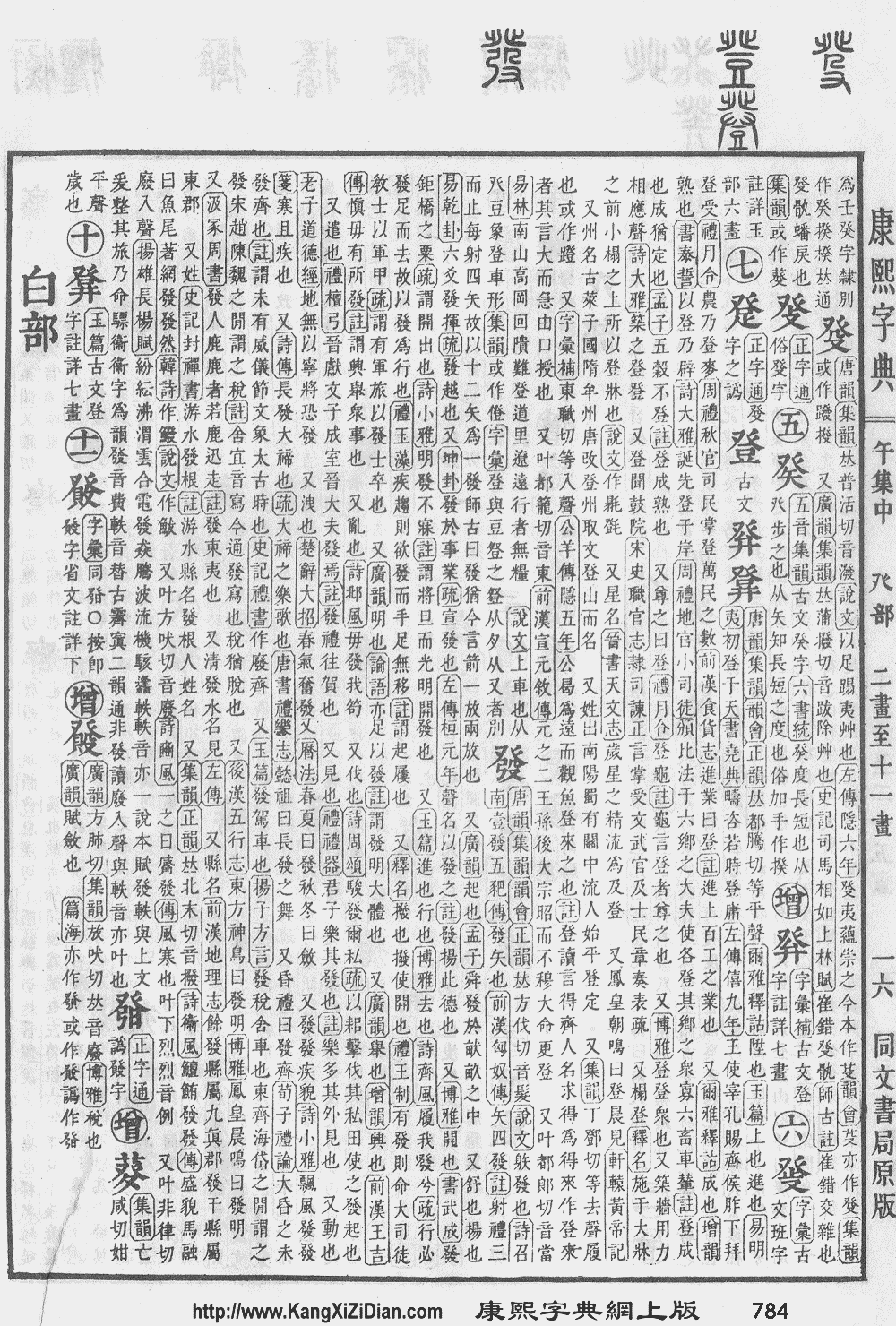
- Kangxi Dictionary: page 784, character 10
- Dai Kanwa Jiten: character 22669
- Dae Jaweon: page 1194, character 1
- Hanyu Da Zidian (first edition): volume 4, page 2761, character 4
- Unihan data for U+767C
Chinese
| trad. | 發 | |
|---|---|---|
| simp. | 发* | |
| alternative forms | 㢭 𤼲 𤼵 彂 活 (stirred with water) | |
Glyph origin
| Historical forms of the character 發 | ||||
|---|---|---|---|---|
| Shang | Spring and Autumn | Warring States | Shuowen Jiezi (compiled in Han) | |
| Oracle bone script | Bronze inscriptions | Chu slip and silk script | Qin slip script | Small seal script |
 |
 |
 |
 |
 |
Phono-semantic compound (形聲/形声, OC *pad) : semantic 弓 (“bow”) + phonetic 癹 (OC *pʰaːd, *baːd).
Etymology 1
STEDT compares 發 (OC *pad) to Proto-Sino-Tibetan *m-p(r)ats (“to vomit”), whence Proto-Lolo-Burmese *C-pat (“to vomit”) (> Burmese ပစ် (pac, “to shoot, to throw, to eject”)) and Jingpho ǹ-phàt (“to vomit”).
According to Schuessler (2007), this is an area word; compare Proto-Vietic *ɓah (“to vomit”), Mon ပန် (“to shoot”).
A derivation is probably 廢 (OC *pads, “to cast aside”).
Pronunciation
Definitions
發
- to shoot; to launch
- to issue
- to depart; to leave
- 始發站/始发站 ― shǐfāzhàn ― station of departure
- 發往北京的列車/发往北京的列车 ― fā wǎng Běijīng de lièchē ― train leaving for Beijing
- 明朝驛使發,一夜絮征袍。 [Classical Chinese, trad.]
- From: Li Bai (李白), c. 8th century, Ballads of Four Seasons: Winter (《子夜吳歌·冬歌》), translated by Witter Bynner.
- Míngzhāo yìshǐ fā, yīyè xù zhēngpáo. [Pinyin]
- The courier will depart next day, she's told.
She sews a warrior's gown all night.
明朝驿使发,一夜絮征袍。 [Classical Chinese, simp.]
- to dispatch
- 發兵/发兵 ― fābīng ― to dispatch troops
- 徵發/征发 ― zhēngfā ― to requisition
- to expand; to extend; to spread
- 發揚/发扬 ― fāyáng ― to promote
- 發展/发展 ― fāzhǎn ― to develop; to enhance
- 發條/发条 ― fātiáo ― coiled spring; clockwork (literally, “expanding strip)”)
- to rise; to emerge
- 舜發於畎畝之中。 [Classical Chinese, trad.]
- From: Mencius, c. 4th century BCE, translated based on James Legge's version
- Shùn fā yú quǎnmǔ zhīzhōng. [Pinyin]
- Shun rose from among the channelled fields.
舜发于畎亩之中。 [Classical Chinese, simp.]
- (colloquial) to gain wealth; to become rich; to make a fortune
- (of food) to rise, expand, or become porous, especially as a result of leavening
- to initiate; to give start to
- to generate; to produce
- to become; to get into a certain state
- ⁜ to open; to remove what seals, blocks, or shuts
- 發掘/发掘 ― fājué ― to excavate; to unearth; (figurative) to develop
- 發軔/发轫 ― fārèn ― to start (literally, “to unblock the wheels”)
- 發現/发现 ― fāxiàn ― to discover; discovery
- 發丘中郎將/发丘中郎将 ― fāqiū zhōnglángjiàng ― General Mound-Opener (graverobber)
- 書未發,威后問使者曰:「歲亦無恙耶?民亦無恙耶?王亦無恙耶?」 [Classical Chinese, trad.]
- From: Zhanguo Ce, circa 5th – 3rd centuries BCE
- Shū wèi fā, Wēihòu wèn shǐzhě yuē: “Suì yì wúyàng yé? Mín yì wúyàng yé? Wáng yì wúyàng yé?” [Pinyin]
- Without opening the letter (bearing the envoy's credentials), the Queen Dowager Wei asked the envoy: "Are the crops good? Are the people content? Is the King in good health?"
书未发,威后问使者曰:「岁亦无恙耶?民亦无恙耶?王亦无恙耶?」 [Classical Chinese, simp.]
- to make manifest; to express; to act out
- (figurative, of the mind) to make clear; to enlighten; to open up; to stimulate
- 退而省其私,亦足以發。 [Classical Chinese, trad.]
- From: The Analects of Confucius, c. 475 – 221 BCE, translated based on James Legge's version
- Tuì ér xǐng qí sī, yì zúyǐ fā. [Pinyin]
- He has retired, and I have examined his conduct when away from me, and found him able to illustrate my teachings.
退而省其私,亦足以发。 [Classical Chinese, simp.]
- Classifier for ammunition.
- (slang) Classifier for ejaculation.
- (Hokkien) to show effect; to break out
- (Mainland China Hokkien) to go bad; to deteriorate; to become rotten
- (Xiamen and Zhangzhou Hokkien) to have quicklime react by mixing with water
- (Zhangzhou Hokkien) stirred with water and squeezed repeatedly becoming dense and flexible (of flour, earth, etc.)
Compounds
- 一發/一发 (yīfā)
- 七發/七发 (Qīfā)
- 不發心/不发心
- 不虛發/不虚发
- 交發/交发
- 併發/并发 (bìngfā)
- 併發症/并发症 (bìngfāzhèng)
- 促發/促发
- 偶發/偶发 (ǒufā)
- 傳發/传发
- 先發/先发 (xiānfā)
- 充發/充发
- 出發/出发 (chūfā)
- 出發點/出发点 (chūfādiǎn)
- 分發/分发 (fēnfā)
- 初發/初发
- 勃發/勃发 (bófā)
- 勞發/劳发
- 印發/印发 (yìnfā)
- 告發/告发 (gàofā)
- 哈利發/哈利发
- 噴發/喷发 (pēnfā)
- 填發/填发 (tiánfā)
- 墊發/垫发
- 多發性/多发性 (duōfāxìng)
- 大發/大发 (dàfā)
- 奮發/奋发 (fènfā)
- 害發/害发
- 寄發/寄发
- 差發/差发
- 引發/引发 (yǐnfā)
- 復發/复发 (fùfā)
- 徵發/征发 (zhēngfā)
- 忿發/忿发
- 性發/性发 (xìngfā)
- 惡發/恶发
- 感發/感发
- 打發/打发 (dǎfa)
- 批發/批发 (pīfā)
- 抒發/抒发 (shūfā)
- 抄發/抄发 (chāofā)
- 批發價/批发价 (pīfājià)
- 批發商/批发商 (pīfāshāng)
- 拍發/拍发
- 拿發/拿发
- 揮發/挥发 (huīfā)
- 揭發/揭发 (jiēfā)
- 揮發油/挥发油
- 撥發/拨发 (bōfā)
- 播發/播发 (bōfā)
- 擊發/击发 (jīfā)
- 收發/收发 (shōufā)
- 啟發/启发 (qǐfā)
- 散發/散发
- 明發/明发
- 暴發/暴发 (bàofā)
- 暴發戶/暴发户 (bàofāhù)
- 核發/核发
- 機發/机发
- 汽發/汽发 (Qìfā)
- 沙發/沙发 (shāfā)
- 沙發床/沙发床 (shāfāchuáng)
- 津發/津发
- 清發/清发
- 激發/激发 (jīfā)
- 濫發/滥发 (lànfā)
- 煥發/焕发 (huànfā)
- 照發/照发
- 蒸發/蒸发 (zhēngfā)
- 蒸發熱/蒸发热
- 爆發/爆发 (bàofā)
- 爆發力/爆发力 (bàofālì)
- 爆發星/爆发星
- 爆發音/爆发音 (bàofāyīn)
- 牒發/牒发
- 猝發/猝发
- 生發/生发 (shēngfā)
- 病發/病发
- 發不了/发不了
- 發乍/发乍
- 發乾/发干
- 發事/发事
- 發亮/发亮 (fāliàng)
- 發人深思/发人深思
- 發人深省/发人深省 (fārénshēnxǐng)
- 發人深醒/发人深醒 (fārénshēnxǐng)
- 發令/发令
- 發付/发付 (fāfù)
- 發令槍/发令枪
- 發佈/发布 (fābù)
- 發作/发作 (fāzuò)
- 發信/发信
- 發俊科/发俊科
- 發個兒/发个儿
- 發傻/发傻
- 發僵/发僵
- 發兆/发兆
- 發光/发光 (fāguāng)
- 發光器/发光器
- 發光屏/发光屏
- 發光度/发光度
- 發光強度/发光强度
- 發光體/发光体
- 發兵/发兵 (fābīng)
- 發冢/发冢
- 發冷/发冷 (fālěng)
- 發凡/发凡
- 發出/发出 (fāchū)
- 發函/发函 (fāhán)
- 發刊/发刊 (fākān)
- 發刊詞/发刊词 (fākāncí)
- 發利市/发利市
- 發勁/发劲
- 發動/发动 (fādòng)
- 發動機/发动机 (fādòngjī)
- 發包/发包 (fābāo)
- 發匱/发匮
- 發呆/发呆 (fādāi)
- 發咒/发咒
- 發問/发问 (fāwèn)
- 發售/发售 (fāshòu)
- 發啞/发哑
- 發單/发单 (fādān)
- 發喪/发丧 (fāsāng)
- 發喘/发喘
- 發喬/发乔
- 發喉急/发喉急
- 發嗲/发嗲 (fādiǎ)
- 發噱/发噱
- 發回/发回 (fāhuí)
- 發報/发报 (fābào)
- 發堵/发堵
- 發報機/发报机
- 發天陰/发天阴
- 發奉/发奉
- 發奮/发奋 (fāfèn)
- 發奮圖強/发奋图强 (fāfèntúqiáng)
- 發奮忘食/发奋忘食
- 發奶/发奶
- 發威/发威 (fāwēi)
- 發嫁/发嫁
- 發家/发家 (fājiā)
- 發封/发封
- 發射/发射 (fāshè)
- 發射光譜/发射光谱
- 發射器/发射器
- 發射極/发射极
- 發射機/发射机 (fāshèjī)
- 發射臺/发射台 (fāshètái)
- 發射點/发射点
- 發展/发展 (fāzhǎn)
- 發展中國家/发展中国家 (fāzhǎnzhōng guójiā)
- 發市/发市
- 發布/发布 (fābù)
- 發廩/发廪
- 發引/发引
- 發往/发往
- 發心/发心 (fāxīn)
- 發忿/发忿
- 發怒/发怒 (fānù)
- 發怔/发怔
- 發怵/发怵
- 發急/发急 (fājí)
- 發性/发性
- 發性地/发性地 (hoat-sìng-tē) (Min Nan)
- 發息/发息
- 發恨/发恨
- 發悶/发闷
- 發情/发情 (fāqíng)
- 發悲/发悲 (fābēi)
- 發情期/发情期 (fāqíngqī)
- 發愁/发愁 (fāchóu)
- 發意/发意
- 發愣/发愣 (fālèng)
- 發惱/发恼
- 發慌/发慌 (fāhuāng)
- 發態度/发态度
- 發憤/发愤 (fāfèn)
- 發憤圖強/发愤图强
- 發懶/发懒
- 發戰/发战
- 發抒/发抒
- 發抖/发抖 (fādǒu)
- 發掘/发掘 (fājué)
- 發排/发排 (fāpái)
- 發揮/发挥 (fāhuī)
- 發揚/发扬 (fāyáng)
- 發揚光大/发扬光大 (fāyángguāngdà)
- 發摃/发𫼱
- 發擂/发擂
- 發擿/发擿
- 發擺子/发摆子
- 發放/发放 (fāfàng)
- 發散/发散 (fāsàn)
- 發散透鏡/发散透镜
- 發文/发文 (fāwén)
- 發旺/发旺
- 發明/发明 (fāmíng)
- 發昏/发昏 (fāhūn)
- 發明家/发明家 (fāmíngjiā)
- 發春/发春 (fāchūn)
- 發暗/发暗
- 發暈/发晕 (fāyūn)
- 發木/发木
- 發村/发村
- 發案/发案
- 發條/发条 (fātiáo)
- 發棠/发棠
- 發楞/发楞
- 發極/发极
- 發業/发业
- 發榜/发榜 (fābǎng)
- 發榮/发荣
- 發標/发标 (fābiāo)
- 發樣/发样
- 發橫/发横
- 發橫財/发横财
- 發歲/发岁
- 發殭/发僵
- 發毛/发毛 (fāmáo)
- 發氣/发气
- 發水/发水 (fāshuǐ)
- 發汗/发汗 (fāhàn)
- 發汗劑/发汗剂
- 發泄 (fāxiè)
- 發泡劑/发泡剂
- 發洪/发洪
- 發洩/发泄 (fāxiè)
- 發洋財/发洋财 (fāyángcái)
- 發淡科/发淡科
- 發渾/发浑
- 發滑/发滑
- 發源/发源 (fāyuán)
- 發源地/发源地 (fāyuándì)
- 發潑/发泼
- 發潮/发潮 (fācháo)
- 發瀋/发沈
- 發火/发火 (fāhuǒ)
- 發火點/发火点
- 發炎/发炎 (fāyán)
- 發煩/发烦
- 發煙劑/发烟剂
- 發熱/发热 (fārè)
- 發燙/发烫
- 發燒/发烧 (fāshāo)
- 發燒友/发烧友 (fāshāoyǒu)
- 發燒客/发烧客
- 發燒度/发烧度
- 發燭/发烛
- 發牌/发牌 (fāpái)
- 發牒/发牒
- 發牙豆/发牙豆
- 發牢騷/发牢骚 (fā láosāo)
- 發物/发物 (fāwù)
- 發狂/发狂 (fākuáng)
- 發狠/发狠 (fāhěn)
- 發獃/发獃
- 發現/发现 (fāxiàn)
- 發球/发球 (fāqiú)
- 發球局/发球局
- 發生/发生 (fāshēng)
- 發生學/发生学
- 發生率/发生率 (fāshēnglǜ)
- 發甲/发甲
- 發疹/发疹
- 發病/发病 (fābìng)
- 發病率/发病率 (fābìnglǜ)
- 發痧/发痧 (fāshā)
- 發痴/发痴
- 發瘋/发疯 (fāfēng)
- 發瘮/发瘆
- 發癢/发痒 (fāyǎng)
- 發癲/发癫 (fādiān)
- 發發/发发
- 發白/发白 (fābái)
- 發皇/发皇
- 發皓齒/发皓齿
- 發監/发监
- 發盤/发盘
- 發直/发直
- 發眩/发眩
- 發睏/发困
- 發矢/发矢
- 發石車/发石车
- 發硎/发硎
- 發神經/发神经 (fā shénjīng)
- 發祥/发祥 (fāxiáng)
- 發票/发票 (fāpiào)
- 發祥地/发祥地 (fāxiángdì)
- 發福/发福 (fāfú)
- 發科/发科
- 發稿/发稿 (fāgǎo)
- 發積/发积
- 發窘/发窘
- 發端/发端 (fāduān)
- 發端詞/发端词
- 發笑/发笑 (fāxiào)
- 發策/发策
- 發箭/发箭 (fājiàn)
- 發篋/发箧
- 發籤/发签
- 發粉/发粉 (fāfěn)
- 發糕/发糕 (fāgāo)
- 發紫/发紫
- 發紺/发绀 (fāgàn)
- 發給/发给 (fāgěi)
- 發緊/发紧
- 發縱指示/发纵指示
- 發老狠/发老狠
- 發聲/发声 (fāshēng)
- 發聲器/发声器
- 發聲法/发声法
- 發聾振聵/发聋振聩
- 發育/发育 (fāyù)
- 發背/发背
- 發胖/发胖 (fāpàng)
- 發胡/发胡
- 發脫/发脱
- 發脹/发胀 (fāzhàng)
- 發脾寒/发脾寒
- 發脾氣/发脾气 (fā píqi)
- 發腳/发脚
- 發膩/发腻
- 發臭/发臭 (fāchòu)
- 發花/发花
- 發芽/发芽 (fāyá)
- 發芽率/发芽率
- 發苦/发苦
- 發苶/发苶
- 發草/发草
- 發草帖/发草帖
- 發莊/发庄
- 發落/发落 (fāluò)
- 發蒙/发蒙
- 發蒙振落/发蒙振落
- 發蔫/发蔫
- 發薪/发薪 (fāxīn)
- 發藍/发蓝
- 發虛/发虚 (fāxū)
- 發號令/发号令
- 發號施令/发号施令 (fāhàoshīlìng)
- 發行/发行
- 發行人/发行人 (fāxíngrén)
- 發表/发表 (fābiǎo)
- 發表會/发表会
- 發覆/发覆
- 發覺/发觉 (fājué)
- 發解/发解
- 發言/发言 (fāyán)
- 發言人/发言人 (fāyánrén)
- 發言權/发言权 (fāyánquán)
- 發訕/发讪
- 發話/发话
- 發話器/发话器
- 發誓/发誓 (fāshì)
- 發語詞/发语词 (fāyǔcí)
- 發課/发课
- 發諢子/发诨子
- 發變/发变
- 發財/发财 (fācái)
- 發財票/发财票
- 發貨/发货 (fāhuò)
- 發賣/发卖 (fāmài)
- 發賴/发赖
- 發起/发起 (fāqǐ)
- 發起人/发起人 (fāqǐrén)
- 發越/发越
- 發足/发足
- 發跡/发迹 (fājì)
- 發蹙/发蹙
- 發躁/发躁
- 發身/发身 (fāshēn)
- 發車/发车 (fāchē)
- 發軔/发轫 (fārèn)
- 發軟/发软
- 發轎/发轿
- 發送/发送
- 發送機/发送机
- 發達/发达 (fādá)
- 發達國家/发达国家 (fādá guójiā)
- 發遣/发遣 (fāqiǎn)
- 發還/发还 (fāhuán)
- 發配/发配 (fāpèi)
- 發酒瘋/发酒疯 (fā jiǔfēng)
- 發酒風/发酒风
- 發酸/发酸
- 發酵/发酵 (fājiào)
- 發酵乳/发酵乳 (fājiàorǔ)
- 發開/发开
- 發陰天/发阴天
- 發陽/发阳
- 發難/发难 (fānàn)
- 發電/发电 (fādiàn)
- 發電廠/发电厂 (fādiànchǎng)
- 發電機/发电机 (fādiànjī)
- 發霉 (fāméi)
- 發露/发露
- 發青/发青 (fāqīng)
- 發鞍/发鞍
- 發音/发音 (fāyīn)
- 發音學/发音学
- 發頭/发头
- 發頭風/发头风
- 發願/发愿 (fāyuàn)
- 發顫/发颤
- 發風/发风
- 發飄/发飘
- 發飆/发飙 (fābiāo)
- 發餉/发饷
- 發馬/发马
- 發騷/发骚 (fāsāo)
- 發高燒/发高烧
- 發鬆/发松
- 發鬧/发闹
- 發麵/发面 (fāmiàn)
- 發麻/发麻 (fāmá)
- 發黏/发黏
- 發黑/发黑
- 發墨/发墨
- 白發/白发
- 益發/益发 (yìfā)
- 研發/研发 (yánfā)
- 秀發/秀发 (xiùfā)
- 突發/突发 (tūfā)
- 簽發/签发 (qiānfā)
- 自發/自发 (zìfā)
- 舉發/举发 (jǔfā)
- 茂發/茂发
- 英發/英发
- 萌發/萌发 (méngfā)
- 虛發/虚发 (xūfā)
- 補發/补发 (bǔfā)
- 覺發/觉发
- 解發/解发
- 觱發/觱发
- 觸發/触发 (chùfā)
- 訐發/讦发
- 誘發/诱发 (yòufā)
- 調發/调发
- 賚發/赉发
- 越發/越发 (yuèfā)
- 轉發/转发 (zhuǎnfā)
- 迸發/迸发 (bèngfā)
- 進發/进发 (jìnfā)
- 遣發/遣发
- 配發/配发
- 長發/长发 (chángfā)
- 開發/开发 (kāifā)
- 開發井/开发井
- 開發區/开发区 (kāifāqū)
- 闡發/阐发 (chǎnfā)
- 陣發性/阵发性 (zhènfāxìng)
- 青發/青发 (qīngfā)
- 頒發/颁发 (bānfā)
- 風發/风发 (fēngfā)
- 駿發/骏发
- 點發/点发
- 齎發/赍发
Descendants
Others:
Pronunciation
Definitions
發
Pronunciation
Etymology 4
| For pronunciation and definitions of 發 – see 暴 (“to sprout”). (This character is a variant form of 暴). |
References
- “發”, in 漢語多功能字庫 (Multi-function Chinese Character Database), 香港中文大學 (the Chinese University of Hong Kong), 2014–
Japanese
| 発 | |
| 發 |
Readings
Korean
Etymology
From Middle Chinese 發 (MC pjot).
| Historical Readings | ||
|---|---|---|
| Dongguk Jeongun Reading | ||
| Dongguk Jeongun, 1448 | 버ᇙ〮 (Yale: pélq) | |
| Middle Korean | ||
| Text | Eumhun | |
| Gloss (hun) | Reading | |
| Sinjeung Yuhap, 1576 | 베플 (Yale: peyphul) | 발 (Yale: pal) |
Pronunciation
- (SK Standard/Seoul) IPA(key): [pa̠ɭ]
- Phonetic hangul: [발]
Compounds
Compounds
- 발견 (發見, balgyeon)
- 발사 (發射, balsa)
- 발명 (發明, balmyeong)
- 발포 (發砲, balpo)
- 오발 (誤發, obal)
- 만발 (滿發, manbal)
- 발상 (發想, balsang)
- 발병 (發病, balbyeong)
- 발열 (發熱, baryeol)
- 발원 (發源, barwon)
- 발전 (發電, baljeon)
- 발화 (發火, balhwa)
- 발광 (發光, balgwang)
- 발굴 (發掘, balgul)
- 발모 (發毛, balmo)
- 발부 (發付, balbu)
- 발산 (發散, balsan)
- 발설 (發說, balseol)
- 발성 (發聲, balseong)
- 발송 (發送, balsong)
- 발신 (發信, balsin)
- 발악 (發惡, barak)
- 발안 (發案, baran)
- 발언 (發言, bareon)
- 발음 (發音, bareum)
- 발의 (發議, barui)
- 발주 (發注, balju)
- 발표 (發表, balpyo)
- 발행 (發行, balhaeng)
- 출발 (出發, chulbal)
- 폭발 (爆發, pokbal)
- 후발 (後發, hubal)
- 발육 (發育, baryuk)
Vietnamese
This article is issued from Wiktionary. The text is licensed under Creative Commons - Attribution - Sharealike. Additional terms may apply for the media files.