畜

畜 U+755C, 畜
CJK UNIFIED IDEOGRAPH-755C
← 畛
[U+755B]
CJK Unified Ideographs 畝 →
[U+755D]

Translingual

Han character

畜 (Kangxi radical 102, 田+5, 10 strokes, cangjie input 卜女戈田 (YVIW), four-corner 00603, composition ⿱玄田)

Derived characters

References

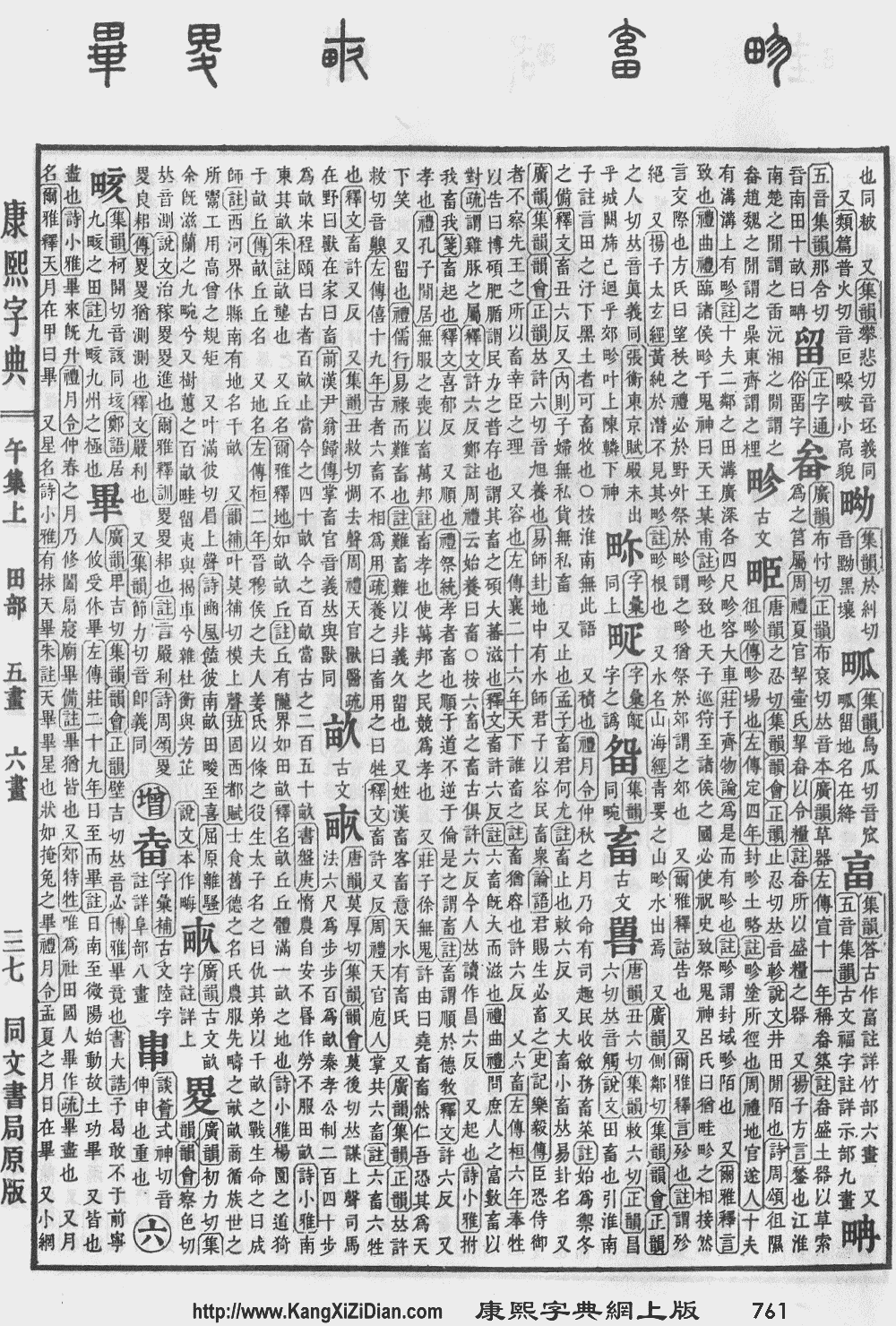
  • Kangxi Dictionary: page 761, character 12
  • Dai Kanwa Jiten: character 21814
  • Dae Jaweon: page 1171, character 5
  • Hanyu Da Zidian (first edition): volume 4, page 2538, character 4
  • Unihan data for U+755C

Chinese

simp. and trad.
畜
alternative forms
 
嘼
𠬀
𤛅
𤠕
𤲸
嘼
𠬀
𤛅
𤠕
𤲸
蓄
𠾧

Glyph origin

Historical forms of the character 畜
Shang Western Zhou Warring States Shuowen Jiezi (compiled in Han)
Oracle bone script Bronze inscriptions Chu slip and silk script Small seal script

Pictogram (象形) : 玄 (“rope tying the bag of feed”) + 田 (“bag of feed”) – a bag of feed, hence livestock.

Alternatively, 玄 (“rope”) + 田 or 囿 (“pen; fold; enclosure”) – tying animals and raising them in the enclosure.

Etymology

“To raise; to rear (an animal)” (*–k) > “domesticated animal; livestock” (*–k–s, exopassive: “what has been raised”). The various pronunciations in Old and Middle Chinese have been confused or merged in many extant dialects.

Etymology unknown. Probably from Proto-Sino-Tibetan *hu (“to be born; birth; to rear”), and thus may be related to 好 (OC *qʰuːʔ, *qʰuːs, “good; to like”) (Matisoff). Alternatively, from Proto-Sino-Tibetan *kruŋ (“to live; alive; to be born; to give birth; green; sprout”), whence Tibetan འཁྲུང ('khrung, “to be born; to arise; to sprout”) (Schuessler, 2007).

Zhengzhang (2015) relates Tibetan ལུག (lug, “sheep”) to this word; this would be parallel to 羊 (OC *laŋ, “sheep”) ?~ 養 (OC *laŋʔ, *laŋs, “to rear”) (Sagart, 1999). In Sagart (1999), 畜 is related to 育 (OC *luɡ, “to nourish”) and 鞠 (OC *kuɡ, *kʰuɡ, *ɡuɡ, “to rear”).

Pronunciation 1


  • Dialectal data
Variety Location 畜
Mandarin Beijing /ʈ͡ʂʰu⁵¹/
Harbin /ʈ͡ʂʰu²⁴/ 牲~
/ʈ͡ʂʰu⁵³/ ~牲
Tianjin /ɕy⁵³/
Jinan /ɕy²¹³/
Qingdao /ʈ͡ʂʰu⁵⁵/
Zhengzhou /ɕy²⁴/
Xi'an /ɕy²¹/
Xining /ɕy⁴⁴/
Yinchuan /ɕy¹³/
Lanzhou /ɕy¹³/
Ürümqi /ɕy²¹³/
Wuhan /ɕiəu²¹³/ ~牧
Chengdu /ɕyo³¹/
/ɕy³¹/
Guiyang /t͡sʰu²¹/ ~牲
/ɕiu²¹/ 牲~
Kunming /ɕiu³¹/
Nanjing /ʂuʔ⁵/
Hefei /ɕyəʔ⁵/
Jin Taiyuan /ɕyəʔ²/
Pingyao /ɕyʌʔ¹³/ ~牧業
/t͡sʰuʌʔ¹³/ ~牲
Hohhot /ɕyəʔ⁴³/
Wu Shanghai /ɕioʔ⁵/
Suzhou /ɕioʔ⁵/ ~牧
/t͡sʰoʔ⁵/ ~牲
Hangzhou /t͡sʰoʔ⁵/ ~牲
/ɕioʔ⁵/ ~牧
Wenzhou /ɕɤu²¹³/
Hui Shexian /ɕiuʔ²¹/
Tunxi /t͡ɕʰiu⁵/
Xiang Changsha /ɕiəu²⁴/
Xiangtan /ɕiəɯ²⁴/
Gan Nanchang /ɕiuʔ⁵/
Hakka Meixian /hiuk̚¹/
Taoyuan /hiuk̚²²/
Cantonese Guangzhou /t͡sʰok̚⁵/
Nanning /t͡sʰuk̚⁵⁵/
Hong Kong /t͡sʰok̚⁵/
Min Xiamen (Hokkien) /hiɔk̚³²/
Fuzhou (Eastern Min) /høyʔ²³/
Jian'ou (Northern Min) /tʰy²⁴/
/xy²⁴/ 新
Shantou (Teochew) /tʰiok̚²/
/tʰek̚²/
Haikou (Hainanese) /sok̚⁵/

Rime
Character 畜
Reading # 3/4
Initial (聲) 曉 (32)
Final (韻) 屋 (4)
Tone (調) Checked (Ø)
Openness (開合) Open
Division (等) III
Fanqie 許竹切
Baxter xjuwk
Reconstructions
Zhengzhang
Shangfang
/hɨuk̚/
Pan
Wuyun
/hiuk̚/
Shao
Rongfen
/xiuk̚/
Edwin
Pulleyblank
/huwk̚/
Li
Rong
/xiuk̚/
Wang
Li
/xĭuk̚/
Bernard
Karlgren
/xi̯uk̚/
Expected
Mandarin
Reflex
xu
Expected
Cantonese
Reflex
huk1
Baxter–Sagart system 1.1 (2014)
Character 畜 畜
Reading # 4/4 2/4
Modern
Beijing
(Pinyin)
xù chù
Middle
Chinese
‹ xjuwk › ‹ trhjuwk ›
Old
Chinese
/*qʰuk/ /*qʰ<r>uk/
English nourish store (v.)

Notes for Old Chinese notations in the Baxter–Sagart system:

* Parentheses "()" indicate uncertain presence;
* Square brackets "[]" indicate uncertain identity, e.g. *[t] as coda may in fact be *-t or *-p;
* Angle brackets "<>" indicate infix;
* Hyphen "-" indicates morpheme boundary;

* Period "." indicates syllable boundary.
Zhengzhang system (2003)
Character 畜
Reading # 3/3
No. 13997
Phonetic
component
畜
Rime
group
覺
Rime
subdivision
1
Corresponding
MC rime
蓄
Old
Chinese
/*hluɡ/

Definitions

畜

  1. to nourish; to raise; to rear
  2. to bring up; to nurture; to foster; to cultivate
  3. † to submit; to obey; to comply
  4. † to tolerate; to allow
  5. † to keep; to house; to collect
  6. † Alternative form of 蓄 (xù, “to store up; to accumulate”)
  7. † Alternative form of 慉 (“to like”)
  8. (dialectal, of a smell) to irritate one's respiratory organs
  9. a surname
Synonyms

Compounds

Pronunciation 2


Note:
  • thiok/hiok - literary;
  • thek/thiak - vernacular.
    • Wu
      • (Shanghai):
        • Wugniu: 7tshoq
        • MiniDict: tshoh入
        • Wiktionary Romanisation (Shanghai): 4tshoq
        • Sinological IPA (Shanghai): /t͡sʰoʔ⁵⁵/

  • Dialectal data
Variety Location 畜
Mandarin Beijing /ʈ͡ʂʰu⁵¹/
Harbin /ʈ͡ʂʰu²⁴/ 牲~
/ʈ͡ʂʰu⁵³/ ~牲
Tianjin /ɕy⁵³/
Jinan /ɕy²¹³/
Qingdao /ʈ͡ʂʰu⁵⁵/
Zhengzhou /ɕy²⁴/
Xi'an /ɕy²¹/
Xining /ɕy⁴⁴/
Yinchuan /ɕy¹³/
Lanzhou /ɕy¹³/
Ürümqi /ɕy²¹³/
Wuhan /ɕiəu²¹³/ ~牧
Chengdu /ɕyo³¹/
/ɕy³¹/
Guiyang /t͡sʰu²¹/ ~牲
/ɕiu²¹/ 牲~
Kunming /ɕiu³¹/
Nanjing /ʂuʔ⁵/
Hefei /ɕyəʔ⁵/
Jin Taiyuan /ɕyəʔ²/
Pingyao /ɕyʌʔ¹³/ ~牧業
/t͡sʰuʌʔ¹³/ ~牲
Hohhot /ɕyəʔ⁴³/
Wu Shanghai /ɕioʔ⁵/
Suzhou /ɕioʔ⁵/ ~牧
/t͡sʰoʔ⁵/ ~牲
Hangzhou /t͡sʰoʔ⁵/ ~牲
/ɕioʔ⁵/ ~牧
Wenzhou /ɕɤu²¹³/
Hui Shexian /ɕiuʔ²¹/
Tunxi /t͡ɕʰiu⁵/
Xiang Changsha /ɕiəu²⁴/
Xiangtan /ɕiəɯ²⁴/
Gan Nanchang /ɕiuʔ⁵/
Hakka Meixian /hiuk̚¹/
Taoyuan /hiuk̚²²/
Cantonese Guangzhou /t͡sʰok̚⁵/
Nanning /t͡sʰuk̚⁵⁵/
Hong Kong /t͡sʰok̚⁵/
Min Xiamen (Hokkien) /hiɔk̚³²/
Fuzhou (Eastern Min) /høyʔ²³/
Jian'ou (Northern Min) /tʰy²⁴/
/xy²⁴/ 新
Shantou (Teochew) /tʰiok̚²/
/tʰek̚²/
Haikou (Hainanese) /sok̚⁵/

Rime
Character 畜 畜 畜
Reading # 1/4 2/4 4/4
Initial (聲) 徹 (10) 曉 (32) 徹 (10)
Final (韻) 尤 (136) 尤 (136) 屋 (4)
Tone (調) Departing (H) Departing (H) Checked (Ø)
Openness (開合) Open Open Open
Division (等) III III III
Fanqie 丑救切 許救切 丑六切
Baxter trhjuwH xjuwH trhjuwk
Reconstructions
Zhengzhang
Shangfang
/ʈʰɨuH/ /hɨuH/ /ʈʰɨuk̚/
Pan
Wuyun
/ʈʰiuH/ /hiuH/ /ʈʰiuk̚/
Shao
Rongfen
/ȶʰiəuH/ /xiəuH/ /ȶʰiuk̚/
Edwin
Pulleyblank
/ʈʰuwH/ /huwH/ /ʈʰuwk̚/
Li
Rong
/ȶʰiuH/ /xiuH/ /ȶʰiuk̚/
Wang
Li
/ȶʰĭəuH/ /xĭəuH/ /ȶʰĭuk̚/
Bernard
Karlgren
/ȶʰi̯ə̯uH/ /xi̯ə̯uH/ /ȶʰi̯uk̚/
Expected
Mandarin
Reflex
chòu xiù chu
Expected
Cantonese
Reflex
cau3 jau3 cuk1
Baxter–Sagart system 1.1 (2014)
Character 畜 畜
Reading # 1/4 3/4
Modern
Beijing
(Pinyin)
chù xù
Middle
Chinese
‹ trhjuwH › ‹ xjuwH ›
Old
Chinese
/*qʰ<r>uk-s/ /*qʰuk-s/
English domesticated animals domestic animal

Notes for Old Chinese notations in the Baxter–Sagart system:

* Parentheses "()" indicate uncertain presence;
* Square brackets "[]" indicate uncertain identity, e.g. *[t] as coda may in fact be *-t or *-p;
* Angle brackets "<>" indicate infix;
* Hyphen "-" indicates morpheme boundary;

* Period "." indicates syllable boundary.
Zhengzhang system (2003)
Character 畜 畜
Reading # 1/3 2/3
No. 13988 13994
Phonetic
component
畜 畜
Rime
group
奧 覺
Rime
subdivision
1 1
Corresponding
MC rime
畜 蓄
Old
Chinese
/*l̥ʰuɡs/ /*l̥ʰuɡ/
Notes 甲金文從幺田,
原意系養田獵所獲幼獸

Definitions

畜

  1. livestock; domesticated animal; farm animal
    家畜  ―  jiāchù  ―  domesticated animal
  2. creature; beast
    畜生  ―  chùshēng  ―  beast, brute

Compounds

References

Japanese

Kanji

畜

(common “Jōyō” kanji)

  1. livestock
  2. domestic fowl and animals

Readings

Korean

Hanja

畜 • (chuk, hyuk) (hangeul 축, 휵, revised chuk, hyuk, McCune–Reischauer ch'uk, hyuk, Yale chwuk, hyuk)

  1. This term needs a translation to English. Please help out and add a translation, then remove the text {{rfdef}}.

Vietnamese

Han character

畜: Hán Nôm readings: súc, húc, sục

Noun

畜

  1. chữ Hán form of súc (“livestock”).

References

  • Thiều Chửu : Hán Việt Tự Điển Hà Nội 1942
  • Trần Văn Chánh: Từ Điển Hán Việt NXB Trẻ, Ho Chi Minh Ville, 1999
  • Vũ Văn Kính: Đại Tự Điển Chữ Nôm, NXB Văn Nghệ, Ho Chi Minh Ville, 1999
This article is issued from Wiktionary. The text is licensed under Creative Commons - Attribution - Sharealike. Additional terms may apply for the media files.