真
| ||||||||
| ||||||||
 | ||||||||
Translingual
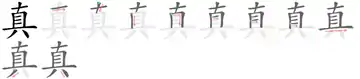
| Stroke order | |||
|---|---|---|---|
 | |||
| Traditional | 真 |
|---|---|
| Simplified | 真 |
| Japanese | 真 |
| Korean | 眞 |
Alternative forms
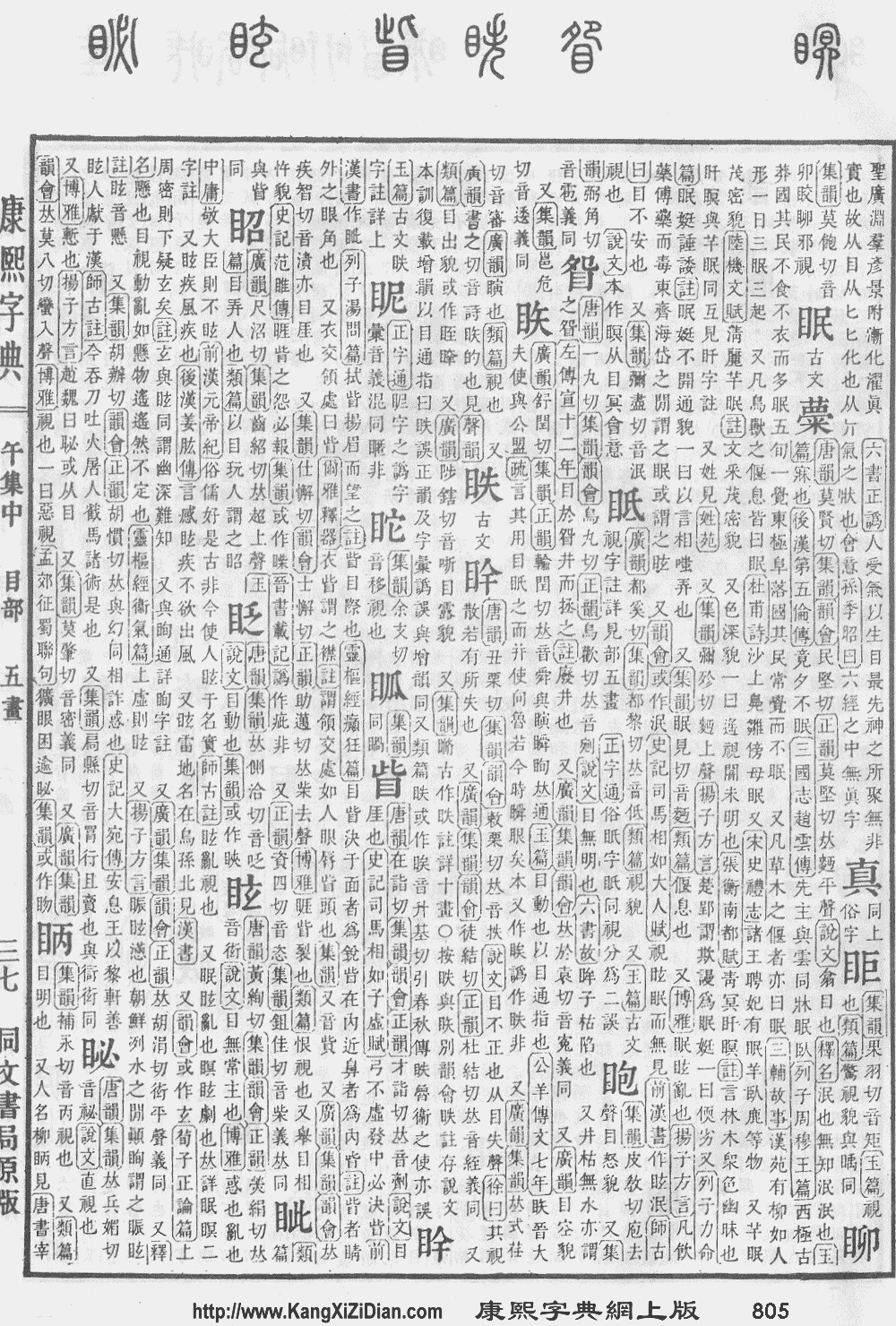
In simplified and traditional Chinese, the 目 component is connected to the horizontal line below it (as seen in the Kangxi dictionary) whereas, in Japanese and Korean, 目 is separate from that line.
Han character
真 (Kangxi radical 109, 目+5, 10 strokes, cangjie input 十月一金 (JBMC), four-corner 40801, composition ⿱十具)
Usage notes
The Kangxi dictionary considers 真 as an unorthodox form (俗字) of 眞. However, the traditional Kangxi form 眞 with 匕 on top is rarely used nowadays. In modern times, 真 is considered the orthodox form in all regions except South Korea.
Derived characters
Related characters
- 眞 (Original form of 真)
Further reading
- Kangxi Dictionary: page 805, character 1
- Dai Kanwa Jiten: character 23236
- Dae Jaweon: page 1221, character 1
- Hanyu Da Zidian (first edition): volume 1, page 249, character 7
- Unihan data for U+771F
- Unihan data for U+2F946
- Unihan data for U+2F947
Chinese
| trad. | 真/眞 | |
|---|---|---|
| simp. | 真 | |
| 2nd round simp. | 𰅴 | |
| alternative forms | ||
Glyph origin
| Historical forms of the character 真 |
|---|
| Shuowen Jiezi (compiled in Han) |
| Small seal script |
 |
| Old Chinese | |
|---|---|
| 寘 | *tjels |
| 䡩 | *kʰriːn |
| 黰 | *ʔriːn, *ʔljinʔ |
| 顛 | *tiːn, *tʰiːns |
| 滇 | *tiːn, *tʰiːns, *diːn |
| 齻 | *tiːn |
| 槙 | *tiːn, *tjinʔ |
| 瘨 | *tiːn |
| 傎 | *tiːn |
| 蹎 | *tiːn |
| 厧 | *tiːn |
| 巔 | *tiːn |
| 癲 | *tiːn |
| 瑱 | *tʰiːns, *tins |
| 填 | *diːn, *diːns, *tin, *tins |
| 窴 | *diːn, *diːns |
| 闐 | *diːn, *diːns |
| 磌 | *diːn, *tjin |
| 鷏 | *diːn |
| 嗔 | *diːn, *tʰjin |
| 搷 | *diːn |
| 鎮 | *tin, *tins |
| 縝 | *tʰin, *ʔljinʔ, *tʰjin |
| 真 | *ʔljin |
| 禛 | *tjin |
| 稹 | *ʔljin, *ʔljinʔ |
| 蒖 | *tjin |
| 鬒 | *ʔljinʔ |
| 瞋 | *tʰjin |
| 謓 | *tʰjin |
| 慎 | *djins |
Originally phono-semantic compound (形聲/形声, OC *ʔljin) : phonetic 𠂈 (OC *l'ɯːnʔ) + 貝 (“cowry”). Often 丁 (OC *rteːŋ, *teːŋ) was added as a second phonetic component. He Linyi posits it to be the original character for 珍 (OC *ʔl'ɯn, “rare; valuable”).
The sound component 𠂈 corrupted into 十 in the modern form, and into 匕 in the orthodox seal script form 眞. The bottom of the character in both forms derives from the components 貝 and 丁 corrupting into 目 and 丌.
Etymology
From Proto-Sino-Tibetan; cognate with Tibetan བདེན (bden, “true; truth”). Possibly connected with 貞 (OC *teŋ) (Schuessler, 2007).
Pronunciation
Definitions
真
- true; genuine; real; actual
- clear; distinct; sharp
- really; truly; very; quite
- portrait; image
- natural disposition
- (Chinese calligraphy) Short for 真書/真书 (zhēnshū, “regular script”).
- (~日) (telegraphy) the eleventh day of a month
- a surname
- 真德秀 ― Zhēn Déxiù ― Zhen Dexiu (a Song dynasty scholar)
Synonyms
Compounds
- 一片真心
- 三昧真火
- 上真 (shàngzhēn)
- 三真六草
- 不真切
- 亂真/乱真 (luànzhēn)
- 以假為真/以假为真
- 仙真
- 信以為真/信以为真 (xìnyǐwéizhēn)
- 保真 (bǎozhēn)
- 假戲真做/假戏真做
- 傳真/传真 (chuánzhēn)
- 傳真存轉/传真存转
- 傳真機/传真机 (chuánzhēnjī)
- 傳真電報/传真电报
- 全真
- 全真先生
- 全真教 (Quánzhēnjiāo)
- 北七真
- 千真萬真/千真万真
- 千真萬確/千真万确 (qiānzhēnwànquè)
- 即真
- 去偽存真/去伪存真 (qùwěicúnzhēn)
- 反其真
- 反璞歸真/反璞归真 (fǎnpúguīzhēn)
- 吉備真備/吉备真备
- 吐真劑/吐真剂 (tǔzhēnjì)
- 圖真/图真
- 夢想成真/梦想成真 (mèngxiǎngchéngzhēn)
- 天命真主
- 太平真君
- 太真 (Tàizhēn)
- 天真 (tiānzhēn)
- 天真地秀
- 天真未鑿/天真未凿
- 天真活潑/天真活泼
- 天真無邪/天真无邪 (tiānzhēnwúxié)
- 天真爛漫/天真烂漫 (tiānzhēnlànmàn)
- 失真 (shīzhēn)
- 女真 (Nǚzhēn)
- 女真文 (nǚzhēnwén)
- 如幻似真
- 宋真宗
- 寫真/写真 (xiězhēn)
- 寫真版/写真版
- 寫真集/写真集 (xiězhēnjí)
- 將假作真/将假作真
- 將假當真/将假当真
- 帶草連真/带草连真
- 幽真
- 弄假成真 (nòngjiǎchéngzhēn)
- 情真意摯/情真意挚
- 懷真抱素/怀真抱素
- 懷質抱真/怀质抱真
- 抱誠守真/抱诚守真
- 會真/会真
- 果真 (guǒzhēn)
- 楊太真/杨太真
- 歸全反真/归全反真
- 歸真/归真 (guīzhēn)
- 歸真反璞/归真反璞
- 歸真證果/归真证果
- 沖虛真人/冲虚真人
- 沖虛真經/冲虚真经
- 活似真的
- 洞悉真相
- 淘真
- 清真 (qīngzhēn)
- 清真寺 (qīngzhēnsì)
- 清真教 (Qīngzhēnjiào)
- 清真詞/清真词
- 火帝真君
- 灼見真知/灼见真知
- 烈火真金
- 玄真
- 率真 (shuàizhēn)
- 玉真
- 玉真子
- 玉陽真君/玉阳真君
- 畢真/毕真
- 畫真/画真
- 當真/当真
- 當真假/当真假
- 真一 (Zhēnyī)
- 真主 (zhēnzhǔ)
- 真事 (zhēnshì)
- 真人 (zhēnrén)
- 真人真事
- 真值 (zhēnzhí)
- 真個/真个 (zhēngè)
- 真值表 (zhēnzhíbiǎo)
- 真假 (zhēnjiǎ)
- 真偽/真伪 (zhēnwěi)
- 真偽莫辨/真伪莫辨
- 真傳/真传 (zhēnchuán)
- 真元
- 真兇實犯/真凶实犯
- 真刀真槍/真刀真枪
- 真切 (zhēnqiè)
- 真分式
- 真分數/真分数 (zhēnfēnshù)
- 真君
- 真命天子 (zhēnmìng tiānzǐ)
- 真品
- 真善美 (zhēn-shàn-měi)
- 真太陽日/真太阳日
- 真妄
- 真如 (zhēnrú)
- 真字 (zhēnzì)
- 真宇
- 真官
- 真宰
- 真實/真实 (zhēnshí)
- 真平
- 真影
- 真心 (zhēnxīn)
- 真心實意/真心实意 (zhēnxīnshíyì)
- 真心真意 (zhēnxīnzhēnyì)
- 真心話/真心话 (zhēnxīnhuà)
- 真心誠意/真心诚意 (zhēnxīnchéngyì)
- 真性 (zhēnxìng)
- 真情 (zhēnqíng)
- 真情實意/真情实意
- 真情流露
- 真意 (zhēnyì)
- 真憑實據/真凭实据 (zhēnpíngshíjù)
- 真成
- 真才實學/真才实学 (zhēncáishíxué)
- 真摯/真挚 (zhēnzhì)
- 真數/真数 (zhēnshù)
- 真是 (zhēnshì)
- 真書/真书 (zhēnshū)
- 真材實料/真材实料 (zhēncáishíliào)
- 真果
- 真格 (zhēngé)
- 真格的
- 真槍實彈/真枪实弹
- 真正 (zhēnzhèng)
- 真武大帝 (Zhēnwǔ Dàdì)
- 真武山 (Zhēnwǔshān)
- 真氣/真气
- 真溶液
- 真率 (zhēnshuài)
- 真珠 (zhēnzhū)
- 真理 (zhēnlǐ)
- 真理報/真理报 (Zhēnlǐbào)
- 真瓷
- 真的
- 真皮 (zhēnpí)
- 真相 (zhēnxiàng)
- 真相大白 (zhēnxiàng dàbái)
- 真真 (zhēnzhēn)
- 真真假假 (zhēnzhēnjiǎjiǎ)
- 真知 (zhēnzhī)
- 真知灼見/真知灼见 (zhēnzhīzhuójiàn)
- 真確/真确 (zhēnquè)
- 真空 (zhēnkōng)
- 真空包裝/真空包装 (zhēnkōng bāozhuāng)
- 真空泵 (zhēnkōngbèng)
- 真空管 (zhēnkōngguǎn)
- 真空處理/真空处理
- 真筆/真笔
- 真筆版/真笔版
- 真箇/真个 (zhēngè)
- 真純/真纯
- 真絲/真丝 (zhēnsī)
- 真經/真经
- 真義/真义
- 真者
- 真臘/真腊 (Zhēnlà)
- 真菌 (zhēnjūn)
- 真言 (zhēnyán)
- 真言宗
- 真詮/真诠
- 真話/真话 (zhēnhuà)
- 真誠/真诚 (zhēnchéng)
- 真誠相見/真诚相见
- 真諦/真谛 (zhēndì)
- 真譜/真谱
- 真貨/真货
- 真贓/真赃
- 真贓實據/真赃实据
- 真贓實犯/真赃实犯
- 真贓正賊/真赃正贼
- 真贗/真赝
- 真趣
- 真跡/真迹 (zhēnjì)
- 真身
- 真金 (zhēnjīn)
- 真金不怕火煉/真金不怕火炼 (zhēn jīn bù pà huǒ liàn)
- 真金烈火
- 真除
- 真際/真际
- 真面目 (zhēnmiànmù)
- 真章
- 真髓
- 真鯛/真鲷 (zhēndiāo)
- 童真 (tóngzhēn)
- 竹里真 (Zhúlǐzhēn)
- 粉真
- 純真/纯真 (chúnzhēn)
- 網路傳真/网路传真
- 羅真人/罗真人
- 羊真孔草
- 美夢成真/美梦成真 (měimèngchéngzhēn)
- 葆真 (bǎozhēn)
- 衣缽真傳/衣钵真传
- 見真章/见真章 (jiànzhēnzhāng)
- 言真道假
- 認真/认真 (rènzhēn)
- 說真格的/说真格的
- 謄真/誊真
- 貨真價實/货真价实 (huòzhēnjiàshí)
- 較真兒/较真儿 (jiàozhēnr)
- 返璞歸真/返璞归真 (fǎnpúguīzhēn)
- 連真/连真
- 道德真經/道德真经
- 道德真言
- 逼真 (bīzhēn)
- 郭公真人
- 鐵木真/铁木真 (Tiěmùzhēn)
- 降真香
- 陶真 (táozhēn)
- 電話傳真/电话传真
- 非七真
- 頂真/顶真 (dǐngzhēn)
- 頂真續麻/顶真续麻
- 養性修真/养性修真
- 養真/养真
- 魯班真人/鲁班真人
Further reading
- “Entry #6396”, in 臺灣閩南語常用詞辭典 [Dictionary of Frequently-Used Taiwan Minnan] (overall work in Mandarin and Hokkien), Ministry of Education, R.O.C., 2023.
- “真”, in 漢語多功能字庫 (Multi-function Chinese Character Database), 香港中文大學 (the Chinese University of Hong Kong), 2014–
Japanese
| 真 | |
| 眞 |
Readings
Etymology 1
| Kanji in this term |
|---|
| 真 |
| しん Grade: 3 |
| on’yomi |
| Alternative spelling |
|---|
| 眞 (kyūjitai) |
From Middle Chinese 真 (MC tsyin).
Idioms
- 真に迫る (shin ni semaru)
Affix
真 • (shin)
Derived terms
- 真意 (shin'i)
- 真意義 (shin'igi)
- 真因 (shin'in)
- 真打 (shin'uchi)
- 真影 (shin'ei)
- 真円 (shin'en)
- 真価 (shinka)
- 真書き (shinkaki)
- 真核細胞 (shinkakusaibō)
- 真贋 (shingan)
- 真偽 (shingi)
- 真義 (shingi)
- 真菌 (shinkin)
- 真紅 (shinku)
- 真空 (shinkū)
- 真剣 (shinken)
- 真箇 (shinko), 真個 (shinko)
- 真骨頂 (shinkotchō)
- 真言 (shingon)
- 真摯 (shinshi)
- 真書 (shinsho)
- 真症 (shinshō)
- 真実 (shinjitsu)
- 真珠 (shinju)
- 真薯 (shinjo)
- 真情 (shinjō)
- 真人 (shinjin)
- 真髄 (shinzui)
- 真性 (shinsei)
- 真正 (shinsei)
- 真跡 (shinseki), 真蹟 (shinseki), 真迹 (shinseki)
- 真相 (shinsō)
- 真率 (shinsotsu)
- 真諦 (shintai)
- 真鍮 (shinchū)
- 真直 (shinchoku)
- 真諦 (shintei)
- 真如 (shinnyo)
- 真犯人 (shinhannin)
- 真美 (shinbi)
- 真否 (shinpi)
- 真皮 (shinpi)
- 真筆 (shinpitsu)
- 真物 (shinbutsu)
- 真部分集合 (shinbubunshūgō)
- 真分数 (shinbunsū)
- 真味 (shinmi)
- 真勇 (shin'yū)
- 真理 (shinri)
- 写真 (shashin)
- 純真 (junshin)
- 正真 (shōshin)
- 浄土真宗 (Jōdo Shinshū)
- 天真 (tenshin)
- 迫真 (hakushin)
Etymology 2
| Kanji in this term |
|---|
| 真 |
| ま Grade: 3 |
| kun’yomi |
| Alternative spelling |
|---|
| 眞 (kyūjitai) |
| For pronunciation and definitions of 真 – see the following entry. | ||
| ||
| (This term, 真, is an alternative spelling of the above term.) |
Etymology 3
| Kanji in this term |
|---|
| 真 |
| まこと Grade: 3 |
| kun’yomi |
| Alternative spelling |
|---|
| 眞 (kyūjitai) |
| For pronunciation and definitions of 真 – see the following entry. | ||
| ||
| (This term, 真, is an alternative spelling of the above term.) |
Etymology 4
| Kanji in this term |
|---|
| 真 |
| Grade: 3 |
| nanori |
| Alternative spelling |
|---|
| 眞 (kyūjitai) |
From classical adjective 厚し (atsushi), modern 厚い (atsui, “thick, heavy; kind, warm”).
Etymology 5
| Kanji in this term |
|---|
| 真 |
| Grade: 3 |
| nanori |
| Alternative spelling |
|---|
| 眞 (kyūjitai) |
From classical adjective 正し (tadashi), modern 正しい (tadashii, “correct, right, true”).
Etymology 6
| Kanji in this term |
|---|
| 真 |
| Grade: 3 |
| nanori |
| Alternative spelling |
|---|
| 眞 (kyūjitai) |
From classical adjective 正し (masashi, “accurate, authentic, correct”).
References
- Matsumura, Akira, editor (2006), 大辞林 [Daijirin] (in Japanese), Third edition, Tōkyō: Sanseidō, →ISBN
- NHK Broadcasting Culture Research Institute, editor (1998), NHK日本語発音アクセント辞典 [NHK Japanese Pronunciation Accent Dictionary] (in Japanese), Tōkyō: NHK Publishing, →ISBN
- Kindaichi, Kyōsuke et al., editors (1997), 新明解国語辞典 [Shin Meikai Kokugo Jiten] (in Japanese), Fifth edition, Tōkyō: Sanseidō, →ISBN