信
| ||||||||
Translingual
| Stroke order | |||
|---|---|---|---|
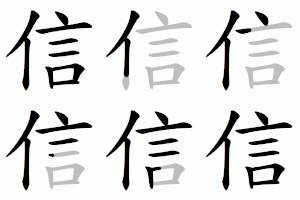 | |||
Han character
信 (Kangxi radical 9, 人+7, 9 strokes, cangjie input 人卜一口 (OYMR), four-corner 20261, composition ⿰亻言)
References
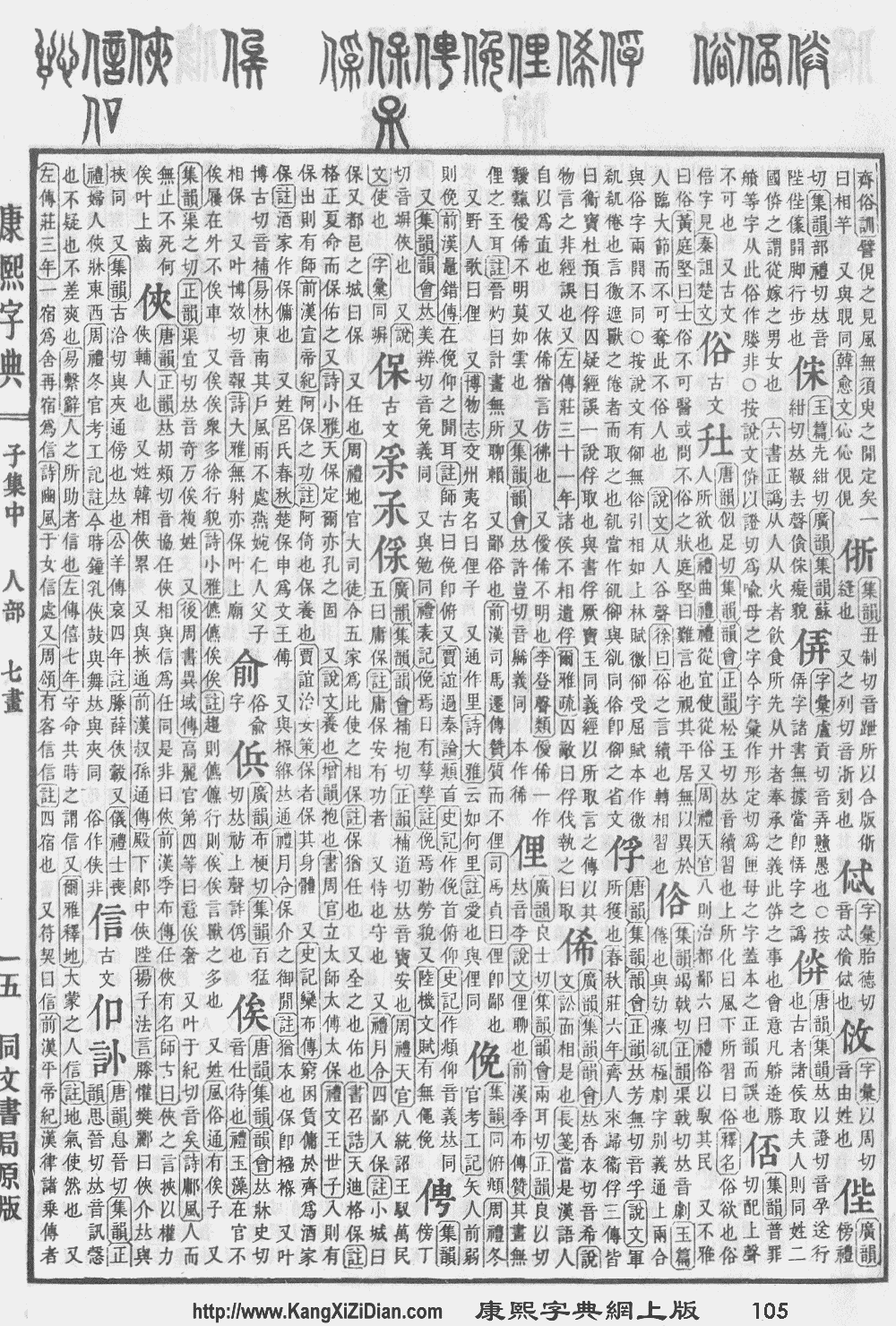
- Kangxi Dictionary: page 105, character 25
- Dai Kanwa Jiten: character 707
- Dae Jaweon: page 224, character 2
- Hanyu Da Zidian (first edition): volume 1, page 165, character 1
- Unihan data for U+4FE1
Chinese
Glyph origin
| Historical forms of the character 信 | |||||||||||||||||||||||||||||||||
|---|---|---|---|---|---|---|---|---|---|---|---|---|---|---|---|---|---|---|---|---|---|---|---|---|---|---|---|---|---|---|---|---|---|
| |||||||||||||||||||||||||||||||||
|
References: Mostly from Richard Sears' Chinese Etymology site (authorisation),
|


Ideogrammic compound (會意/会意) and phono-semantic compound (形聲/形声, OC *hljins) : phonetic 人 (OC *njin, “person”) + semantic 言 (“word”).
Etymology 1
| simp. and trad. |
信 | |
|---|---|---|
| 2nd round simp. | 伩 | |
| alternative forms | 㐰 孞 | |
Schuessler (2007) reconstructs the Old Chinese minimally as *sin and suggests possible derivation from 允 (OC *winʔ, “to trust; to be true”).
Alternatively, Sagart and Baxter (2012) reconstruct *s-niŋ-s (*s-ni[ŋ]-s in Baxter and Sagart, 2014) and suggest a derivation from 仁 (OC *niŋ, “kind”) with the prefix *s-, probably used to increase its valency.
Pronunciation
Definitions
信
- true; accurate; verifiable
- truly; indeed
- 信可樂也。 [Literary Chinese, trad.]
- From: 353 CE, Wang Xizhi, Preface to the Poems Composed at the Orchid Pavilion
- Xìn kě lè yě. [Pinyin]
- Truly, what an enjoyable occasion it was!
信可乐也。 [Literary Chinese, simp.]
- trustworthy
- to believe; to trust in something
- to believe in (a faith); to be religious in
- 我父親信佛教。/我父亲信佛教。 ― Wǒ fùqīn xìn fójiào. ― My father is a Buddhist. (lit. My father believes in Buddhism.)
- 這人來,為要作見證,就是為光作見證,叫眾人因他可以信。 [MSC, trad.]
- From: 新標點和合本 (Chinese Union Version with New Punctuation), 約翰福音 (John) 1:7
- Zhè rén lái, wèi yào zuò jiànzhèng, jiù shì wèi guāng zuò jiànzhèng, jiào zhòngrén yīn tā kěyǐ xìn. [Pinyin]
- The same came for a witness, to bear witness of the Light, that all men through him might believe.
这人来,为要作见证,就是为光作见证,叫众人因他可以信。 [MSC, simp.]
- trust; confidence; faith
- 祢用重價救贖我,使我脫離罪惡河,叫我這不配的人憑信得救。 [MSC, trad.]
- From: 2009, 磐石現代樂團 [Music Stone], lyrics by 謝鴻文 [Steve Hsieh], 讓我 [Let Me]
- Mí yòng zhòngjià jiùshú wǒ, shǐ wǒ tuōlí zuì'è hé, jiào wǒ zhè bùpèi de rén píng xìn déjiù. [Pinyin]
- Allowing me, this unworthy person, to be saved by faith.
祢用重价救赎我,使我脱离罪恶河,叫我这不配的人凭信得救。 [MSC, simp.]
- at will
- letter (written communication) (Classifier: 封 m c mn)
- message; information; news
- 信息 ― xìnxī ― message
- evidence
- 信物 ― xìnwù ― token, keepsake
- courier; messenger
- Short for 信州 (Xìnzhōu).
- (mineralogy) Short for 信石 (xìnshí, “arsenolite”).
- a surname: Xin
Synonyms
- (true):
- (to believe):
- (to believe in a faith): 信仰 (xìnyǎng)
- (letter):
- 信件 (xìnjiàn)
- 信函 (xìnhán)
- 信札 (xìnzhá)
- 八行 (bāháng) (literary)
- 八行書/八行书 (bāhángshū) (literary)
- 函件 (hánjiàn)
- 手書/手书 (shǒushū) (literary)
- 手簡/手简 (shǒujiǎn) (literary)
- 書/书 (shū) (literary, or in compounds)
- 書信/书信 (shūxìn) (formal)
- 書函/书函 (shūhán)
- 書札/书札 (shūzhá) (literary)
- 書牘/书牍 (shūdú) (literary)
- 書簡/书简 (shūjiǎn) (literary)
- 筆札/笔札 (bǐzhá) (literary, figurative)
- 簡/简 (jiǎn) (literary, or in compounds)
- 鴻/鸿 (hóng) (literary, figurative)
- (message):
- (information):
- (evidence):
- 佐證/佐证 (zuǒzhèng)
- 例證/例证 (lìzhèng)
- 信據/信据 (xìnjù) (literary, reliable evidence)
- 力證/力证 (lìzhèng) (strong evidence)
- 印證/印证 (yìnzhèng)
- 實證/实证 (shízhèng) (concrete evidence)
- 干證 (Hokkien)
- 憑/凭 (píng) (literary, or in compounds)
- 憑信/凭信 (píngxìn)
- 憑據/凭据 (píngjù)
- 憑條/凭条 (Min Nan)
- 憑證/凭证 (píngzhèng)
- 據/据 (literary, or in compounds)
- 論證/论证 (lùnzhèng)
- 證/证 (zhèng)
- 證據/证据 (zhèngjù)
- 證明/证明 (zhèngmíng)
- 證見/证见 (Hokkien, literary)
Compounds
- 不信 (bùxìn)
- 不信任案
- 不信道
- 中信局
- 互信 (hùxìn)
- 來信/来信 (láixìn)
- 信人 (xìnrén)
- 信以為真/信以为真 (xìnyǐwéizhēn)
- 信仰 (xìnyǎng)
- 信件 (xìnjiàn)
- 信任 (xìnrèn)
- 信任投票 (xìnrèn tóupiào)
- 信任狀/信任状
- 信使 (xìnshǐ)
- 信兒/信儿 (xìnr)
- 信函 (xìnhán)
- 信匯/信汇 (xìnhuì)
- 信南山
- 信及豚魚/信及豚鱼
- 信口 (xìnkǒu)
- 信口捏膿/信口捏脓
- 信口胡說/信口胡说
- 信口開合/信口开合 (xìnkǒukāihé)
- 信口開喝/信口开喝
- 信口開河/信口开河 (xìnkǒukāihé)
- 信口雌黃/信口雌黄 (xìnkǒucíhuáng)
- 信史 (xìnshǐ)
- 信嘴胡說/信嘴胡说
- 信士 (xìnshì)
- 信天游 (xìntiānyóu)
- 信天翁 (xìntiānwēng)
- 信奉 (xìnfèng)
- 信女 (xìnnǚ)
- 信子
- 信守 (xìnshǒu)
- 信守不渝
- 信宿
- 信實/信实 (xìnshí)
- 信封 (xìnfēng)
- 信差 (xìnchāi)
- 信底
- 信徒 (xìntú)
- 信從/信从 (xìncóng)
- 信得過/信得过 (xìndéguò)
- 信心 (xìnxīn)
- 信心十足
- 信念 (xìnniàn)
- 信息 (xìnxī)
- 信愛/信爱
- 信意
- 信手 (xìnshǒu)
- 信手兒/信手儿
- 信手拈來/信手拈来
- 信據/信据 (xìnjù)
- 信教 (xìnjiào)
- 信是
- 信服 (xìnfú)
- 信札 (xìnzhá)
- 信條/信条 (xìntiáo)
- 信標燈/信标灯
- 信步 (xìnbù)
- 信步而行
- 信水
- 信江
- 信濃川/信浓川
- 信炮
- 信然
- 信牒
- 信物 (xìnwù)
- 信用 (xìnyòng)
- 信用交易
- 信用卡 (xìnyòngkǎ)
- 信用狀/信用状 (xìnyòngzhuàng)
- 信用額度/信用额度 (xìnyòng édù)
- 信石 (xìnshí)
- 信票
- 信禽
- 信筆/信笔
- 信筒
- 信筆塗鴉/信笔涂鸦
- 信箋/信笺 (xìnjiān)
- 信管
- 信箱 (xìnxiāng)
- 信篤/信笃 (sìn-táu) (Min Nan)
- 信籠/信笼
- 信紙/信纸 (xìnzhǐ)
- 信繩/信绳
- 保羅書信/保罗书信
- 信義/信义 (xìnyì)
- 信義宗/信义宗 (xìnyìzōng)
- 信義會/信义会 (xìnyìhuì)
- 信而有徵/信而有征 (xìn'éryǒuzhēng)
- 信腳/信脚
- 信臣
- 信號/信号 (xìnhào)
- 信號彈/信号弹 (xìnhàodàn)
- 信號槍/信号枪 (xìnhàoqiāng)
- 信號機/信号机 (xìnhàojī)
- 信號燈/信号灯 (xìnhàodēng)
- 信行 (xìnxíng)
- 信行兒/信行儿
- 信衣
- 信託/信托 (xìntuō)
- 信託基金/信托基金
- 信託資金/信托资金
- 信誓 (xìnshì)
- 信誓旦旦 (xìnshìdàndàn)
- 信譽/信誉 (xìnyù)
- 信貸/信贷 (xìndài)
- 信賞必罰/信赏必罚
- 信賴/信赖 (xìnlài)
- 信道 (xìndào)
- 信陵 (Xìnlíng)
- 信陵君
- 信陽/信阳 (Xìnyáng)
- 信風/信风 (xìnfēng)
- 信香
- 信馬游韁/信马游缰
- 信馬由韁/信马由缰 (xìnmǎyóujiāng)
- 信鳥/信鸟
- 信鴿/信鸽 (xìngē)
- 信鼓
- 偏聽偏信/偏听偏信
- 傳信/传信 (chuánxìn)
- 傳信牌/传信牌
- 光學通信/光学通信
- 入信
- 公信力 (gōngxìnlì)
- 公開信/公开信 (gōngkāixìn)
- 准信 (zhǔnxìn)
- 凶信
- 匯信/汇信
- 匿名信 (nìmíngxìn)
- 半信不信
- 半信半疑 (bànxìn-bànyí)
- 卬首信眉
- 印信 (yìnxìn)
- 取信 (qǔxìn)
- 取信於人/取信于人
- 口信 (kǒuxìn)
- 口頭信/口头信
- 可信 (kěxìn)
- 叵信
- 善信 (shànxìn)
- 喜信 (xǐxìn)
- 善男信女 (shànnán xìnnǚ)
- 回信 (huíxìn)
- 國信/国信
- 土地信託/土地信托
- 堅信/坚信 (jiānxìn)
- 報信/报信 (bàoxìn)
- 大信不約/大信不约
- 大信封
- 失信 (shīxìn)
- 威信 (wēixìn)
- 威信掃地/威信扫地
- 存證信函/存证信函
- 守信 (shǒuxìn)
- 家信 (jiāxìn)
- 寄信 (jìxìn)
- 寫信/写信 (xiěxìn)
- 寵信/宠信 (chǒngxìn)
- 將信將疑/将信将疑 (jiāngxìn-jiāngyí)
- 小忠小信
- 尼斯信條/尼斯信条
- 尾生之信
- 崇信 (chóngxìn)
- 帶信/带信
- 幡信
- 平信 (píngxìn)
- 庚信
- 引信 (yǐnxìn)
- 徙木之信
- 徙木立信
- 復信/复信 (fùxìn)
- 微信 (wēixìn)
- 徵信/征信 (zhēngxìn)
- 徵信社/征信社
- 徵信錄/征信录
- 忠信 (zhōngxìn)
- 快信 (kuàixìn)
- 急腳信/急脚信
- 悶信/闷信
- 憑信/凭信 (píngxìn)
- 應徵信/应征信
- 打信號/打信号
- 抱柱信
- 捎信 (shāoxìn)
- 探信
- 採信/采信 (cǎixìn)
- 掛號信/挂号信 (guàhàoxìn)
- 推誠布信/推诚布信
- 敬信 (Jìngxìn, “Jingxin”)
- 數位通信/数位通信
- 方信道
- 旦旦信誓 (dàndànxìnshì)
- 明信片 (míngxìnpiàn)
- 昧信
- 春信
- 書信/书信 (shūxìn)
- 月信 (yuèxìn)
- 有信兒/有信儿
- 杖莫如信
- 杳無信息/杳无信息
- 杳無音信/杳无音信 (yǎowúyīnxìn)
- 棨信
- 檀信 (tánxìn)
- 正信 (zhèngxìn)
- 死信 (sǐxìn)
- 民信局
- 民間信仰/民间信仰 (mínjiān xìnyǎng)
- 沒信心/没信心
- 泛靈信仰/泛灵信仰
- 活信
- 浸信會/浸信会 (Jìnxìnhuì)
- 深信 (shēnxìn)
- 深信不疑 (shēnxìnbùyí)
- 溺信
- 滿懷信心/满怀信心
- 潮信 (cháoxìn)
- 無信不立/无信不立 (wúxìnbùlì)
- 無徵不信/无征不信
- 燭信/烛信
- 狎信
- 疑信參半/疑信参半
- 發信/发信
- 的信
- 盲信 (mángxìn)
- 直躬之信
- 相信 (xiāngxìn)
- 瞎信 (xiāxìn)
- 破迷信財/破迷信财
- 確信/确信 (quèxìn)
- 移木之信
- 答信
- 篤信/笃信 (dǔxìn)
- 篤信好古/笃信好古 (dǔxìnhàogǔ)
- 紀念信封/纪念信封
- 網路信/网路信
- 網路信件/网路信件 (wǎnglù xìnjiàn)
- 置信 (zhìxìn)
- 美言不信
- 考信錄/考信录
- 聽信/听信 (tīngxìn)
- 背信 (bèixìn)
- 背信忘義/背信忘义
- 背信棄義/背信弃义 (bèixìnqìyì)
- 背信罪
- 自信 (zìxìn)
- 自信心 (zìxìnxīn)
- 自信滿滿/自信满满
- 至信
- 航空信 (hángkōngxìn)
- 芳信
- 花信
- 花信風/花信风
- 苗信
- 荒信
- 蛇信
- 衛星通信/卫星通信 (wèixīng tōngxìn)
- 覆信 (fùxìn)
- 見信/见信
- 親信/亲信 (qīnxìn)
- 言而不信 (yán'érbùxìn)
- 言而有信
- 言而無信/言而无信 (yán'érwúxìn)
- 討信/讨信
- 詘寸信尺/诎寸信尺
- 誠信/诚信 (chéngxìn)
- 誠信原則/诚信原则
- 誤信/误信 (wùxìn)
- 語音信箱/语音信箱 (yǔyīn xìnxiāng)
- 講信修睦/讲信修睦
- 證信/证信
- 識別信號/识别信号
- 貪而無信/贪而无信
- 賞罰不信/赏罚不信
- 賭不信/赌不信
- 輕信/轻信 (qīngxìn)
- 輕言寡信/轻言寡信
- 輕諾寡信/轻诺寡信
- 送信 (sòngxìn)
- 迷信 (míxìn)
- 通信 (tōngxìn)
- 通信兵 (tōngxìnbīng)
- 通信員/通信员 (tōngxìnyuán)
- 通信社 (tōngxìnshè)
- 通信系統/通信系统
- 通信網/通信网
- 通信處/通信处
- 通信衛星/通信卫星
- 通風報信/通风报信 (tōngfēngbàoxìn)
- 違信背約/违信背约
- 郵政信箱/邮政信箱 (yóuzhèng xìnxiāng)
- 鄉信/乡信
- 長信宮/长信宫
- 限時信/限时信 (xiànshíxìn)
- 隴頭音信/陇头音信
- 難以置信/难以置信 (nányǐzhìxìn)
- 電信/电信 (diànxìn)
- 電子信件/电子信件
- 電子信箱/电子信箱 (diànzǐ xìnxiāng)
- 靈信/灵信
- 韓信囊沙/韩信囊沙
- 韓信將兵/韩信将兵
- 韓信用兵/韩信用兵
- 韓信登壇/韩信登坛
- 韓信點兵/韩信点兵
- 音信 (yīnxìn)
- 音信杳然 (yīnxìnyǎorán)
- 音信杳無/音信杳无
- 音稀信杳
- 頭信/头信
- 類比信號/类比信号
- 風信/风信
- 風信器/风信器
- 風信子/风信子 (fēngxìnzǐ)
- 飆信/飙信
- 體信/体信
- 體己信兒/体己信儿
- 鬼靈信仰/鬼灵信仰
- 魚信/鱼信
- 鳥信/鸟信
- 鴨信/鸭信
- 麥信風/麦信风
- 黑信 (hēixìn)
Pronunciation
Definitions
信
- Alternative form of 申 (shēn, “to express; to state”)
- 《春秋》貴義而不貴惠,信道而不信邪。 [Classical Chinese, trad.]
- From: Commentary of Guliang, circa 206 BCE– 9 CE
- “Chūnqiū” guì yì ér bù guì huì, shēn dào ér bù shēn xié. [Pinyin]
- The Spring and Autumn Annals treasure deeds of righteousness rather than the dispensation of favour, and advocate the just principles instead of corrupt ways.
《春秋》贵义而不贵惠,信道而不信邪。 [Classical Chinese, simp.]
- Alternative form of 伸 (shēn, “to extend”)
- Alternative form of 身 (“body”)
References
- “信”, in 漢語多功能字庫 (Multi-function Chinese Character Database), 香港中文大學 (the Chinese University of Hong Kong), 2014–
Japanese
Readings
Compounds
- 信愛
- 信越
- 信管
- 信疑
- 信義 (shingi): faith
- 信教
- 信仰 (shinkō): belief, faith; to have faith in a religion, profess faith in
- 信金
- 信経
- 信玄袋
- 信号 (shingō): a signal; traffic lights
- 信士
- 信実 (shinjitsu): sincerity, honesty, truth, faithfulness
- 信者 (shinja): a believer
- 信受
- 信書
- 信女
- 信証
- 信賞必罰
- 信条
- 信心 (shinjin)
- 信託 (shintaku): a trust, an entrustment; leaving things up to a trusted party; to set up a financial trust; to leave in trust
- 信天翁 (shinten'ō)
- 信徒 (shinto): one who believes in a religion; a believer
- 信任 (shinnin): trust, confidence, credence; to trust, confide
- 信認
- 信念
- 信販
- 信伏, 信服, 信腹
- 信奉 (shinpō): belief, faith
- 信望
- 信約
- 信用 (shin'yō): confidence, trust
- 信頼 (shinrai): reliance, trust, confidence
- 信憑 (shinpyō)
- 入信 (nyūshin)
Noun
信 • (shin)
Korean
Etymology
(This etymology is missing or incomplete. Please add to it, or discuss it at the Etymology scriptorium. Particularly: “Middle Korean readings, if any”)
Pronunciation
- (SK Standard/Seoul) IPA(key): [ɕʰi(ː)n]
- Phonetic hangul: [신(ː)]
- Though still prescribed in Standard Korean, most speakers in both Koreas no longer distinguish vowel length.
Vietnamese
Han character
- This term needs a translation to English. Please help out and add a translation, then remove the text
{{rfdef}}.