伍
See also: 五
| ||||||||
Translingual
| Stroke order | |||
 | |||
Han character
伍 (Kangxi radical 9, 人+4, 6 strokes, cangjie input 人一木一 (OMDM), four-corner 21217, composition ⿰亻五)
References
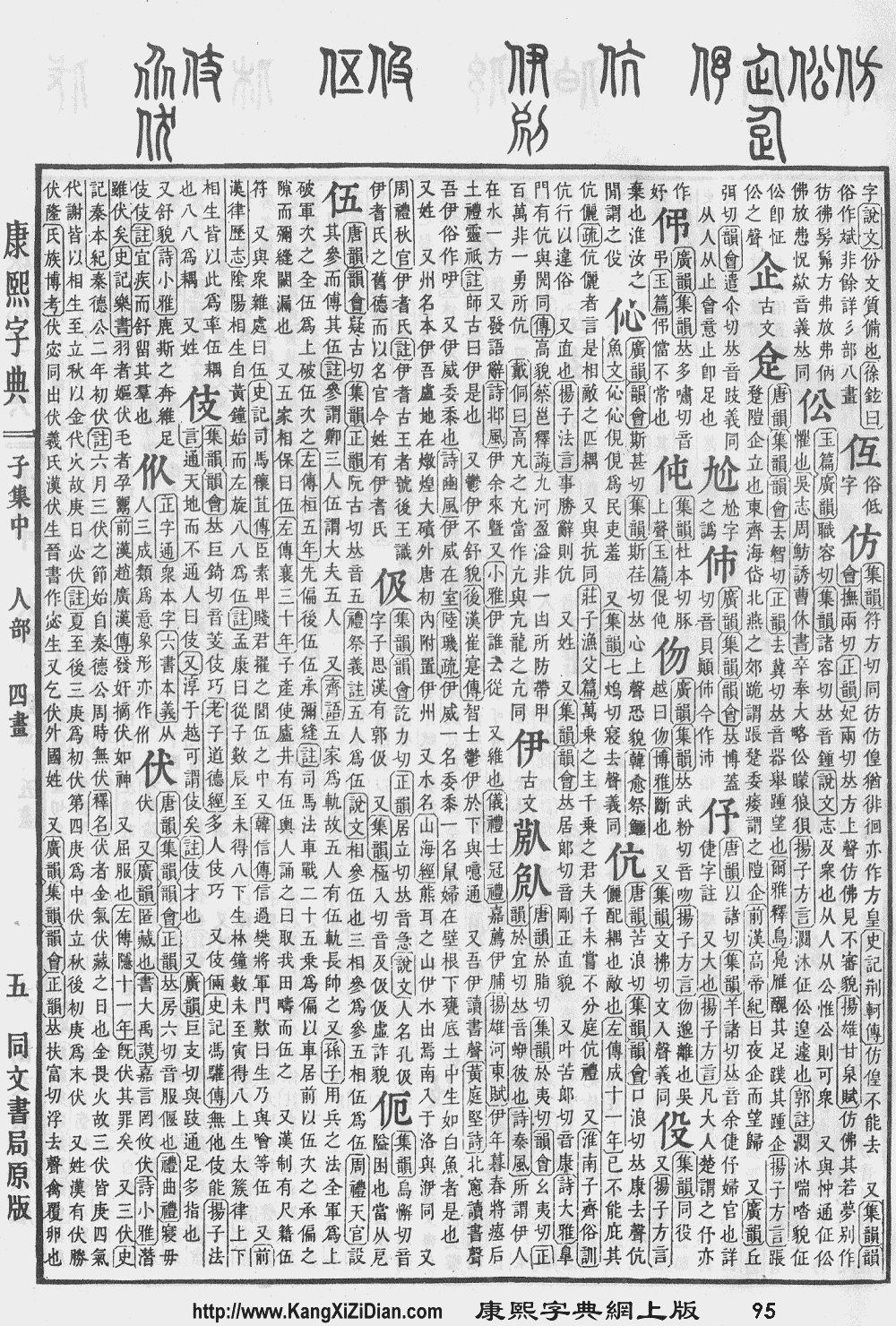
- Kangxi Dictionary: page 95, character 20
- Dai Kanwa Jiten: character 435
- Dae Jaweon: page 202, character 4
- Hanyu Da Zidian (first edition): volume 1, page 118, character 1
- Unihan data for U+4F0D
Chinese
Glyph origin
| Historical forms of the character 伍 | ||||
|---|---|---|---|---|
| ||||
|
References: Mostly from Richard Sears' Chinese Etymology site (authorisation),
|


Characters in the same phonetic series (五) (Zhengzhang, 2003)
Phono-semantic compound (形聲/形声, OC *ŋaːʔ) : semantic 亻 + phonetic 五 (OC *ŋaːʔ). Also ideogrammic compound (會意/会意) .
Pronunciation
Definitions
伍
See also
| Chinese numbers | |||||||||||||||||
|---|---|---|---|---|---|---|---|---|---|---|---|---|---|---|---|---|---|
| 0 | 1 | 2 | 3 | 4 | 5 | 6 | 7 | 8 | 9 | 10 | 102 | 103 | 104 | 106 | 108 | 1012 | |
| Normal (小寫/小写) |
〇, 零, 空 | 一, 蜀 | 二, 兩/两 | 三 | 四 | 五 | 六 | 七 | 八 | 九 | 十 | 百 | 千 | 萬/万, 十千 (Malaysia, Singapore) |
百萬/百万, 桶(Philippines), 面桶 (Philippines) |
億/亿 | 兆 (Taiwan) 萬億/万亿 (Mainland China) |
| Financial (大寫/大写) |
零 | 壹 | 貳/贰 | 參/叁 | 肆 | 伍 | 陸/陆 | 柒 | 捌 | 玖 | 拾 | 佰 | 仟 | ||||
Compounds
- 伍伯
- 伍員乘潮/伍员乘潮
- 伍員抉目/伍员抉目
- 伍員鞭屍/伍员鞭尸
- 伍子胥
- 伍家 (Wǔjiā)
- 伍家崗/伍家岗 (Wǔjiāgǎng)
- 伍山 (Wǔshān)
- 伍洛 (Wǔluò)
- 伍相廟/伍相庙 (Wǔxiàngmiào)
- 伍茲/伍兹 (Wǔzī)
- 伍長/伍长
- 入伍 (rùwǔ)
- 卒伍
- 參伍/参伍
- 噲伍/哙伍
- 士伍
- 恥與為伍/耻与为伍 (chǐyǔwéiwǔ)
- 本伍
- 歸伍/归伍
- 火伍
- 為伍/为伍 (wéiwǔ)
- 燕雀伍
- 砥兵礪伍/砥兵砺伍
- 簿伍
- 羞與噲伍/羞与哙伍
- 羞與為伍/羞与为伍 (xiūyǔwéiwǔ)
- 老行伍
- 與噲為伍/与哙为伍
- 落伍 (luòwǔ)
- 行伍 (hángwǔ)
- 行伍出身
- 超伍
- 退伍 (tuìwǔ)
- 部伍
- 鄰伍/邻伍
- 配伍 (pèiwǔ)
- 閭伍/闾伍
- 隊伍/队伍 (duìwǔ)
- 隊伍行列/队伍行列
- 黨伍/党伍
Descendants
Others:
Pronunciation
Japanese
See also
Korean
Etymology
From Middle Chinese 伍 (MC nguX). Recorded as Middle Korean 오〯 (wǒ) (Yale: wo) in Hunmong Jahoe (訓蒙字會 / 훈몽자회), 1527.
This article is issued from Wiktionary. The text is licensed under Creative Commons - Attribution - Sharealike. Additional terms may apply for the media files.