零
| ||||||||
| ||||||||
Translingual
| Traditional | 零 |
|---|---|
| Simplified | 零 |
| Japanese | 零 |
| Korean | 零 |
| Stroke order | |||
|---|---|---|---|
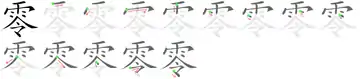 | |||
| Stroke order | |||
|---|---|---|---|
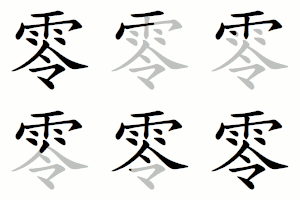 | |||
Alternative forms
In Japan, Korea and Traditional Chinese jiu zixing, the bottom component 令 is written 亼 + 𰆊, similar to its Kangxi dictionary form. In traditional Chinese as defined by Taiwan MOE and Hong Kong CLIAC, 令 is written 亼 + マ. In simplified Chinese, the component 令 is written 亽 + マ.
Han character
零 (Kangxi radical 173, 雨+5, 13 strokes, cangjie input 一月人戈戈 (MBOII), four-corner 10307, composition ⿱⻗令)
References
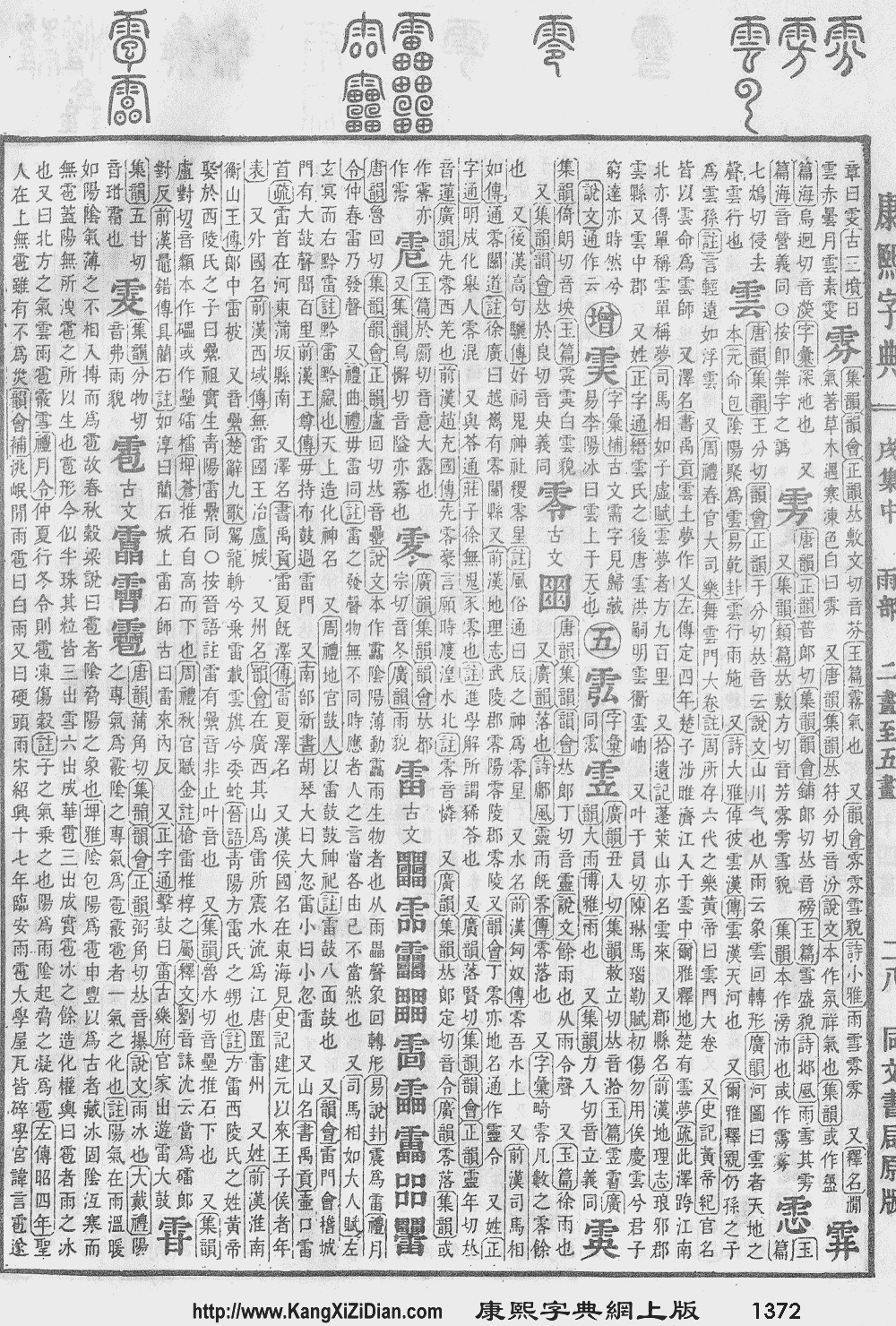
- Kangxi Dictionary: page 1372, character 10
- Dai Kanwa Jiten: character 42242
- Dae Jaweon: page 1880, character 5
- Hanyu Da Zidian (first edition): volume 6, page 4061, character 1
- Unihan data for U+96F6
- Unihan data for U+F9B2
Chinese
| trad. | 零 | |
|---|---|---|
| simp. # | 零 | |
| 2nd round simp. | ⿱⿻丅⿱冖⿰丶丶令 | |
| alternative forms | ||
Glyph origin
| Historical forms of the character 零 | |
|---|---|
| Shuowen Jiezi (compiled in Han) | Liushutong (compiled in Ming) |
| Small seal script | Transcribed ancient scripts |
 |
 |
| Old Chinese | |
|---|---|
| 令 | *ren, *reŋ, *reŋs, *reːŋ, *reːŋs |
| 怜 | *riːn, *reːŋ |
| 零 | *riːŋ, *reːŋ, *reːŋs |
| 魿 | *ɡriŋ, *reːŋ |
| 命 | *mreŋs |
| 冷 | *raːŋʔ, *reːŋ, *reːŋʔ |
| 跉 | *reŋ, *reːŋ |
| 嶺 | *reŋʔ |
| 領 | *reŋʔ |
| 阾 | *reŋʔ, *reːŋ |
| 柃 | *reŋʔ, *reːŋ |
| 袊 | *reŋʔ |
| 詅 | *reŋs, *reːŋ |
| 旍 | *ʔsleŋ |
| 舲 | *reːŋ |
| 齡 | *reːŋ |
| 囹 | *reːŋ |
| 鴒 | *reːŋ |
| 蛉 | *reːŋ |
| 鈴 | *reːŋ |
| 苓 | *reːŋ |
| 伶 | *reːŋ |
| 泠 | *reːŋ |
| 瓴 | *reːŋ |
| 拎 | *reːŋ |
| 刢 | *reːŋ |
| 玲 | *reːŋ |
| 聆 | *reːŋ |
| 竛 | *reːŋ |
| 軨 | *reːŋ |
| 笭 | *reːŋ, *reːŋʔ |
| 翎 | *reːŋ |
| 閝 | *reːŋ |
| 鹷 | *reːŋ |
| 昤 | *reːŋ |
| 駖 | *reːŋ |
| 彾 | *reːŋ |
| 呤 | *reːŋ |
| 狑 | *reːŋ |
| 秢 | *reːŋ |
| 岭 | *reːŋ |
| 紷 | *reːŋ |
| 砱 | *reːŋ |
| 羚 | *reːŋ |
| 姈 | *reːŋ |
| 蕶 | *reːŋ |
| 澪 | *reːŋ |
Phono-semantic compound (形聲/形声, OC *riːŋ, *reːŋ, *reːŋs) : semantic 雨 (“rain”) + phonetic 令 (OC *ren, *reŋ, *reŋs, *reːŋ, *reːŋs). On the oracle bone script, only thick raindrops are depicted falling from the sky.
Etymology 1
Unclear. Schuessler (2007) proposes several possibilities:
- From Austroasiatic; compare Khmer ភ្លៀង (phliəng, “rain”), from Proto-Mon-Khmer *(p)liɲ ~ *(p)liəɲ ~ (p)liiɲ (“sky, rain”).
- Possibly related to Jingpho marang (“rain”), for which STEDT sets up Proto-Sino-Tibetan *m/s-raŋ (“rain”). Starostin also relates it to this Jingpho word and sets up Proto-Sino-Tibetan *rēŋ (“to drop”), also comparing Tibetan སྤྲིན (sprin, “cloud”) and Burmese ရည် (rany, “liquid; juice”).
- Possibly related to 隕 (OC *ɢunʔ, “to drop”) and 霣 (OC *ɢunʔ, “to rain; to fall down like rain”) if one assumes Proto-Sino-Tibetan *r/s/g-wa (“water; rain”) (or its variant *rwe-) can be simplified to *re- and *we-.
Sense "zero" is introduced in 1248 by Chinese mathematician Li Ye.
Pronunciation
Definitions
零
- fragmentary; scattered
- 零星 ― língxīng ― fragmentary
- fraction; remainder
- zero [from 1248]
- 一減一等於零。/一减一等于零。 ― Yī jiǎn yī děngyú líng. ― One minus one equals zero.
- 三點零五分/三点零五分 ― sān diǎn líng wǔ fēn ― three oh five
- 七百零三 ― qī bǎi líng sān ― seven hundred and three
- 二零零一年 ― èrlínglíngyī nián ― year 2001
- 從零開始/从零开始 ― cóng líng kāishǐ ― Start from scratch
- alt. forms: 〇
- Hypernyms: 實數/实数 (shíshù), 有理數/有理数 (yǒulǐshù), 整數/整数 (zhěngshù)
- Coordinate terms: 正數/正数 (zhèngshù), 負數/负数 (fùshù)
- (Cantonese, Hakka, Northern Min, Eastern Min) Used after a number or a classifier to express a small remaining quantity.
- (gay slang) bottom
- alt. forms: 0
- (obsolete) drizzle
- (literary, of precipitation or tears) to fall
- 感激涕零 ― gǎnjītìlíng ― grateful to tears
- 念彼共人,涕零如雨。 [Pre-Classical Chinese, trad. and simp.]
- From: The Classic of Poetry, c. 11th – 7th centuries BCE, translated based on James Legge's version
- Niàn bǐ gòng rén, tì líng rú yǔ. [Pinyin]
- I think of those [at court] in their offices,
And my tears flow down like rain.
- 今當遠離,臨表涕零,不知所言。 [Classical Chinese, trad.]
- From: 227, 諸葛亮 (Zhūgě Liàng) (Zhuge Liang), 前出師表 (Former Chu Shi Biao)
- Jīn dāng yuǎnlí, lín biǎo tì líng, bù zhī suǒ yán. [Pinyin]
- Now I must leave [for battle] far away. As I face this memorial, my tears fall, and I know not what I have said.
今当远离,临表涕零,不知所言。 [Classical Chinese, simp.]
- (of plants or flowers) to wither and fall
- 凋零 ― diāolíng ― to wither and fall
- (Cantonese, cant, in 之辰代碼/之辰代码) six
- 斗零 [Cantonese] ― dau2 ling4-2 [Jyutping] ― five-cent coin (literally, “[coin with mass of] 3 candareens and 6 cash”)
- a surname
Synonyms
Compounds
- 一零兒/一零儿
- 丁零 (dīnglíng)
- 七零九 (Qīlíngjiǔ)
- 七零九所 (Qīlíngjiǔsuǒ)
- 七零八散
- 七零八落 (qīlíngbāluò)
- 三零四散
- 不零不搭
- 不零不落
- 五零四散
- 先零
- 凋零 (diāolíng)
- 化整為零/化整为零 (huàzhěngwéilíng)
- 化零為整/化零为整
- 半零不落
- 合零為整/合零为整
- 奇零 (jīlíng)
- 孤孤零零
- 孤苦零丁 (gūkǔlíngdīng)
- 孤零零
- 家業凋零/家业凋零
- 小零兒/小零儿
- 彫零/雕零
- 感激涕零 (gǎnjītìlíng)
- 手零腳碎/手零脚碎
- 抹零
- 拆零 (chāilíng)
- 拾零 (shílíng)
- 掛零/挂零
- 書劍飄零/书剑飘零
- 有零 (yǒulíng)
- 望秋先零
- 東零西散/东零西散
- 東零西落/东零西落
- 歸零/归零
- 涕淚交零/涕泪交零
- 涕零 (tìlíng)
- 淅留淅零
- 淋零
- 淅零淅留
- 淅零零
- 湖海飄零/湖海飘零
- 滴零搭拉
- 漂零蓬斷/漂零蓬断
- 琴劍飄零/琴剑飘零
- 畸零
- 畸零地
- 破零三亂/破零三乱
- 破零二落
- 稀零 (xīlíng)
- 粉零麻碎
- 絕對零度/绝对零度 (juéduì língdù)
- 藕零兒/藕零儿
- 雞零狗碎/鸡零狗碎
- 雨零星散
- 零丁 (língdīng)
- 零七八碎
- 零丁孤苦
- 零丁洋 (Língdīngyáng)
- 零下 (língxià)
- 零亂/零乱 (língluàn)
- 零付款
- 零件 (língjiàn)
- 零係數/零系数
- 零利
- 零吃 (língchī)
- 零和 (línghé)
- 零售 (língshòu)
- 零售價/零售价 (língshòujià)
- 零售價格/零售价格
- 零售商 (língshòushāng)
- 零售市場/零售市场
- 零售店 (língshòudiàn)
- 零售業/零售业 (língshòuyè)
- 零售點/零售点
- 零嘴 (língzuǐ)
- 零基預算/零基预算
- 零存整付
- 零工 (línggōng)
- 零布
- 零座
- 零庫存/零库存
- 零打碎敲
- 零散
- 零敲碎打
- 零數/零数
- 零方案
- 零星 (língxīng)
- 零時/零时
- 零替
- 零活 (línghuó)
- 零淚/零泪
- 零用 (língyòng)
- 零用金
- 零用錢/零用钱
- 零碎 (língsuì)
- 零碼/零码
- 零稅率/零税率
- 零組件/零组件 (língzǔjiàn)
- 零線/零线 (língxiàn)
- 零缺點/零缺点
- 零聲母/零声母 (língshēngmǔ)
- 零股交易
- 零花 (línghuā)
- 零落 (língluò)
- 零落山丘
- 零賣/零卖
- 零部件 (língbùjiàn)
- 零配件
- 零錢/零钱 (língqián)
- 零雨
- 零零七
- 零零散散
- 零零星星 (línglíngxīngxīng)
- 零零碎碎
- 零零落落
- 零頭/零头 (língtóu)
- 零食 (língshí)
- 零餘子/零余子
- 零點/零点 (língdiǎn)
- 飄零/飘零 (piāolíng)
Descendants
Others:
See also
| Chinese numbers | |||||||||||||||||
|---|---|---|---|---|---|---|---|---|---|---|---|---|---|---|---|---|---|
| 0 | 1 | 2 | 3 | 4 | 5 | 6 | 7 | 8 | 9 | 10 | 102 | 103 | 104 | 106 | 108 | 1012 | |
| Normal (小寫/小写) |
〇, 零, 空 | 一, 蜀 | 二, 兩/两 | 三 | 四 | 五 | 六 | 七 | 八 | 九 | 十 | 百 | 千 | 萬/万, 十千 (Malaysia, Singapore) |
百萬/百万, 桶(Philippines), 面桶 (Philippines) |
億/亿 | 兆 (Taiwan) 萬億/万亿 (Mainland China) |
| Financial (大寫/大写) |
零 | 壹 | 貳/贰 | 參/叁 | 肆 | 伍 | 陸/陆 | 柒 | 捌 | 玖 | 拾 | 佰 | 仟 | ||||
Pronunciation
References
- “零”, in 漢語多功能字庫 (Multi-function Chinese Character Database), 香港中文大學 (the Chinese University of Hong Kong), 2014–
Japanese
| 0 | 1 > | |
|---|---|---|
| Cardinal : 零 | ||
Readings
From Middle Chinese 零 (MC leng); compare Mandarin 零 (líng):
From Middle Chinese 零 (MC len); compare Mandarin 零 (lián):
From native Japanese roots:
Compounds
- 零雨 (reiu)
- 零下 (reika): sub-zero
- 零砕 (reisai)
- 零細 (reisai)
- 零散 (reisan)
- 零星 (reisei)
- 零戦 (Reisen)
- 零楮 (reicho)
- 零凋 (reichō)
- 零丁 (reitei) (令丁)
- 零点 (reiten)
- 零度 (reido)
- 零敗 (reihai)
- 零廃 (reihai)
- 零買 (reibai)
- 零売 (reibai)
- 零封 (reifū)
- 零墨 (reiboku)
- 零本 (reihon)
- 零余 (reiyo)
- 零落 (reiraku)
- 零乱 (reiran)
- 零涙 (reirui)
- 零露 (reiro)
- 零戦 (Zerosen)
- 零和 (zerowa): zero-sum
- 先零 (Senren)
Etymology 1
| Kanji in this term |
|---|
| 零 |
| れい Grade: S |
| kan’on |
From Middle Chinese 零 (MC leng) with an original meaning of a small rainfall. The character was later repurposed in 1248 by mathematician Li Ye as a placeholder, extending from its a little bit (of rain) meaning to indicate a bit more remaining. In Li Ye's notation, a number like 302 would be represented as 三百零二 (èr), literally three hundred and remaining two, with the 零 character used as a means of skipping the tens place, by indicating zero tens.[1] It would thus implicitly take on the meaning of zero.
Alternative forms
Usage notes
The 〇 spelling is more common in numeric notation.
Etymology 2
| Kanji in this term |
|---|
| 零 |
| こぼ(し) Grade: S |
| kun’yomi |
| For pronunciation and definitions of 零 – see the following entry. | ||
| ||
| (This term, 零, is an alternative spelling of the above term.) |
Etymology 3
| Kanji in this term |
|---|
| 零 |
| こぼ(れ) Grade: S |
| kun’yomi |
| For pronunciation and definitions of 零 – see the following entry. | ||
| ||
| (This term, 零, is an alternative spelling of the above term.) |
Etymology 4
| Kanji in this term |
|---|
| 零 |
| ぜろ Grade: S (ateji) |
| kun’yomi |
| For pronunciation and definitions of 零 – see the following entry. | ||
| ||
| (This term, 零, is an alternative spelling of the above term.) |
References
- 1999, 「算木」を超えた男: もう一つの近代数学の誕生と関孝和 ("Sangi" o Koeta Otoko: Mō Hitotsu no Kindai Sūgaku no Tanjō to Seki Takakazu, “The Man Who Went Beyond 'Counting Sticks': The Birth of Another Modern Mathematics, and Seki Takakazu”) (in Japanese), Wang Qing-xiang, Tōkyō: Toyo Shoten, →ISBN
- Matsumura, Akira, editor (2006), 大辞林 [Daijirin] (in Japanese), Third edition, Tōkyō: Sanseidō, →ISBN
| Japanese numbers | |||||||||||
|---|---|---|---|---|---|---|---|---|---|---|---|
| 0 | 1 | 2 | 3 | 4 | 5 | 6 | 7 | 8 | 9 | 10 | |
| Regular | 零 (rei) 零 (zero) |
一 (ichi) | 二 (ni) | 三 (san) | 四 (yon) 四 (shi) |
五 (go) | 六 (roku) | 七 (nana) 七 (shichi) |
八 (hachi) | 九 (kyū) 九 (ku) |
十 (jū) |
| Formal | 壱 (ichi) | 弐 (ni) | 参 (san) | 拾 (jū) | |||||||
| 90 | 100 | 300 | 600 | 800 | 1,000 | 3,000 | 8,000 | 10,000 | 100,000,000 | ||
| Regular | 九十 (kyūjū) | 百 (hyaku) 一百 (ippyaku) |
三百 (sanbyaku) | 六百 (roppyaku) | 八百 (happyaku) | 千 (sen) 一千 (issen) |
三千 (sanzen) | 八千 (hassen) | 一万 (ichiman) | 一億 (ichioku) | |
| Formal | 一萬 (ichiman) | ||||||||||
| 1012 | 8×10¹² | 1013 | 1016 | 6×10¹⁶ | 8×10¹⁶ | 1017 | 1018 | ||||
| 一兆 (itchō) | 八兆 (hatchō) | 十兆 (jutchō) | 一京 (ikkei) | 六京 (rokkei) | 八京 (hakkei) | 十京 (jukkei) | 百京 (hyakkei) | ||||
Korean
Etymology 1
From Middle Chinese 零 (MC leng|lengH).
Pronunciation
- (SK Standard/Seoul) IPA(key): [ɾjʌ̹ŋ] ~ [jʌ̹ŋ]
- Phonetic hangul: [령/영]
Compounds
- 영간 (零簡, yeonggan)
- 영견 (零絹, yeonggyeon)
- 영견잔묵 (零絹殘墨, yeonggyeonjanmuk)
- 영도 (零度, yeongdo)
- 영락 (零落, yeongnak)
- 영락소지 (零落掃地, yeongnaksoji)
- 영령쇄쇄 (零靈碎碎, yeongnyeongswaeswae)
- 영령쇄쇄 (零零碎碎, yeongnyeongswaeswae)
- 영령쇄쇄 (零零瑣瑣, yeongnyeongswaeswae)
- 영로 (零露, yeongno)
- 영루 (零淚, yeongnu)
- 영매 (靈買, yeongmae)
- 영매 (靈賣, yeongmae)
- 영매소 (零賣所, yeongmaeso)
- 영묵 (零墨, yeongmuk)
- 영본 (零本, yeongbon)
- 영산 (零散, yeongsan)
- 영상 (零上, yeongsang)
- 영선 (零羨, yeongseon)
- 영성 (零星, yeongseong)
- 영세 (零細, yeongse)
- 영쇄 (零碎, yeongswae)
- 영쇄 (零瑣, yeongswae)
- 영시 (零時, yeongsi)
- 영여 (零餘, yeong'yeo)
- 영염 (零染, yeong'yeom)
- 영우 (零雨, yeong'u)
- 영원 (零元, yeong'won)
- 영잔 (零殘, yeongjan)
- 영재 (零在, yeongjae)
- 영적 (零賊, yeongjeok)
- 영전 (零錢, yeongjeon)
- 영점 (零點, yeongjeom)
- 영정 (零丁, yeongjeong)
- 영정고고 (零丁孤苦, yeongjeonggogo)
- 영제 (零濟, yeongje)
- 영조 (零凋, yeongjo)
- 영조 (零糶, yeongjo)
- 영조 (零條, yeongjo)
- 영즉필휴 (零則必虧, yeongjeukpilhyu)
- 영체 (零替, yeongche)
- 영추 (零墜, yeongchu)
- 영축 (零縮, yeongchuk)
- 영타 (零唾, yeongta)
- 영하 (零下, yeongha)
- 영헐 (零歇, yeongheol)
- 고고영정 (孤苦零丁, gogoyeongjeong)
- 단간영묵 (斷簡零墨, dan'ganyeongmuk)
- 자령 (自零, jaryeong)
- 정령 (丁零, jeongnyeong)
- 조령 (凋零, joryeong)
- 칠령팔락 (七零八落, chillyeongpallak)
- 표령 (飄零, pyoryeong)
Etymology 2
From Middle Chinese 零 (MC len).
Pronunciation
- (SK Standard/Seoul) IPA(key): [ɾjʌ̹n] ~ [jʌ̹n]
- Phonetic hangul: [련/연]
Hanja
Wikisource 零 (eumhun 종족 이름 련 (jongjok ireum ryeon), South Korea 종족 이름 연 (jongjok ireum yeon))
- This term needs a translation to English. Please help out and add a translation, then remove the text
{{rfdef}}.