副
| ||||||||
Translingual
| Stroke order | |||
|---|---|---|---|
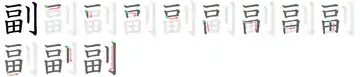 | |||
| Stroke order (Japan) | |||
|---|---|---|---|
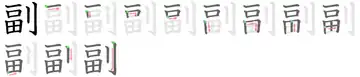 | |||
Han character
副 (Kangxi radical 18, 刀+9, 11 strokes, cangjie input 一田中弓 (MWLN), four-corner 12600, composition ⿰畐刂)
Derived characters
- 㨽, 𫋖, 𨄩, 𠠦, 𦸕
References
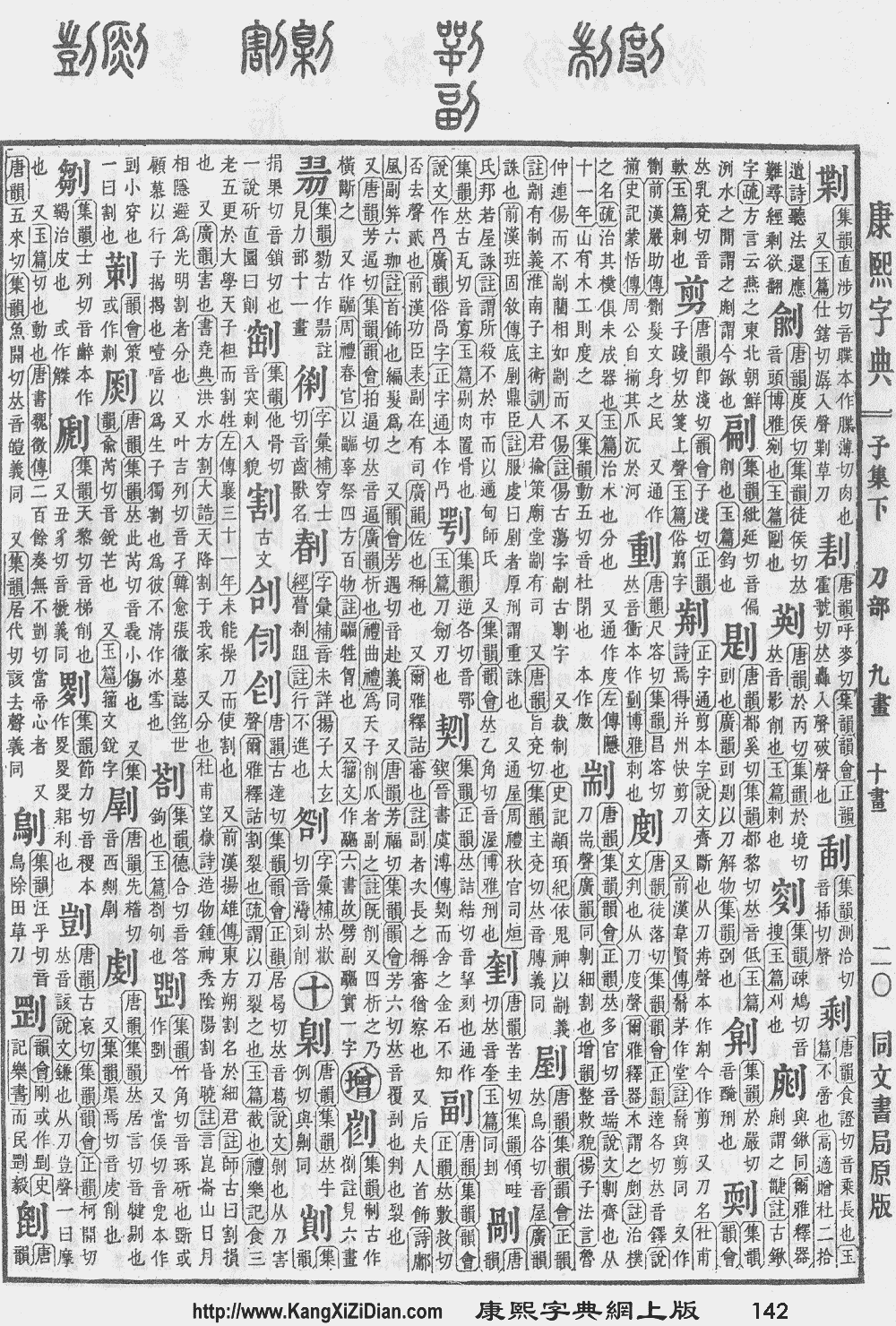
- Kangxi Dictionary: page 142, character 23
- Dai Kanwa Jiten: character 2097
- Dae Jaweon: page 322, character 8
- Hanyu Da Zidian (first edition): volume 1, page 347, character 16
- Unihan data for U+526F
Chinese
Glyph origin
| Historical forms of the character 副 | |
|---|---|
| Shuowen Jiezi (compiled in Han) | Liushutong (compiled in Ming) |
| Small seal script | Transcribed ancient scripts |
 |
 |
Characters in the same phonetic series (畐) (Zhengzhang, 2003)
Phono-semantic compound (形聲/形声, OC *pʰɯɡs, *pʰrɯɡ, *pʰɯɡ) : phonetic 畐 (OC *pʰrɯɡ, *bɯɡ) + semantic 刂 (“knife”).
Definitions
副
- secondary; auxiliary
- 秦皇帝東游,良與客狙擊秦皇帝博浪沙中,誤中副車。 [Classical Chinese, trad.]
- From: The Records of the Grand Historian, by Sima Qian, c. 91 BCE
- Qín Huángdì dōng yóu, Liáng yǔ kè jūjī Qín Huángdì Bólàng shā zhōng, wù zhòng fù chē. [Pinyin]
- Zhang Liang and his hire were lying in wait in the dunes of Bolang to attack the Emperor of Qin who was on his eastward tour. However, they hit his auxiliary carriage by mistake.
秦皇帝东游,良与客狙击秦皇帝博浪沙中,误中副车。 [Classical Chinese, simp.]
- duplicate
- 副本 ― fùběn ― duplicate; copy
- 藏之名山,副在京師,俟後世聖人君子。 [Classical Chinese, trad.]
- From: The Records of the Grand Historian, by Sima Qian, c. 91 BCE
- Cáng zhī míngshān, fù zài Jīngshī, sì hòushì shèngrén jūnzǐ. [Pinyin]
- I will induct them into the monumentous archives of the state while the copies circulate in our capital. By this, I await the future generations of wisdom and virtue.
藏之名山,副在京师,俟后世圣人君子。 [Classical Chinese, simp.]
- (grammar) Short for 副詞/副词 (fùcí, “adverb”).
- Classifier for pairs, sets of things, medical prescriptions, facial expressions, etc..
- assistant; deputy
- 副手 ― fùshǒu ― assistant
- sub-; vice- (subsidiary, secondary)
- (literary) to match; to agree; to be concordant; to be congruent
- 華實副則禮。 [Classical Chinese, trad.]
- From: Yang Xiong, Fa Yan (Exemplary Sayings), 9 CE, translated based on Jeffrey S. Bullock's version
- Huá shí fù zé lǐ. [Pinyin]
- If ornamentation and substance are paired, then it is li.
华实副则礼。 [Classical Chinese, simp.]
- (obsolete) name of an ornamental headdress
- 夫人副褘立于房中。 [Classical Chinese, trad.]
- From: The Book of Rites, c. 4th – 2nd century BCE, translated based on James Legge's version
- Fūrén fù yī lì yú fáng zhōng. [Pinyin]
- [A]nd his wife, in her head-dress and embroidered robe, stood in her room.
夫人副袆立于房中。 [Classical Chinese, simp.]
Compounds
- 一副
- 三副 (sānfù)
- 二副 (èrfù)
- 全副 (quánfù)
- 副主席 (fùzhǔxí)
- 副作用 (fùzuòyòng)
- 副冊/副册
- 副刊 (fùkān)
- 副官 (fùguān)
- 副室
- 副將/副将 (fùjiàng)
- 副性徵/副性征 (fùxìngzhēng)
- 副手 (fùshǒu)
- 副控室 (fùkòngshì)
- 副啟/副启
- 副教授 (fùjiàoshòu)
- 副文化
- 副曲
- 副會長/副会长
- 副本 (fùběn)
- 副末
- 副東/副东
- 副業/副业 (fùyè)
- 副榜
- 副標題/副标题 (fùbiāotí)
- 副歌 (fùgē)
- 副淨/副净
- 副理
- 副產品/副产品 (fùchǎnpǐn)
- 副甲狀腺/副甲状腺 (fùjiǎzhuàngxiàn)
- 副省級/副省级 (fùshěngjí)
- 副睪丸/副睾丸
- 副程式 (fùchéngshì)
- 副笄
- 副經理/副经理
- 副線/副线
- 副總理/副总理 (fùzǒnglǐ)
- 副總統/副总统 (fùzǒngtǒng)
- 副總裁/副总裁 (fùzǒngcái)
- 副署 (fùshǔ)
- 副翼 (fùyì)
- 副職/副职 (fùzhí)
- 副能
- 副虹
- 副角
- 副詞/副词 (fùcí)
- 副語言/副语言
- 副議長/副议长
- 副貢/副贡
- 副貳/副贰
- 副車/副车
- 副靖
- 副領事/副领事
- 副題/副题 (fùtí)
- 副食 (fùshí)
- 副食物
- 副鼻腔炎 (fùbíqiāngyán)
- 力不副心
- 名不副實/名不副实 (míngbùfùshí)
- 名副其實/名副其实 (míngfùqíshí)
- 名實不副/名实不副
- 名實俱副/名实俱副
- 名實相副/名实相副 (míngshíxiāngfù)
- 名高難副/名高难副
- 坼副 (chèpì)
- 大副 (dàfù)
- 家庭副業/家庭副业
- 對副/对副
- 成副兒/成副儿
- 盛名難副/盛名难副
Usage notes
As classifier, it should not be confused with 幅 (fú).
Japanese
Readings
Compounds
- 介副 (kaizoe)
Derived terms
- 副王 (fukuō)
- 副官 (fukukan), 副官 (fukkan)
- 副業 (fukugyō)
- 副署 (fukusho)
- 副将 (fukushō)
- 副賞 (fukushō)
- 副食 (fukushoku)
- 副審 (fukushin)
- 副腎 (fukujin)
- 副層 (fukusō)
- 副題 (fukudai)
- 副本 (fukuhon)
- 関副 (kanfuku)
- 正副 (seifuku)
- 大副 (taifu)
- 副詞 (fukushi)
- 副意識 (fukuishiki)
- 副音声 (fukuonsei)
- 副会長 (fukukaichō)
- 副監督 (fukukantoku)
- 副作用 (fukusayō)
- 副産物 (fukusanbutsu)
- 副詞節 (fukushisetsu)
- 副次的 (fukujiteki)
- 副社長 (fukushachō)
- 副首相 (fukushushō)
- 副収入 (fukushūnyū)
- 副助詞 (fukujoshi)
- 副食物 (fukushokubutsu)
- 副神経 (fukushinkei)
- 副振動 (fukushindō)
- 副葬品 (fukusōhin)
- 副知事 (fukuchiji)
- 副鼻腔 (fukubikō), 副鼻腔 (fukubikū)
- 副甲状腺 (fukukōjōsen)
- 副操縦士 (fukusōjūshi)
- 副大統領 (fukudaitōryō)
References
- Matsumura, Akira, editor (2006), 大辞林 [Daijirin] (in Japanese), Third edition, Tōkyō: Sanseidō, →ISBN
Korean
Etymology
From Middle Chinese 副 (MC phjuwH). Recorded as Middle Korean 부〯 (pwǔ) (Yale: pwu) in Hunmong Jahoe (訓蒙字會 / 훈몽자회), 1527.
Compounds
Compounds
- 부사 (副詞, busa, “adverb”)
- 부작용 (副作用, bujagyong, “side effect”)
- 부통령 (副統領, butongnyeong, “vice president”)
Vietnamese
This article is issued from Wiktionary. The text is licensed under Creative Commons - Attribution - Sharealike. Additional terms may apply for the media files.