廷

廷 U+5EF7, 廷
CJK UNIFIED IDEOGRAPH-5EF7
← 延
[U+5EF6]
CJK Unified Ideographs 廸 →
[U+5EF8]

Translingual

Han character

廷 (Kangxi radical 54, 廴+4, 6 strokes in Chinese, 7 strokes in Japanese, cangjie input 弓大竹土 (NKHG), four-corner 12401, composition ⿺廴𡈼)

Derived terms

References

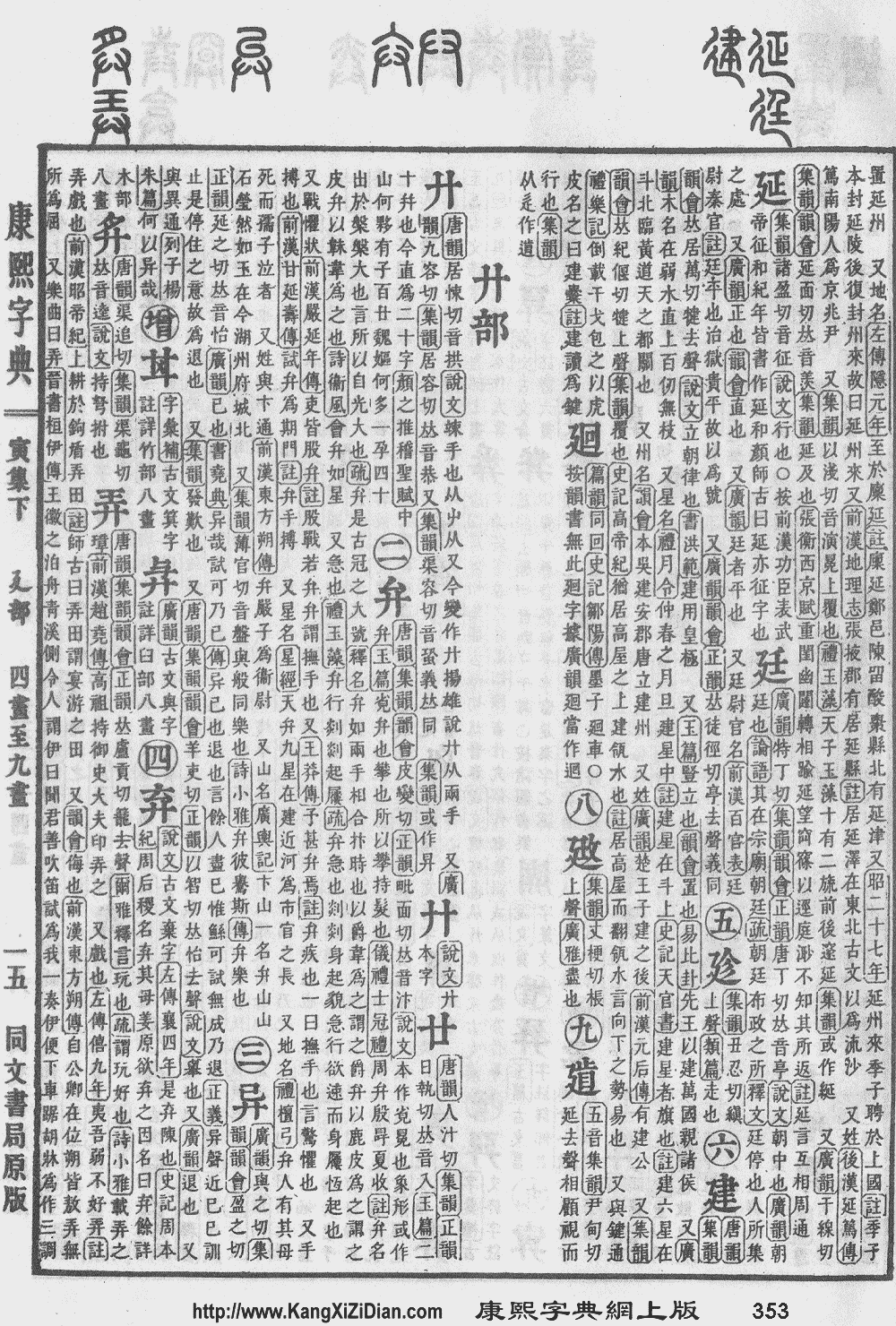
  • Kangxi Dictionary: page 353, character 2
  • Dai Kanwa Jiten: character 9571
  • Dae Jaweon: page 667, character 1
  • Hanyu Da Zidian (first edition): volume 1, page 403, character 11
  • Unihan data for U+5EF7

Chinese

simp. and trad.
廷
2nd round simp. 𨑳

Glyph origin

Historical forms of the character 廷
Western Zhou Shuowen Jiezi (compiled in Han) Liushutong (compiled in Ming)
Bronze inscriptions Small seal script Transcribed ancient scripts

Phono-semantic compound (形聲/形声, OC *l'eːŋ, *l'eːŋʔ) : semantic 廴 + phonetic 𡈼 (OC *l̥ʰeːŋʔ).

The phonetic 𡈼 is itself an ideogrammic compound, depicting a person standing on soil, and is also the ancient form of 徵/征 (“to convene, to assemble”), signifying a place where people stand in assembly — a court.

Etymology

From 聽 (OC *l̥ʰeːŋ, *l̥ʰeːŋs, “to hear”), i.e. “where hearings take place”. Related to 廳 (OC *l̥ʰeːŋ, “hall”).

Pronunciation


Rime
Character 廷 廷
Reading # 1/2 2/2
Initial (聲) 定 (7) 定 (7)
Final (韻) 青 (125) 青 (125)
Tone (調) Level (Ø) Departing (H)
Openness (開合) Open Open
Division (等) IV IV
Fanqie 特丁切 徒徑切
Baxter deng dengH
Reconstructions
Zhengzhang
Shangfang
/deŋ/ /deŋH/
Pan
Wuyun
/deŋ/ /deŋH/
Shao
Rongfen
/dɛŋ/ /dɛŋH/
Edwin
Pulleyblank
/dɛjŋ/ /dɛjŋH/
Li
Rong
/deŋ/ /deŋH/
Wang
Li
/dieŋ/ /dieŋH/
Bernard
Karlgren
/dʱieŋ/ /dʱieŋH/
Expected
Mandarin
Reflex
tíng dìng
Expected
Cantonese
Reflex
ting4 ding6
Baxter–Sagart system 1.1 (2014)
Character 廷
Reading # 1/1
Modern
Beijing
(Pinyin)
tíng
Middle
Chinese
‹ deng ›
Old
Chinese
/*lˁeŋ/
English courtyard

Notes for Old Chinese notations in the Baxter–Sagart system:

* Parentheses "()" indicate uncertain presence;
* Square brackets "[]" indicate uncertain identity, e.g. *[t] as coda may in fact be *-t or *-p;
* Angle brackets "<>" indicate infix;
* Hyphen "-" indicates morpheme boundary;

* Period "." indicates syllable boundary.
Zhengzhang system (2003)
Character 廷 廷
Reading # 1/2 2/2
No. 12420 12440
Phonetic
component
廷 廷
Rime
group
耕 耕
Rime
subdivision
0 0
Corresponding
MC rime
庭 定
Old
Chinese
/*l'eːŋ/ /*l'eːŋʔ/
Notes 金文象人立在旁有掩蔽但露天不蔽雨點陽光之地

Definitions

廷

  1. (historical) palace courtyard; court of a feudal lord
  2. (historical) government; governmental office
    朝廷  ―  cháotíng  ―  the imperial government
    清廷  ―  Qīngtíng  ―  the Qing government
    英廷  ―  Yīngtíng  ―  (dated or Hong Kong) the British government
  3. † Alternative form of 庭 (tíng, “courtyard”)

Compounds

  • 二朝廷
  • 內廷/内廷
  • 宮廷/宫廷 (gōngtíng)
  • 小朝廷
  • 廟廷/庙廷
  • 廷尉 (tíngwèi)
  • 廷對/廷对
  • 廷年
  • 廷掾
  • 廷杖 (tíngzhàng)
  • 廷爭面折/廷争面折
  • 廷試/廷试
  • 廷諍/廷诤
  • 廷辱
  • 廷魁
  • 徑廷/径廷 (jìngtíng)
  • 教廷 (jiàotíng)
  • 朝廷 (cháotíng)
  • 清廷 (qīngtíng)
  • 銓廷/铨廷
  • 阿根廷 (Āgēntíng)
  • 面折廷爭/面折廷争

Descendants

  • → Tibetan: ཐིང (thing, “government department or office at the provincial level”)

Japanese

Kanji

廷

(common “Jōyō” kanji)

  1. judicial or royal court
  2. imperial court
  3. government bureau or department

Readings

Korean

Hanja

廷 • (jeong) (hangeul 정, revised jeong, McCune–Reischauer chŏng)

  1. (조정 정) royal court, in the capital. See also: 朝廷.
  2. (마을 정) rural court, in the village.

See also

Vietnamese

Han character

廷: Hán Nôm readings: đình

  1. This term needs a translation to English. Please help out and add a translation, then remove the text {{rfdef}}.
This article is issued from Wiktionary. The text is licensed under Creative Commons - Attribution - Sharealike. Additional terms may apply for the media files.