恰
| ||||||||
Translingual
Han character
恰 (Kangxi radical 61, 心+6, 9 strokes, cangjie input 心人一口 (POMR), four-corner 98061, composition ⿰忄合)
Derived characters
- 𪣺
References
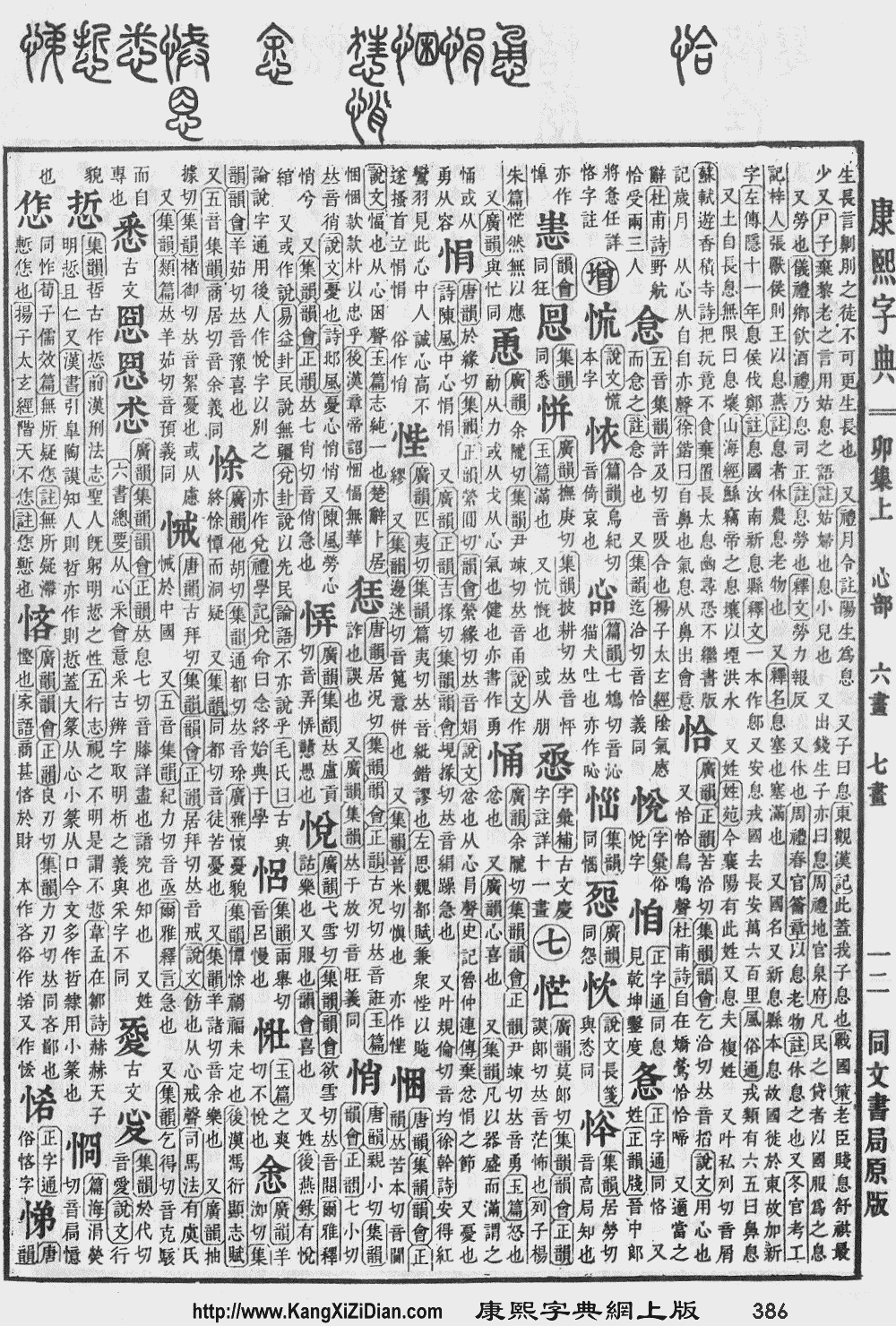
- Kangxi Dictionary: page 386, character 1
- Dai Kanwa Jiten: character 10603
- Dae Jaweon: page 718, character 2
- Hanyu Da Zidian (first edition): volume 4, page 2297, character 2
- Unihan data for U+6070
Chinese
Glyph origin
| Historical forms of the character 恰 | |
|---|---|
| Shuowen Jiezi (compiled in Han) | Liushutong (compiled in Ming) |
| Small seal script | Transcribed ancient scripts |
 |
 |
Characters in the same phonetic series (合) (Zhengzhang, 2003)
| Old Chinese | |
|---|---|
| 龕 | *kʰuːm |
| 媕 | *quːm, *qromʔ, *qɯːm, *qramʔ, *qɯːb |
| 頜 | *ɡuːmʔ, *kuːb |
| 答 | *tkuːb |
| 畣 | *tkuːb |
| 荅 | *tkuːb |
| 嗒 | *tuːb, *tʰoːb |
| 褡 | *tuːb, *toːb |
| 撘 | *tuːb |
| 搭 | *tuːb, *tʰoːb |
| 榙 | *tkuːb, *ɡuːb |
| 佮 | *tkʰuːb, *kuːb, *quːb, *quːb |
| 蛤 | *kuːb |
| 鴿 | *kuːb |
| 合 | *kuːb, *ɡuːb |
| 郃 | *kuːb, *ɡuːb |
| 匌 | *kuːb, *kʰuːb |
| 鉿 | *kuːb |
| 閤 | *kuːb |
| 鞈 | *kuːb, *kruːb |
| 韐 | *kuːb, *kruːb |
| 鮯 | *kuːb |
| 哈 | *ŋɡuːb |
| 姶 | *quːb, *quːb |
| 欱 | *qʰuːb, *qʰruːb |
| 盒 | *ɡuːb |
| 耠 | *ɡuːb |
| 詥 | *ɡuːb |
| 塔 | *tʰuːb |
| 鞳 | *tʰoːb |
| 劄 | *rtuːb |
| 跲 | *kruːb, *kob, *ɡob |
| 袷 | *kruːb, *ŋkob |
| 餄 | *kruːb |
| 恰 | *kʰruːb |
| 帢 | *kʰruːb |
| 洽 | *ɡruːb |
| 祫 | *ɡruːb |
| 珨 | *ɡruːb |
| 烚 | *ɡruːb |
| 歙 | *qʰjob, *qʰrub |
| 湁 | *tkʰub |
| 拾 | *ɡjub |
| 給 | *krub |
| 翕 | *qʰrub |
| 噏 | *qʰrub |
| 潝 | *qʰrub |
| 熻 | *qʰrub |
| 嬆 | *qʰrub |
| 翖 | *qʰrub |
| 闟 | *qʰrub |
Phono-semantic compound (形聲/形声, OC *kʰruːb) : semantic 忄 + phonetic 合 (OC *kuːb, *ɡuːb).
Pronunciation
Compounds
- 不恰好
- 半恰
- 恰不道
- 恰似 (qiàsì)
- 恰便似
- 恰克圖/恰克图 (Qiàkètú)
- 恰到好處/恰到好处 (qiàdàohǎochù)
- 恰則/恰则
- 恰哈 (Qiàhā)
- 恰如 (qiàrú)
- 恰好 (qiàhǎo)
- 恰如其分 (qiàrúqífèn)
- 恰巧 (qiàqiǎo)
- 恰恰 (qiàqià)
- 恰正
- 恰爾巴格/恰尔巴格 (Qià'ěrbāgé)
- 恰爾隆/恰尔隆 (Qià'ěrlóng)
- 恰當/恰当 (qiàdàng)
- 恰纔/恰才 (qiàcái)
- 恰薩/恰萨 (Qiàsà)
- 恰限
- 普恰克其 (Pǔqiàkèqí)
- 洽恰
- 烏恰/乌恰 (Wūqià)
- 烏魯克恰提/乌鲁克恰提 (Wūlǔkèqiàtí)
- 阿恰勒 (Āqiàlè)
- 阿恰塔格 (Āqiàtǎgé)
Etymology 2
| simp. and trad. |
恰 | |
|---|---|---|
| alternative forms | 太 | |
(This etymology is missing or incomplete. Please add to it, or discuss it at the Etymology scriptorium. Particularly: “related to Teochew kah4, Hokkien khah?”)
Pronunciation
Definitions
恰
- (Eastern Min) too; so
- 噇飽恰閒。 [Eastern Min, trad.]
- Chòng bā kák-èng. / [t͡sʰouŋ⁵³ pa³³ kʰaʔ²⁴⁻²¹ ɛiŋ⁵³] [Bàng-uâ-cê / IPA]
- Have nothing else to do. / Don't you have nothing else to do? / Mind your own concerns/business.
噇饱恰闲。 [Eastern Min, simp.]
Synonyms
Dialectal synonyms of 太 (“too; excessively”) [map]
Pronunciation
Synonyms
Pronunciation
Definitions
恰
References
- Dictionary of Chinese Character Variants (教育部異體字字典), A01336
- “恰”, in 漢語多功能字庫 (Multi-function Chinese Character Database), 香港中文大學 (the Chinese University of Hong Kong), 2014–
Japanese
Kanji
恰
(“Jinmeiyō” kanji used for names)
- This term needs a translation to English. Please help out and add a translation, then remove the text
{{rfdef}}.
Korean
Hanja
恰 (eum 흡 (heup))
- This term needs a translation to English. Please help out and add a translation, then remove the text
{{rfdef}}.
Vietnamese
Han character
恰: Hán Nôm readings: kháp
- This term needs a translation to English. Please help out and add a translation, then remove the text
{{rfdef}}.
This article is issued from Wiktionary. The text is licensed under Creative Commons - Attribution - Sharealike. Additional terms may apply for the media files.