拍
| ||||||||
Translingual
Han character
拍 (Kangxi radical 64, 手+5, 8 strokes, cangjie input 手竹日 (QHA), four-corner 56000, composition ⿰扌白)
Derived characters
- 啪, 𣁨
References
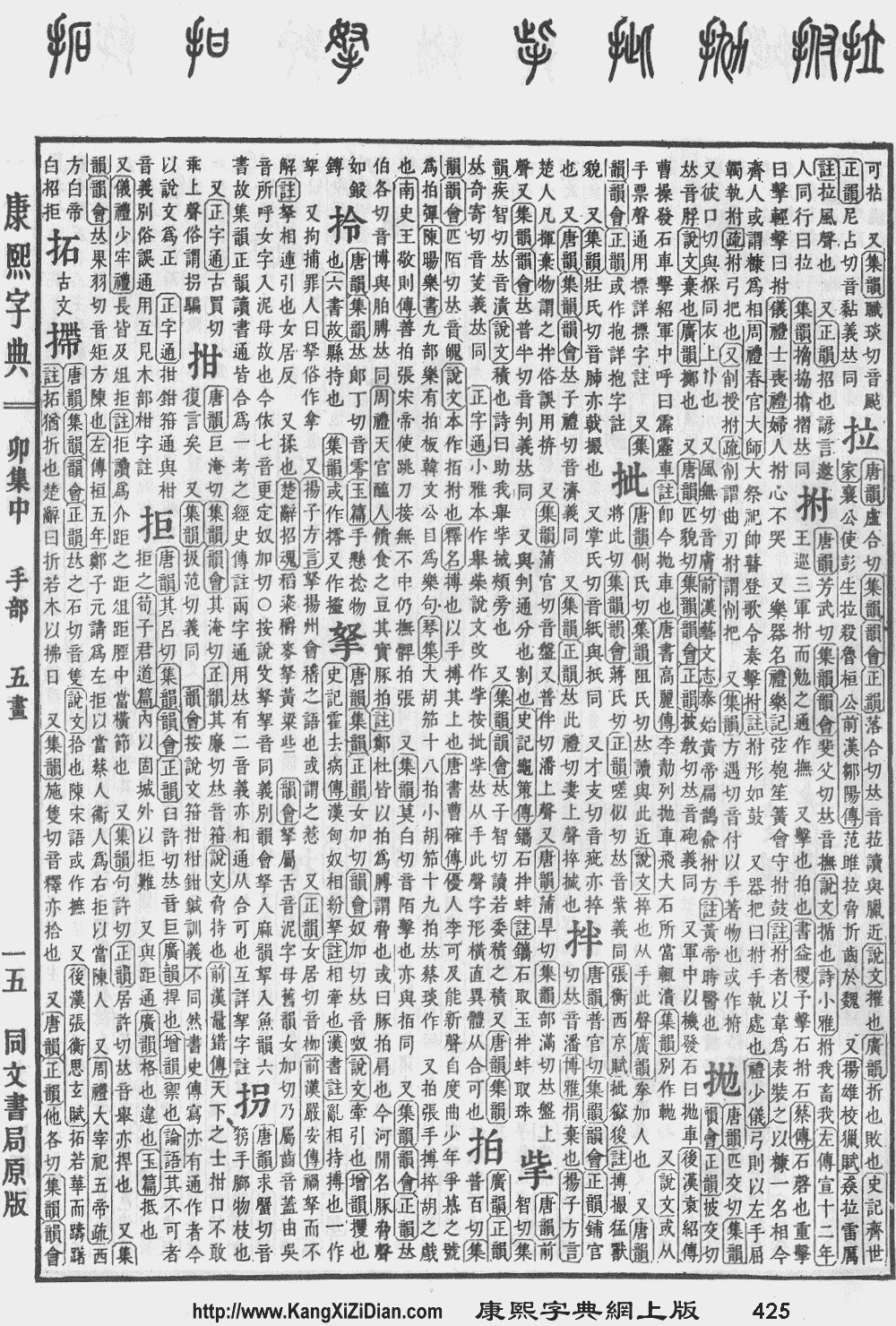
- Kangxi Dictionary: page 425, character 7
- Dai Kanwa Jiten: character 11952
- Dae Jaweon: page 773, character 12
- Hanyu Da Zidian (first edition): volume 3, page 1854, character 3
- Unihan data for U+62CD
Chinese
Glyph origin
Characters in the same phonetic series (白) (Zhengzhang, 2003)
| Old Chinese | |
|---|---|
| 怕 | *pʰraːɡs, *pʰraːɡ |
| 帕 | *pʰraːɡs, *mbraːd |
| 粕 | *pʰaːɡ, *pʰraːɡ |
| 胉 | *pʰaːɡ |
| 泊 | *baːɡ |
| 箔 | *baːɡ |
| 魄 | *tʰaːɡ, *pʰraːɡ |
| 皕 | *prɯɡ |
| 伯 | *praːɡ |
| 百 | *praːɡ |
| 迫 | *praːɡ |
| 敀 | *praːɡ, *pʰraːɡ |
| 柏 | *praːɡ |
| 湐 | *praːɡ |
| 拍 | *pʰraːɡ |
| 珀 | *pʰraːɡ |
| 皛 | *pʰraːɡ, *ɡeːwʔ |
| 洦 | *mpʰraːɡ, *mbraːɡ |
| 白 | *braːɡ |
| 帛 | *braːɡ |
| 舶 | *braːɡ |
| 鮊 | *braːɡ |
| 陌 | *mbraːɡ |
| 帞 | *mbraːɡ |
| 袹 | *mbraːɡ |
| 蛨 | *mbraːɡ |
| 貊 | *mbraːɡ |
| 佰 | *mbraːɡ |
| 銆 | *mbraːɡ |
| 碧 | *praɡ, *preɡ |
| 咟 | *ɦmreːɡ |
Phono-semantic compound (形聲/形声, OC *pʰraːɡ) : semantic 手 (“hand”) + phonetic 白 (OC *braːɡ).
Etymology 1
| simp. and trad. |
拍 | |
|---|---|---|
| alternative forms | 𢫦 扑 Min Nan vernacular 撲 Min Nan vernacular 打 Min Nan vernacular | |
Pronunciation
Definitions
拍
- to pat; to slap; to clap; to swat; to hit with a flat surface (palm, swatter, etc.)
- (Taiwanese Hokkien, music) to play (a percussion instrument)
- 拍鼓 [Hokkien] ― phah-kó͘ [Pe̍h-ōe-jī] ― to play the drums
- (Taiwanese Hokkien, music) to play (a percussion instrument)
- racket; swatter; paddle (flat implement for hitting)
- to take; to shoot (a picture, a video, etc.)
- Used as a dummy verb to make a verbal phrase from a noun, including but not limited to:
- (Min) to call (on the phone)
- 拍電話/拍电话 [Hokkien] ― phah tiān-ōe [Pe̍h-ōe-jī] ― to call someone on the phone
- 拍手機/拍手机 [Hokkien] ― phah chhiú-ki [Pe̍h-ōe-jī] ― to call someone's cellphone
- (Mandarin, Hokkien) to send (a telegram)
- (Hokkien, computing) to type
- (Hokkien) to perform (a martial art)
- (Hokkien) to make (a gesture, signal, etc.)
- 拍招呼 [Hokkien] ― phah-chio-ho͘ [Pe̍h-ōe-jī] ― to say hello
- (Hokkien) to perform sexual activity
- 拍手銃/拍手铳 [Hokkien] ― phah-chhiú-chhèng [Pe̍h-ōe-jī] ― to masturbate
- (Taiwanese Hokkien) to play (mahjong, card games, etc.)
- (Taiwanese Hokkien) to buy (meat, etc.)
- 拍肉 [Hokkien] ― phah bah [Pe̍h-ōe-jī] ― to buy meat
- (Min) to call (on the phone)
- (online shopping) to place an order
- (Cantonese) to move an object closer to another object; to be near; to become near
- (Cantonese, figuratively) to cooperate
- 拍住上 [Cantonese] ― paak3 zyu6 soeng5 [Jyutping] ― (please add an English translation of this usage example)
- (Min) to hit; to beat; to whack
- 拍尻川 [Hokkien] ― phah kha-chhng [Pe̍h-ōe-jī] ― to spank someone's bottom
- (Hokkien) to fight; to attack
- (Hokkien) to breed; to mate; to copulate
- (Hokkien, music) bamboo clapper for beating time in nanyin (made of two bamboo blocks)
- (Wuhan Mandarin) to brownnose; to suck up; to kiss someone's ass
- (music) Classifier for beats.
Synonyms
- (to take a picture):
Dialectal synonyms of 打 (“to hit; to strike; to beat”) [map]
- (to brownnose):
Dialectal synonyms of 拍馬屁 (“to brownnose; to suck up to”) [map]
Compounds
- 一拍即合 (yīpāijíhé)
- 三言二拍
- 仙人拍鼓有時錯,跤步踏差啥人無/仙人拍鼓有时错,跤步踏差啥人无 (sian-jîn phah kó͘ iú sî chhò, kha-pō͘ ta̍h-chha siáⁿ-lâng bô) (Min Nan)
- 促拍
- 偷拍 (tōupāi)
- 最佳拍檔/最佳拍档
- 合拍 (hépāi)
- 單拍子/单拍子
- 大拍賣/大拍卖
- 大拍頭/大拍头
- 實拍拍/实拍拍
- 急拍
- 慢半拍
- 打拍
- 打拍子
- 打拍浮
- 拍塞
- 拍外景
- 拍子 (pāizi)
- 拍子記號/拍子记号
- 拍序
- 拍張/拍张
- 拍惜
- 拍戲/拍戏 (pāixì)
- 拍戶/拍户
- 拍手 (pāishǒu)
- 拍手叫好
- 拍手打腳/拍手打脚
- 拍手拍腳/拍手拍脚
- 拍手稱快/拍手称快
- 拍打 (pāidǎ)
- 拍拍
- 拍拖 (pāituō)
- 拍拳頭/拍拳头 (phah kûn-thâu) (Min Nan)
- 拍掌 (pāizhǎng)
- 拍損/拍损 (phah-sńg) (Min Nan)
- 拍攝/拍摄 (pāishè)
- 拍木勝/拍木胜 (phah-bo̍k-sèng) (Min Nan)
- 拍板 (pāibǎn)
- 拍案 (pāi'àn)
- 拍桌
- 拍案叫妙
- 拍案叫絕/拍案叫绝 (pāi'ànjiàojué)
- 拍案怒罵/拍案怒骂
- 拍案稱奇/拍案称奇
- 拍案而起
- 拍桌驚嘆/拍桌惊叹
- 拍案驚奇/拍案惊奇 (pāi'ànjīngqí)
- 拍檔/拍档 (pāidàng)
- 拍泛
- 拍浮
- 拍照 (pāizhào)
- 拍片
- 拍球 (phok-khiù)
- 拍發/拍发
- 拍節機/拍节机
- 拍算 (phah-sǹg)
- 拍索
- 拍紙簿/拍纸簿 (pāizhǐbù)
- 拍結/拍结 (phah-kat) (Min Nan)
- 拍結毬/拍结球 (phah-kat-kiû) (Min Nan)
- 拍老腔兒/拍老腔儿
- 拍胸脯 (pāixiōngpú)
- 拍腦袋/拍脑袋
- 拍腿
- 拍膝嗟歎/拍膝嗟叹
- 拍花的
- 拍賣/拍卖 (pāimài)
- 拍門/拍门 (pāimén)
- 拍電影/拍电影 (pāi diànyǐng)
- 拍音
- 拍馬/拍马 (pāimǎ)
- 拍馬屁/拍马屁 (pāi mǎpì)
- 拍馬挺鎗/拍马挺枪
- 拍鬼臉/拍鬼脸
- 拍鼓
- 捶床拍枕
- 捶檯拍凳/捶台拍凳
- 揮拍/挥拍
- 撫拍/抚拍
- 收拍
- 椎拍輐斷/椎拍𰺇断
- 歇拍
- 氣拍/气拍
- 法拍屋
- 溜鬚拍馬/溜须拍马 (liūxūpāimǎ)
- 狼牙拍
- 球拍 (qiúpāi)
- 畢拍/毕拍
- 穩拍拍/稳拍拍
- 節拍/节拍 (jiépāi)
- 節拍計/节拍计
- 籌拍/筹拍
- 粉拍
- 翻拍 (fānpāi)
- 肩須拍/肩须拍
- 航拍 (hángpāi)
- 蒼蠅拍子/苍蝇拍子
- 號天拍地/号天拍地
- 複拍子/复拍子 (fùpāizi)
- 豚拍
- 重拍
- 鐵拍板/铁拍板
- 開拍/开拍 (kāipāi)
- 驚濤拍岸/惊涛拍岸
Further reading
- “Entry #3971”, in 臺灣閩南語常用詞辭典 [Dictionary of Frequently-Used Taiwan Minnan] (overall work in Mandarin and Hokkien), Ministry of Education, R.O.C., 2023.
Japanese
References
- Matsumura, Akira, editor (2006), 大辞林 [Daijirin] (in Japanese), Third edition, Tōkyō: Sanseidō, →ISBN
- NHK Broadcasting Culture Research Institute, editor (1998), NHK日本語発音アクセント辞典 [NHK Japanese Pronunciation Accent Dictionary] (in Japanese), Tōkyō: NHK Publishing, →ISBN
Korean
Hanja
Vietnamese
This article is issued from Wiktionary. The text is licensed under Creative Commons - Attribution - Sharealike. Additional terms may apply for the media files.