敲
| ||||||||
Translingual
Han character
敲 (Kangxi radical 66, 攴+10, 14 strokes, cangjie input 卜月卜水 (YBYE), four-corner 01247, composition ⿰高攴)
Derived characters
- 𡁞
References
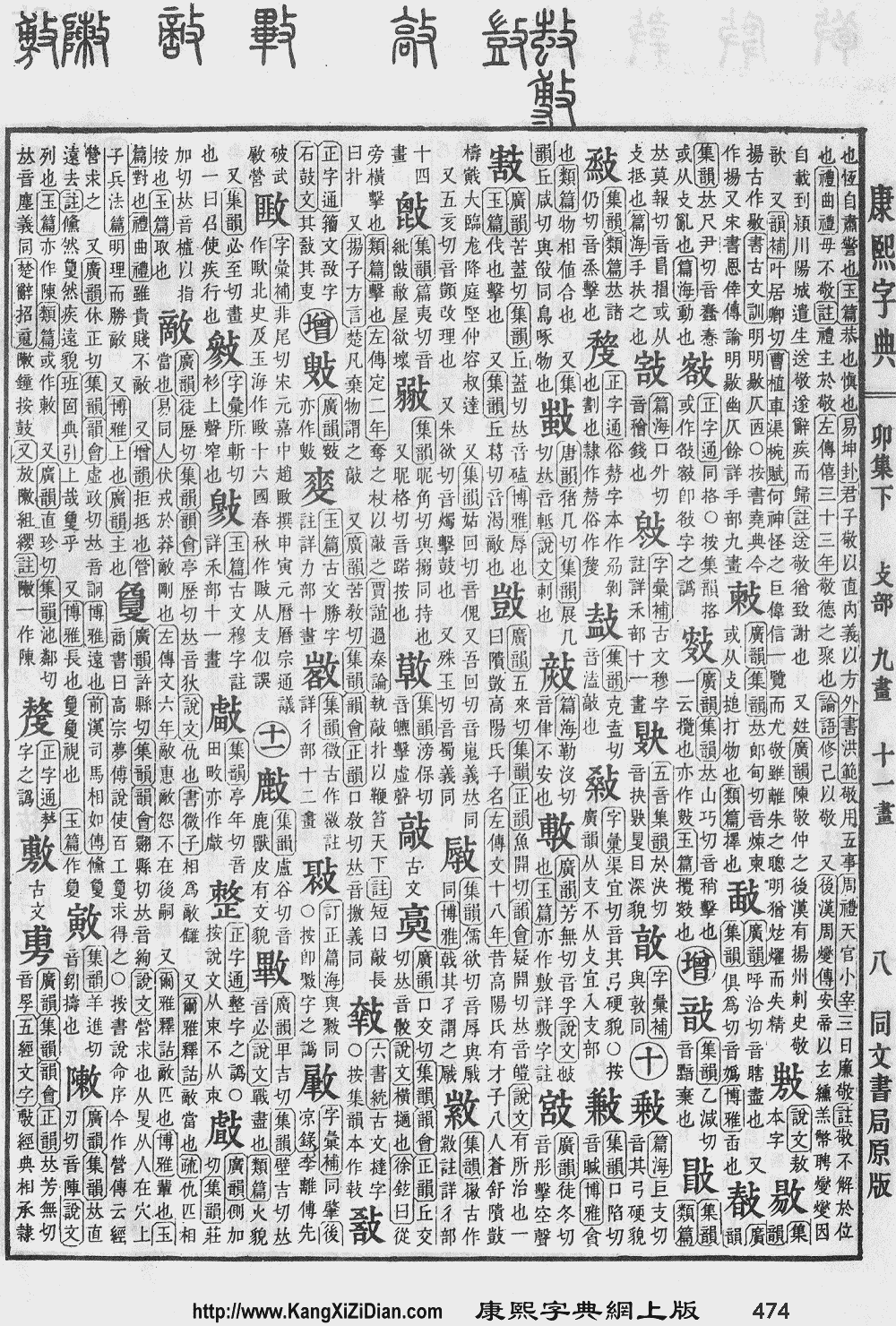
- Kangxi Dictionary: page 474, character 31
- Dai Kanwa Jiten: character 13337
- Dae Jaweon: page 828, character 14
- Hanyu Da Zidian (first edition): volume 2, page 1471, character 11
- Unihan data for U+6572
Chinese
Glyph origin
| Historical forms of the character 敲 | |
|---|---|
| Shuowen Jiezi (compiled in Han) | Liushutong (compiled in Ming) |
| Small seal script | Transcribed ancient scripts |
 |
 |
Characters in the same phonetic series (高) (Zhengzhang, 2003)
| Old Chinese | |
|---|---|
| 高 | *kaːw |
| 膏 | *kaːw, *kaːws |
| 篙 | *kaːw |
| 稿 | *kaːwʔ |
| 稾 | *kaːwʔ, *kʰaːws |
| 槁 | *kaːwʔ, *kʰaːwʔ |
| 縞 | *kaːwʔ, *kaːws |
| 暠 | *kaːwʔ |
| 槀 | *kaːwʔ |
| 藁 | *kaːwʔ |
| 燺 | *kʰaːwʔ |
| 薧 | *kʰaːwʔ, *kʰaːws, *qʰaːw |
| 犒 | *kʰaːws |
| 蒿 | *qʰaːw |
| 藃 | *qʰaːws, *qʰraːw, *qʰraw |
| 豪 | *ɡaːw |
| 毫 | *ɡaːw |
| 壕 | *ɡaːw |
| 濠 | *ɡaːw |
| 鎬 | *ɡaːwʔ |
| 滈 | *ɡaːwʔ, *qʰraːwɢ |
| 鄗 | *ɡaːwʔ, *kʰraːw, *qʰaːwɢ |
| 鰝 | *ɡaːwʔ, *qʰaːwɢ |
| 薃 | *ɡaːwʔ |
| 搞 | *kruːʔ |
| 敲 | *kʰraːw, *kʰraːws |
| 髇 | *qʰraːw |
| 嗃 | *qʰraːw, *qʰraːws, *qʰaːwɢ |
| 巐 | *kʰl'awʔ |
| 歊 | *qʰraw, *qʰoːwɢ |
| 謞 | *qʰaːwɢ, *qʰraːwɢ |
| 熇 | *qʰaːwɢ, *qʰoːwɢ, *qʰoːɡ |
| 碻 | *kʰraːwɢ |
| 塙 | *kʰraːwɢ |
| 毃 | *kʰraːwɢ |
| 翯 | *qʰraːwɢ, *ɡraːwɢ, *ɡoːwɢ |
| 瀥 | *qʰraːwɢ |
Phono-semantic compound (形聲/形声, OC *kʰraːw, *kʰraːws) : phonetic 高 (OC *kaːw) + semantic 攴 (“to hit lightly; to tap”).
Pronunciation
Definitions
敲
- to hit; to strike; to tap; to rap; to knock
- (colloquial) to rip off; to overcharge; to blackmail
- (colloquial) to criticize; to warn
- (Hokkien, Singapore Teochew) to call someone (by phone); to telephone
- 我昨日敲予先生。 [Philippine Hokkien, trad. and simp.]
- Guá chǎ-li̍t khà hō͘ sian-siⁿ. [Pe̍h-ōe-jī]
- I called the teacher yesterday (on the phone).
- (Xiamen, Quanzhou and Zhangzhou Hokkien) to knock down; to remove; to demolish
- (Taiwanese Hokkien) to alter (clothes)
- (Zhangzhou Hokkien) to compete (among businesses)
Synonyms
- (to hit):
- (to rip off):
Compounds
- 三敲六問/三敲六问
- 亂棒胡敲/乱棒胡敲
- 刻敲
- 吃敲才
- 吃敲材
- 吃敲賊/吃敲贼
- 唾壺敲缺/唾壶敲缺
- 戛玉敲冰
- 戛玉敲金
- 推敲 (tuīqiāo)
- 撩兒敲兒/撩儿敲儿
- 擊玉敲金/击玉敲金
- 敲冰戛玉
- 敲冰求火
- 敲冰煮茗
- 敲冰玉屑
- 敲冰紙/敲冰纸
- 敲冰索火
- 敲削
- 敲剝/敲剥
- 敲句
- 敲吟
- 敲坷垃
- 敲字邊/敲字边 (qiāozìbiān)
- 敲定 (qiāodìng)
- 敲尖
- 敲山振虎
- 敲山震虎
- 敲彈/敲弹
- 敲才
- 敲扑
- 敲打 (qiāodǎ)
- 敲拍
- 敲掉
- 敲推
- 敲搒
- 敲搕
- 敲搗/敲捣
- 敲撲/敲扑
- 敲擊/敲击 (qiāojī)
- 敲擊樂器/敲击乐器
- 敲擊音樂/敲击音乐
- 敲日
- 敲更
- 敲朴
- 敲枰
- 敲棋
- 敲榜
- 敲榨勒索
- 敲殺/敲杀
- 敲比
- 敲沙罐 (qiāo shāguàn)
- 敲油
- 敲火
- 敲牙
- 敲牙料嘴
- 敲牛宰馬/敲牛宰马
- 敲矢
- 敲石
- 敲碁
- 敲碎
- 敲磕
- 敲磨
- 敲竹杠 (qiāo zhúgàng)
- 敲竹槓/敲竹杠 (qiāo zhúgàng)
- 敲竹竿
- 敲絲/敲丝
- 敲膏吸髓
- 敲菱殼/敲菱壳
- 敲訂/敲订
- 敲詐/敲诈 (qiāozhà)
- 敲詐勒索/敲诈勒索 (qiāozhàlèsuǒ)
- 敲詩/敲诗
- 敲邊鼓/敲边鼓
- 敲金戛玉
- 敲金擊玉/敲金击玉
- 敲金擊石/敲金击石
- 敲釘錘/敲钉锤
- 敲釘鎚/敲钉锤
- 敲釘鑽脚/敲钉钻脚
- 敲釘鑽腳/敲钉钻脚
- 敲鏗/敲铿
- 敲鏝兒/敲镘儿
- 敲鐘/敲钟 (qiāozhōng)
- 敲鑼打鼓/敲锣打鼓
- 敲鑼擊鼓/敲锣击鼓
- 敲鑼放炮/敲锣放炮
- 敲鑼邊兒/敲锣边儿
- 敲門/敲门 (qiāomén)
- 敲門石/敲门石
- 敲門磚/敲门砖 (qiāoménzhuān)
- 敲開/敲开 (qiāokāi)
- 敲電話/敲电话
- 敲頭/敲头
- 敲骨剝髓/敲骨剥髓
- 敲骨吸髓 (qiāogǔ xīsuǐ)
- 敲骨榨髓
- 敲髓灑膏/敲髓洒膏
- 敲點/敲点
- 旁敲
- 旁敲側擊/旁敲侧击 (pángqiāocèjī)
- 更鼓敲盡/更鼓敲尽
- 東敲西逼/东敲西逼
- 盎盂相敲
- 緊打慢敲/紧打慢敲
- 胡敲
- 謊敲才/谎敲才
- 輕敲/轻敲 (qīngqiāo)
- 輕敲緩擊/轻敲缓击
- 零打碎敲
- 零敲碎打
Etymology 2
| simp. and trad. |
敲 | |
|---|---|---|
| alternative forms | 休 𡁞 齁 吼 | |
From 休 (MC xjuw, “to rest; to stop”) (Kwok and Kataoka, 2006). Compare Guangzhou 嘵/哓 (hiu1), which has become obsolete.
Pronunciation
Definitions
敲
- (Macau and Dongguan Cantonese) Used after a verb to indicate perfective aspect (action completion).
Synonyms
Dialectal synonyms of 了 (“(perfective particle)”) [map]
References
- Dictionary of Chinese Character Variants (教育部異體字字典), A01736
- “敲”, in 漢語多功能字庫 (Multi-function Chinese Character Database), 香港中文大學 (the Chinese University of Hong Kong), 2014–
Japanese
Korean
Vietnamese
This article is issued from Wiktionary. The text is licensed under Creative Commons - Attribution - Sharealike. Additional terms may apply for the media files.