盅
See also: 沖
| ||||||||
Translingual
Han character
盅 (Kangxi radical 108, 皿+4, 9 strokes, cangjie input 中月廿 (LBT), four-corner 50107, composition ⿱中皿)
Derived characters
- 𢝈, 𰜒, 𨡵
References
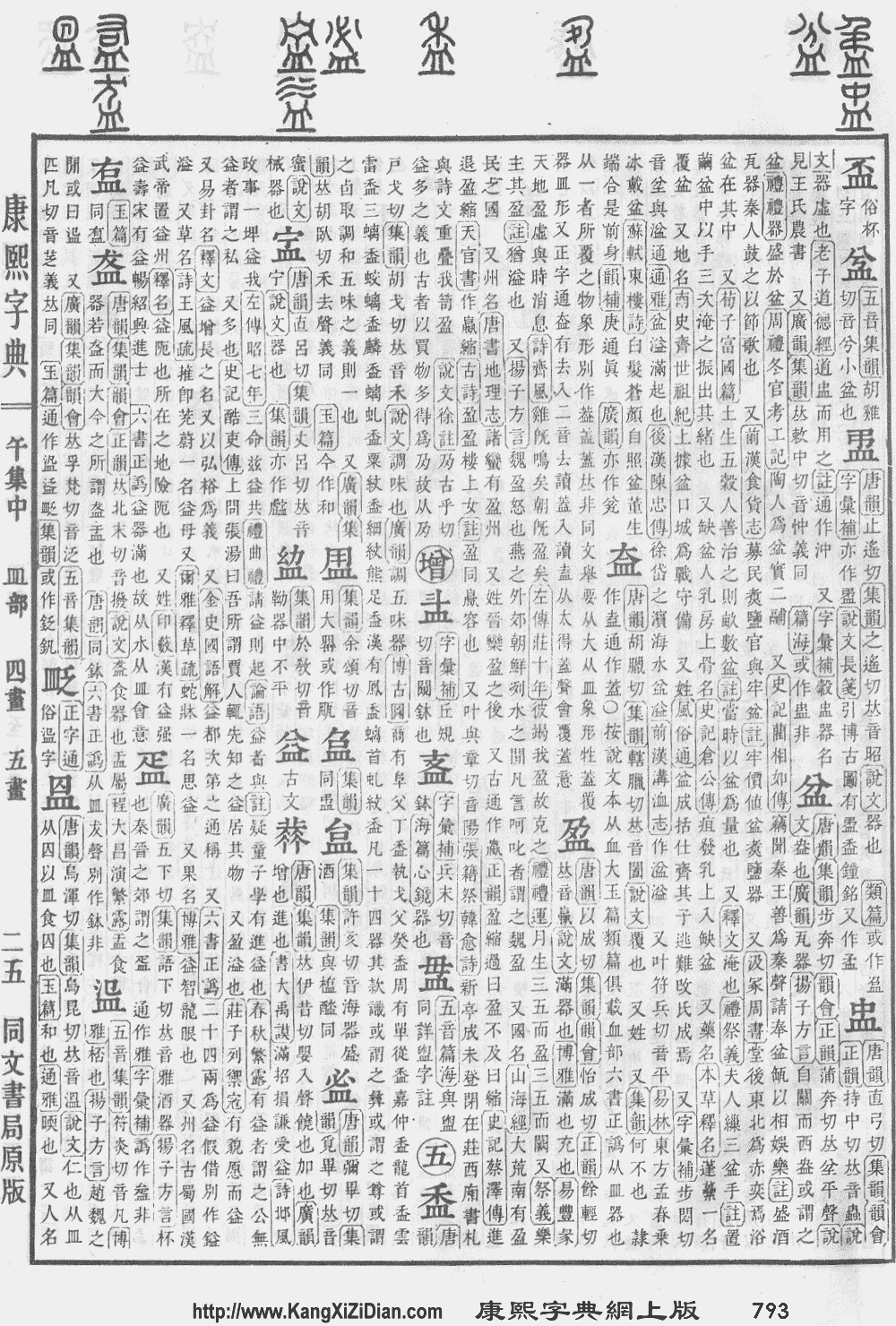
- Kangxi Dictionary: page 793, character 4
- Dai Kanwa Jiten: character 22958
- Dae Jaweon: page 1208, character 6
- Hanyu Da Zidian (first edition): volume 4, page 2558, character 5
- Unihan data for U+76C5
Chinese
Glyph origin
| Historical forms of the character 盅 | |
|---|---|
| Western Zhou | Shuowen Jiezi (compiled in Han) |
| Bronze inscriptions | Small seal script |
 |
 |
Characters in the same phonetic series (中) (Zhengzhang, 2003)
Phono-semantic compound (形聲/形声, OC *tʰuŋ, *duŋ, *tjoŋ) : phonetic 中 (OC *tuŋ, *tuŋs) + semantic 皿 (“dish; vessel”).

Definitions
盅
Synonyms
Dialectal synonyms of 杯子 (“drinkware; cup; glass; mug”) [map]
Dialectal synonyms of 杯 (“classifier for cups of drinks/food”) [map]
| Variety | Location | Words |
|---|---|---|
| Formal (Written Standard Chinese) | 杯 | |
| Mandarin | Taiwan | 杯 |
| Malaysia | 杯 | |
| Singapore | 杯 | |
| Cantonese | Hong Kong | 杯 |
| Singapore (Guangfu) | 杯 | |
| Hakka | Meixian | 杯 |
| Miaoli (N. Sixian) | 杯 | |
| Pingtung (Neipu; S. Sixian) | 杯 | |
| Hsinchu County (Zhudong; Hailu) | 杯 | |
| Taichung (Dongshi; Dabu) | 杯 | |
| Hsinchu County (Qionglin; Raoping) | 杯 | |
| Yunlin (Lunbei; Zhao'an) | 杯 | |
| Southern Min | Xiamen | 杯 |
| Quanzhou | 杯 | |
| Zhangzhou | 杯 | |
| Tainan | 杯 | |
| Penang (Hokkien) | 甌 | |
| Singapore (Hokkien) | 杯 | |
| Manila (Hokkien) | 杯 | |
| Haifeng | 杯 | |
| Singapore (Teochew) | 杯 | |
| Wenchang | 盅 | |
| Haikou | 盅 | |
| Singapore (Hainanese) | 盅 | |
| Wu | Shanghai | 杯 |
Pronunciation
Further reading
- “盅”, in 漢語多功能字庫 (Multi-function Chinese Character Database), 香港中文大學 (the Chinese University of Hong Kong), 2014–
Japanese
Korean
Etymology
(This etymology is missing or incomplete. Please add to it, or discuss it at the Etymology scriptorium. Particularly: “Middle Korean readings, if any”)
Pronunciation
- (SK Standard/Seoul) IPA(key): [t͡ɕʰuŋ]
- Phonetic hangul: [충]
Vietnamese
Han character
盅: Hán Việt readings: chung[1][2][3], trung[1][4]
盅: Nôm readings: chung[1], trung[1]
- chữ Hán form of chung (“small handleless cup”).
References
- Trần (2004).
- Nguyễn (1974).
- Thiều Chửu (1942).
- Trần (1999).
This article is issued from Wiktionary. The text is licensed under Creative Commons - Attribution - Sharealike. Additional terms may apply for the media files.