臭
| ||||||||
 | ||||||||
Translingual
| Japanese | 臭 |
|---|---|
| Simplified | 臭 |
| Traditional | 臭 |
Alternative forms
- In Japanese shinjitai, the bottom component is simplified to 大, rather than the traditional 犬 (“dog”).
- This character has technically been encoded in Unicode as 𦤀 (
U+26900) but is not used in Japanese computing; instead, the character 臭 (U+81ED) changes appearance depending on the font. - A CJK compatibility ideograph exists at
U+FA5Cfor the kyūjitai form used in Japanese which contains 犬 as its bottom component.
- This character has technically been encoded in Unicode as 𦤀 (
Han character
| Stroke order | |||
|---|---|---|---|
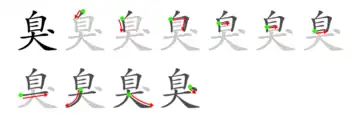 | |||
| Stroke order (Japan) | |||
|---|---|---|---|
 | |||
臭 (Kangxi radical 132, 自+4 in Chinese, 自+3 in Japanese, 10 strokes in Chinese, 9 strokes in Japanese, cangjie input 竹山戈大 (HUIK), four-corner 26430, composition ⿱自犬(GHTKV or U+FA5C) or ⿱自大(J))
Derived characters
References
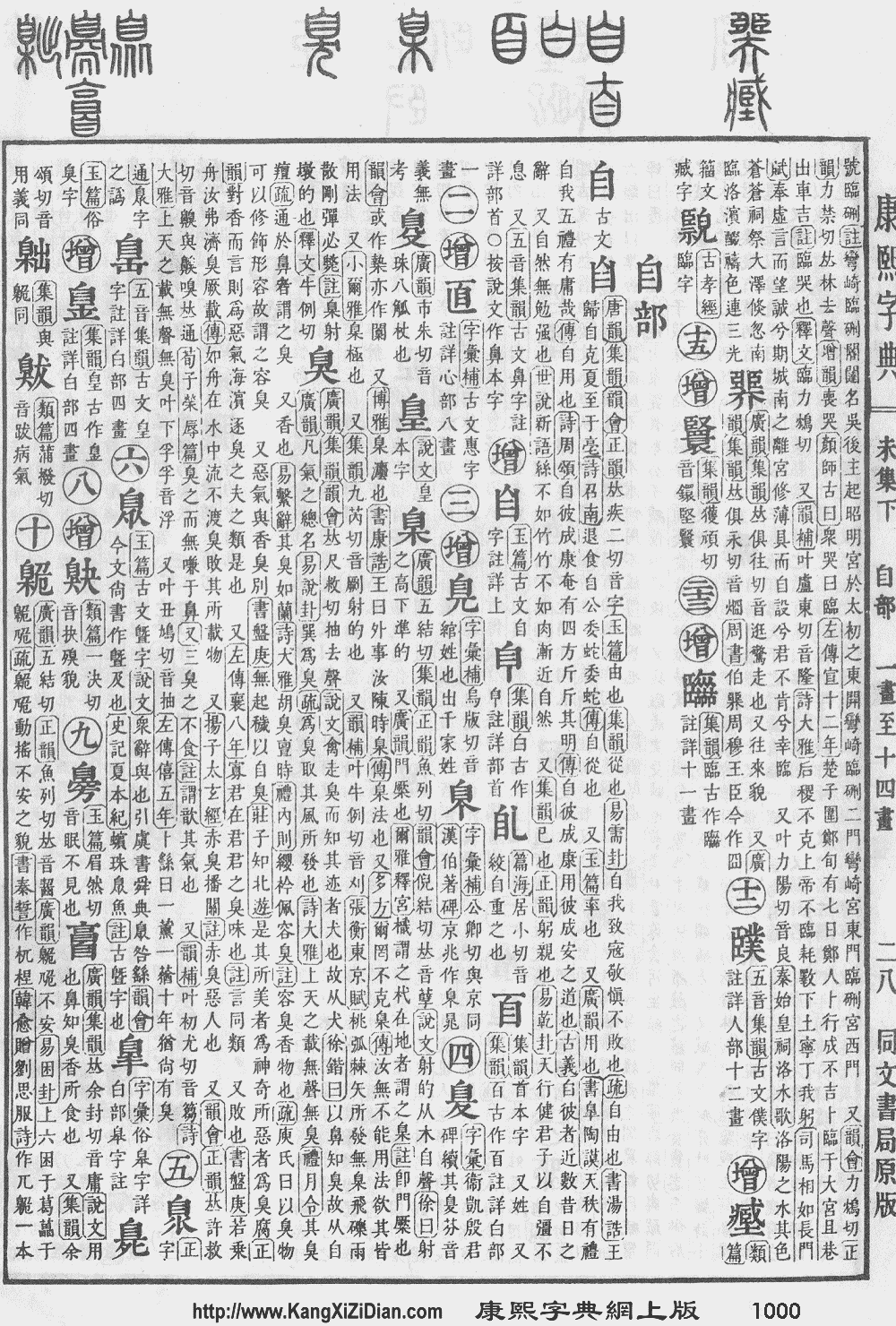
- Kangxi Dictionary: page 1000, character 20
- Dai Kanwa Jiten: character 30103
- Dae Jaweon: page 1456, character 7
- Hanyu Da Zidian (first edition): volume 5, page 3047, character 4
- Unihan data for U+81ED
- Unihan data for U+FA5C
Chinese
| trad. | 臭 | |
|---|---|---|
| simp. # | 臭 | |
| alternative forms | 𦤀 | |
Glyph origin
Ideogrammic compound (會意/会意) : 犬 (“dog”) + 自 (“nose”), referring to the dog's strong sense of smell.
Etymology
Schuessler (2007) considers it to be cognate with 犨 (OC *kʰju, “sound of an ox breathing”) and connects it to Burmese ဟိုက် (huik, “to pant”).
Also compare 朽 (OC *qʰluʔ, “to rot; to decay”) (Baxter and Sagart, 2014).
Pronunciation 1
Definitions
臭
Compounds
- 不知香臭
- 口臭 (kǒuchòu)
- 惡臭/恶臭 (èchòu)
- 捧臭腳/捧臭脚 (pěng chòujiǎo)
- 播惡遺臭/播恶遗臭
- 淫汙穢臭/淫污秽臭
- 渾身銅臭/浑身铜臭
- 狐臭 (húchòu)
- 狐騷臭/狐骚臭
- 發臭/发臭 (fāchòu)
- 胡臭 (húchòu)
- 脫臭/脱臭
- 腐臭 (fǔchòu)
- 腋臭 (yèchòu)
- 腥臭 (xīngchòu)
- 臭不可當/臭不可当
- 臭不可聞/臭不可闻
- 臭么
- 臭乎乎
- 臭侷
- 臭名 (chòumíng)
- 臭名昭彰
- 臭名昭著 (chòumíngzhāozhù)
- 臭名遠揚/臭名远扬
- 臭嚼
- 臭屁 (chòupì)
- 臭彈/臭弹 (chhàu-tōaⁿ) (Min Nan)
- 臭恭維/臭恭维
- 臭打
- 臭排場/臭排场
- 臭架子 (chòujiàzi)
- 臭椿 (chòuchūn)
- 臭死
- 臭氧 (chòuyǎng)
- 臭氣/臭气 (chòuqì)
- 臭氧層/臭氧层 (chòuyǎngcéng)
- 臭氣沖天/臭气冲天
- 臭泥
- 臭烘烘 (chòuhōnghōng)
- 臭皮匠 (chòupíjiàng)
- 臭皮囊
- 臭短臊長/臭短臊长
- 臭罵/臭骂 (chòumà)
- 臭美 (chòuměi)
- 臭耳聾/臭耳聋 (chhàu-hīⁿ-lâng) (Min Nan)
- 臭肉來蠅/臭肉来蝇
- 臭腺
- 臭腳丫子/臭脚丫子
- 臭蓋/臭盖
- 臭蟲/臭虫 (chòuchóng)
- 臭街爛巷/臭街烂巷
- 臭豆
- 臭豆腐 (chòudòufu)
- 臭錢/臭钱 (chòuqián)
- 臭頭/臭头 (chòutóu)
- 臭鼬 (chòuyòu)
- 逐臭
- 逐臭之夫
- 遺臭/遗臭
- 遺臭千年/遗臭千年
- 遺臭萬代/遗臭万代
- 遺臭萬年/遗臭万年 (yíchòuwànnián)
- 遺臭萬載/遗臭万载
- 防臭劑/防臭剂 (fángchòujì)
- 附膻逐臭
- 餿臭/馊臭 (sōuchòu)
- 體臭/体臭
- 齆臭 (wèngchòu)
Pronunciation 2
Definitions
臭
- † odour
- 羴:羊臭也。 [Classical Chinese, trad. and simp.]
- From: Shuowen Jiezi, circa 2nd century CE
- Shān: yáng xiù yě. [Pinyin]
- The character 羴 (shān): sheep's smell.
- † fragrance
- 二人同心,其利斷金。同心之言,其臭如蘭。 [Pre-Classical Chinese, trad.]
- From: I Ching, 11th – 8th century BCE
- Èrrén tóngxīn, qí lì duàn jīn. Tóngxīn zhī yán, qí chòu rú lán. [Pinyin]
- But when two men are one in heart, not iron bolts keep them apart. The words they in their union use, fragrance like orchid plants diffuse.
二人同心,其利断金。同心之言,其臭如兰。 [Pre-Classical Chinese, simp.]
- † Original form of 嗅 (xiù, “to smell”).
References
- “臭”, in 漢語多功能字庫 (Multi-function Chinese Character Database), 香港中文大學 (the Chinese University of Hong Kong), 2014–
Japanese
| Shinjitai | 臭 | |
| Kyūjitai [1][2] |
臭 臭or 臭+ ︀? |
|
| 臭󠄁 臭+ 󠄁?(Adobe-Japan1) | ||
| 臭󠄃 臭+ 󠄃?(Hanyo-Denshi) (Moji_Joho) | ||
| The displayed kanji may be different from the image due to your environment. See here for details. | ||
Kanji
Readings
From Middle Chinese 臭 (MC tsyhuwH):
From Middle Chinese; compare Mandarin 臭 (xiù):
From native Japanese roots:
Etymology
| Kanji in this term |
|---|
| 臭 |
| しゅう Grade: S |
| on’yomi |
| Alternative spelling |
|---|
| 臭 (kyūjitai) |
From Middle Chinese 臭 (MC tsyhuwH).
Suffix
臭 • (-shū)
References
- “臭”, in 漢字ぺディア (Kanjipedia) (in Japanese), 日本漢字能力検定協会, 2015–2024
- Haga, Gōtarō (1914) 漢和大辞書 [The Great Kanji-Japanese Dictionary] (in Japanese), Fourth edition, Tōkyō: Kōbunsha, , page 1776 (paper), page 940 (digital)
Korean
Etymology
From a corrupted or unorthodox reading. The original reading is 추 (chu) based on Middle Chinese 臭 (MC tsyhuwH).
| Historical Readings | ||
|---|---|---|
| Middle Korean | ||
| Text | Eumhun | |
| Gloss (hun) | Reading | |
| Hunmong Jahoe, 1527 | 내〮 (Yale: náy) | ᄎᆔ〯 (Yale: chywǔy) |
Pronunciation
- (SK Standard/Seoul) IPA(key): [t͡ɕʰɥi(ː)] ~ [t͡ɕʰy(ː)]
- Phonetic hangul: [취(ː)]
- Though still prescribed in Standard Korean, most speakers in both Koreas no longer distinguish vowel length.