蒙
| ||||||||
Translingual
Han character
蒙 (Kangxi radical 140, 艸+10, 13 strokes, cangjie input 廿月一人 (TBMO), four-corner 44232, composition ⿱艹冡 or ⿳𫇦一豕)
References
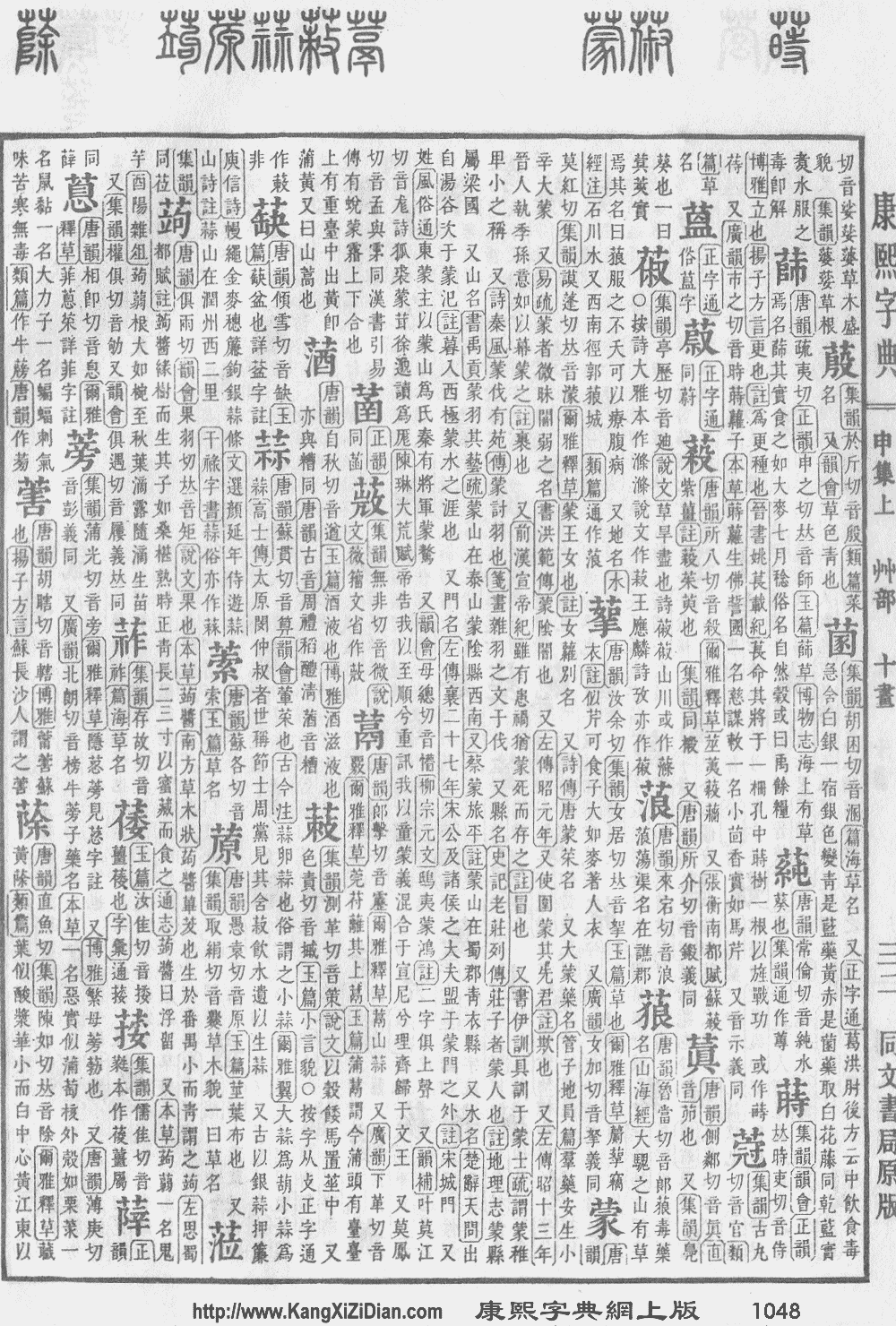
- Kangxi Dictionary: page 1048, character 15
- Dai Kanwa Jiten: character 31555
- Dae Jaweon: page 1509, character 22
- Hanyu Da Zidian (first edition): volume 5, page 3271, character 4
- Unihan data for U+8499
Chinese
Glyph origin
| Historical forms of the character 蒙 | ||
|---|---|---|
| Warring States | Shuowen Jiezi (compiled in Han) | Liushutong (compiled in Ming) |
| Bronze inscriptions | Small seal script | Transcribed ancient scripts |
 |
 |
 |
Etymology 1
| trad. | 蒙 | |
|---|---|---|
| simp. # | 蒙 | |
| 2nd round simp. | 𰰡 | |
| alternative forms | ⿱𫇦二 2nd round simp. (1981) | |
STEDT compares it to Proto-Sino-Tibetan *muːŋ ~ r/s-muːk (“foggy; dark; sullen; menacing; thunder”).
Pronunciation 1
Definitions
蒙
Compounds
- 佛蒙特州
- 冥蒙
- 吳下阿蒙/吴下阿蒙
- 呂蒙正/吕蒙正
- 坑蒙
- 多蒙寄聲/多蒙寄声
- 多蒙推轂/多蒙推毂
- 多蒙藥石/多蒙药石
- 幸蒙
- 忪蒙
- 性荷爾蒙/性荷尔蒙
- 愚蒙
- 承蒙 (chéngméng)
- 啟蒙/启蒙 (qǐméng)
- 啟蒙哲學/启蒙哲学
- 啟蒙時代/启蒙时代 (Qǐméng Shídài)
- 啟蒙運動/启蒙运动 (qǐméng yùndòng)
- 易學啓蒙/易学启蒙
- 晦蒙
- 曠若發蒙/旷若发蒙
- 狐裘蒙戎
- 疵蒙謬累/疵蒙谬累
- 發蒙/发蒙
- 發蒙振落/发蒙振落
- 童蒙 (tóngméng)
- 童蒙訓/童蒙训
- 荷爾蒙/荷尔蒙
- 蒙主寵召/蒙主宠召 (méngzhǔchǒngzhào)
- 蒙事
- 蒙住
- 蒙冤
- 蒙受 (méngshòu)
- 蒙叟
- 蒙古斑 (měnggǔbān)
- 蒙吏
- 蒙哄
- 蒙地卡羅/蒙地卡罗 (Méngdìkǎluó)
- 蒙在鼓裡/蒙在鼓里 (méngzàigǔlǐ)
- 蒙坑
- 蒙垢
- 蒙塵/蒙尘 (méngchén)
- 蒙太奇 (méngtàiqí)
- 蒙娜麗莎/蒙娜丽莎 (Méngnà Lìshā)
- 蒙學/蒙学 (méngxué)
- 蒙席 (méngxí)
- 蒙師/蒙师
- 蒙恩
- 蒙恬造筆/蒙恬造笔
- 蒙愛/蒙爱
- 蒙戎
- 蒙拾
- 蒙故業/蒙故业
- 蒙昧 (méngmèi)
- 蒙昧主義/蒙昧主义 (méngmèizhǔyì)
- 蒙昧無知/蒙昧无知
- 蒙求
- 蒙汜
- 蒙汗藥/蒙汗药
- 蒙混 (ménghùn)
- 蒙稚
- 蒙童 (méngtóng)
- 蒙籠/蒙笼
- 蒙籠暗碧/蒙笼暗碧
- 蒙絡/蒙络
- 蒙羞 (méngxiū)
- 蒙自 (Méngzì)
- 蒙莊/蒙庄
- 蓎蒙 (tángméng)
- 蒙蒙 (méngméng)
- 蒙蒙亮 (mēngmēngliàng)
- 蒙蒙黑
- 蒙蔽 (méngbì)
- 蒙藥/蒙药
- 蒙蘢/蒙茏
- 蒙衝/蒙冲
- 蒙谷
- 蒙難/蒙难 (méngnàn)
- 蒙霧露/蒙雾露
- 蒙面 (méngmiàn)
- 蒙頭/蒙头
- 蒙頭衲被/蒙头衲被
- 蒙頭轉向/蒙头转向
- 蒙養/蒙养
- 蒙館/蒙馆 (méngguǎn)
- 蒙驢/蒙驴
- 蔑蒙
- 蜂蒙
- 衲被蒙頭/衲被蒙头
- 被澤蒙庥/被泽蒙庥
- 被災蒙禍/被灾蒙祸
- 訓蒙/训蒙
- 費洛蒙/费洛蒙 (fèiluòméng)
- 賀爾蒙/贺尔蒙 (hè'ěrméng)
- 過蒙/过蒙
- 銜恨蒙枉/衔恨蒙枉
- 鋪眉蒙眼/铺眉蒙眼
- 開蒙/开蒙
- 頑蒙/顽蒙
- 顓蒙/颛蒙
- 驢蒙虎皮/驴蒙虎皮
- 鴻蒙/鸿蒙 (hóngméng)
Pronunciation 2
Pronunciation
Definitions
蒙
Compounds
- 內蒙古/内蒙古
- 外蒙 (Wàiměng)
- 外蒙古
- 東蒙/东蒙
- 海西蒙古族藏族自治州
- 肅北蒙古族自治縣/肃北蒙古族自治县
- 蒙元 (měngyuán)
- 蒙古 (měnggǔ)
- 蒙古人種/蒙古人种 (měnggǔ rénzhǒng)
- 蒙古兒/蒙古儿
- 蒙古利亞/蒙古利亚
- 蒙古包 (měnggǔbāo)
- 蒙古地方
- 蒙古大夫 (měnggǔ dàifu)
- 蒙古帝國/蒙古帝国 (měnggǔ Dìguó)
- 蒙古文 (měnggǔwén)
- 蒙古斑 (měnggǔbān)
- 蒙古族 (měnggǔzú)
- 蒙古症 (měnggǔzhèng)
- 蒙古語/蒙古语 (měnggǔyǔ)
- 蒙古高原 (měnggǔ Gāoyuán)
- 蒙學/蒙学 (méngxué)
- 蒙戈 (měnggē)
- 蒙文 (měngwén)
- 蒙族 (měngzú)
- 蒙東/蒙东 (měngdōng)
- 蒙胞
- 蒙藥/蒙药
Etymology 3
| For pronunciation and definitions of 蒙 – see 濛 (“drizzling, misty, raining”). (This character is the simplified form of 濛). |
Notes:
|
Etymology 4
| For pronunciation and definitions of 蒙 – see 懞 (“honest; sincere; etc.”). (This character is the simplified form of 懞). |
Notes:
|
Etymology 5
| For pronunciation and definitions of 蒙 – see 矇 (“to cheat; to deceive; to dupe; to make a wild guess; etc.”). (This character is the simplified form of 矇). |
Notes:
|
Japanese
Readings
Compounds
| Kanji in this term |
|---|
| 蒙 |
| もう Jinmeiyō |
| kan’yōon |
Pronoun
蒙 • (mō)
References
- Matsumura, Akira, editor (2006), 大辞林 [Daijirin] (in Japanese), Third edition, Tōkyō: Sanseidō, →ISBN
- NHK Broadcasting Culture Research Institute, editor (1998), NHK日本語発音アクセント辞典 [NHK Japanese Pronunciation Accent Dictionary] (in Japanese), Tōkyō: NHK Publishing, →ISBN
- Gotō, Tanji with Saburō Kamada (1960) Nihon Koten Bungaku Taikei 34: Taiheiki 1 (in Japanese), Tōkyō: Iwanami Shoten, →ISBN
Korean
Vietnamese
This article is issued from Wiktionary. The text is licensed under Creative Commons - Attribution - Sharealike. Additional terms may apply for the media files.