著
| ||||||||
 | ||||||||
| ||||||||
Translingual
| Stroke order | |||
Mainland China and Japan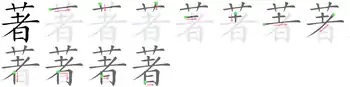 | |||
Alternative forms
- In Korean hanja, the bottom component 者 is written with an additional 丶 stroke above 日, which is the form found in the historical Kangxi dictionary.
- Two CJK Compatibility Ideographs exist at
U+FA5FandU+2F99F. The former corresponds to the alternative Japanese form with an additional 丶 stroke above 日 while the latter corresponds to the alternative Korean form without an additional 丶 stroke above 日.
Han character
著 (Kangxi radical 140, 艸+8 in Chinese and Japanese, 艸+9 in Korean, 12 strokes in Chinese in traditional Chinese, 11 strokes in mainland China and Japanese, 13 strokes in Korean, cangjie input 廿十大日 (TJKA) or 廿十大戈 (TJKI), four-corner 44604, composition ⿱艹者)
Related characters
- 着 (Preferred form used in Hong Kong and mainland China for Pronunciation 1 and 2 in Chinese)
References
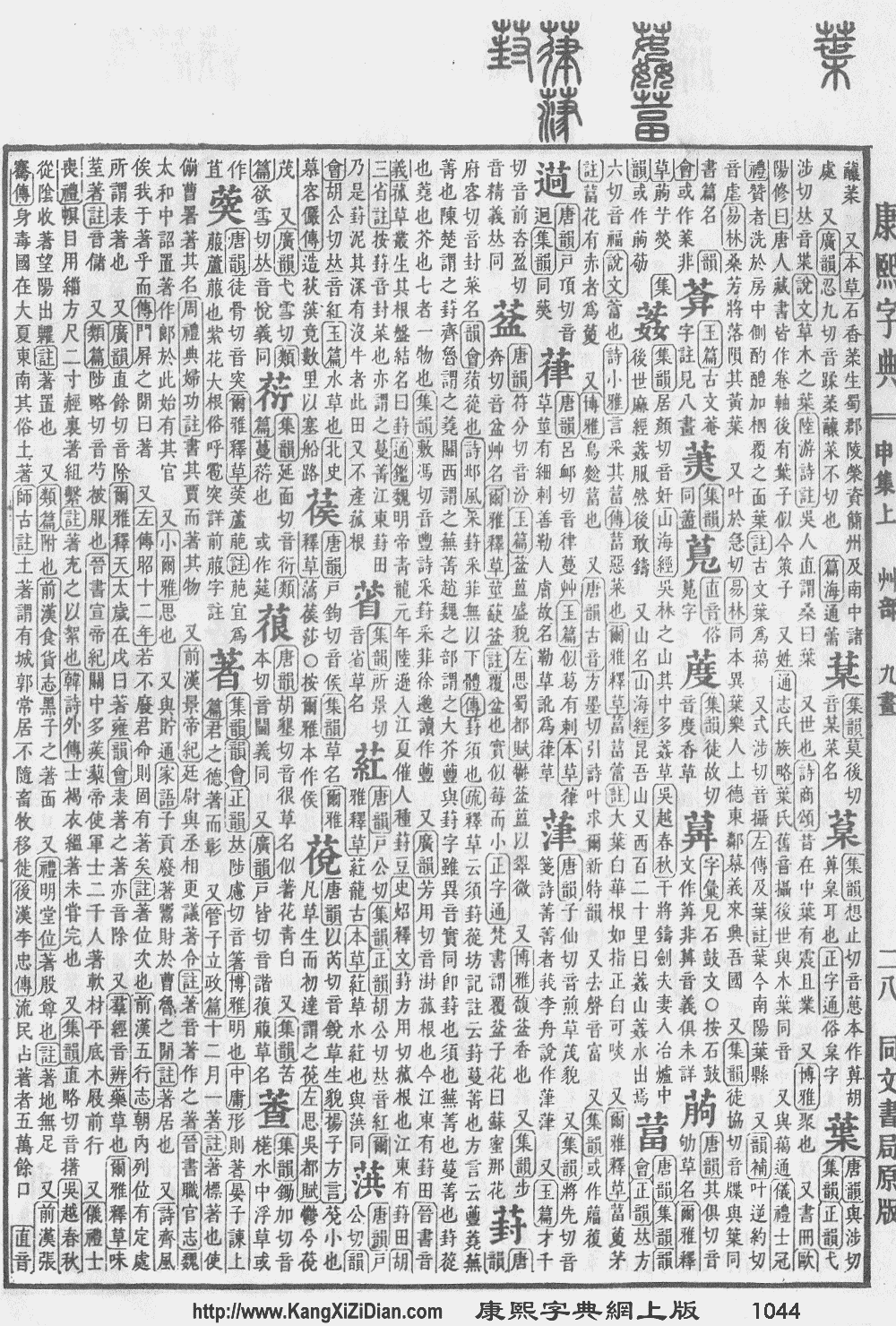
- Kangxi Dictionary: page 1044, character 26
- Dai Kanwa Jiten: character 31302
- Dae Jaweon: page 1505, character 19
- Hanyu Da Zidian (first edition): volume 5, page 3228, character 2
- Unihan data for U+8457
- Unihan data for U+FA5F
- Unihan data for U+2F99F
Chinese
Glyph origin
Characters in the same phonetic series (者) (Zhengzhang, 2003)
| Old Chinese | |
|---|---|
| 觰 | *rtaːʔ, *rtaː |
| 諸 | *tjaː, *tja |
| 者 | *tjaːʔ |
| 堵 | *tjaːʔ, *taːʔ |
| 赭 | *tjaːʔ |
| 撦 | *l̥ʰjaːʔ |
| 扯 | *tʰjaːʔ |
| 闍 | *djaː, *taː |
| 奢 | *hljaː |
| 鍺 | *toːlʔ |
| 都 | *taː |
| 醏 | *taː |
| 覩 | *taːʔ |
| 睹 | *taːʔ |
| 暏 | *taːʔ |
| 賭 | *taːʔ |
| 帾 | *taːʔ |
| 楮 | *taːʔ, *tʰaʔ |
| 屠 | *daː, *da |
| 瘏 | *daː |
| 廜 | *daː |
| 鷵 | *daː |
| 緒 | *ljaʔ |
| 豬 | *ta |
| 猪 | *ta |
| 瀦 | *ta |
| 藸 | *ta, *da |
| 櫫 | *ta |
| 褚 | *taʔ, *tʰaʔ |
| 著 | *taʔ, *tas, *da, *taɡ, *daɡ |
| 箸 | *tas, *das |
| 儲 | *da |
| 躇 | *da |
| 櫧 | *tja |
| 藷 | *tja, *djas |
| 蠩 | *tja |
| 煮 | *tjaʔ |
| 渚 | *tjaʔ |
| 煑 | *tjaʔ |
| 陼 | *tjaʔ |
| 翥 | *tjas |
| 署 | *djas |
| 薯 | *djas |
| 曙 | *djas |
| 書 | *hlja |
| 暑 | *hjaʔ |
| 鐯 | *taɡ |
| 擆 | *taɡ |
| 櫡 | *taɡ |
Phono-semantic compound (形聲/形声, OC *taʔ, *tas, *da, *taɡ, *daɡ) : semantic 艸 (“grass; plant”) + phonetic 者 (OC *tjaːʔ).
Etymology
From Proto-Sino-Tibetan *s-ta-t (“to put; to place”). Cognate with Tibetan སྟད (stad, “to put on; to lay on”), སྟ་གོན (sta gon, “preparation; arrangement”), Burmese ထား (hta:, “to put; to place”).
Pronunciation 1
| trad. | 著/着 | |
|---|---|---|
| simp. | 着 | |
| alternative forms | 𣋐 囉/啰 (lo̍h) Zhangzhou Hokkien 就 (tō) Taiwanese Hokkien | |
| 着 - See its usage notes. | ||
Definitions
著
- ⁜ (literary or Hokkien) to attach to; to stick to; to adhere to
- ⁜ (literary or Hokkien) to touch; to contact
- (literary or dialectal) to wear; to put on; to be dressed in; clothing
- (obsolete or dialectal Mandarin, Jin, Wu) to put; to place
- † to arrange
- † to blossom or bear fruit
- † something to depend on; something to fall back on; desired end; a sense of belonging
- to catch fire; to burn; to combust; to be ignited
- † to love deeply; to cling to and be reluctant to leave
- † to make (someone to); to order
- † to cost
- † to live in a fixed place
- † an ancient drinking vessel
- † (Min, Wu) to need to; to ought to; should
- to be affected by; to be troubled with; to suffer
- † (Hakka, Min) to get; to receive
- 著獎/着奖 [Sixian Hakka] ― chho̍k-chióng [Pha̍k-fa-sṳ] ― to win a prize
- (dialectal Mandarin, Wu) to fall asleep
- † to fall into a trap; to be trapped
- Particle denoting that an action was "appropriately done"; "not done in vain".
- Particle denoting the success or continuation of an action.
- (Beijing Mandarin) Particle used after verbs to denote the severity of the event.
- (Cantonese) one by one
- (Cantonese, Hakka, Min) correct; right
- (Eastern Min) at; in (a place)
- (Northern Min, Eastern Min, Xiamen, Zhangzhou and Taiwanese Hokkien, Teochew) it's now ...'s turn
- (Hokkien) to hit; to fit exactly
- (Hokkien, used for emphasis) exactly; precisely; just
- (Hokkien, used to express earliness) as soon as; as early as
- (Hokkien) as early as; already
- (Mainland China Hokkien) used for strong emphasis: even
- (Mainland China Hokkien) there is need to; it is necessary or worthwhile to
- (Taiwanese Hokkien) then
- (dialectal Mandarin, Xiang) all right; OK; that's exactly what I was thinking
- (chiefly dialectal Hakka, Teochew, Wu) To play (chess)
- 著棋/着棋 [Shanghainese] ― 7tsaq 6ji [Wugniu] ― to play chess
- (dialectal Mandarin, colloquial) to put in; to add
- Alternative form of 招 (“move; step (in chess or Go)”)
- Alternative form of 招 (“Classifier for moves or blows (especially in martial arts).”)
- (figurative) Alternative form of 招 (“trick; device”)
Synonyms
Dialectal synonyms of 穿 (“to wear (clothes)”) [map]
Dialectal synonyms of 對 (“correct”) [map]
Dialectal synonyms of 到 (“verbal complement indicating completion”) [map]
| Variety | Location | Words |
|---|---|---|
| Formal (Written Standard Chinese) | 到 | |
| Mandarin | Taiwan | 到 |
| Malaysia | 到 | |
| Singapore | 到 | |
| Cantonese | Hong Kong | 到 |
| Singapore (Guangfu) | 到 | |
| Southern Min | Xiamen | 著 |
| Quanzhou | 著 | |
| Jinjiang | 著 | |
| Zhangzhou | 著 | |
| Taipei | 著 GT | |
| Singapore (Hokkien) | 著 | |
| Manila (Hokkien) | 著 | |
| Singapore (Teochew) | 著 | |
| Note | GT - General Taiwanese (no specific region identified) | |
Dialectal synonyms of 在 (“at, in”) [map]
Compounds
- 一著/一着
- 不地著/不地着
- 不犯著/不犯着
- 不用著急/不用着急
- 不著/不着 (bùzhuó)
- 不著一字/不着一字
- 不著不落/不着不落
- 不著人/不着人
- 不著家/不着家
- 不著忙/不着忙
- 不著急/不着急
- 不著情/不着情
- 不著意/不着意
- 不著疼熱/不着疼热
- 不著痕跡/不着痕迹 (bùzhuóhénjì)
- 不著痛癢/不着痛痒
- 不著筋節/不着筋节
- 不著腳/不着脚
- 不著要/不着要
- 不著親/不着亲
- 不著調/不着调 (bùzháodiào)
- 不著邊際/不着边际 (bùzhuóbiānjì)
- 乾著急/干着急
- 佛頭著糞/佛头着粪
- 做我不著/做我不着
- 先吾著鞭/先吾着鞭
- 兩頭不著/两头不着
- 八竿子打不著/八竿子打不着 (bā gānzi dǎbùzháo)
- 刮著/刮着
- 剗著/刬着
- 劈著/劈着
- 十捉九著/十捉九着
- 合不著/合不着
- 合得著/合得着
- 喫著不盡/喫着不尽
- 土著/土着
- 地著/地着
- 執著/执着 (zhízhuó)
- 大處著眼/大处着眼
- 失著/失着
- 安著/安着
- 寒著/寒着 (hòn-tó)
- 少吃無著/少吃无着
- 巴著/巴着
- 彈著點/弹着点
- 得著/得着 (dézháo)
- 心狂火著/心狂火着 (Min Nan)
- 愛怎麼著怎麼著/爱怎么着怎么着 (ài zěnme zhāo zěnme zhāo)
- 抹不著影/抹不着影
- 拄著/拄着 (tú-tio̍h)
- 拔著短籌/拔着短寿
- 揀啊揀,揀著一個賣龍眼/揀啊揀,揀著一个賣龍眼/拣啊拣,拣着一个卖龙眼 (kéng--ah kéng, kéng-tio̍h chi̍t ê bē lêng-géng) (Hokkien)
- 搔著癢處/搔着痒处
- 摸不著/摸不着
- 摸著/摸着
- 摸門不著/摸门不着
- 摸頭不著/摸头不着
- 撥著癢處/拨着痒处
- 有著落/有着落
- 末著/末着
- 棋高一著/棋高一着
- 次著/次着
- 歪打正著/歪打正着 (wāidǎzhèngzháo)
- 歸著/归着
- 毋著/毋着 (m̀-chho̍k)
- 水著/水着
- 沉著/沉着 (chénzhuó)
- 沒著沒落/没着没落
- 沉著痛快/沉着痛快
- 沒著落/没着落
- 湯著/汤着
- 烏雲著頂/乌云着顶
- 無著/无着
- 照相著色/照相着色
- 犯不著/犯不着 (fànbùzháo)
- 犯得著/犯得着 (fàndezháo)
- 猛著先鞭/猛着先鞭
- 猛著祖鞭/猛着祖鞭
- 用不著/用不着 (yòngbùzháo)
- 畫蛇著足/画蛇着足
- 當著不著/当着不着
- 睡不著/睡不着 (shuìbùzháo)
- 睡著/睡着 (shuìzháo)
- 矇著/蒙着
- 知心著意/知心着意
- 知疼著熱/知疼着热
- 碰著/碰着
- 祖鞭先著/祖鞭先着
- 穿紅著綠/穿红着绿
- 穿著/穿着 (chuānzhuó)
- 膠著/胶着 (jiāozhuó)
- 膠著狀態/胶着状态
- 花巾著目/花巾着目
- 著人/着人
- 著先鞭/着先鞭
- 著力/着力 (zhuólì)
- 著即/着即
- 著地/着地
- 著實/着实 (zhuóshí)
- 著己/着己
- 著床/着床 (zhuóchuáng)
- 著忙/着忙 (zháománg)
- 著志/着志
- 著急/着急 (zháojí)
- 著惱/着恼
- 著意/着意 (zhuóyì)
- 著想/着想
- 著愛/着爱 (tio̍h-ài)
- 著慌/着慌 (zháohuāng)
- 著手/着手 (zhuóshǒu)
- 著手回春/着手回春
- 著手成春/着手成春
- 著手腳/着手脚
- 著摸/着摸
- 著數/着数
- 著棋/着棋 (zhuóqí)
- 著水/着水
- 著涼/着凉 (zháoliáng)
- 著火/着火 (zháohuǒ)
- 著火點/着火点
- 著然/着然
- 著甚/着甚
- 著甚來由/着甚来由
- 著生植物/着生植物
- 著用/着用
- 著疼熱/着疼热
- 著眼/着眼 (zhuóyǎn)
- 著眼點/着眼点 (zhuóyǎndiǎn)
- 著筆/着笔 (zhuóbǐ)
- 著糞佛頭/着粪佛头
- 著緊/着紧
- 著肉/着肉
- 著腳/着脚
- 著腳書樓/着脚书楼
- 著色/着色 (zhuósè)
- 著花/着花
- 著莫/着莫
- 著著失敗/着着失败
- 著著進逼/着着进逼
- 著落/着落
- 著處/着处
- 著衣/着衣
- 著衣鏡/着衣镜
- 著跡/着迹
- 著身/着身
- 著迷/着迷 (zháomí)
- 著道/着道
- 著重/着重 (zhuózhòng)
- 著重兒/着重儿
- 著陸/着陆 (zhuólù)
- 著雨/着雨
- 著題/着题
- 著風/着风
- 著驚/着惊 (Min Nan)
- 著魔/着魔 (zháomó)
- 著墨/着墨 (zhuómò)
- 衣著/衣着 (yīzhuó)
- 說得著/说得着
- 貫手著棼/贯手着棼
- 過得著/过得着
- 道著/道着
- 銀質沉著/银质沉着
- 錯有錯著/錯有錯着
- 附著/附着 (fùzhuó)
- 附著力/附着力 (fùzhuólì)
- 陰著兒/阴着儿
- 高著兒/高着儿 (gāozhāor)
- 黏著/黏着
- 黏著劑/黏着剂 (niánzhuójì)
- 黏著力/粘着力
- 點著/点着
Descendants
- → English: tio
Definitions
- Particle indicating the continuation of an action or a state. Often used with 正在 (zhèngzài) or 正 (zhèng).
- Particle used after some adjectives to denote comparison of levels. (Can we add an example for this sense?)
- Particle denoting a command, request or advice.
Synonyms
Dialectal synonyms of 著 (“(particle indicating the continuation of an action or a state)”) [map]
| Variety | Location | Words |
|---|---|---|
| Formal (Written Standard Chinese) | 著 | |
| Mandarin | Beijing | 著 |
| Taiwan | 著 | |
| Harbin | 著 | |
| Yantai (Muping) | 著 | |
| Jinan | 著 | |
| Wanrong | 著 | |
| Xi'an | 著 | |
| Wuhan | 倒 | |
| Guiyang | 倒 | |
| Guilin | 倒 | |
| Liuzhou | 倒, 穩 | |
| Xuzhou | 著 | |
| Nanjing | 著 | |
| Singapore | 著 | |
| Cantonese | Guangzhou | 緊 |
| Hong Kong | 緊 | |
| Singapore (Guangfu) | 緊 | |
| Gan | Nanchang | 倒 |
| Hakka | Meixian | 等 |
| Miaoli (N. Sixian) | 等 | |
| Pingtung (Neipu; S. Sixian) | 等 | |
| Hsinchu County (Zhudong; Hailu) | 等 | |
| Taichung (Dongshi; Dabu) | 緊 | |
| Hsinchu County (Qionglin; Raoping) | 等 | |
| Kuching (Hepo) | 緊 | |
| Jin | Taiyuan | 著 |
| Southern Pinghua | Nanning (Tingzi) | 緊 |
| Wu | Shanghai | 勒海, 勒該 |
| Ningbo | 的, 該, 當, 東, 仔, 勒眼 | |
| Zhoushan | 底, 的 rare, 該, 當, 仔, 勒眼 | |
Compounds
- 乍著膽子/乍着胆子
- 乾著/干着
- 估著眼/估着眼
- 來著/来着 (láizhe)
- 儘著/尽着
- 光著眼/光着眼
- 可著/可着
- 向著/向着 (xiàngzhe)
- 合著/合着
- 呆著臉/呆着脸
- 哭喪著臉/哭丧着脸 (kūsāng zhe liǎn)
- 單注著/单注着
- 喪著臉/丧着脸
- 團著/团着
- 夾著尾巴/夹着尾巴
- 奓著膽子/奓着胆子
- 巴噠著嘴/巴哒着嘴
- 忖著勁兒/忖着劲儿
- 怎麼著/怎么着
- 悠著/悠着
- 憑著/凭着
- 懷著身子/怀着身子
- 懷著鬼胎/怀着鬼胎
- 打著/打着
- 打著竄鼓/打着窜鼓
- 抓著癢處/抓着痒处
- 扯著脖子/扯着脖子
- 拉絆著/拉绊着
- 拿著腔兒/拿着腔儿
- 挨著/挨着
- 捏著鼻子/捏着鼻子
- 接著/接着 (jiēzhe)
- 掮著/掮着
- 捻著鼻子/捻着鼻子
- 提溜著心/提溜着心
- 搿著口兒/搿着口儿
- 放精神著/放精神着
- 放著/放着
- 斂著/敛着
- 明擺著/明摆着 (míngbǎizhe)
- 板著臉/板着脸
- 歪著/歪着
- 活著/活着
- 滿打著/满打着
- 火著心兒/火着心儿
- 獃著臉/獃着脸
- 白閒著/白闲着
- 皮著臉/皮着脸
- 直著身子/直着身子
- 看著辦/看着办
- 眼看著/眼看着
- 瞪著眼/瞪着眼
- 矇著鍋兒/蒙着锅儿
- 破著/破着
- 硬著頭皮/硬着头皮 (yìngzhe tóupí)
- 粘著/粘着
- 緊接著/紧接着
- 緊著/紧着
- 綽著經兒/绰着经儿
- 老著臉/老着脸
- 老著臉皮/老着脸皮
- 者著/者着
- 耐著性子/耐着性子
- 耗著/耗着
- 腆著臉/腆着脸
- 花搭著/花搭着
- 苦著臉/苦着脸
- 落著臉/落着脸
- 記著/记着 (jìzhe)
- 說著玩兒/说着玩儿
- 豁著/豁着
- 走著瞧/走着瞧 (zǒuzheqiáo)
- 趕著/赶着
- 跟著/跟着 (gēnzhe)
- 逞著/逞着
- 逞著勁兒/逞着劲儿
- 這麼著/这么着 (zhèmezhe)
- 那麼著/那么着 (nàmezhe)
- 長著臉/长着脸
- 髭髭著/髭髭着
- 鬧著玩兒/闹着玩儿 (nàozhewánr)
- 麻胡著臉/麻胡着脸
- 麻著膽子/麻着胆子
Definitions
著
- ⁜ notable; remarkable; striking
- ⁜ famous; well-known
- 著名 ― zhùmíng ― famous
- † to show; to manifest
- † to praise; to speak approvingly of
- ⁜ to write; to compose
- ⁜ literary work; composition; book
- † to record; to document
- † to establish; to set up; to build up
- † achievements; attainments
- ⁜ aboriginal; native inhabitants
- 土著 ― tǔzhù ― aborigine
- † precedence; order
- † the space between the front gate and the screens/shields
Compounds
- 以微知著
- 仰屋著書/仰屋著书
- 刻著
- 劣跡昭著/劣迹昭著
- 卓著 (zhuózhù)
- 原著 (yuánzhù)
- 名著 (míngzhù)
- 大著
- 專著/专著 (zhuānzhù)
- 巨著 (jùzhù)
- 彰明較著/彰明较著 (zhāngmíngjiàozhù)
- 彰著
- 恩威並著/恩威并著
- 拙著 (zhuózhù)
- 撰著 (zhuànzhù)
- 昭著 (zhāozhù)
- 炳著
- 焯著
- 玄著
- 白著
- 睹微知著 (dǔwēizhīzhù)
- 矜張顯著/矜张显著
- 視微知著/视微知著
- 積微成著/积微成著
- 編著/编著 (biānzhù)
- 罪惡昭著/罪恶昭著 (zuì'èzhāozhù)
- 臭名昭著 (chòumíngzhāozhù)
- 著作 (zhùzuò)
- 著作權/著作权 (zhùzuòquán)
- 著作權法/著作权法 (zhùzuòquánfǎ)
- 著作物
- 著作等身
- 著作自由
- 著作郎
- 著名 (zhùmíng)
- 著書/著书 (zhùshū)
- 著書立說/著书立说
- 著稱/著称 (zhùchēng)
- 著績/著绩
- 著者 (zhùzhě)
- 著論/著论
- 著述 (zhùshù)
- 著述等身
- 著錄/著录 (zhùlù)
- 見微知著/见微知著 (jiànwēizhīzhù)
- 論著/论著 (lùnzhù)
- 譯著/译著 (yìzhù)
- 較著/较著
- 遐邇著聞/遐迩著闻
- 遺著/遗著 (yízhù)
- 鉅著/巨著 (jùzhù)
- 雜著/杂著 (zázhù)
- 顯著/显著 (xiǎnzhù)
Descendants
Definitions
著
- † Only used in 著雍.
Definitions
著
References
- Dictionary of Chinese Character Variants (教育部異體字字典), A03506
- “著”, in 漢語多功能字庫 (Multi-function Chinese Character Database), 香港中文大學 (the Chinese University of Hong Kong), 2014–
- “Entry #9007”, in 臺灣閩南語常用詞辭典 [Dictionary of Frequently-Used Taiwan Minnan] (overall work in Mandarin and Hokkien), Ministry of Education, R.O.C., 2023.
Japanese
| Shinjitai | 著 | |
| Kyūjitai [1][2] |
著 著or 著+ ︀? |
|
| 著󠄁 著+ 󠄁?(Adobe-Japan1) | ||
| 著󠄄 著+ 󠄄?(Hanyo-Denshi) (Moji_Joho) | ||
| 著󠄃 著+ 󠄃?(Hanyo-Denshi) (Moji_Joho) |
 | |
| The displayed kanji may be different from the image due to your environment. See here for details. | ||
Readings
From Middle Chinese 著 (MC trjoH):
- Go-on: ちょ (cho, Jōyō)←ちよ (tyo, historical)
- Kan-on: ちょ (cho, Jōyō)←ちよ (tyo, historical)
From Middle Chinese 著 (MC trjak|drjak):
- Go-on: じゃく (jaku)←ぢやく (dyaku, historical)
- Kan-on: ちゃく (chaku)←ちやく (tyaku, historical)
From native Japanese roots:
- Kun: あらわす (arawasu, 著す, Jōyō)←あらはす (arafasu, 著す, historical); いちじるしい (ichijirushii, 著しい, Jōyō)←いちじるし (itizirusi, 著し, historical); あらわれる (arawareru, 著れる)←あらはる (arafaru, 著る, historical); きる (kiru, 著る); しるし (shirushi, 著し); つく (tsuku, 著く); つける (tsukeru, 著ける)←つく (tuku, 著く, historical)
- Nanori: あき (aki); あきら (akira); つぎ (tsugi); つぐ (tsugu)
Suffix
著 • (-cho)
References
- “著”, in 漢字ぺディア (Kanjipedia) (in Japanese), 日本漢字能力検定協会, 2015–2024
- Haga, Gōtarō (1914) 漢和大辞書 [The Great Kanji-Japanese Dictionary] (in Japanese), Fourth edition, Tōkyō: Kōbunsha, , page 1837 (paper), page 970 (digital)
- Yamada, Tadao et al., editors (2011), 新明解国語辞典 [Shin Meikai Kokugo Jiten] (in Japanese), Seventh edition, Tōkyō: Sanseidō, →ISBN
- Matsumura, Akira, editor (2006), 大辞林 [Daijirin] (in Japanese), Third edition, Tōkyō: Sanseidō, →ISBN
Korean
Vietnamese
Han character
著 : Hán Nôm readings: trứ, nước, trước, chước
- This term needs a translation to English. Please help out and add a translation, then remove the text
{{rfdef}}.
References
This article is issued from Wiktionary. The text is licensed under Creative Commons - Attribution - Sharealike. Additional terms may apply for the media files.