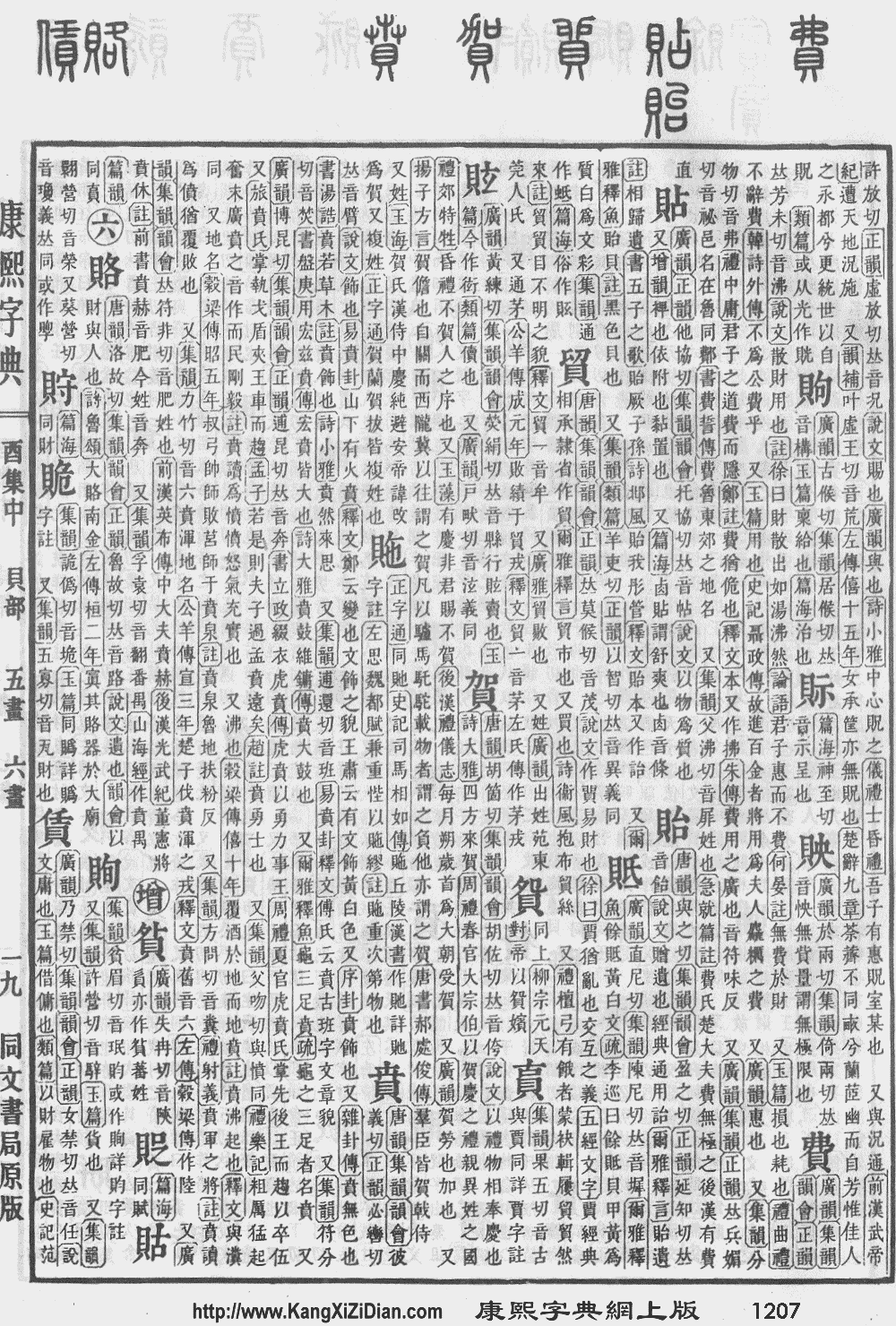
賁

See also: 贲
賁 U+8CC1, 賁
CJK UNIFIED IDEOGRAPH-8CC1
← 賀
[U+8CC0]
CJK Unified Ideographs 賂 →
[U+8CC2]
賁 U+2F9D5, 賁
CJK COMPATIBILITY IDEOGRAPH-2F9D5
← 貫
[U+2F9D4]
CJK Compatibility Ideographs Supplement 贛 →
[U+2F9D6]

Translingual

Han character

賁 (Kangxi radical 154, 貝+5, 12 strokes, cangjie input 十廿月金 (JTBC), four-corner 40806, composition ⿱卉貝)

Derived characters

References

Chinese

Glyph origin

Historical forms of the character 賁
Warring States Shuowen Jiezi (compiled in Han) Liushutong (compiled in Ming)
Chu slip and silk script Small seal script Transcribed ancient scripts

Phono-semantic compound (形聲/形声, OC *prals, *bɯl, *pɯːn, *bɯn) : phonetic 卉 (OC *hmɯlʔ, *hmɯls) + semantic 貝 (“cowry”) for the reading bì (*prals). The character was borrowed for the word 奔 (OC *pɯːn, *pɯːns) in ancient times, hence its reading bēn (*pɯːn).

Etymology 1

trad. 賁
simp. 贲

Pronunciation


Rime
Character 賁
Reading # 4/4
Initial (聲) 幫 (1)
Final (韻) 支 (13)
Tone (調) Departing (H)
Openness (開合) Open
Division (等) III
Fanqie 彼義切
Baxter pjeH
Reconstructions
Zhengzhang
Shangfang
/pˠiᴇH/
Pan
Wuyun
/pᵚiɛH/
Shao
Rongfen
/piɛH/
Edwin
Pulleyblank
/pjiə̆H/
Li
Rong
/pjeH/
Wang
Li
/pǐeH/
Bernard
Karlgren
/pie̯H/
Expected
Mandarin
Reflex
bì
Expected
Cantonese
Reflex
bei3
Baxter–Sagart system 1.1 (2014)
Character 賁
Reading # 2/3
Modern
Beijing
(Pinyin)
bì
Middle
Chinese
‹ pjeH ›
Old
Chinese
/*por-s/
English ornate (name of a hexagram)

Notes for Old Chinese notations in the Baxter–Sagart system:

* Parentheses "()" indicate uncertain presence;
* Square brackets "[]" indicate uncertain identity, e.g. *[t] as coda may in fact be *-t or *-p;
* Angle brackets "<>" indicate infix;
* Hyphen "-" indicates morpheme boundary;

* Period "." indicates syllable boundary.
Zhengzhang system (2003)
Character 賁
Reading # 1/4
No. 433
Phonetic
component
奔
Rime
group
歌
Rime
subdivision
1
Corresponding
MC rime
賁
Old
Chinese
/*prals/

Definitions

賁

  1. to adorn oneself (with jewellery)
    See also: 賁如, 賁然
  2. to honor with one's presence
    See also: 賁臨
  3. 22nd hexagram of the I Ching

Compounds

  • 賁如/贲如
  • 賁然/贲然
  • 賁臨/贲临 (bìlín)
  • 賁飾/贲饰

Etymology 2

trad. 賁
simp. 贲

Pronunciation


Rime
Character 賁
Reading # 3/4
Initial (聲) 幫 (1)
Final (韻) 魂 (55)
Tone (調) Level (Ø)
Openness (開合) Closed
Division (等) I
Fanqie 博昆切
Baxter pwon
Reconstructions
Zhengzhang
Shangfang
/puən/
Pan
Wuyun
/puon/
Shao
Rongfen
/puən/
Edwin
Pulleyblank
/pwən/
Li
Rong
/puən/
Wang
Li
/puən/
Bernard
Karlgren
/puən/
Expected
Mandarin
Reflex
bēn
Expected
Cantonese
Reflex
bun1
Baxter–Sagart system 1.1 (2014)
Character 賁
Reading # 1/3
Modern
Beijing
(Pinyin)
bēn
Middle
Chinese
‹ pwon ›
Old
Chinese
/*pˁur/
English ardent, brave

Notes for Old Chinese notations in the Baxter–Sagart system:

* Parentheses "()" indicate uncertain presence;
* Square brackets "[]" indicate uncertain identity, e.g. *[t] as coda may in fact be *-t or *-p;
* Angle brackets "<>" indicate infix;
* Hyphen "-" indicates morpheme boundary;

* Period "." indicates syllable boundary.
Zhengzhang system (2003)
Character 賁
Reading # 3/4
No. 442
Phonetic
component
奔
Rime
group
文
Rime
subdivision
1
Corresponding
MC rime
奔
Old
Chinese
/*pɯːn/

Definitions

賁

  1. brave, energetic, forge ahead (same as 奔)
  2. cardia
    See also: 賁門

Compounds

Etymology 3

trad. 賁
simp. 贲

Pronunciation


Rime
Character 賁
Reading # 2/4
Initial (聲) 並 (3)
Final (韻) 文 (59)
Tone (調) Level (Ø)
Openness (開合) Closed
Division (等) III
Fanqie 符分切
Baxter bjun
Reconstructions
Zhengzhang
Shangfang
/bɨun/
Pan
Wuyun
/biun/
Shao
Rongfen
/biuən/
Edwin
Pulleyblank
/bun/
Li
Rong
/biuən/
Wang
Li
/bĭuən/
Bernard
Karlgren
/bʱi̯uən/
Expected
Mandarin
Reflex
fén
Expected
Cantonese
Reflex
fan4
Baxter–Sagart system 1.1 (2014)
Character 賁
Reading # 3/3
Modern
Beijing
(Pinyin)
fén
Middle
Chinese
‹ bjun ›
Old
Chinese
/*[b]ur/
English great, big

Notes for Old Chinese notations in the Baxter–Sagart system:

* Parentheses "()" indicate uncertain presence;
* Square brackets "[]" indicate uncertain identity, e.g. *[t] as coda may in fact be *-t or *-p;
* Angle brackets "<>" indicate infix;
* Hyphen "-" indicates morpheme boundary;

* Period "." indicates syllable boundary.
Zhengzhang system (2003)
Character 賁
Reading # 4/4
No. 461
Phonetic
component
奔
Rime
group
文
Rime
subdivision
1
Corresponding
MC rime
汾
Old
Chinese
/*bɯn/

Definitions

賁

  1. three-legged tortoise
  2. Used in 賁鼓/贲鼓 (“large drum”).

Compounds

  • 賁鼓/贲鼓

Etymology 4

trad. 賁
simp. 贲

Pronunciation


Note: Bēn - modern pronunciation.

Rime
Character 賁
Reading # 1/4
Initial (聲) 並 (3)
Final (韻) 微 (21)
Tone (調) Level (Ø)
Openness (開合) Closed
Division (等) III
Fanqie 符非切
Baxter bj+j
Reconstructions
Zhengzhang
Shangfang
/bʉi/
Pan
Wuyun
/bʷɨi/
Shao
Rongfen
/biuəi/
Edwin
Pulleyblank
/buj/
Li
Rong
/biuəi/
Wang
Li
/bĭwəi/
Bernard
Karlgren
/bʱwe̯i/
Expected
Mandarin
Reflex
féi
Expected
Cantonese
Reflex
fei4
Baxter–Sagart system 1.1 (2014)
Character 賁
Reading # 2/3
Modern
Beijing
(Pinyin)
bì
Middle
Chinese
‹ pjeH ›
Old
Chinese
/*por-s/
English ornate (name of a hexagram)

Notes for Old Chinese notations in the Baxter–Sagart system:

* Parentheses "()" indicate uncertain presence;
* Square brackets "[]" indicate uncertain identity, e.g. *[t] as coda may in fact be *-t or *-p;
* Angle brackets "<>" indicate infix;
* Hyphen "-" indicates morpheme boundary;

* Period "." indicates syllable boundary.
Zhengzhang system (2003)
Character 賁
Reading # 2/4
No. 435
Phonetic
component
奔
Rime
group
微
Rime
subdivision
1
Corresponding
MC rime
肥
Old
Chinese
/*bɯl/

Definitions

賁

  1. a surname.

Etymology 5

trad. 賁
simp. 贲

Pronunciation


Definitions

賁

  1. Only used in 賁渾/贲浑.

Etymology 6

trad. 賁
simp. 贲

Pronunciation


Definitions

賁

  1. Only used in 賁禺/贲禺.

Etymology 7

trad. 賁
simp. 贲

Pronunciation


Definitions

賁

  1. Alternative form of 墳/坟
  2. Alternative form of 忿 (fèn)

Etymology 8

trad. 賁
simp. 贲

Pronunciation


Definitions

賁

  1. Alternative form of 僨/偾 (fèn)
  2. Alternative form of 奮/奋 (fèn)

Etymology 9

For pronunciation and definitions of 賁 – see 斑 (“spot; stripe; spotted; striped; mottled; etc.”).
(This character is a variant form of 斑).

Etymology 10

trad. 賁
simp. 贲

Pronunciation


Definitions

賁

  1. (Hakka) Alternative form of 笨 (“thick”)

Japanese

Kanji

賁

(uncommon “Hyōgai” kanji)

  1. to decorate

Readings

Korean

Hanja

賁 (eumhun 클 분 (keul bun))

  1. This term needs a translation to English. Please help out and add a translation, then remove the text {{rfdef}}.

Hanja

賁 (eumhun 꾸밀 비 (kkumil bi))

  1. This term needs a translation to English. Please help out and add a translation, then remove the text {{rfdef}}.

Vietnamese

Han character

賁: Hán Nôm readings: bí, bôn

  1. This term needs a translation to English. Please help out and add a translation, then remove the text {{rfdef}}.
This article is issued from Wiktionary. The text is licensed under Creative Commons - Attribution - Sharealike. Additional terms may apply for the media files.