昆
| ||||||||
Translingual
Han character
昆 (Kangxi radical 72, 日+4, 8 strokes, cangjie input 日心心 (APP), four-corner 60711, composition ⿱日比)
References
- Kangxi Dictionary: page 490, character 39
- Dai Kanwa Jiten: character 13792
- Dae Jaweon: page 852, character 9
- Hanyu Da Zidian (first edition): volume 2, page 1489, character 9
- Unihan data for U+6606
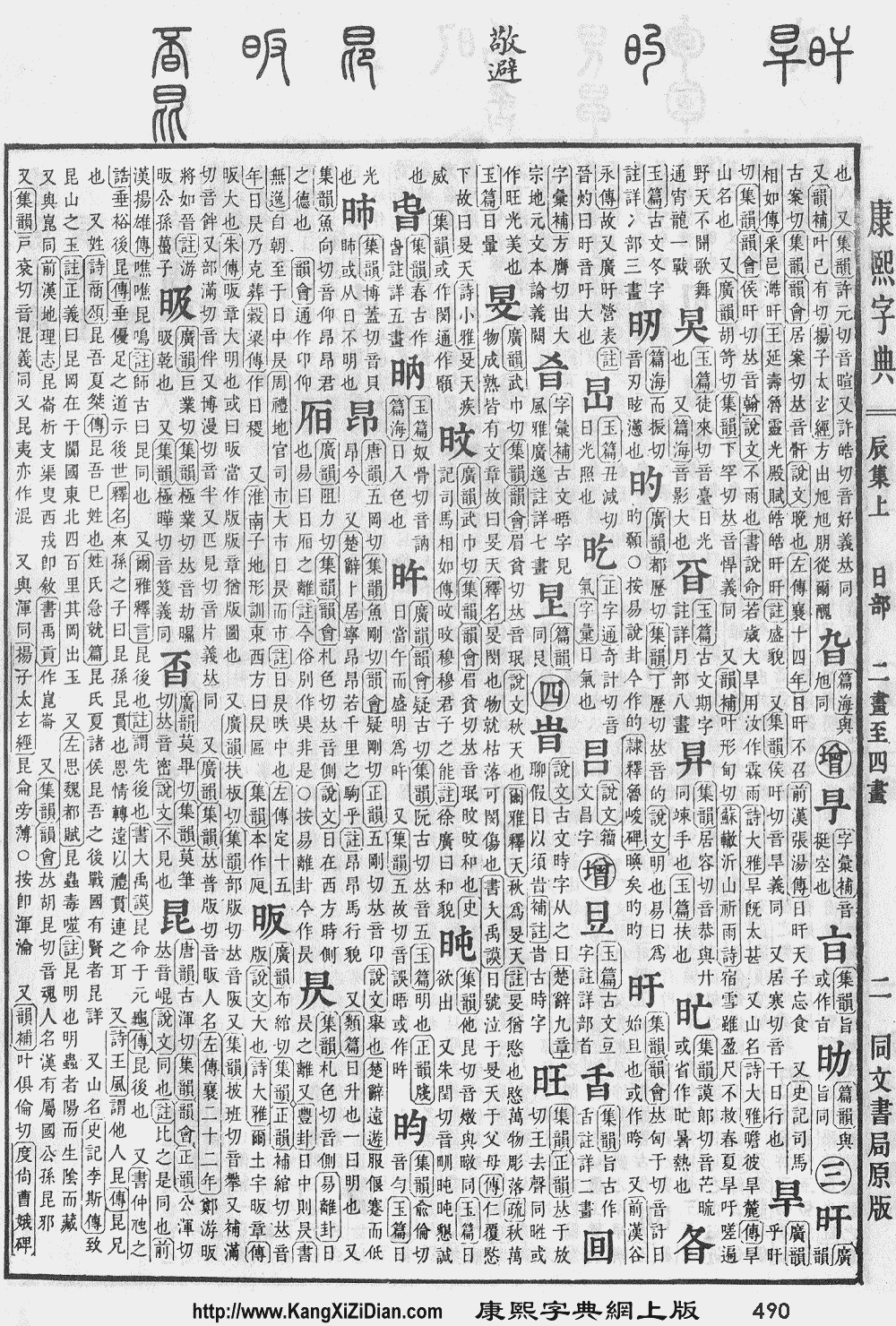
Chinese
| trad. | 昆 | |
|---|---|---|
| simp. # | 昆 | |
| alternative forms | 晜 𥊽 㒭 𣋥 𧲟 | |
Glyph origin
| Historical forms of the character 昆 | ||
|---|---|---|
| Western Zhou | Shuowen Jiezi (compiled in Han) | Liushutong (compiled in Ming) |
| Bronze inscriptions | Small seal script | Transcribed ancient scripts |
 |
 |
 |
Characters in the same phonetic series (昆) (Zhengzhang, 2003)
Pictogram (象形) – the body and legs of an insect.
Etymology 1
| trad. | 昆 | |
|---|---|---|
| simp. # | 昆 | |
| alternative forms | 蜫 䖵 | |
- “elder brother”
- From Proto-Sino-Tibetan *(g/k)əw-n (“elder brother; senior male relative”); cognate with 舅 (OC *ɡuʔ, “maternal uncle”) (Benedict, 1972; STEDT).
- Alternatively, it may be related to Middle Mon ကော (kao, “elder brother”), with nominal suffix -n added (Schuessler, 2007).
- “descendants; later”
- Perhaps from Proto-Mon-Khmer *kuun (“child”); cognate with Min 囝 (“son; child”) (Schuessler, 2007) and with ancient Chu dialect 觀 (OC *koːn, “child; offspring”) (Ye, 2014); cf. also some rear meanings of the characters 丱 (OC *kroːns, “young child”), 鯤 (OC *kuːn, “roe; fish egg”) and 鰥 (OC *kruːn, “roe”) (ibid.). In modern Wu dialects the character 官 (OC *koːn) is used to mean "children" (ibid.).
- “many; numerous”
- From Proto-Sino-Tibetan *m-kul (“twenty; all”); cognate with 群 (OC *ɡlun, “herd; all”) (Schuessler, 2007; STEDT).
- “quetta-”
- Phono-semantic matching of English quetta-. Coined by the China National Committee for Terminology in Science and Technology and the State Administration for Market Regulation on World Metrology Day in 2023 (20 May 2023).
昆 is pronounced with aspirated initial /kʰ/ instead of the expected /k/ in the majority of modern varieties of Chinese. The /k/ sound in 昆 (MC kwon) was changed to /kʰ/ during its historical development to avoid homophony with 褌 (MC kwon, “underclothing”), a word that was historically in vernacular use (Hirayama, 2005).
This etymology is incomplete. You can help Wiktionary by elaborating on the origins of this term.
Pronunciation
Definitions
昆
- (obsolete) together
- (literary) elder brother
- 終遠兄弟,謂他人昆。謂他人昆,亦莫我聞。 [Pre-Classical Chinese, trad.]
- From: The Classic of Poetry, c. 11th – 7th centuries BCE, translated based on James Legge's version
- Zhōng yuàn xiōngdì, wèi tārén kūn. Wèi tārén kūn, yì mò wǒ wén. [Pinyin]
- For ever separated from my brothers,
I call a stranger elder-brother.
I call a stranger elder-brother,
But he will not listen to me.
终远兄弟,谓他人昆。谓他人昆,亦莫我闻。 [Pre-Classical Chinese, simp.]
- (literary) descendants
- (obsolete) later
- (obsolete) many; numerous
- (obsolete) Alternative form of 焜 (kūn)
- Short for 昆明 (Kūnmíng).
- 成昆鐵路/成昆铁路 ― Chéng Kūn Tiělù ― Chengdu–Kunming railway
- a surname
- (Mainland China) quetta- (SI unit prefix)
- Synonym: 奎 (kuí) (Taiwan)
Compounds
Pronunciation
Pronunciation
Pronunciation
Etymology 5
| For pronunciation and definitions of 昆 – see 崑. (This character is the simplified and variant traditional form of 崑). |
Notes:
|
References
- 李學勤,2012《字源》,天津:天津古籍出版社,2013年7月2次印刷
- “昆”, in 漢語多功能字庫 (Multi-function Chinese Character Database), 香港中文大學 (the Chinese University of Hong Kong), 2014–
Japanese
Kanji
昆
- A swarm of or an organism that swarms (e.g. bugs), an organism that forms in large groups (e.g. kombu)
- elder brother
- descendants, great-great-great-great grandchild
Readings
Korean
Etymology
From Middle Chinese 昆 (MC kwon). Recorded as Middle Korean 곤 (kwon) (Yale: kwon) in Hunmong Jahoe (訓蒙字會 / 훈몽자회), 1527.
See also
Vietnamese
This article is issued from Wiktionary. The text is licensed under Creative Commons - Attribution - Sharealike. Additional terms may apply for the media files.