安
| ||||||||
Translingual
| Stroke order | |||
|---|---|---|---|
 | |||
| Stroke order | |||
|---|---|---|---|
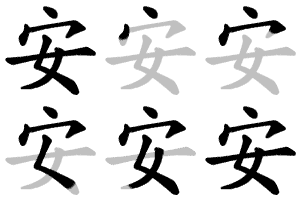 | |||
Han character
安 (Kangxi radical 40, 宀+3, 6 strokes, cangjie input 十女 (JV), four-corner 30404, composition ⿱宀女)
Derived characters
Descendants
- あ (Hiragana character derived from man'yōgana)
References
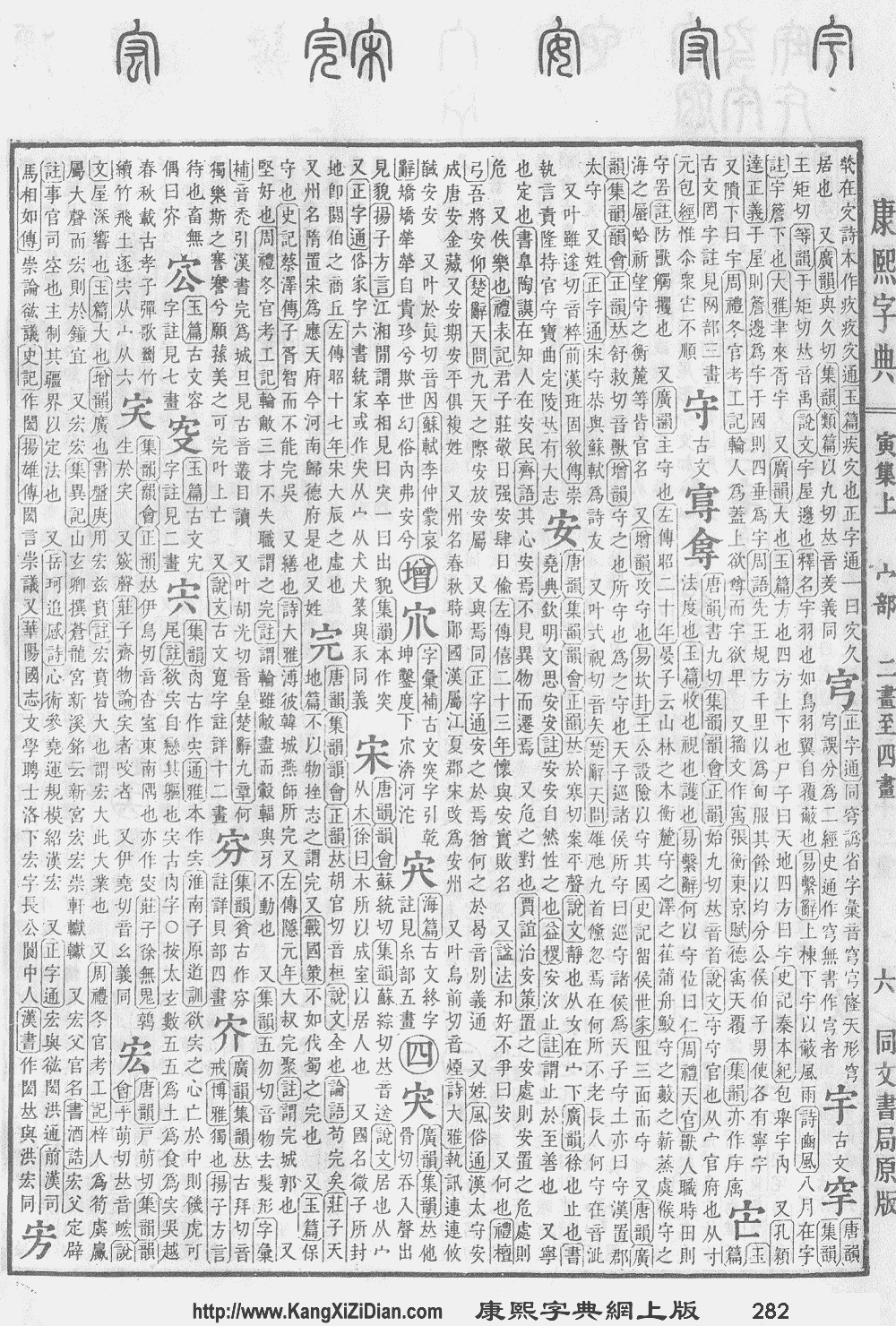
- Kangxi Dictionary: page 282, character 8
- Dai Kanwa Jiten: character 7072
- Dae Jaweon: page 552, character 5
- Hanyu Da Zidian (first edition): volume 2, page 913, character 9
- Unihan data for U+5B89
Chinese
| trad. | 安 | |
|---|---|---|
| simp. # | 安 | |
| alternative forms | 侒 𠕷 𭑨 𡚴 | |
Glyph origin
| Historical forms of the character 安 | |||
|---|---|---|---|
| Shang | Western Zhou | Shuowen Jiezi (compiled in Han) | Liushutong (compiled in Ming) |
| Oracle bone script | Bronze inscriptions | Small seal script | Transcribed ancient scripts |
 |
 |
 |
 |
Characters in the same phonetic series (安) (Zhengzhang, 2003)
Ideogrammic compound (會意/会意) : 宀 (“house”) + 女 (“a woman or a kneeling person”) – person in a kneeling position sitting on the heels at home.
Etymology
- calm; peaceful
- A parallel stem is 宴 (OC *qeːns, “to be at ease; to rest”) (Wang, 1982; Schuessler, 2007).
- Cognate with 按 (OC *qaːns, “to push down with hand”), an exoactive derivative, literally “to cause to be settled; calmed” (ibid.).
- Starostin reconstructs Proto-Sino-Tibetan *ʔɨāɫ (“rest”), comparing it to Mizo âwl (“to rest”) (and also noting Dhimal [script needed] (el-ka, “good”)). STEDT, however, traces the Mizo word to Proto-Sino-Tibetan *s-grwal ~ *ʔwal (“finish, loose, relax”) and did not list 安 (OC *qaːn) among its comparanda: namely 完 (OC *ɦŋoːn), 緩 (OC *ɢʷaːnʔ), 諼 (OC *qʰʷan, *qʰʷanʔ), 援 (OC *ɢʷans, *ɢʷan).
Pronunciation
Definitions
安
- calm; peaceful; tranquil; quiet
- comfortable; at ease
- 安逸 ― ānyì ― easy and comfortable
- 君子食無求飽,居無求安。 [Classical Chinese, trad.]
- From: The Analects of Confucius, c. 475 – 221 BCE, translated based on James Legge's version
- Jūnzǐ shí wú qiú bǎo, jū wú qiú ān. [Pinyin]
- He who aims to be a man of complete virtue in his food does not seek to gratify his appetite, nor in his dwelling place does he seek the appliances of ease.
君子食无求饱,居无求安。 [Classical Chinese, simp.]
- safe; secure
- 是故君子安而不忘危,存而不忘亡,治而不忘亂;是以身安而國家可保也。 [Pre-Classical Chinese, trad.]
- From: I Ching, 11th – 8th century BCE
- Shìgù jūnzǐ ān ér bù wàng wēi, cún ér bù wàng wáng, zhì ér bù wàng luàn; shìyǐ shēn ān ér guójiā kě bǎo yě. [Pinyin]
- Therefore the superior man, when resting in safety, does not forget that danger may come; when in a state of security, he does not forget the possibility of ruin; and when all is in a state of order, he does not forget that disorder may come. Thus his person is kept safe, and his states and all their clans can be preserved.
是故君子安而不忘危,存而不忘亡,治而不忘乱;是以身安而国家可保也。 [Pre-Classical Chinese, simp.]
- to calm; to pacify
- to feel satisfied with
- to find a place for; to plant
- to fit; to install
- to cherish; to harbour
- to confer (a title); to bestow; to put (the blame on someone)
- (Cantonese) ounce
- (literary) where
- 沛公安在? [Classical Chinese, trad. and simp.]
- From: The Records of the Grand Historian, by Sima Qian, c. 91 BCE
- Pèigōng ān zài? [Pinyin]
- Where is Pei Gong (Liu Bang)?
- (literary) how; why
- 雄兔腳撲朔,雌兔眼迷離。兩兔傍地走,安能辨我是雄雌? [Classical Chinese, trad.]
- From: 《木蘭詩》; translation by Jack Yuan
- Xióng tù jiǎo pūshuò, cí tù yǎn mílí. Liǎng tù bàng dì zǒu, ān néng biàn wǒ shì xióng cí? [Pinyin]
- The buck bounds here and there, whilst the doe has narrow eyes. But when the two rabbits run side by side, how can you tell the female from the male?
雄兔脚扑朔,雌兔眼迷离。两兔傍地走,安能辨我是雄雌? [Classical Chinese, simp.]
- (physics) Short for 安培 (ānpéi, “ampere”).
- Short for 安非他命 (ānfēitāmìng, “amphetamine”).
- 吸安 ― xī'ān ― to use amphetamine (illegally)
- a surname
- Short for 安那其主義/安那其主义 (ānnàqí zhǔyì, “anarchism”).
Synonyms
- (ounce):
Compounds
- 一路平安 (yīlùpíng'ān)
- 上下相安
- 不安 (bù'ān)
- 不安其室
- 不安分
- 不安席
- 不安於位/不安于位
- 不安於室/不安于室
- 不安本分
- 不安生
- 不得安穩/不得安稳
- 不得安身
- 乂安 (yì'ān)
- 久安長治/久安长治 (jiǔ'ānchángzhì)
- 交通安全
- 人不自安
- 佈陣安營/布阵安营
- 侷促不安
- 保國安民/保国安民
- 保安 (bǎo'ān)
- 便安 (biàn'ān)
- 保安族 (Bǎo'ānzú)
- 保安林
- 保安處分/保安处分
- 保安警察
- 偏安 (piān'ān)
- 偷安 (tōu'ān)
- 備安庫/备安库
- 入土為安/入土为安 (rùtǔwéi'ān)
- 內興安嶺/内兴安岭
- 公共安全
- 六安
- 公安 (gōng'ān)
- 公安局 (gōng'ānjú)
- 六安茶
- 公安體/公安体
- 六畜不安
- 六神不安
- 冒露安身
- 動盪不安/动荡不安
- 南安 (Nán'ān)
- 印第安人 (yìndì'ānrén)
- 去危就安
- 同安 (Tóng'ān)
- 吉安 (Jí'ān)
- 吉安鄉/吉安乡
- 呂安題鳳/吕安题凤
- 咸安 (Xián'ān)
- 問安/问安 (wèn'ān)
- 問安視膳/问安视膳
- 國安局/国安局
- 國安法/国安法 (guó'ānfǎ)
- 國泰民安/国泰民安 (guótàimín'ān)
- 坐不安席 (zuò bù ān xí)
- 坐立不安 (zuòlìbù'ān)
- 坐臥不安/坐卧不安
- 報任安書/报任安书
- 報竹平安/报竹平安
- 大不安
- 大安 (dà'ān)
- 大安溪
- 大槐安國/大槐安国
- 大興安嶺/大兴安岭 (Dàxīng'ānlǐng)
- 太安 (Tài'ān)
- 天安門/天安门 (Tiān'ānmén)
- 奉安 (fèng'ān)
- 奠安
- 妨害治安
- 安下 (ānxià)
- 安上
- 安不上
- 安不忘危 (ānbùwàngwēi)
- 安之若命
- 安之若素 (ānzhīruòsù)
- 安享 (ānxiǎng)
- 安享天年
- 安享餘年/安享余年
- 安人
- 安仁鬢秋/安仁鬓秋
- 安伏
- 安住 (ānzhù)
- 安佚
- 安克拉治 (Ānkèlāzhì)
- 安內/安内
- 安內攘外/安内攘外
- 安全 (ānquán)
- 安全係數/安全系数 (ānquán xìshù)
- 安全刀片
- 安全剃刀 (ānquán tìdāo)
- 安全島/安全岛 (ānquándǎo)
- 安全帶/安全带 (ānquándài)
- 安全帽 (ānquánmào)
- 安全感 (ānquángǎn)
- 安全期
- 安全梯
- 安全氣囊/安全气囊 (ānquán qìnáng)
- 安全火柴 (ānquán huǒchái)
- 安全燈/安全灯 (ānquándēng)
- 安全率
- 安全玻璃
- 安全理事會/安全理事会 (Ānquán Lǐshìhuì)
- 安全距離/安全距离
- 安全速度
- 安全門/安全门 (ānquánmén)
- 安全閥/安全阀 (ānquánfá)
- 安全電壓/安全电压 (ānquán diànyā)
- 安全電流/安全电流
- 安公子
- 安凱/安凯 (Ānkǎi)
- 安分 (ānfèn)
- 安分守己 (ānfènshǒujǐ)
- 安分守紀/安分守纪
- 安南 (Ānnán)
- 安南子
- 安南山脈/安南山脉
- 安卡拉 (Ānkǎlā)
- 安危 (ānwēi)
- 安厝 (āncuò)
- 安可 (ānkě)
- 安史之亂/安史之乱 (Ān Shǐ Zhī Luàn)
- 安和
- 安咐
- 安命 (ānmìng)
- 安和樂利/安和乐利
- 安哥拉 (Āngēlā)
- 安哥拉兔 (āngēlā tù)
- 安固
- 安土
- 安土樂業/安土乐业
- 安土重遷/安土重迁 (āntǔzhòngqiān)
- 安在 (ānzài)
- 安坐 (ānzuò)
- 安坐待斃/安坐待毙
- 安坪 (Ānpíng)
- 安培 (ānpéi)
- 安培定則/安培定则
- 安培小時/安培小时
- 安培計/安培计 (ānpéijì)
- 安堵 (āndǔ)
- 安堵如故
- 安堵樂業/安堵乐业
- 安大略湖 (Āndàlüè Hú)
- 安太歲/安太岁
- 安好 (ānhǎo)
- 安如泰山 (ānrútàishān)
- 安如盤石/安如盘石
- 安如磐石 (ānrúpánshí)
- 安妥 (āntuǒ)
- 安存
- 安宅
- 安守本分
- 安宅正路
- 安安穩穩/安安稳稳
- 安安靜靜/安安静静
- 安定 (āndìng)
- 安定器
- 安定均衡
- 安定學派/安定学派
- 安定翼
- 安家 (ānjiā)
- 安家帖
- 安家樂業/安家乐业
- 安家立業/安家立业 (ānjiālìyè)
- 安家落戶/安家落户 (ānjiāluòhù)
- 安家費/安家费
- 安宿
- 安富
- 安富尊榮/安富尊荣
- 安富恤窮/安富恤穷
- 安富恤貧/安富恤贫
- 安寢/安寝 (ānqǐn)
- 安寧/安宁 (ānníng)
- 安寧照顧/安宁照顾
- 安居 (ānjū)
- 安居工程
- 安居樂業/安居乐业 (ānjūlèyè)
- 安山岩 (ānshānyán)
- 安帖 (āntiē)
- 安席
- 安常履順/安常履顺
- 安常處順/安常处顺
- 安平 (ānpíng)
- 安平古堡
- 安平港
- 安床
- 安度 (āndù)
- 安座
- 安康 (ānkāng)
- 安康計畫/安康计画
- 安廣/安广 (ānguǎng)
- 安得 (āndé)
- 安德魯/安德鲁 (Āndélǔ)
- 安徽 (Ānhuī)
- 安心 (ānxīn)
- 安心落意
- 安必思危
- 安恬 (āntián)
- 安息 (ānxī)
- 安息年
- 安息日 (ānxīrì)
- 安息香 (ānxīxiāng)
- 安息香樹/安息香树
- 安息香酸 (ānxīxiāngsuān)
- 安慰 (ānwèi)
- 安扎
- 安打 (āndǎ)
- 安拉 (Ānlā)
- 安抵 (āndǐ)
- 安排 (ānpái)
- 安插 (ānchā)
- 安提瓜和巴布達/安提瓜和巴布达 (Āntíguā hé Bābùdá)
- 安提阿
- 安撫/安抚 (ānfǔ)
- 安放 (ānfàng)
- 安於/安于 (ānyú)
- 安於一隅/安于一隅
- 安於泰山/安于泰山
- 安於現狀/安于现状 (ānyúxiànzhuàng)
- 安普
- 安曼 (Ānmàn)
- 安村 (Āncūn)
- 安枕 (ānzhěn)
- 安枕無憂/安枕无忧
- 安枕而臥/安枕而卧
- 安根子
- 安業/安业
- 安樂/安乐 (ānlè)
- 安樂世界/安乐世界
- 安樂國/安乐国
- 安樂椅/安乐椅 (ānlèyǐ)
- 安樂死/安乐死 (ānlèsǐ)
- 安樂窩/安乐窝 (ānlèwō)
- 安歇 (ānxiē)
- 安步 (ānbù)
- 安步當車/安步当车
- 安死
- 安民 (ānmín)
- 安民告示 (ānmín gàoshì)
- 安民恤眾/安民恤众 (ānmínxùzhòng)
- 安汶島/安汶岛
- 安泊
- 安泰 (āntài)
- 安濟坊/安济坊
- 安瀋鐵路/安沈铁路
- 安瀾/安澜 (ānlán)
- 安然 (ānrán)
- 安然無事/安然无事
- 安然無恙/安然无恙 (ānránwúyàng)
- 安營/安营 (ānyíng)
- 安營下寨/安营下寨 (ānyíngxiàzhài)
- 安營扎寨
- 安營紮寨/安营扎寨
- 安理會/安理会 (Ānlǐhuì)
- 安琪兒/安琪儿 (ānqí'ér)
- 安生 (ānshēng)
- 安眉帶眼/安眉带眼
- 安眠 (ānmián)
- 安眠藥/安眠药 (ānmiányào)
- 安睡 (ānshuì)
- 安知
- 安石榴 (ānshíliú)
- 安碓磑/安碓硙
- 安神 (ānshén)
- 安福寺 (Ānfúsì)
- 安禪/安禅
- 安穩/安稳 (ānwěn)
- 安童
- 安置 (ānzhì)
- 安老懷少/安老怀少
- 安老院 (ānlǎoyuàn)
- 安聲/安声
- 安胡
- 安胎符
- 安胎藥/安胎药
- 安能 (ānnéng)
- 安舒
- 安良
- 安若泰山
- 安著
- 安葬 (ānzàng)
- 安處/安处
- 安裝/安装 (ānzhuāng)
- 安親班/安亲班 (ānqīnbān)
- 安設/安设 (ānshè)
- 安詳/安详 (ānxiáng)
- 安謐/安谧 (ānmì)
- 安貧/安贫
- 安貧守道/安贫守道
- 安貧樂賤/安贫乐贱
- 安貧樂道/安贫乐道 (ānpínlèdào)
- 安足
- 安跡/安迹
- 安身 (ānshēn)
- 安身之地
- 安身之所
- 安身之處/安身之处
- 安身樂業/安身乐业
- 安身立命 (ānshēnlìmìng)
- 安車/安车 (ānchē)
- 安輯/安辑 (ānjí)
- 安輿/安舆
- 安辦/安办
- 安迪爾/安迪尔 (Āndí'ěr)
- 安逸 (ānyì)
- 守道安貧/守道安贫
- 安道爾/安道尔 (Āndào'ěr)
- 安適/安适 (ānshì)
- 安適如常/安适如常
- 安邊/安边
- 安邦 (ānbāng)
- 安那其主義/安那其主义 (ānnàqí zhǔyì)
- 安邦定國/安邦定国 (ānbāngdìngguó)
- 安邦治國/安邦治国
- 安釘子/安钉子
- 安門/安门
- 安閒/安闲 (ānxián)
- 安闍那/安阇那
- 安陵 (Ānlíng)
- 安陸/安陆 (Ānlù)
- 安陽/安阳 (Ānyáng)
- 安陽河/安阳河
- 安雅
- 安集
- 安難/安难
- 安靈/安灵
- 安靖 (ānjìng)
- 安靜/安静 (ānjìng)
- 安靜自在/安静自在
- 安非他命 (ānfēitāmìng)
- 安頓/安顿 (āndùn)
- 安養/安养 (ānyǎng)
- 安香
- 安骨
- 安魂曲 (ānhúnqǔ)
- 定安 (Dìng'ān)
- 宴安
- 宴安鴆毒/宴安鸩毒
- 富國安民/富国安民
- 寢不安席/寝不安席
- 寢不遑安/寝不遑安
- 寢食不安/寝食不安 (qǐnshíbù'ān)
- 寢食難安/寝食难安 (qǐnshínán'ān)
- 小興安嶺/小兴安岭 (Xiǎoxīng'ānlǐng)
- 少安勿躁 (shǎo'ān wùzào)
- 少安毋躁
- 少安無躁/少安无躁
- 局促不安
- 局蹐不安
- 居安思危 (jū'ānsīwēi)
- 居安慮危/居安虑危
- 居安資深/居安资深
- 居無求安/居无求安
- 帶眼安眉/带眼安眉
- 平安 (píng'ān)
- 平安夜 (píng'ānyè)
- 平安帖
- 平安火
- 平安無事/平安无事 (píng'ānwúshì)
- 平安竹報/平安竹报
- 平安險/平安险
- 平平安安
- 床上安床 (chuángshàng'ānchuáng)
- 床下安床 (chuángxià'ānchuáng)
- 建安 (Jiàn'ān)
- 建安七子
- 建安文學/建安文学
- 建安風骨/建安风骨
- 建安體/建安体
- 弭盜安民/弭盗安民
- 心安 (xīn'ān)
- 心安理得 (xīn'ānlǐdé)
- 心安神泰
- 忐忑不安 (tǎntèbù'ān)
- 怔忡不安
- 怏怏不安
- 恐懼不安/恐惧不安 (kǒngjùbù'ān)
- 惶恐不安 (huángkǒngbù'ān)
- 惶悚不安
- 惴惴不安
- 惶惶不安 (huánghuángbù'ān)
- 慈安太后
- 慰安 (wèi'ān)
- 慰安婦/慰安妇 (wèi'ānfù)
- 懷安/怀安 (Huái'ān)
- 打火安身
- 招安 (zhāo'ān)
- 捨安就危/舍安就危
- 損人安己/损人安己
- 撫安/抚安
- 擲果潘安/掷果潘安
- 攘外安內/攘外安内 (rángwài'ānnèi)
- 教安
- 新安派
- 於心不安/于心不安
- 早安 (zǎo'ān)
- 晚安 (wǎn'ān)
- 望安 (Wàng'ān)
- 朱理安曆/朱理安历
- 松安 (Sōng'ān)
- 東安/东安 (Dōng'ān)
- 柳安 (liǔ'ān)
- 栗栗不安
- 槐安國/槐安国
- 樂天安命/乐天安命
- 樂業安居/乐业安居
- 樂道安貧/乐道安贫
- 欠安 (qiàn'ān)
- 武安 (Wǔ'ān)
- 歲歲平安/岁岁平安
- 毫安 (háo'ān)
- 民不安枕
- 民安 (Mín'ān)
- 民安國泰/民安国泰
- 民安物阜
- 永安 (Yǒng'ān)
- 永安宮/永安宫 (Yǒng'āngōng)
- 治國安民/治国安民
- 泰安 (Tài'ān)
- 治安 (zhì'ān)
- 治安機關/治安机关
- 治安法庭
- 治安策
- 泰山之安
- 海安 (Hǎi'ān)
- 海安集 (Hǎi'ānjí)
- 淮安 (Huái'ān)
- 潘安 (Pān Ān)
- 潘安之貌
- 潘安再世
- 潘安容儀/潘安容仪
- 潘安白髮/潘安白发
- 濟世安人/济世安人
- 濟世安民/济世安民
- 濟世安邦/济世安邦
- 炕上安鍋/炕上安锅
- 燕安
- 燕安鴆毒/燕安鸩毒
- 物阜民安
- 甕安/瓮安 (Wèng'ān)
- 畏難苟安/畏难苟安 (wèinángǒu'ān)
- 盤石之安/盘石之安
- 盧安達/卢安达 (Lú'āndá)
- 相安 (xiāng'ān)
- 相安無事/相安无事 (xiāng'ānwúshì)
- 知命安身
- 知安忘危
- 碇安 (Dìng'ān)
- 社會安全/社会安全
- 神安氣定/神安气定
- 神安氣集/神安气集
- 福安 (Fú'ān)
- 萬安/万安 (wàn'ān)
- 立命安身
- 立國安邦/立国安邦
- 立業安邦/立业安邦
- 立鼎安爐/立鼎安炉
- 竹報平安/竹报平安 (zhúbàopíng'ān)
- 紅安/红安 (Hóng'ān)
- 索米長安/索米长安
- 結夏安居/结夏安居
- 緊張不安/紧张不安
- 翔安 (Xiáng'ān)
- 能忍自安
- 臥不安席/卧不安席
- 臥不安枕/卧不安枕
- 臺安/台安
- 興國安邦/兴国安邦
- 興安嶺/兴安岭 (Xīng'ānlǐng)
- 良心不安
- 艾安
- 苟且偷安
- 苟安 (gǒu'ān)
- 苟安一隅
- 處安思危/处安思危 (chǔ'ānsīwēi)
- 行坐不安 (xíngzuòbù'ān)
- 袁安臥雪/袁安卧雪
- 西安 (Xī'ān)
- 西安事變/西安事变 (Xī'ān Shìbiàn)
- 覆盂之安
- 計將安出/计将安出 (jì jiāng ān chū)
- 討安歇/讨安歇
- 誨安/诲安
- 請安/请安 (qǐng'ān)
- 謝安折屐/谢安折屐
- 變危為安/变危为安
- 貪安好逸/贪安好逸
- 跼蹐不安
- 踧踖不安
- 轉側不安/转侧不安
- 轉危為安/转危为安 (zhuǎnwēiwéi'ān)
- 辛安驛/辛安驿
- 道安
- 遠安/远安 (Yuǎn'ān)
- 鈞安/钧安
- 銀安殿/银安殿
- 錫安/锡安 (xī'ān)
- 錫安主義/锡安主义 (xī'ān-zhǔyì)
- 鎮安/镇安 (Zhèn'ān)
- 長安/长安 (cháng'ān)
- 長安如弈/长安如弈
- 長安道上/长安道上
- 長治久安/长治久安 (chángzhìjiǔ'ān)
- 門裡安心/门里安心
- 阿利安人
- 除暴安良 (chúbào'ānliáng)
- 隨寓而安/随寓而安
- 隨遇而安/随遇而安 (suíyù'ér'ān)
- 雅利安 (yǎlì'ān)
- 雅安 (Yǎ'ān)
- 雄安 (Xióng'ān, “Xiong'an”)
- 集體安全/集体安全
- 靈安社/灵安社
- 靖安
- 頭上安頭/头上安头
- 養心安神/养心安神
- 馬安/马安 (Mǎ'ān)
- 高山安仰
- 高枕安寢/高枕安寝
- 高枕安臥/高枕安卧
- 麾安
- 黛安娜 (Dài'ānnà)
Japanese
Readings
Derived terms
Compounds
- 塩安 (en'an): ammonium chloride
- 硝安 (shōan): ammonium nitrate
- 炭安 (tan'an): ammonium carbonate
- 硫安 (ryūan): ammonium sulphate
- 燐安 (rin'an): ammonium phosphate
- 安易 (an'i)
- 安逸 (an'itsu)
- 安穏 (annon)
- 安危 (anki)
- 安心 (anshin), 安心 (anjin)
- 安息 (ansoku)
- 安泰 (antai)
- 安置 (anchi)
- 安直 (anchoku)
- 安堵 (ando)
- 安寧 (annei)
- 安否 (anpi)
- 安眠 (anmin)
- 安楽 (anraku)
- 安宿 (yasuyado)
Korean
Etymology
(This etymology is missing or incomplete. Please add to it, or discuss it at the Etymology scriptorium. Particularly: “Middle Korean readings, if any”)
Pronunciation
- (SK Standard/Seoul) IPA(key): [a̠n]
- Phonetic hangul: [안]
Tày
Adjective
安 (an; yên)
Classifier
安 (ăn)
Noun
安 (ăn)
Vietnamese
Han character
安: Hán Việt readings: an[1][2][3][4][5], yên[4][5]
安: Nôm readings: yên[1][2][3][6][4][7], an[1][2][4][7], án[1], ăn[1]
Compounds
References
- Nguyễn (2014).
- Nguyễn et al. (2009).
- Trần (2004).
- Bonet (1899).
- Génibrel (1898).
- Hồ (1976).
- Taberd & Pigneau de Béhaine (1838).
Zhuang
References
- 古壮字字典 [Dictionary of Old Zhuang Characters] (in Chinese), Guangxi: Ethnic Publishing House (广西民族出版社), 2012, →ISBN, page 1
This article is issued from Wiktionary. The text is licensed under Creative Commons - Attribution - Sharealike. Additional terms may apply for the media files.