牛
| ||||||||
| ||||||||
Translingual
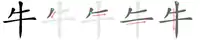
| Stroke order | |||
|---|---|---|---|
 | |||
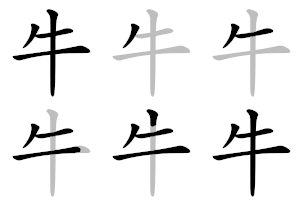
| Stroke order | |||
|---|---|---|---|
 | |||
Alternative forms
Han character
牛 (Kangxi radical 93, 牛+0, 4 strokes, cangjie input 竹手 (HQ), four-corner 25000, composition ⿻𠂉十)
- Kangxi radical #93, ⽜.
- Shuowen Jiezi radical №19
Derived characters
References
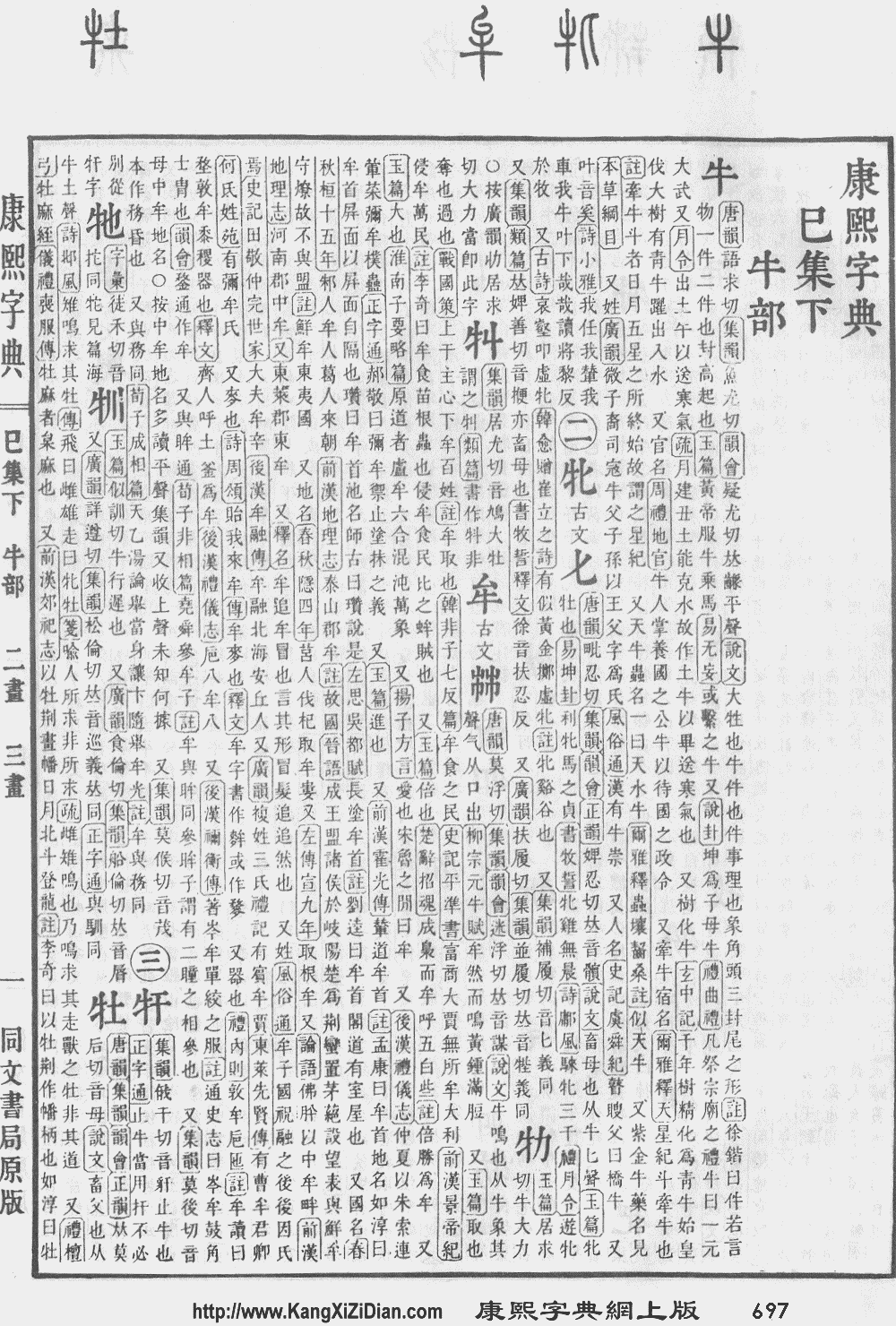
- Kangxi Dictionary: page 697, character 1
- Dai Kanwa Jiten: character 19922
- Dae Jaweon: page 1108, character 16
- Hanyu Da Zidian (first edition): volume 3, page 1800, character 1
- Unihan data for U+725B
Chinese
| simp. and trad. |
牛 | |
|---|---|---|
| alternative forms | 𠂒 | |
Glyph origin
| Historical forms of the character 牛 | ||||
|---|---|---|---|---|
| Shang | Western Zhou | Warring States | Shuowen Jiezi (compiled in Han) | Liushutong (compiled in Ming) |
| Oracle bone script | Bronze inscriptions | Chu slip and silk script | Small seal script | Transcribed ancient scripts |
 |
 |
 |
 |
 |
Pictogram (象形) .
Etymology
From Proto-Sino-Tibetan *ŋwa.
Pronunciation
Definitions
牛
- bovine, e.g. cow, bull, ox, buffalo, bison, yak (Classifier: 頭/头 m c mb md; 條/条 m g h x; 隻/只 m c g mn w x)
- beef
- stubborn; pigheaded
- (colloquial) arrogant
- (Mainland China, Mandarin, slang) awesome; powerful
- (~宿) (Chinese astronomy) Ox (one of Twenty-Eight Mansions)
- (physics) Short for 牛頓/牛顿 (niúdùn, “newton”).
- (Hong Kong Cantonese, computing) Short for 火牛 (“transformer”). (Classifier: 隻/只 c)
- a surname
- 牛僧孺 ― Niú Sēngrú ― Niu Sengru (Tang politician)
Synonyms
Dialectal synonyms of 牛 (“bovine”) [map]
- (beef): 牛肉 (niúròu)
- (awesome):
- 不得了 (bùdéliǎo) (colloquial)
- 了不得 (colloquial)
- 了不起 (liǎobùqǐ) (colloquial)
- 了勿起 (Wu)
- 佼佼 (jiǎojiǎo) (literary)
- 俊偉/俊伟 (jùnwěi) (literary)
- 偉大/伟大 (wěidà)
- 傑出/杰出 (jiéchū)
- 傲人 (àorén) (nowadays especially of breasts, body curve)
- 優異/优异 (yōuyì)
- 優秀/优秀 (yōuxiù)
- 優越/优越 (yōuyuè)
- 出挑 (chhut-thio) (Quanzhou Hokkien)
- 出擢 (Hokkien)
- 出眾/出众 (chūzhòng)
- 出腳/出脚 (Hokkien)
- 出色 (chūsè)
- 勢面/势面 (Hokkien)
- 勿得了 (Wu)
- 卓然 (zhuórán) (literary)
- 卓犖/卓荦 (zhuóluò) (literary)
- 卓異/卓异 (zhuóyì) (literary)
- 卓著 (zhuózhù)
- 卓越 (zhuóyuè)
- 厲害/厉害 (lìhài) (informal)
- 咧斗 (Zhangzhou Hokkien)
- 咧斗 (Zhangzhou Hokkien)
- 好極了/好极了 (hǎo jíle)
- 尤異/尤异 (yóuyì) (literary)
- 崢嶸/峥嵘 (zhēngróng)
- 彰顯/彰显 (zhāngxiǎn)
- 惡實/恶实 (o5 shr6) (Xiang, used as a complement)
- 打得 (Hakka)
- 挺 (tǐng)
- 斐然 (fěirán)
- 棒 (bàng) (colloquial)
- 標青/标青 (biu1 ceng1) (Cantonese, Teochew)
- 漂亮
- 炳 (bǐng) (literary)
- 牛鬼 (Guilin Mandarin)
- 特出 (tèchū)
- 特異/特异 (tèyì)
- 犀利 (xīlì) (originally Cantonese, sometimes Mandarin)
- 皦皦 (jiǎojiǎo) (literary)
- 看家 (kānjiā) (attributive, of skill, ability, etc.)
- 穩/稳 (wěn) (slang, neologism)
- 突出 (tūchū)
- 英英 (yīngyīng) (literary)
- 蓋帽/盖帽 (gàimào) (slang)
- 表表 (biǎobiǎo) (literary)
- 超凡 (chāofán)
- 超卓 (chāozhuó) (literary)
- 超常 (chāocháng)
- 超拔 (chāobá) (literary)
- 超絕/超绝 (chāojué)
- 非凡 (fēifán)
- 響噹噹/响当当 (xiǎngdāngdāng)
- 顯著/显著 (xiǎnzhù)
- 高強/高强 (gāoqiáng)
Dialectal synonyms of 厲害 (“impressive; excellent; amazing; fantastic”) [map]
| Variety | Location | Words |
|---|---|---|
| Mandarin | Beijing | 牛, 牛兒, 牛屄 vulgar |
| Taiwan | 厲害, 棒 | |
| Malaysia | 厲害, 夠力 | |
| Singapore | 厲害 | |
| Cantonese | Guangzhou | 犀利, 勁 |
| Hong Kong | 犀利, 勁, 勁抽, 堅抽 | |
| Penang (Guangfu) | 犀利 | |
| Singapore (Guangfu) | 犀利, 勁 | |
| Hakka | Miaoli (N. Sixian) | 厲害, 慶 |
| Pingtung (Neipu; S. Sixian) | 厲害, 慶, 壁 | |
| Hsinchu County (Zhudong; Hailu) | 厲害, 慶 | |
| Taichung (Dongshi; Dabu) | 厲害, 慶 | |
| Hsinchu County (Qionglin; Raoping) | 厲害, 慶 | |
| Yunlin (Lunbei; Zhao'an) | 厲害, 慶 | |
| Hong Kong | 叻 | |
| Kuching (Hepo) | 慶 | |
| Southern Min | Xiamen | 厲害 |
| Shishi | 厲害 | |
| Zhao'an | 厲害 | |
| Tainan | 厲害 | |
| Penang (Hokkien) | 厲害 | |
| Singapore (Hokkien) | 厲害, 勥, 𠢕 | |
| Manila (Hokkien) | 厲害, 勥, 𠢕 | |
| Haifeng | 厲害 | |
| Singapore (Teochew) | 厲害 | |
| Wu | Shanghai | 結棍 |
| Suzhou | 結棍 | |
| Wuxi | 結棍 | |
| Hangzhou | 結棍 | |
| Ningbo | 結棍 | |
| Xiang | Changsha | 䏧腮 |
- (transformer):
Dialectal synonyms of 變壓器 (“transformer”) [map]
Descendants
- Wutunhua: nek
Compounds
- 一牛吼地
- 丙吉問牛/丙吉问牛
- 九牛一毛 (jiǔniúyīmáo)
- 九牛毛
- 乞食飯牛/乞食饭牛
- 乳牛 (rǔniú)
- 亡羊得牛
- 人工蝸牛/人工蜗牛
- 仔牛肉 (zǎiniúròu)
- 休牛放馬/休牛放马
- 休牛散馬/休牛散马
- 休牛歸馬/休牛归马
- 偷渡黃牛/偷渡黄牛
- 做牛做馬/做牛做马 (zuòniúzuòmǎ)
- 充棟汗牛/充栋汗牛
- 全牛
- 公牛 (gōngniú)
- 千牛
- 千牛刀
- 午夜牛郎
- 原牛 (yuánniú)
- 吹牛 (chuīniú)
- 吞牛
- 吳牛喘月/吴牛喘月 (Wú niú chuǎnyuè)
- 吹牛大王 (chuīniú dàwáng)
- 吹牛皮 (chuī niúpí)
- 呼牛作馬/呼牛作马
- 呼牛呼馬/呼牛呼马
- 問牛/问牛
- 問牛知馬/问牛知马
- 土牛
- 土牛木馬/土牛木马
- 地牛發威/地牛发威
- 地牛翻身 (dìniú fānshēn)
- 地黃牛/地黄牛
- 執牛耳/执牛耳 (zhí niú'ěr)
- 壯氣吞牛/壮气吞牛
- 夔牛
- 多如牛毛 (duōrúniúmáo)
- 大吹牛皮
- 天牛 (tiānniú)
- 如牛負重/如牛负重 (rúniúfùzhòng)
- 孺子牛 (rúzǐniú)
- 寧為雞口,無為牛後/宁为鸡口,无为牛后 (níng wéi jīkǒu, wú wéi níuhòu)
- 封牛 (fēngniú)
- 對牛彈琴/对牛弹琴 (duìniútánqín)
- 小放牛
- 小牛 (xiǎoniú)
- 小試牛刀/小试牛刀
- 屠牛朝歌
- 帶牛佩犢/带牛佩犊
- 庖丁解牛 (páodīngjiěniú)
- 志沖斗牛
- 扯牛尾巴
- 摸春牛
- 放牛 (fàngniú)
- 放牛吃草
- 放牛歸馬/放牛归马
- 放牛班
- 敲牛宰馬/敲牛宰马
- 斗牛 (dǒuniú)
- 旄牛
- 春牛
- 春牛圖/春牛图
- 木牛流馬/木牛流马 (mùniú liúmǎ)
- 村牛
- 椎牛饗士/椎牛飨士
- 歸馬放牛/归马放牛
- 殷師牛鬥/殷师牛斗
- 母牛 (mǔniú)
- 氂牛/牦牛
- 氣克斗牛
- 氣力如牛/气力如牛
- 氣吞牛斗
- 氣喘如牛/气喘如牛 (qìchuǎnrúniú)
- 氣沖斗牛/气冲斗牛
- 氣沖牛斗/气冲牛斗
- 水牛 (shuǐniú)
- 水牛兒/水牛儿
- 汗牛充棟/汗牛充栋 (hànniúchōngdòng)
- 泥牛
- 泥牛入海 (níniú-rùhǎi)
- 海牛 (hǎiniú)
- 濯濯牛山
- 火牛陣/火牛阵
- 無殼蝸牛/无壳蜗牛
- 版築飯牛/版筑饭牛
- 牛B (niúbī)
- 牛X (niúchā)
- 牛之一毛
- 牛乳 (niúrǔ)
- 牛乳油
- 牛人 (niúrén)
- 牛仔
- 牛仔布 (niúzǎibù)
- 牛仔舞
- 牛仔裝/牛仔装
- 牛仔褲/牛仔裤
- 牛倌
- 牛刀 (niúdāo)
- 牛刀割雞/牛刀割鸡
- 牛刀小試/牛刀小试
- 牛勁/牛劲
- 牛叉 (niúchā)
- 牛回磨轉/牛回磨转
- 牛圈 (niújuàn)
- 牛女
- 牛女佳期
- 牛奶 (niúnǎi)
- 牛奶糖 (niúnǎitáng)
- 牛子 (niúzǐ)
- 牛宿 (Niúxiù)
- 牛小排
- 牛屄 (niúbī)
- 牛山 (Niúshān)
- 牛山下涕
- 牛山歎/牛山叹
- 牛山濯濯
- 牛崽
- 牛崽褲/牛崽裤 (niúzǎikù)
- 牛市 (niúshì)
- 牛年
- 牛年馬月/牛年马月
- 牛後/牛后
- 牛心
- 牛心古怪
- 牛心左性
- 牛性
- 牛房
- 牛掰 (niúbāi)
- 牛排 (niúpái)
- 牛李黨爭/牛李党争
- 牛棚 (niúpéng)
- 牛欄/牛栏 (niúlán)
- 牛步化
- 牛比 (niúbǐ)
- 牛毛 (niúmáo)
- 牛毛雨
- 牛氣/牛气 (niúqi)
- 牛油 (niúyóu)
- 牛津 (niújīn)
- 牛津大學/牛津大学
- 牛溲馬勃/牛溲马勃
- 牛熊證/牛熊证 (niúxióngzhèng)
- 牛犁
- 牛犢/牛犊 (niúdú)
- 牛犢子/牛犊子 (niúdúzi)
- 牛痘 (niúdòu)
- 牛痘苗 (niúdòumiáo)
- 牛瘟 (niúwēn)
- 牛皮 (niúpí)
- 牛皮大王 (niúpí dàwáng)
- 牛皮癬/牛皮癣 (niúpíxuǎn)
- 牛皮糖
- 牛皮紙/牛皮纸 (niúpízhǐ)
- 牛眠地
- 牛眼 (niúyǎn)
- 牛童馬走/牛童马走
- 牛筋牛降
- 牛耳
- 牛肉 (niúròu)
- 牛肉場/牛肉场
- 牛肉秀
- 牛脖子
- 牛脾氣/牛脾气 (niúpíqi)
- 牛腩 (niúnǎn)
- 牛腰
- 牛腱 (niújiàn)
- 牛舌 (niúshé)
- 牛舌餅/牛舌饼
- 牛舍 (niúshè)
- 牛莊/牛庄 (Niúzhuāng)
- 牛莊/牛庄 (Niúzhuāng)
- 牛蒡 (niúbàng)
- 牛虻 (niúméng)
- 牛蛙 (niúwā)
- 牛蠅/牛蝇 (niúyíng)
- 牛衣
- 牛衣對泣/牛衣对泣
- 牛表牛觔/牛表牛斤
- 牛角 (niújiǎo)
- 牛角之歌
- 牛角尖 (niújiǎojiān)
- 牛角掛書/牛角挂书
- 牛角書生/牛角书生
- 牛角麵包/牛角面包 (niújiǎo miànbāo)
- 牛蹄中魚/牛蹄中鱼
- 牛蹄子
- 牛車/牛车 (niúchē)
- 牛軛湖/牛轭湖
- 牛逼 (niúbī)
- 牛郎 (niúláng)
- 牛郎星
- 牛郎織女/牛郎织女
- 牛酪 (niúlào)
- 牛鐲/牛镯
- 牛雜/牛杂 (niúzá)
- 牛革
- 牛鞅
- 牛鞭 (niúbiān)
- 牛頓/牛顿 (Niúdùn)
- 牛頭/牛头 (niútóu)
- 牛頭不對馬嘴/牛头不对马嘴 (niútóubùduìmǎzuǐ)
- 牛頭禪/牛头禅
- 牛頭馬面/牛头马面 (niútóumǎmiàn)
- 牛飲/牛饮
- 牛餼退敵/牛饩退敌
- 牛首 (Niúshǒu)
- 牛馬/牛马 (niúmǎ)
- 牛馬之衣/牛马之衣
- 牛馬襟裾/牛马襟裾
- 牛馬走/牛马走 (niúmǎzǒu)
- 牛驥共牢/牛骥共牢
- 牛驥同皁/牛骥同皁
- 牛鬼蛇神 (niúguǐshéshén)
- 牛魔王 (niú mówáng)
- 牛黃/牛黄 (niúhuáng)
- 牛黄 (niúhuáng)
- 牛黃狗寶/牛黄狗宝
- 牛鼎烹雞/牛鼎烹鸡 (niúdǐngpēngjī)
- 牛鼻 (niúbí)
- 牛鼻子 (niúbízi)
- 牧牛兒/牧牛儿
- 牧牛放馬/牧牛放马
- 牯牛 (gǔniú)
- 犁牛之子
- 牻牛兒苗/牻牛儿苗
- 牽牛拔樁/牵牛拔桩
- 牽牛星/牵牛星 (Qiānniúxīng)
- 牽牛織女/牵牛织女
- 牽牛花/牵牛花 (qiānniúhuā)
- 犀牛 (xīniú)
- 犀牛望月
- 犀牛角
- 犍牛 (jiānniú)
- 犛牛/牦牛
- 犯牛勁/犯牛劲
- 甯戚飯牛/甯戚饭牛
- 瘠牛僨豚/瘠牛偾豚
- 白犀牛
- 目無全牛/目无全牛 (mùwúquánniú)
- 目牛游刃 (mùniúyóurèn)
- 目牛無全/目牛无全
- 石牛道
- 石牛開道/石牛开道
- 種牛痘/种牛痘 (zhòng niúdòu)
- 童牛角馬/童牛角马
- 約翰牛/约翰牛
- 細漢偷挽匏,大漢偷牽牛/细汉偷挽匏,大汉偷牵牛 (sè-hàn thau bán pû, tōa-hàn thau khan gû) (Min Nan)
- 紫金牛
- 繭絲牛毛/茧丝牛毛
- 羞以牛後/羞以牛后
- 羚牛 (língniú)
- 老牛破車/老牛破车
- 老牛筋
- 老牛箝嘴
- 老牛箍嘴
- 老牛舐犢/老牛舐犊
- 耕牛 (gēngniú)
- 臥牛城/卧牛城
- 花牛腿
- 荷蘭乳牛/荷兰乳牛
- 菲列牛排
- 菜牛 (càiniú)
- 蚊動牛鬥/蚊动牛斗
- 蝸牛/蜗牛 (wōniú)
- 蟒牛 (Mǎngniú)
- 蠻牛/蛮牛
- 裾馬襟牛/裾马襟牛
- 襟裾馬牛/襟裾马牛
- 買牛賣劍/买牛卖剑
- 賣刀買牛/卖刀买牛
- 賣劍買牛/卖剑买牛
- 蹊田奪牛/蹊田夺牛
- 酸牛奶 (suānniúnǎi)
- 野牛 (yěniú)
- 金牛 (jīnniú)
- 金牛山
- 金牛座 (jīnniúzuò)
- 金牛道
- 鐵牛/铁牛 (tiěniú)
- 鐵牛車/铁牛车
- 鑽牛犄角/钻牛犄角
- 鑽牛角尖/钻牛角尖 (zuān niújiǎojiān)
- 隔山打牛
- 雞口牛後/鸡口牛后 (jīkǒuníuhòu)
- 雞尸牛從/鸡尸牛从
- 青牛
- 青牛紫氣/青牛紫气
- 青盲牛 (chăng-màng-ngù) (Eastern Min)
- 鞅牛
- 鞭牛
- 頂牛/顶牛
- 風馬牛不相及/风马牛不相及 (fēng mǎ niú bù xiāngjí)
- 馬勃牛溲/马勃牛溲
- 馬牛襟裾/马牛襟裾
- 騎牛覓牛/骑牛觅牛
- 鬥牛/斗牛 (dòuniú)
- 鬥牛士/斗牛士 (dòuniúshì)
- 鬥牛陣/斗牛阵
- 麝牛 (shèniú)
- 黄牛 (huángniú)
- 黃牛/黄牛 (huángniú)
- 黃牛岩/黄牛岩 (Huángniúyán)
- 黧牛
- 齊王捨牛/齐王舍牛
See also
References
- “Entry #1228”, in 臺灣閩南語常用詞辭典 [Dictionary of Frequently-Used Taiwan Minnan] (overall work in Mandarin and Hokkien), Ministry of Education, R.O.C., 2023.
Japanese
Readings
Compounds
Compounds
- 牛馬 (ushiuma)
- 牛鬼 (ushioni), 牛鬼 (gyūki)
- 牛氈鹿 (ushikamoshika, “wildebeest, gnu”)
- 牛車 (gissha), 牛車 (gyūsha), 牛車 (ushiguruma) : oxcart
- 牛脂 (gyūshi, “tallow of cow”)
- 牛舎 (gyūsha)
- 牛耳る (gyūjiru)
- 牛肉 (gyūniku, “beef”)
- 牛乳 (gyūnyū, “cow's milk”)
- 牛馬 (gyūba)
- 牛皮 (gyūhi, “cowhide”)
- 牛酪 (gyūraku, “butter”)
- 牛頭天王 (Gozu Tennō) : name of a deity
- 牛蒡 (gobō) : greater burdock (Arctium lappa)
- インド牛 (indōshi), 瘤牛 (kobūshi), 犎牛 (hōgyū) : zebu
- 雄牛, 牡牛 (ōshi)
- 蝸牛 (kagyū, “snail; cochlea”)
- 蝸牛 (katatsumuri, “snail”)
- 子牛, 仔牛 (kōshi)
- 呉牛 (gogyū), 水牛 (suigyū) : water buffalo
- 麝香牛 (jakōushi, “musk ox”)
- 肉牛 (nikugyū, “beef cattle”)
- 乳牛 (nyūgyū, “dairy cattle”)
- 雌牛, 牝牛 (meushi)
Noun
牛 or 牛 • (ushi)
- cow, bull, ox, cattle, a domestic bovine
- Synonyms: (dialectal, Tohoku) べこ, (dialectal, Akita, Sendai, Shimokita, Tsugaru) べご, (dialectal, Kagoshima) べぶ
- 1999 November 18, “牛魔人 [Bull Jinn]”, in Vol.6, Konami:
- 森に住む牛の魔人。ツノを突き出し突進して攻撃。
- Mori ni sumu ushi no majin. Tsuno o tsukidashi tosshin shite kōgeki.
- A bovine jinn who resides in the woods. He’ll charge at you and stick you with his horns.
- 森に住む牛の魔人。ツノを突き出し突進して攻撃。
- 1999 December 1, “ミノタウルス [Minotaurus]”, in BOOSTER 6, Konami:
- すごい力を持つウシの怪物。オノひと振りで何でもなぎ倒す。
- Sugoi chikara o motsu ushi no kaibutsu. Ono hitofuri de nani demo nagitaosu.
- A bovine monster with tremendous power who chops up anyone in his way with one axe swing.
- すごい力を持つウシの怪物。オノひと振りで何でもなぎ倒す。
- beef
Usage notes
As with many terms that name organisms, this term is often spelled in katakana, especially in biological contexts (where katakana is customary), as ウシ.
Etymology 2
| Kanji in this term |
|---|
| 牛 |
| ぎゅう Grade: 2 |
| kan’on |
From Middle Chinese 牛 (ngjuw, “cow”). Compare Hokkien 牛 (giû / ngiû).
References
- Matsumura, Akira, editor (2006), 大辞林 [Daijirin] (in Japanese), Third edition, Tōkyō: Sanseidō, →ISBN
- NHK Broadcasting Culture Research Institute, editor (1998), NHK日本語発音アクセント辞典 [NHK Japanese Pronunciation Accent Dictionary] (in Japanese), Tōkyō: NHK Publishing, →ISBN
Korean
Okinawan
Etymology
| Kanji in this term |
|---|
| 牛 |
| うし Grade: 2 |
| kun’yomi |
From Proto-Ryukyuan *Osi, from Proto-Japonic *Osi.
Pronunciation
- IPA(key): /ʔuɕi/
References
- “うし【牛】” in JLect - Japonic Languages and Dialects Database Dictionary, 2019.
Vietnamese
Yonaguni
Etymology
From Proto-Ryukyuan *Osi, from Proto-Japonic *Osi.
References
- “うち【牛】” in JLect - Japonic Languages and Dialects Database Dictionary, 2019.
This article is issued from Wiktionary. The text is licensed under Creative Commons - Attribution - Sharealike. Additional terms may apply for the media files.