豬
| ||||||||
Translingual
| Stroke order | |||
|---|---|---|---|
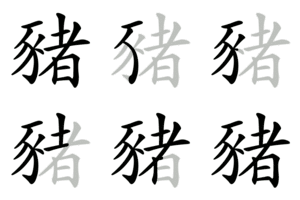 | |||
Han character
豬 (Kangxi radical 152, 豕+8 in Chinese, 豕+9 in Korean, 15 strokes in Chinese, 16 strokes in Korean, cangjie input 一人十大日 (MOJKA), four-corner 14260, composition ⿰豕者)
References
- Kangxi Dictionary: page 1198, character 2
- Dai Kanwa Jiten: character 36432
- Dae Jaweon: page 1660, character 6
- Hanyu Da Zidian (first edition): volume 6, page 3616, character 4
- Unihan data for U+8C6C

Chinese
| trad. | 豬 | |
|---|---|---|
| simp. | 猪 | |
| alternative forms | 䐗 𢑳 𧳯 | |
Glyph origin
| Historical forms of the character 豬 | |||
|---|---|---|---|
| Warring States | Shuowen Jiezi (compiled in Han) | ||
| Bronze inscriptions | Chu slip and silk script | Qin slip script | Small seal script |
 |
 |
 |
 |
| Old Chinese | |
|---|---|
| 觰 | *rtaːʔ, *rtaː |
| 諸 | *tjaː, *tja |
| 者 | *tjaːʔ |
| 堵 | *tjaːʔ, *taːʔ |
| 赭 | *tjaːʔ |
| 撦 | *l̥ʰjaːʔ |
| 扯 | *tʰjaːʔ |
| 闍 | *djaː, *taː |
| 奢 | *hljaː |
| 鍺 | *toːlʔ |
| 都 | *taː |
| 醏 | *taː |
| 覩 | *taːʔ |
| 睹 | *taːʔ |
| 暏 | *taːʔ |
| 賭 | *taːʔ |
| 帾 | *taːʔ |
| 楮 | *taːʔ, *tʰaʔ |
| 屠 | *daː, *da |
| 瘏 | *daː |
| 廜 | *daː |
| 鷵 | *daː |
| 緒 | *ljaʔ |
| 豬 | *ta |
| 猪 | *ta |
| 瀦 | *ta |
| 藸 | *ta, *da |
| 櫫 | *ta |
| 褚 | *taʔ, *tʰaʔ |
| 著 | *taʔ, *tas, *da, *taɡ, *daɡ |
| 箸 | *tas, *das |
| 儲 | *da |
| 躇 | *da |
| 櫧 | *tja |
| 藷 | *tja, *djas |
| 蠩 | *tja |
| 煮 | *tjaʔ |
| 渚 | *tjaʔ |
| 煑 | *tjaʔ |
| 陼 | *tjaʔ |
| 翥 | *tjas |
| 署 | *djas |
| 薯 | *djas |
| 曙 | *djas |
| 書 | *hlja |
| 暑 | *hjaʔ |
| 鐯 | *taɡ |
| 擆 | *taɡ |
| 櫡 | *taɡ |
Phono-semantic compound (形聲/形声, OC *ta) : semantic 豕 + phonetic 者 (OC *tjaːʔ).
Etymology 1
Possibly from Proto-Sino-Tibetan (Schuessler, 2007). Löffler (1966) considers Mru tia (“(wild) pig”) to be cognate.
Fangyan states that 豭 (OC *kraː) is a dialectal variant of 豬 (OC *ta), yet *kra was apparently older than *t(r)a and homophonic with 麚 (OC *kraː, “stag”); so instead *t(r)a is possibly an early rural dialectal variant (from the sound changes *ʈa < *tra < *Cra) of *kra, which would have had a general meaning of "male animal". See 豭 for more.
Pronunciation
Definitions
豬
Usage notes
Synonyms
Compounds
- 一龍一豬/一龙一猪
- 乳豬/乳猪 (rǔzhū)
- 仔豬/仔猪
- 伊比利亞豬/伊比利亚猪
- 偃豬/偃猪
- 光豬/光猪
- 公豬/公猪 (gōngzhū)
- 冷水燙豬/冷水烫猪
- 剝光豬/剥光猪 (bōguāngzhū)
- 剝豬玀/剥猪猡
- 匽豬/匽猪
- 婁豬/娄猪
- 媚豬/媚猪
- 嬲嬲豬/嬲嬲猪
- 孟豬/孟猪
- 宿豬/宿猪
- 山豬/山猪 (shānzhū)
- 急獐拘豬/急獐拘猪
- 戀豬肝/恋猪肝
- 拜江豬/拜江猪
- 指豬罵狗/指猪骂狗
- 朴豬
- 架子豬/架子猪 (jiàzizhū)
- 歲豬/岁猪
- 殼郎豬/壳郎猪 (kélangzhū)
- 母豬/母猪 (mǔzhū)
- 毛豬/毛猪
- 毫豬/毫猪
- 江豬/江猪
- 泥豬/泥猪
- 泥豬瓦狗/泥猪瓦狗
- 泥豬疥狗/泥猪疥狗
- 泥豬癩狗/泥猪癞狗
- 海豬/海猪 (hǎizhū)
- 浸豬籠/浸猪笼
- 湯豬/汤猪
- 烤乳豬/烤乳猪 (kǎorǔzhū)
- 燒豬/烧猪
- 爛瞓豬/烂𰥛猪
- 牙豬/牙猪 (yázhū)
- 牧豬奴/牧猪奴
- 牧豬奴戲/牧猪奴戏
- 牽豬哥/牵猪哥
- 犵豬/犵猪
- 狟豬/狟猪
- 獾豬/獾猪
- 生豬/生猪 (shēngzhū)
- 白條豬/白条猪
- 矇豬/蒙猪
- 石豬/石猪
- 箭豬/箭猪 (jiànzhū)
- 約克夏豬/约克夏猪 (yuēkèxià zhū)
- 肥豬/肥猪 (féizhū)
- 肥豬拱門/肥猪拱门
- 肥豬粉/肥猪粉
- 草豬/草猪
- 荷蘭豬/荷兰猪
- 萊豬/莱猪 (láizhū)
- 蒿豬/蒿猪
- 虎咬豬/虎咬猪 (hǔyǎozhū)
- 蠢豬/蠢猪 (chǔnzhū)
- 覺覺豬/觉觉猪
- 豪豬/豪猪 (háozhū)
- 豪豬靴/豪猪靴
- 豬仔/猪仔 (zhūzǎi)
- 豬仔國會/猪仔国会
- 豬仔議員/猪仔议员
- 豬倌/猪倌 (zhūguān)
- 豬兜/猪兜
- 豬兜炮/猪兜炮
- 豬八戒/猪八戒 (Zhū Bājiè)
- 豬公/猪公 (zhūgōng)
- 豬加/猪加
- 豬哥/猪哥
- 豬嘜/猪唛
- 豬嘴瘟/猪嘴瘟
- 豬圈/猪圈 (zhūjuàn)
- 豬娃/猪娃
- 豬娃子/猪娃子
- 豬婆/猪婆
- 豬婆子/猪婆子
- 豬婆龍/猪婆龙
- 豬尿泡/猪尿泡
- 豬尿脬/猪尿脬
- 豬崽/猪崽 (zhūzǎi)
- 豬年/猪年 (zhūnián)
- 豬彘/猪彘
- 豬心/猪心
- 豬心瓣膜/猪心瓣膜
- 豬扒/猪扒 (zhūpá)
- 豬拐子/猪拐子
- 豬排/猪排 (zhūpái)
- 豬朋狗友/猪朋狗友 (zhūpénggǒuyǒu)
- 豬欄/猪栏 (zhūlán)
- 豬欄瘋/猪栏疯
- 豬毋大,大對狗去/猪毋大,大对狗去 (ti m̄ tōa, tōa tùi káu khì)
- 豬水/猪水
- 豬油/猪油 (zhūyóu)
- 豬油渣/猪油渣
- 豬溷/猪溷
- 豬熊/猪熊
- 豬爪/猪爪
- 豬牙子/猪牙子
- 豬牢/猪牢
- 豬牯/猪牯
- 豬狗/猪狗 (zhūgǒu)
- 豬狗不如/猪狗不如 (zhūgǒubùrú)
- 豬獾/猪獾 (zhūhuān)
- 豬玀/猪猡 (zhūluó)
- 豬玀棚/猪猡棚
- 豬王/猪王
- 豬瘟/猪瘟 (zhūwēn)
- 豬癲瘋/猪癫疯
- 豬神/猪神
- 豬突/猪突
- 豬突豨勇/猪突豨勇
- 豬籠/猪笼
- 豬籠入水/猪笼入水
- 豬籠草/猪笼草 (zhūlóngcǎo)
- 豬紅/猪红
- 豬肉乾/猪肉干
- 豬肝/猪肝 (zhūgān)
- 豬肚/猪肚 (zhūdǔ)
- 豬胞/猪胞
- 豬脂/猪脂 (zhūzhī)
- 豬胰/猪胰
- 豬脬/猪脬
- 豬腳/猪脚 (zhūjiǎo)
- 豬腳爪/猪脚爪
- 豬腸粉/猪肠粉 (zhūchángfěn)
- 豬腳腳/猪脚脚
- 豬腳麵線/猪脚面线
- 豬膏/猪膏 (zhūgāo)
- 豬膘/猪膘
- 豬膶/猪𬂀
- 豬舌頭/猪舌头
- 豬舍/猪舍 (zhūshè)
- 豬苓/猪苓 (zhūlíng)
- 豬莧/猪苋
- 豬蓴/猪莼
- 豬觜關/猪觜关
- 豭豬/豭猪
- 豬跤/猪跤 (ti-kha) (Min Nan)
- 豬蹄/猪蹄 (zhūtí)
- 豬蹄子/猪蹄子 (zhūtízi)
- 豬軟骨/猪软骨 (zhūruǎngǔ)
- 豬郎/猪郎
- 豬都/猪都 (zhūdū)
- 豬野/猪野
- 豬闌/猪阑
- 豬霍亂/猪霍乱
- 豬革/猪革
- 豬頭三/猪头三 (zhūtóusān)
- 豬頭三牲/猪头三牲 (zhūtóusānshēng)
- 豬頭丙/猪头丙
- 豬頭肉/猪头肉
- 豬頭肥/猪头肥
- 豬顛風/猪颠风
- 豬鬃/猪鬃
- 豬鬃草/猪鬃草
- 豬鬐/猪鬐
- 豬鬣/猪鬣
- 豬鼻/猪鼻
- 豬龍/猪龙 (zhūlóng)
- 豲豬/豲猪
- 豱豬頭/豱猪头
- 貆豬/貆猪
- 貓豬/猫猪
- 買豬肝/买猪肝
- 賣豬仔/卖猪仔 (mài zhūzǎi)
- 踏豬車/踏猪车
- 迷你豬/迷你猪
- 遏豬/遏猪
- 野豬/野猪 (yězhū)
- 野豬林/野猪林
- 開鎖豬/开锁猪
- 闟豬車/𰿻猪车
- 電宰豬肉/电宰猪肉
- 馬店買豬/马店买猪
- 騎豬/骑猪
- 騬豬/𱅢猪
- 鸞豬/鸾猪
- 鹹豬手/咸猪手 (xiánzhūshǒu)
- 黑毛豬/黑毛猪
- 黑豬渡河/黑猪渡河
- 墨豬/墨猪
- 龍豬/龙猪
Descendants
- → Thai: ตือ (dtʉʉ)
Pronunciation
Japanese
Korean
Hanja
- This term needs a translation to English. Please help out and add a translation, then remove the text
{{rfdef}}.
Usage notes
The Malgun Gothic (맑은 고딕) font has the wrong glyph ⿰豸者 (i.e. 𧳯). The correct form is ⿰豕者.