甘
| ||||||||
| ||||||||
Translingual
| Stroke order | |||
|---|---|---|---|
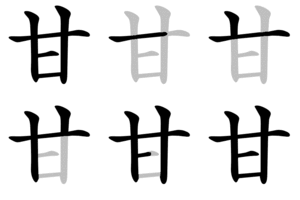 | |||
Han character
甘 (Kangxi radical 99, 甘+0, 5 strokes, cangjie input 廿一 (TM), four-corner 44770, composition ⿻廿一)
- Kangxi radical #99, ⽢.
Derived characters
References
- Kangxi Dictionary: page 753, character 19
- Dai Kanwa Jiten: character 21643
- Dae Jaweon: page 1161, character 1
- Hanyu Da Zidian (first edition): volume 4, page 2413, character 1
- Unihan data for U+7518

Chinese
| simp. and trad. |
甘 | |
|---|---|---|
| alternative forms | ||
Glyph origin
| Historical forms of the character 甘 | |||
|---|---|---|---|
| Shang | Western Zhou | Shuowen Jiezi (compiled in Han) | Liushutong (compiled in Ming) |
| Oracle bone script | Bronze inscriptions | Small seal script | Transcribed ancient scripts |
 |
 |
 |
 |
Characters in the same phonetic series (甘) (Zhengzhang, 2003)
Ideogram (指事) – something in the mouth, sweet. Original form of 含.
Etymology
From Proto-Sino-Tibetan *s-klum (“sweet”) (Schuessler, 2007; STEDT). Cognate with Mizo thlum, Lepcha [script needed] (khlyam).
Possibly related to 含 (OC *ɡɯːm, “to keep in mouth”) and 甜 (OC *l'iːm, “sweet”), 柑 (MC kam, “mandarin orange”) (Schuessler, 2007).
Pronunciation
Definitions
甘
- sweet
- pleasant; satisfactory
- willingly; readily
- (Cantonese, ironic) bitter; difficult to bear
- a surname
- 甘寧/甘宁 ― Gān Níng ― Gan Ning (military general serving under Sun Quan in the late Eastern Han dynasty)
- Short for 甘肅/甘肃 (Gānsù, “Gansu”).
Synonyms
- (sweet):
Dialectal synonyms of 甜 (“sweet”) [map]
Antonyms
- (antonym(s) of “sweet”): 苦 (kǔ)
Compounds
- 不甘 (bùgān)
- 不甘寂寞 (bùgānjìmò)
- 不甘後人/不甘后人 (bùgānhòurén)
- 不甘心
- 不甘示弱 (bùgānshìruò)
- 不甘雌伏
- 不甘食貧/不甘食贫
- 不知甘苦
- 供膳甘肥
- 倒吃甘蔗
- 分甘
- 分甘共苦
- 同甘共苦 (tónggāngòngkǔ)
- 同甘同苦
- 善罷甘休/善罢甘休 (shànbàgānxiū)
- 嚥苦吞甘/咽苦吞甘
- 回甘 (huígān)
- 幣厚言甘/币厚言甘
- 幣重言甘/币重言甘
- 心甘情願/心甘情愿 (xīngānqíngyuàn)
- 旨甘
- 普降甘霖
- 樂貧甘賤/乐贫甘贱
- 沛雨甘霖
- 爐甘石/炉甘石 (lúgānshí)
- 甘之如薺/甘之如荠
- 甘之如飴/甘之如饴 (gānzhīrúyí)
- 甘之若素
- 甘之若飴/甘之若饴
- 甘井先竭 (gānjǐngxiānjié)
- 甘休 (gānxiū)
- 甘伏
- 甘冒虎口
- 甘冽
- 甘分
- 甘分隨時/甘分随时
- 甘加 (Gānjiā)
- 甘受 (gānshòu)
- 甘味 (gānwèi)
- 甘地主義/甘地主义
- 甘塘坳 (Gāntáng'ào)
- 甘始
- 甘孜 (Gānzī)
- 甘孜藏族自治州 (Gānzī Zàngzú Zìzhìzhōu)
- 甘家廠/甘家厂 (Gānjiāchǎng)
- 甘居中游
- 甘心 (gānxīn)
- 甘心如薺/甘心如荠
- 甘心情願/甘心情愿
- 甘心瞑目
- 甘心鈇鉞/甘心𫓧钺
- 甘拜下風/甘拜下风 (gānbàixiàfēng)
- 甘旨
- 甘旨肥濃/甘旨肥浓
- 甘服
- 甘木 (Gānmù)
- 甘棠 (gāntáng)
- 甘棠之惠
- 甘棠有蔭/甘棠有荫
- 甘棠遺愛/甘棠遗爱
- 甘死如飴/甘死如饴 (gānsǐrúyí)
- 甘比亞/甘比亚 (Gānbǐyà)
- 甘毳
- 甘水
- 甘油 (gānyóu)
- 甘泉 (gānquán)
- 甘泉必竭
- 甘涼/甘凉
- 甘珠爾/甘珠尔
- 甘瓜苦蒂
- 甘甜 (gāntián)
- 甘盡苦來/甘尽苦来
- 甘納豆/甘纳豆
- 甘紫菜
- 甘結/甘结 (gānjié)
- 甘羅/甘罗
- 甘美 (gānměi)
- 甘羞
- 甘肅/甘肃 (Gānsù)
- 甘脆 (gāncuì)
- 甘膬
- 甘芳
- 甘苦 (gānkǔ)
- 甘茂
- 甘草 (gāncǎo)
- 甘草人物
- 甘草粉
- 甘菊 (gānjú)
- 甘蔗
- 甘蔗板
- 甘蔗顛子/甘蔗颠子
- 甘蕉 (gānjiāo)
- 甘藍/甘蓝 (gānlán)
- 甘薯 (gānshǔ)
- 甘薯簽/甘薯签
- 甘薯葉/甘薯叶
- 甘藷/甘薯 (gānshǔ)
- 甘處下流/甘处下流
- 甘蠅/甘蝇
- 甘言 (gānyán)
- 甘言厚幣/甘言厚币
- 甘言厚禮/甘言厚礼
- 甘言好辭/甘言好辞
- 甘言巧辭/甘言巧辞
- 甘言美語/甘言美语
- 甘谷 (Gāngǔ)
- 甘貧守分/甘贫守分
- 甘貧守志/甘贫守志
- 甘貧守節/甘贫守节
- 甘貧樂道/甘贫乐道
- 甘迺迪角
- 甘醴
- 甘限
- 甘雨 (gānyǔ)
- 甘雨隨車/甘雨随车
- 甘霖 (gānlín)
- 甘露 (gānlù)
- 甘露之變/甘露之变
- 甘露子
- 甘露水漿/甘露水浆
- 甘露法雨
- 甘露滋心
- 甘願/甘愿 (gānyuàn)
- 甘食褕衣
- 甘馨之費/甘馨之费
- 甘鮮/甘鲜
- 甜甘
- 硝化甘油 (xiāohuàgānyóu)
- 結球甘藍/结球甘蓝 (jiéqiú gānlán)
- 絕甘分少/绝甘分少
- 美甘甘
- 美食甘寢/美食甘寝
- 肥甘
- 自甘墮落/自甘堕落 (zìgānduòluò)
- 苦盡甘來/苦尽甘来 (kǔjìngānlái)
- 荒漠甘泉
- 莫甘
- 蒲甘 (Púgān)
- 蔫甘
- 褕衣甘食
- 誓不甘休
- 輸服甘結/输服甘结
- 食不求甘
- 食不甘味
- 飫甘饜肥/饫甘餍肥
- 黃甘甘/黄甘甘
Japanese
Readings
Pronunciation
- IPA(key): [kã̠ɴ]
- IPA(key): [a̠ma̠i]
Korean
Hanja
甘 • (gam) (hangeul 감, revised gam, McCune–Reischauer kam, Yale kam)
- This term needs a translation to English. Please help out and add a translation, then remove the text
{{rfdef}}.
Vietnamese
This article is issued from Wiktionary. The text is licensed under Creative Commons - Attribution - Sharealike. Additional terms may apply for the media files.