ぞ
See also: そ
 | ||||||||||
Japanese
| Stroke order | |||
|---|---|---|---|
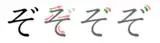 | |||
Pronunciation
- IPA(key): [d͡zo̞]
See also
Etymology 2
From Old Japanese. Previously unvoiced as so until the Nara period.
Particle
ぞ • (zo)
- (colloquial, men's speech) a particle used at the end of sentences, which indicates certainty or emphasis.
- やるぞ!
- Yaru zo!
- I'm gonna do it!
- 1925, Denji Kuroshima, 「紋」:
- よそで飯を盗んで食うたりするんじゃないぞ
- yoso de meshi o nusunde kūtari suru n ja nai zo
- You may not steal and eat food in other houses, ever.
- よそで飯を盗んで食うたりするんじゃないぞ
- やるぞ!
- a particle used as a suffix to an interrogative word to mark it indefinite.
- 1909, Mokutaro Kinoshita, 南蛮寺門前:
- 何処ぞで歌うたふ声が聞えるやうやのう
- dokozo de uta utau koe ga kikoeru yō ya nō
- It feels like we can hear voice of singers somewhere.
- 何処ぞで歌うたふ声が聞えるやうやのう
- (archaic) a particle which makes a question emphasized or rhetorical, used at the end of a sentence or appended to an interrogative word.
- 1932, Yoshio Mikami, 和算の社会的・芸術的特性について:
- 単純化を貴ぶ精神が無くして、なんぞ、この種のことが起きて来ようぞ。
- Tanjunka o tōtobu seishin ga nakushite, nanzo, kono shu no koto ga okite koyō zo.
- Without the spirit of treasuring simplification, how could this kind of things ever happen.
- 単純化を貴ぶ精神が無くして、なんぞ、この種のことが起きて来ようぞ。
- (predicative, men's speech) topic particle used for emphasis
- これぞ辞典の本当の力だ‼
- Kore zo jiten no hontō no chikara da‼
- This is the true power of a dictionary!!
- これぞ辞典の本当の力だ‼
This article is issued from Wiktionary. The text is licensed under Creative Commons - Attribution - Sharealike. Additional terms may apply for the media files.