ゔ
See also: う
 | ||||||||||
Japanese
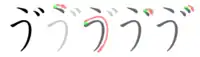
| Stroke order | |||
|---|---|---|---|
 | |||
Etymology
The hiragana character う (u) with a dakuten (゛). The hiragana ゔ, ゕ and ゖ were introduced for hiragana-katakana correspondence with ヴ, ヵ and ヶ in the Japanese input method in Fujitsu OASYS[1] and then registered in JIS X 0213.[2]
Pronunciation
- IPA(key): [vɯ̟ᵝ]
- IPA(key): [bɯ̟ᵝ] (some speakers, especially older people)
Usage notes
- This is a relatively recent addition to kana usage to represent the non-native sound vu. As such, this is only found in borrowed words. Many speakers, especially older people, may pronounce this more as bu, [bɯ̟ᵝ].
See also
References
- ooooasys, 2008-08-16
- Katsumi Kokoma, message on 「ヴ」のひらがな(道浦俊彦), Kotoba Kaigishitsu, 2000-05-16
This article is issued from Wiktionary. The text is licensed under Creative Commons - Attribution - Sharealike. Additional terms may apply for the media files.