曷
| ||||||||
Translingual
Han character
曷 (Kangxi radical 73, 曰+5, 9 strokes, cangjie input 日心女人 (APVO), four-corner 60727, composition ⿱曰匃)
Derived characters
References
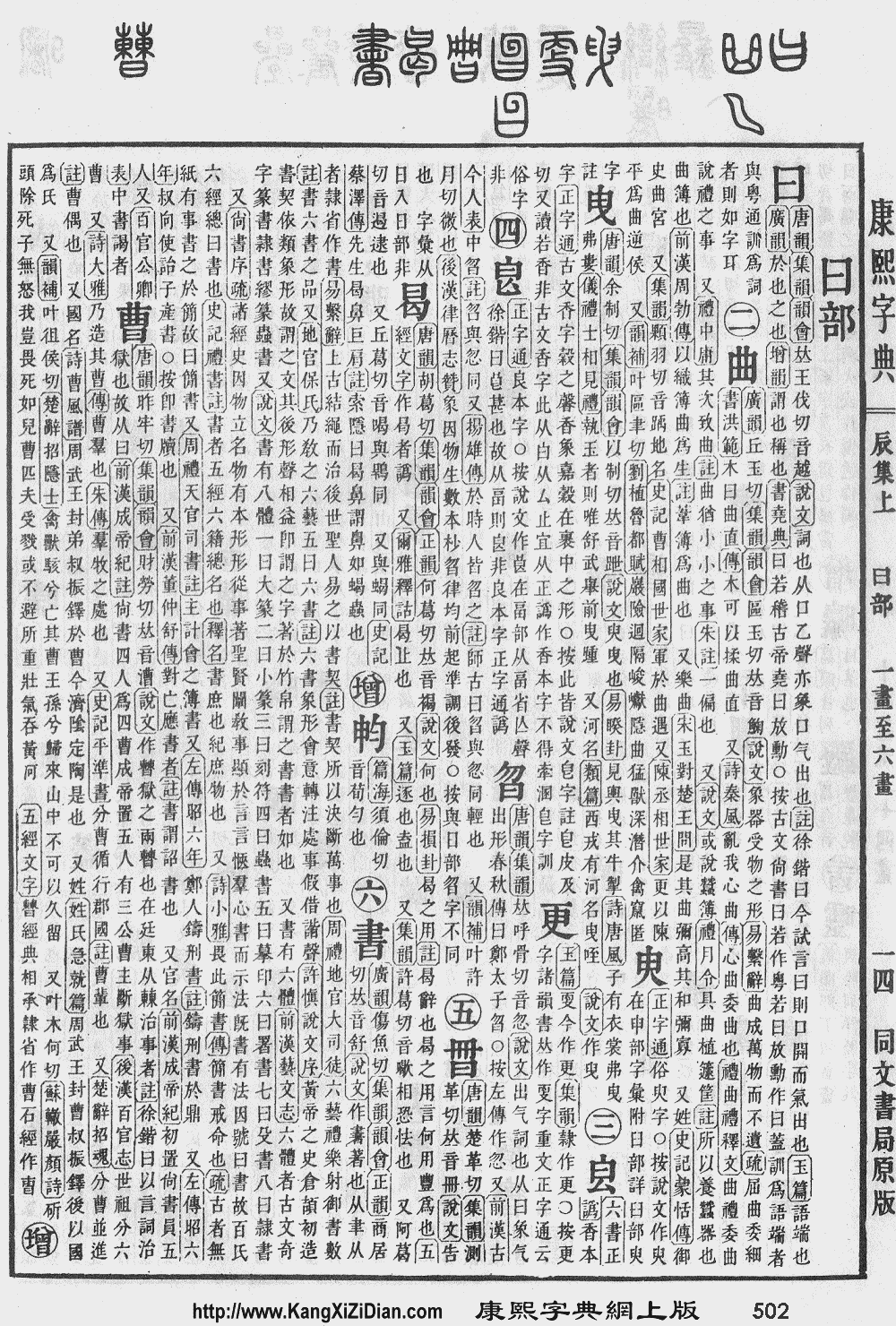
- Kangxi Dictionary: page 502, character 10
- Dai Kanwa Jiten: character 14290
- Dae Jaweon: page 874, character 15
- Hanyu Da Zidian (first edition): volume 2, page 1502, character 10
- Unihan data for U+66F7
Chinese
| trad. | 曷 | |
|---|---|---|
| simp. # | 曷 | |
Glyph origin
| Historical forms of the character 曷 | ||
|---|---|---|
| Warring States | Shuowen Jiezi (compiled in Han) | Liushutong (compiled in Ming) |
| Bronze inscriptions | Small seal script | Transcribed ancient scripts |
 |
 |
 |
Characters in the same phonetic series (曷) (Zhengzhang, 2003)
| Old Chinese | |
|---|---|
| 愒 | *kʰaːds, *kʰrads, *kʰrad |
| 馤 | *qaːds |
| 靄 | *qaːds, *qaːd |
| 餲 | *qraːds, *qrads, *ɡaːd, *qaːd |
| 喝 | *qraːds, *qʰoːb, *qʰaːd |
| 揭 | *kʰrads, *ked, *kʰrad, *ɡrad, *kad, *ɡad |
| 偈 | *ɡrads, *ɡrad |
| 猲 | *kʰob, *qʰaːd, *qʰad |
| 葛 | *kaːd |
| 輵 | *kaːd |
| 獦 | *klaːd, *rab |
| 渴 | *kʰaːd, *ɡrad |
| 嵑 | *kʰaːd |
| 暍 | *qʰaːd, *qad |
| 曷 | *ɡaːd |
| 褐 | *ɡaːd |
| 鶡 | *ɡaːd |
| 毼 | *ɡaːd |
| 蝎 | *ɡaːd |
| 鞨 | *ɡaːd, *ɢljad |
| 遏 | *qaːd |
| 齃 | *qaːd |
| 堨 | *qaːd |
| 擖 | *kʰreːd, *kraːd, *r'aːb |
| 楬 | *kʰraːd, *ɡrad, *ɡad |
| 朅 | *kʰrad |
| 藒 | *kʰrad |
| 竭 | *ɡrad, *ɡad |
| 碣 | *ɡrad, *ɡad |
| 羯 | *kad |
| 鍻 | *kad |
| 歇 | *qʰad |
| 蠍 | *qʰad |
| 謁 | *qad |
Shuowen Jiezi: Phono-semantic compound (形聲/形声, OC *ɡaːd) : phonetic 匃 () + semantic 曰
Etymology
Cognate with 何 (OC *ɡaːl, “what; where; why; how”). See there for more.
Pronunciation
Definitions
曷
- † why; what; where; how; when
- 汝曷弗告朕,而胥動以浮言,恐沈于眾? [Classical Chinese, trad.]
- From: The Book of Documents, circa 4th – 3rd century BCE
- Rǔ hé fú gào zhèn, ér xū dòng yǐ fúyán, kǒng shěn yú zhòng? [Pinyin]
- Why do you not report (their words) to me, but go about to excite one another by empty speeches, frightening and involving the multitudes in misery?
汝曷弗告朕,而胥动以浮言,恐沈于众? [Classical Chinese, simp.]- 苟不學,曷為人。 [Classical Chinese, trad.]
- From: Three Character Classic, circa 13th century CE
- Gǒu bù xué, hé wéi rén. [Pinyin]
- If [foolishly] you do not study, how can you become men?
苟不学,曷为人。 [Classical Chinese, simp.]
Synonyms
Dialectal synonyms of 為什麼 (“why”) [map]
Dialectal synonyms of 什麼時候 (“when”) [map]
Compounds
- 曷嘗/曷尝
- 曷爲/曷为
- 曷若
- 曷鼻
References
- “曷”, in 漢語多功能字庫 (Multi-function Chinese Character Database), 香港中文大學 (the Chinese University of Hong Kong), 2014–
- “Query for 曷”, in 臺灣閩南語常用詞辭典 [Dictionary of Frequently-Used Taiwan Minnan] (overall work in Hokkien and Mandarin), Ministry of Education, R.O.C., 2023.
Japanese
Kanji
曷
- This term needs a translation to English. Please help out and add a translation, then remove the text
{{rfdef}}.
Korean
Hanja
曷 • (gal) (hangeul 갈, revised gal, McCune–Reischauer kal, Yale kal)
- This term needs a translation to English. Please help out and add a translation, then remove the text
{{rfdef}}.
Vietnamese
This article is issued from Wiktionary. The text is licensed under Creative Commons - Attribution - Sharealike. Additional terms may apply for the media files.