郭
| ||||||||
Translingual
Han character
郭 (Kangxi radical 163, 邑+8, 11 strokes, cangjie input 卜木弓中 (YDNL), four-corner 07427, composition ⿰享阝)
References
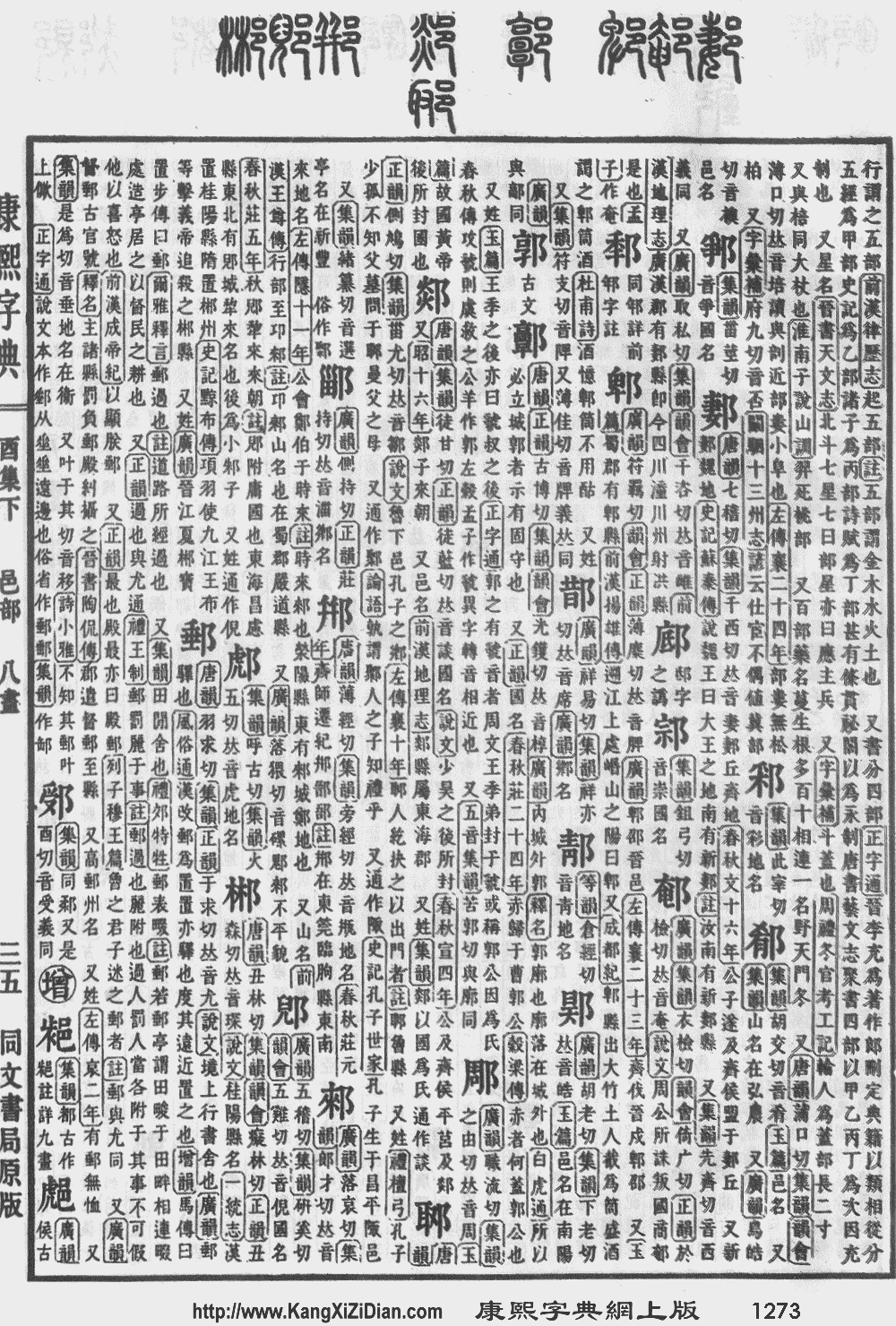
- Kangxi Dictionary: page 1273, character 13
- Dai Kanwa Jiten: character 39474
- Dae Jaweon: page 1771, character 20
- Hanyu Da Zidian (first edition): volume 6, page 3780, character 7
- Unihan data for U+90ED
Chinese
| simp. and trad. |
郭 | |
|---|---|---|
| alternative forms | 𨟍 𩫩 𩫏 𩫖 | |
Glyph origin
| Historical forms of the character 郭 | |
|---|---|
| Shuowen Jiezi (compiled in Han) | Liushutong (compiled in Ming) |
| Small seal script | Transcribed ancient scripts |
 |
 |
Characters in the same phonetic series (郭) (Zhengzhang, 2003)
Originally written 𩫏.
Later 邑 was added to form an ideogrammic compound (會意/会意) : 𩫏 (“tall building”) + 邑 (“city”) – a city with tall buildings.
From clerical script, the 𩫏 became written as the unrelated 享 through the process of libian.
Etymology
From Proto-Sino-Tibetan *s/r-kawk ~ s/r-kwak (“outer covering; skin, bark, rind”) (STEDT, Schuessler, 2007).
Pronunciation
Definitions
郭
- outer city wall
- 三里之城,七里之郭,環而攻之而不勝。 [Classical Chinese, trad.]
- From: Mencius, c. 4th century BCE
- Sān lǐ zhī chéng, qī lǐ zhī guō, huán ér gōng zhī ér bù shèng. [Pinyin]
- There is a city, with an inner wall of three li in circumference, and an outer wall of seven. The enemy surround and attack it, but they are not able to take it.
三里之城,七里之郭,环而攻之而不胜。 [Classical Chinese, simp.]
- (literary) (alt. form 廓) outline
- (~國) (historical) Guo, a minor state that existed during the Zhou dynasty and was conquered by the state of Qi in 670 BCE.
- (Taiwan, Internet slang) to be none of someone's own business; to have nothing to do with someone
- a surname
- 郭守敬 ― Guō Shǒujìng ― Guo Shoujing (Yuan dynasty Chinese astronomer)
Compounds
- 倚郭
- 倚郭縣/倚郭县
- 傅郭
- 北郭
- 北郭先生
- 北郭十友
- 匡郭
- 南郭 (nánguō)
- 南郭先生
- 南郭子綦
- 南郭綦
- 南郭處士/南郭处士 (nánguō chǔshì)
- 吳郭魚/吴郭鱼 (wúguōyú)
- 周郭
- 四郭
- 坊郭
- 城郭 (chéngguō)
- 城郭國/城郭国
- 夏五郭公
- 外郭
- 女郭
- 尺郭
- 山郭
- 崖郭
- 巴音郭楞 (Bāyīnguōléng)
- 市郭
- 帶郭/带郭
- 廛郭
- 折巾郭
- 月郭
- 村郭
- 李郭
- 李郭仙
- 李郭仙舟
- 李郭同舟
- 李郭同船
- 李郭舟
- 東郭/东郭 (Dōngguō)
- 東郭之疇/东郭之畴
- 東郭之跡/东郭之迹
- 東郭先生/东郭先生 (dōng guō xiānshēng)
- 東郭履/东郭履
- 東郭逡/东郭逡
- 柳郭
- 棺郭
- 機郭/机郭
- 水郭
- 江郭
- 治郭安邦
- 溢郭
- 溝郭/沟郭
- 石郭
- 稜郭/棱郭
- 羅郭/罗郭
- 耳郭 (ěrguō)
- 膚郭/肤郭
- 西郭
- 許郭/许郭
- 謝郭/谢郭
- 負郭/负郭
- 負郭田/负郭田
- 負郭相君/负郭相君
- 賈郭/贾郭
- 赤郭
- 車側郭門/车侧郭门
- 輪郭/轮郭
- 迎郭伋
- 邊郭/边郭
- 邑郭
- 邯鄲郭公/邯郸郭公
- 郊郭
- 郛郭
- 郡郭
- 郭亮 (Guōliàng)
- 郭伋待期
- 郭公 (guōgōng)
- 郭公塼/郭公砖
- 郭公夏五
- 郭公真人
- 郭公磚/郭公砖
- 郭前 (Guōqián)
- 郭勒木德 (Guōlèmùdé)
- 郭圍/郭围
- 郭塹/郭堑
- 郭家 (Guōjiā)
- 郭家堡
- 郭家金穴
- 郭履
- 郭巨
- 郭巨埋兒/郭巨埋儿
- 郭巾
- 郭景飛仙/郭景飞仙
- 郭李
- 郭椒
- 郭汾陽/郭汾阳
- 郭河 (Guōhé)
- 郭泰巾
- 郭泰碑銘/郭泰碑铭
- 郭況穴/郭况穴
- 郭泰船
- 郭洛帶/郭洛带
- 郭璞之說/郭璞之说
- 郭申
- 郭碑
- 郭禿/郭秃
- 郭穴
- 郭索
- 郭細侯/郭细侯
- 郭舟
- 郭華情罪/郭华情罪
- 郭術/郭术
- 郭邑
- 郭郎
- 郭郎子
- 郭郛
- 郭里 (Guōlǐ)
- 郭門/郭门
- 郭隗宮/郭隗宫
- 郭隗尊
- 郭隗臺/郭隗台
- 郭隗請始/郭隗请始
- 郭隗金
- 郭雀兒/郭雀儿
- 郭順時/郭顺时
- 鄒郭/邹郭 (Zōuguō)
- 鄽郭
- 重來郭伋/重来郭伋
- 銅郭/铜郭
- 錫林郭勒/锡林郭勒 (Xīlínguōlè)
- 鐵郭金城/铁郭金城
- 鐵郭銅關/铁郭铜关
- 附郭
- 附郭縣/附郭县
- 陰郭/阴郭
- 青郭
- 靖郭君
- 靖郭氏
- 靜郭君/静郭君
Japanese
Readings
Etymology
| Kanji in this term |
|---|
| 郭 |
| くるわ Grade: S |
| kun’yomi |
| For pronunciation and definitions of 郭 – see the following entry. | ||
| ||
| (This term, 郭, is an alternative spelling of the above term.) |
Korean
Etymology
From Middle Chinese 郭 (MC kwak). Recorded as Middle Korean 곽〮 (kwák) (Yale: kwak) in Hunmong Jahoe (訓蒙字會 / 훈몽자회), 1527.
Compounds
Vietnamese
Han character
郭: Hán Việt readings: quách[1][2][3][4][5][6]
郭: Nôm readings: quách[1][2][3][7], quắt[1]
References
- Nguyễn (2014).
- Nguyễn et al. (2009).
- Trần (2004).
- Trần (1999).
- Nguyễn (1974).
- Thiều Chửu (1942).
- Hồ (1976).
This article is issued from Wiktionary. The text is licensed under Creative Commons - Attribution - Sharealike. Additional terms may apply for the media files.